UK contractors: avoid 4–6 week delays on Section 50 licence
If your works break open the highway and you have no statutory right to be there, you need a Section 50 licence under the New Roads and Street Works Act 1991. Works cannot legally start until the licence is signed, so the first move is simple: check whether your apparatus falls under statutory undertaker or SWA code powers, and if it does not, contact your local highway authority to begin the application.
TL;DR:
- The application process typically takes four to six weeks for a complete submission, with additional time for traffic orders or road closures, which can extend timelines further.
- Fees vary significantly across councils, ranging from around £530 to over £1,130, depending on the location and whether the work is retrospective or involves existing apparatus.
- Ensuring that contractors are NRSWA accredited, have valid insurance covering the full guarantee period, and provide quality documentation is essential to avoiding rejection or delays.
- Coordinating the licence, traffic management plan, and road space booking simultaneously accelerates project completion and reduces disruptions on site.
- Working without the proper licence or application delays can lead to penalties, high remediation costs, and even removal of unauthorized apparatus at the project owner’s expense.
Table of Contents
- What is a section 50 licence and when do you need one?
- What documents does a section 50 application need?
- How much does a section 50 licence cost?
- How long does a section 50 application take?
- What happens after the works are finished?
- Where do section 50 projects go wrong on site?
- How do you pick a contractor for section 50 works?
- What are the penalties for unauthorised street works?
- Delivering section 50 projects with minimal disruption
- How gcs contractors supports section 50 works
- Where to check the latest section 50 guidance
- Sources
What is a section 50 licence and when do you need one?
A Section 50 licence is a legal permit granted under NRSWA 1991 that lets someone without statutory undertaker powers place, retain, and maintain apparatus in a publicly maintained highway. “Apparatus” covers pipes, cables, and any fixed equipment laid under, on, or over the road; an “undertaker” is anyone with the legal right to install and manage it there.
You’ll typically need one for private drain connections crossing a footway, EV chargepoint connections feeding a driveway, new manholes, or private water and electricity supply lines running under a road or verge. Statutory undertakers (major utility companies) already hold blanket powers and don’t need this route. EV charge point operators working under the SWA code sit in a similar position. Everyone else, including most private contractors and property owners, applies for a Section 50 licence on a case-by-case basis. Getting this distinction wrong is the fastest way to submit the wrong application entirely.
What documents does a section 50 application need?
Councils reject incomplete applications more often than poor-quality ones, so treat the paperwork as seriously as the groundworks itself. Every application checklist follows roughly the same shape, though local authorities vary on formatting and supporting evidence.
- A site plan showing the exact location of proposed apparatus relative to the highway boundary
- An apparatus plan with dimensions, depth, and an “as-laid” drawing template ready for post-completion submission
- Public liability insurance evidence, typically between £5 million and £10 million cover
- NRSWA supervisor and operative cards confirming the workforce is accredited
- A traffic management plan and any STAT plans required for the road category
- Evidence of adoption agreements or wayleaves where the apparatus will eventually transfer to a statutory body
Councils sometimes request a bond or cash guarantee alongside these documents, held against the risk of defective reinstatement. It’s returned once the guarantee period ends and the final inspection passes.
Pro Tip: Get your insurance certificate dated to cover the full guarantee period, not just the construction phase. A policy that lapses before the two or three-year inspection window closes is one of the most common reasons applications stall at renewal.
How much does a section 50 licence cost?
Fees are set locally, so there’s no single national rate, and the variation catches out contractors who assume one council’s pricing applies everywhere. Buckinghamshire Council charges £1,130.43 for a standard application. BCP Council charges £780 for new apparatus and £530 where apparatus already exists. Durham, Liverpool, and Worcestershire all publish their own schedules, and none of them match exactly.
Retrospective applications typically cost significantly more than standard applications, reflecting additional enforcement and inspection work, reflecting the extra enforcement and inspection work involved in licensing works after the fact.
Budget for these elements separately:
- The base application fee, set by your specific local authority
- A bond or guarantee, held for the duration of the reinstatement warranty
- Possible penalty charges if work started before the licence was signed
- Any TTRO or road closure fees running alongside the licence
Never assume last year’s quote from one council applies to a different authority’s patch.
How long does a section 50 application take?
Processing takes a minimum of four to six weeks once you submit a complete application, according to Durham County Council. That’s the floor, not the average. Add a Temporary Traffic Regulation Order or road closure into the mix and lead times can stretch to multiple weeks, because TTRO notice periods run independently of the licence timeline.
- Pre-application check. Contact the highway authority to confirm whether Section 50 is the right route and flag any known constraints on the road.
- Submit the SWL form with the full document checklist attached, including insurance and NRSWA cards.
- Notify statutory undertakers operating in the same stretch of highway, since clashes with existing apparatus cause delays if caught late.
- Apply for TTRO or road closure permissions in parallel, not after the licence is granted.
- Wait for the signed licence before mobilising plant. Works cannot start legally beforehand.
- Submit a start notice, then a stop notice once works finish, triggering the registration clock.
Build your programme around the slowest permission, not the fastest.
What happens after the works are finished?
Signing the licence and reinstating the surface isn’t the end of your obligations. Worcestershire County Council requires registration of works, including “as-laid” drawings, within ten working days of completion. Miss that window and you risk a fixed penalty notice.
- Expect an inspection during the works themselves, another within six months, and further checks up to 24 or 36 months later for deeper excavations
- Guarantee periods run multiple years depending on how deep the apparatus sits
- Defects found during any inspection can trigger a remedial invoice, billed to you as the licence holder
- Where a statutory undertaker later adopts the apparatus, your ongoing licence obligations typically transfer with it
The registration deadline catches out more contractors than the actual reinstatement work does.
Where do section 50 projects go wrong on site?
Most delays and rejections trace back to the same handful of mistakes, and having watched enough of these projects unfold, the pattern rarely changes. Coordination failures top the list: applying for the Section 50 licence without booking the TTRO or road space alongside it means the licence sits ready while a separate permission holds everything up. Councils recommend booking road space early and quoting your licence reference when you do it.
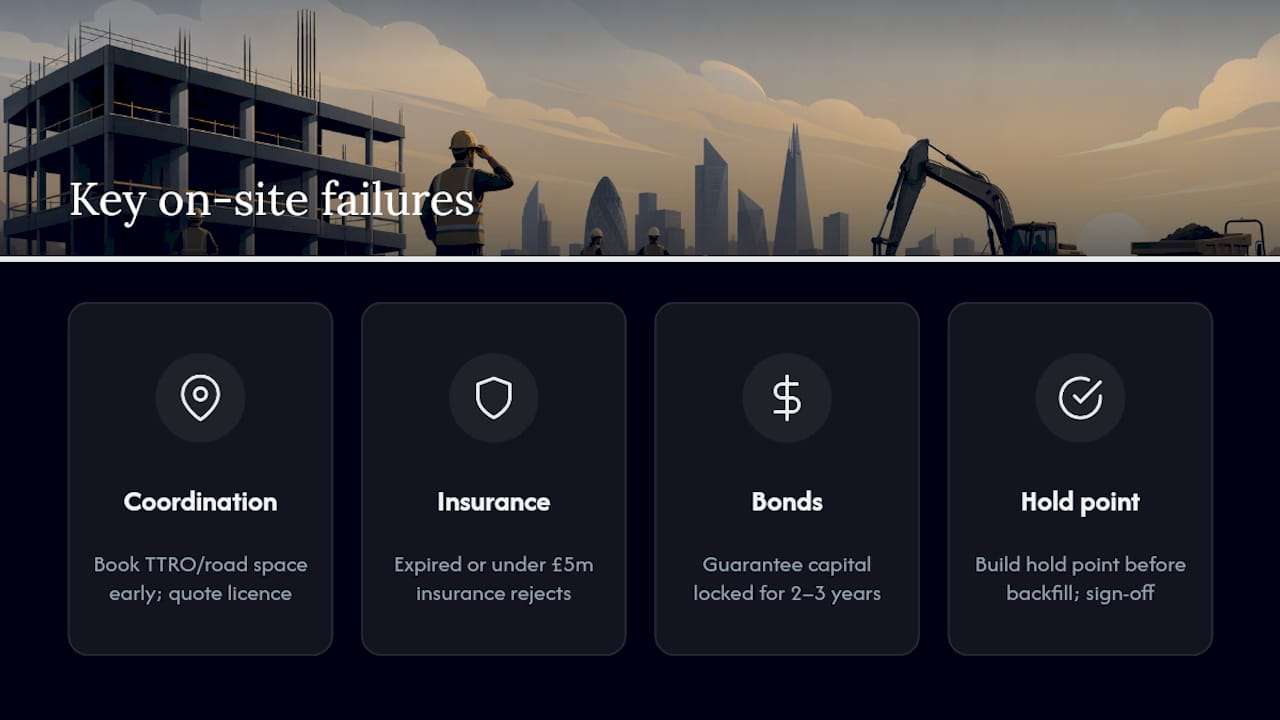
Using a non-accredited contractor or presenting insurance that’s expired or under the £5 million threshold gets applications rejected outright, no negotiation. Bonds are the other blind spot. Contractors budget for the fee and forget the guarantee capital sits locked up for two or three years.
Pro Tip: Build a hold point into your programme before backfill, so a supervisor signs off apparatus depth and bedding against the approved plan. It’s far cheaper than a failed 24-month inspection.
How do you pick a contractor for section 50 works?
Choosing the wrong contractor is the single biggest risk factor in a Section 50 project, because the licence sits in your name even when someone else does the digging.
- Confirm NRSWA accreditation for every supervisor and operative named on site, not just the company as a whole
- Check public liability insurance covers the full works period plus the guarantee window, not just the installation date
- Ask for sample “as-laid” drawings and STAT plans from previous jobs to judge documentation standards
- Request RAMS and a written reinstatement guarantee before signing anything
- Treat vague warranty language, an expired NRSWA card, or insurance below £5 million as immediate red flags
A contractor with genuine groundworks and site preparation experience should produce this evidence without hesitation.
What are the penalties for unauthorised street works?
Working without a licence when one is required is a criminal offence under Section 51 of NRSWA, carrying potentially unlimited fines. Councils can remove unauthorised apparatus and reinstate the highway at your expense, on top of any fixed penalty notice issued for late registration or defective work. Retrospective licence fees run roughly double the standard rate, and remedial invoices for defective reinstatement stack on top. Unauthorised works rarely save money; they just move the cost further down the project timeline.
Delivering section 50 projects with minimal disruption
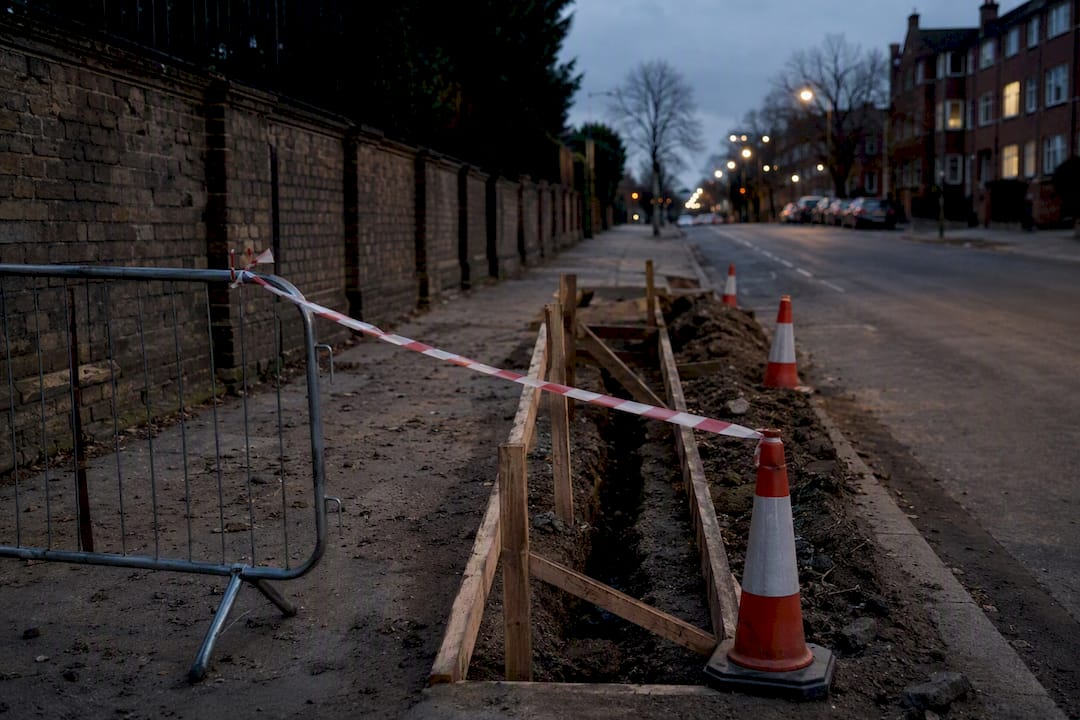
Section 50 projects succeed or fail on sequencing, not paperwork alone. The applications that move fastest are the ones where the traffic management plan, TTRO booking, and licence submission all start on the same day rather than in sequence. Specialist groundworks teams reduce reinstatement risk simply by getting compaction and bedding right the first time, because a failed inspection eighteen months later costs far more than an extra hour on site now.
— George
How gcs contractors supports section 50 works
Gcscontractors gives you a single point of accountability for the parts of a Section 50 project that go wrong most often: groundworks, reinstatement, drainage, and coordination with the highway authority’s timeline. Rather than juggling a licence application, a separate reinstatement contractor, and your own site management, you get one team that understands NRSWA obligations from the plan stage through to the final inspection.

Before you commission anyone for Section 50 works, ask for their NRSWA cards, current insurance certificate, and sample reinstatement records covering a completed guarantee period, not just a fresh job. Gcscontractors can supply all three alongside site management and roadworks delivery across Cambridge and East Anglia. If you’re weighing up a live application or a project already delayed by a failed inspection, get in touch through our groundworks and foundation services page for a quote.
Where to check the latest section 50 guidance
Start with GOV.UK’s issuing guidance for the legal framework, then check your specific council’s page, such as Liverpool’s application portal, for current fees and forms before submitting.
Sources
- Gov
- Apply for a Section 50 licence | Buckinghamshire Council
- Apply to install apparatus under a road, verge or pavement (Section 50 Licence) – Durham County Council
- Section 50 street works licence – Liverpool City Council
- The Section 50 licence – Worcestershire County Council