What must a waste transfer note in the UK contain?
A waste transfer note is a legally required written record for every transfer of non-hazardous business waste in the UK, made mandatory under Duty of Care and Section 34 of the Environmental Protection Act 1990. If your waste is hazardous, a WTN will not do. You need a consignment note instead, and the two documents are not interchangeable.
For everything else, here’s what to do right now:
- Download the GOV.UK duty of care template (form WMC2A) or build a document with the same fields.
- Get both transferor and transferee to sign before the waste leaves site.
- Keep a copy, on paper or digitally, for at least two years.
Pro Tip: If you run repeat collections with the same carrier, ask about a season ticket rather than signing a fresh WTN every time a skip leaves site.
Key Takeaways
Every non-hazardous waste transfer in the UK needs a signed transfer note containing an accurate EWC code, quantity, and both parties’ details, retained for two years.
| Point | Details |
|---|---|
| WTN is mandatory | Required under Duty of Care for every non-hazardous business waste transfer, not optional paperwork. |
| Get the EWC code right | Generic descriptions are the most common reason transfer notes fail scrutiny during inspections. |
| Retention is two years | Keep records, paper or digital, and be able to produce them within seven days if requested. |
| Season tickets need schedules | Any change of carrier, waste type, or location invalidates the ticket immediately. |
| Electronic signatures are valid | Digital WTNs are fully acceptable provided the signature is authenticated and logically linked. |
Table of Contents
- Waste transfer note requirements: the fields you cannot skip
- How to fill in a waste transfer note step by step
- When does a hazardous waste consignment note apply instead?
- What records must you keep, and for how long?
- Building a site-ready waste transfer note checklist
- Official templates and legislation worth bookmarking
- Why contractors get this wrong more than they should
- Sources
Waste transfer note requirements: the fields you cannot skip
Under regulation 35 of The Waste (England and Wales) Regulations 2011, a transfer note isn’t valid unless it identifies the waste correctly, states how much of it there was, and confirms who handed it to whom. Get one field wrong and the whole document loses its value as evidence of Duty of Care.
Here’s what a compliant WTN needs, field by field:
- Waste description and EWC code — a precise European Waste Catalogue code, not a vague label like “mixed debris”. Natural Resources Wales is blunt about this: inaccurate coding is one of the most common reasons transfer notes fail scrutiny.
- Quantity and container type — tonnes, cubic metres, number of skips, or sacks. A note reading “1 x 8 yard skip, mixed inert rubble” is far more defensible than “some waste”.
- Transferor and transferee details — full names, addresses, SIC code, and the carrier’s waste permit or registration number.
- Date, place of transfer, and both signatures, plus a declaration that the waste hierarchy has been applied before disposal.
- Season ticket schedule, if you’re using an annual note, listing every individual transfer it covers.
Electronic signatures are fine under the regulations, provided they’re properly authenticated and logically tied to the document. There’s no requirement to print anything.
How to fill in a waste transfer note step by step
Filling one in properly takes minutes once you’ve done it a few times. Rushing it is how errors creep in.
- Start from a template that mirrors the GOV.UK layout. Trying to invent your own field structure is how sites end up missing something Regulation 35 actually requires.
- Enter transferor and transferee details first — names, addresses, and permit numbers, before anything about the waste itself.
- Confirm the EWC code. Use regulator guidance or the NetRegs waste classification tool. Demolition arisings commonly fall under codes like 17 01 07 (mixed concrete, bricks, tiles) or 17 09 04 (mixed construction and demolition waste). If you’re unsure which applies, our guide to types of construction waste breaks down common categories.
- Record quantity and container format consistently. For example: “1 x 40 yard skip, approximately 6 tonnes, EWC 17 01 07.” Vague entries are the first thing an inspector will query.
- Sign, or apply an authenticated electronic signature, and file the record immediately rather than leaving it in someone’s inbox.
- If using a season ticket, log the transfer on the accompanying schedule the moment it happens, not at month end.
Pro Tip: Photograph the loaded skip alongside the signed note. It costs nothing and gives you a second layer of evidence if a description is ever disputed.
When does a hazardous waste consignment note apply instead?
Hazardous waste, such as asbestos, contaminated soils, or certain fluorescent tubes, is never covered by a standard WTN. It requires a consignment note, which carries stricter tracking obligations and typically involves the Environment Agency’s electronic system rather than a simple paper form.
A few complications come up repeatedly on construction sites:
- Brokers and dealers: if a broker arranges collection on your behalf, their details still need to appear on the WTN. You remain responsible for checking they’re properly registered.
- Mixed or uncertain loads: if you’re not sure whether material should be reclassified (rubble contaminated with plasterboard, for instance), stop and get it assessed rather than guessing a code.
- Season ticket limits: any change of carrier, waste type, or collection address invalidates the ticket immediately. You’ll need a fresh note.
What records must you keep, and for how long?
You must retain WTNs, or equivalent electronic records, for at least two years, and produce them promptly if a regulator asks. For season tickets, that two-year clock starts from the date of the last transfer on the schedule, not the date the ticket was issued.
Electronic storage is entirely acceptable, provided the record is complete and retrievable, and any electronic signature is properly authenticated.
The most common audit failings on construction sites are surprisingly basic:
- Missing or generic EWC codes that don’t match what was actually removed.
- No schedule kept alongside a season ticket, so individual transfers can’t be traced.
- Records split across paper and someone’s phone, with no single point of retrieval.
Poor documentation exposes both the producer and the carrier to enforcement action, and it undermines your ability to demonstrate that the waste hierarchy was genuinely applied.
Building a site-ready waste transfer note checklist
Most contractors don’t fail on the law itself. They fail on consistency, one site keeps tidy digital records, another leaves signed notes in a site cabin drawer for months.
A workable pre-transfer checklist covers five things: confirm the carrier’s registration or permit number, describe the waste accurately with its EWC code, record quantity and container type, get both signatures, and file the note the same day.
Two examples make this concrete. A single skip removal from a strip-out job needs one WTN, completed on the day the skip leaves. An annual season ticket covering weekly groundworks spoil collections needs one master note plus a running schedule, updated after every single lift, not retrospectively.
For recordkeeping, decide early who owns the record, site manager, office administrator, or contracts team, and store digital WTNs alongside weighbridge tickets or invoicing data so everything about a transfer sits in one place.
- Verify the carrier before waste leaves site.
- Confirm EWC code and quantity match what’s actually loaded.
- Get signatures and file the note within 24 hours.
Site teams handling regular waste removal also benefit from a working understanding of correct classification and disposal routes; our guide to recycling demolition waste covers how accurate documentation supports better reuse decisions. For staff who need formal training in this area, the certificate in removing non-hazardous wastes for construction is worth considering.
Official templates and legislation worth bookmarking
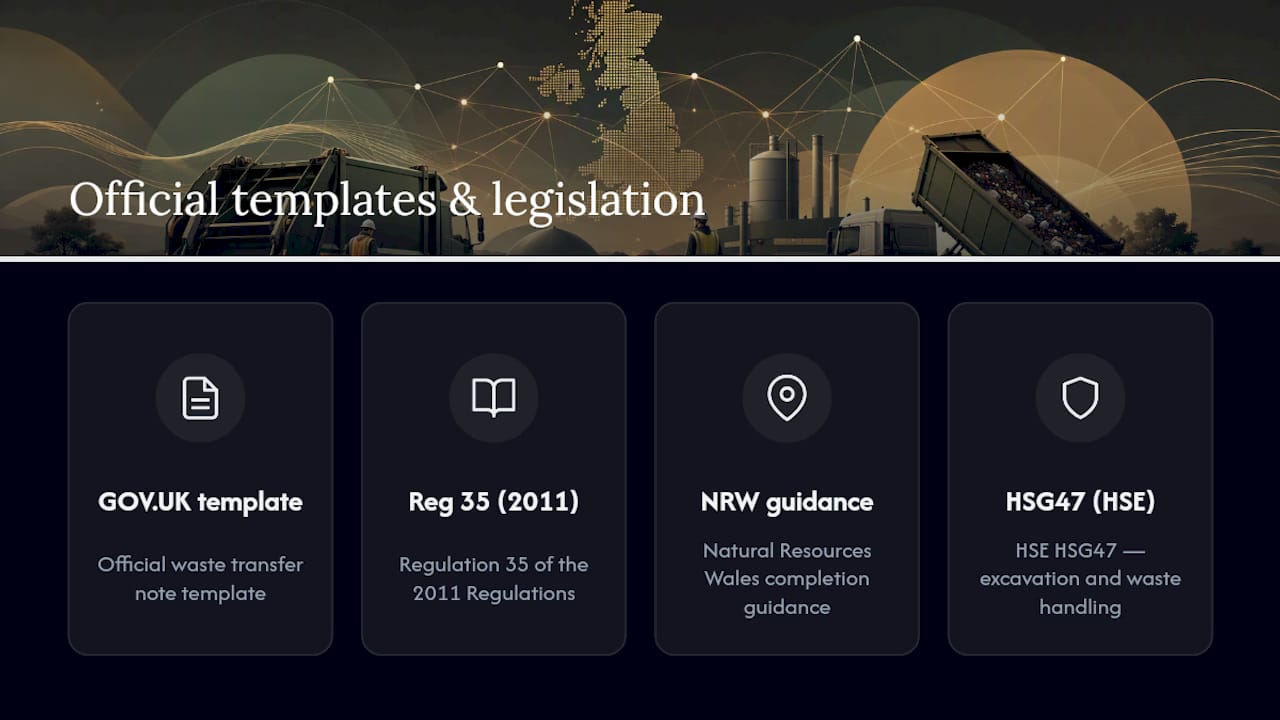
Keep these close: the GOV.UK waste transfer note template, regulation 35 of the 2011 Regulations, Natural Resources Wales completion guidance, and HSE’s HSG47 guidance for excavation safety alongside waste handling.
Why contractors get this wrong more than they should
The conventional advice on waste transfer notes treats them as an administrative afterthought, something you fill in once the skip’s already gone. That’s backwards. A WTN written from memory two days later is where most of the coding errors and vague descriptions creep in, and it’s exactly what an enforcement officer notices first.
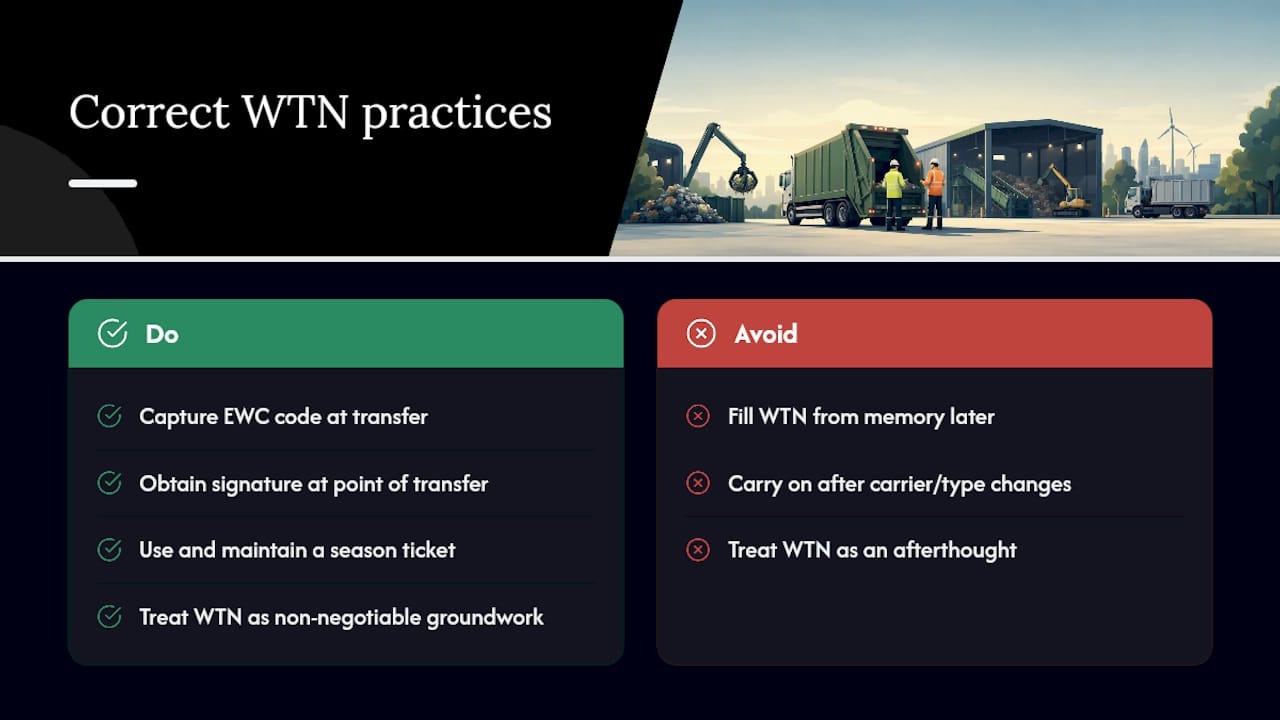
What’s underrated is the season ticket. Most sites either avoid it entirely, because the paperwork sounds complicated, or misuse it by carrying on regardless when a carrier or waste type changes. Used properly, with a maintained schedule, it saves real administrative time on repeat groundworks or strip-out jobs. Used carelessly, it’s a liability dressed up as convenience.
If you take one thing from this: get the EWC code and the signature captured at the point of transfer, not afterwards. Everything else, retention, storage, formatting, is manageable once that habit is in place. Our own site teams treat it as non-negotiable groundwork, not paperwork, on every job we run, from strip-out projects through to full groundworks packages.
— George
Sources
- Gov
- The Waste (England and Wales) Regulations 2011 — regulation 35
- Completing waste transfer notes — Natural Resources Wales