Rehabilitation of structures: Cambridge project manager’s guide
Structural rehabilitation requires a structural assessment and a compliant method statement demonstrating conformity with Building Regulations Part A before any remedial work begins. For Cambridge and East Anglia projects, the immediate next steps are:
- Commission a structural survey or pre-acquisition technical due diligence (TDD) if ownership is changing, or a Planned Preventative Maintenance (PPM) survey for an asset already under management.
- Obtain all as-built drawings, maintenance records, and previous survey reports before instructing any contractor.
- Instruct a method statement and temporary works design aligned to Part A structural duties and, where concrete repair is involved, to BS EN 1504.
Gcscontractors delivers strip-out, groundworks, and reinstatement across Cambridge and East Anglia and can be instructed at any stage of this process.
Table of Contents
- Key takeaways for commissioning structural rehabilitation
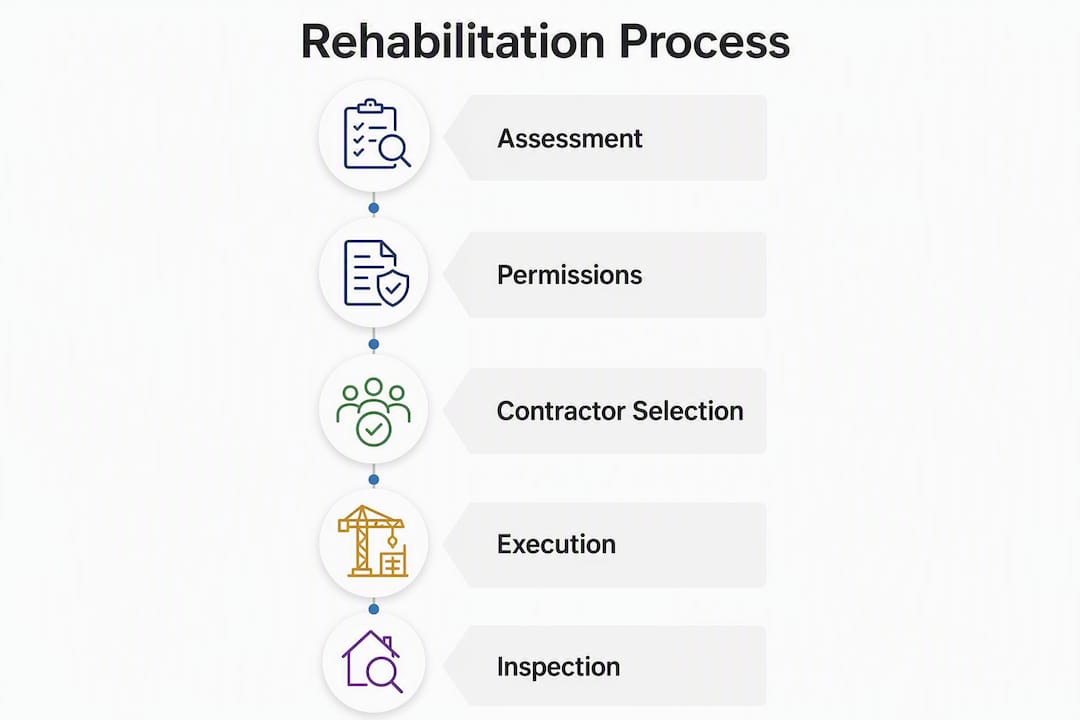
- What the staged rehabilitation process looks like in practice
- Commission Gcscontractors for your rehabilitation project
- Authoritative references for tendering and compliance
Key takeaways for commissioning structural rehabilitation
Structural rehabilitation is most cost-effective when surveys, standards compliance, and contractor selection are addressed before mobilisation, not after opening-up reveals hidden defects.
| Point | Details |
|---|---|
| Survey first | Commission a PPM or TDD survey with a maintenance period of 5–10 years, extendable up to 30 years per RICS guidance, before scoping any repair works. |
| Cite the right standards | Tender documents must reference Part A, BS EN 1504 for concrete repair, and Series 5700 for highway structures. |
| Budget for contingency | Opening-up investigations frequently uncover hidden defects; include provisional sums in every contract. |
| Darwin Green precedent | Foundation and groundworks complexity at Darwin Green, Cambridge illustrates why early ground investigation matters on local clay soils. |
| Appoint Gcscontractors | Gcscontractors covers strip-out, foundations, drainage, and reinstatement for rehabilitation projects across Cambridge and East Anglia. |
What the staged rehabilitation process looks like in practice
Assessment and survey selection
RICS PPM guidance recommends survey periods of 5–10 years, extendable up to 30 years, producing schedules that identify when repair or replacement becomes most cost-effective. TDD surveys serve a different purpose: they apply when ownership or occupation is changing and need to confirm structural suitability and cost liabilities before exchange. Where foundation movement or contamination is suspected, intrusive opening-up, trial pits, and geotechnical ground investigation are required in addition to a visual survey.
Standards and regulatory checklist
Every scope of work for building restoration should reference:
- Building Regulations Part A (load transmission, ground movement, disproportionate collapse prevention)
- BS EN 1504 for concrete repair material selection and performance verification
- Series 5700 Specification for Highway Works for highway and civil structures, which mandates EN 1504 compliance for both materials and execution
- CDM 2015, which requires designers and principal contractors to plan for safe future maintenance access from the outset
- SIRAS/LRQA accreditation where corrosion control or cathodic protection is specified
Permissions and hazards to resolve early
Planning consent and listed-building consent, party wall notices, asbestos surveys, demolition notifications, environmental permits, and traffic management or S278 agreements for highway works must all be confirmed before mobilisation. For live-site construction signage and traffic management, early engagement with the local highway authority avoids programme delays.
Pro Tip: Always include a provisional sum for hidden defects. Opening-up on older Cambridge stock regularly reveals carbonation, chloride ingress, or foundation movement that was invisible at survey stage. It is prudent to allow a contingency on structural repair packages to cover unforeseen issues.
Commission Gcscontractors for your rehabilitation project
Gcscontractors brings together the full range of enabling and structural rehabilitation services Cambridge and East Anglia project managers need under one contract: strip-out and demolition, temporary works and propping, concrete repair preparation, groundworks and foundations, drainage, and reinstatement. The team is experienced in live environments and can provide method statements, CDM documentation, insurance certificates, and SIRAS/EN 1504 compliance evidence on request.

To get a compliant quote quickly, prepare your as-built drawings, most recent PPM or survey report, and programme windows before making contact. Request a survey or quote directly via gcscontractors.co.uk.
Authoritative references for tendering and compliance
- BS EN 1504 via Standards for Highways — governs material selection and performance verification for concrete repair on both buildings and highway structures
- Series 5700 Specification for Highway Works — mandatory for highway concrete repair; links directly to EN 1504 for materials and execution
- RICS PPM guidance (June 2022) — defines survey scope, recommended periods, and how to programme remedial works
Recommended
- Concrete Services in Cambridge: A Guide to Structural Excellence (2026) – GCS Contractors Ltd
- Professional Demolition Services in Cambridge: The Complete 2026 Developer’s Guide – GCS Contractors Ltd
- Professional Roadworks Contractors in Cambridge: A Developer’s Guide to Infrastructure Excellence – GCS Contractors Ltd
- Roadworks and Paving in Cambridge: A Professional Contractor’s Guide – GCS Contractors Ltd