How to Choose a Trustworthy Groundworks Contractor in 2026
In 2026, hiring a groundworks contractor who lacks verified qualifications isn’t just a gamble; it’s a direct violation of the UK’s strengthened building safety regime. Following the transition of the Building Safety Regulator (BSR) to an independent body in January, the legal stakes for site preparation have never been higher. Understanding how to choose a trustworthy groundworks contractor is now the most critical step in protecting your project from structural failure and the criminal penalties associated with non-compliant materials.
You likely recognise that a project is only as stable as its substructure, yet the anxiety of budget overruns and “ground condition” extras remains a constant pressure. It’s frustrating to face potential delays because a partner failed to account for the latest ISO 14001:2026 environmental standards or the abolition of CSCS “Grandfather Rights” for their workforce. You deserve a transparent partnership built on technical precision and disciplined compliance rather than vague promises.
This article provides the critical technical benchmarks and red flags required to identify a reliable groundworks partner for your next construction project. We will examine the essential 2026 regulatory updates, transparent pricing structures, and the rigorous safety accreditations that ensure your foundations are legally compliant and delivered on schedule.
Key Takeaways
- Verify 2026 compliance by checking for valid CSCS cards and comprehensive liability insurance to ensure site safety and legal accountability.
- Learn how to choose a trustworthy groundworks contractor by evaluating technical benchmarks such as plant ownership and specialised expertise in complex site environments.
- Assess a firm’s operational certainty by reviewing their internal fleet of machinery and their proven track record with specific substructures and reinforced concrete works.
- Protect your budget by identifying red flags like suspiciously low quotes that often precede hidden ground condition costs or structural shortcuts.
- Secure project timelines by demanding a detailed Schedule of Works rather than a generic estimate to guarantee transparency from the first excavation.
The Foundation of Trust: Essential Accreditations and Compliance
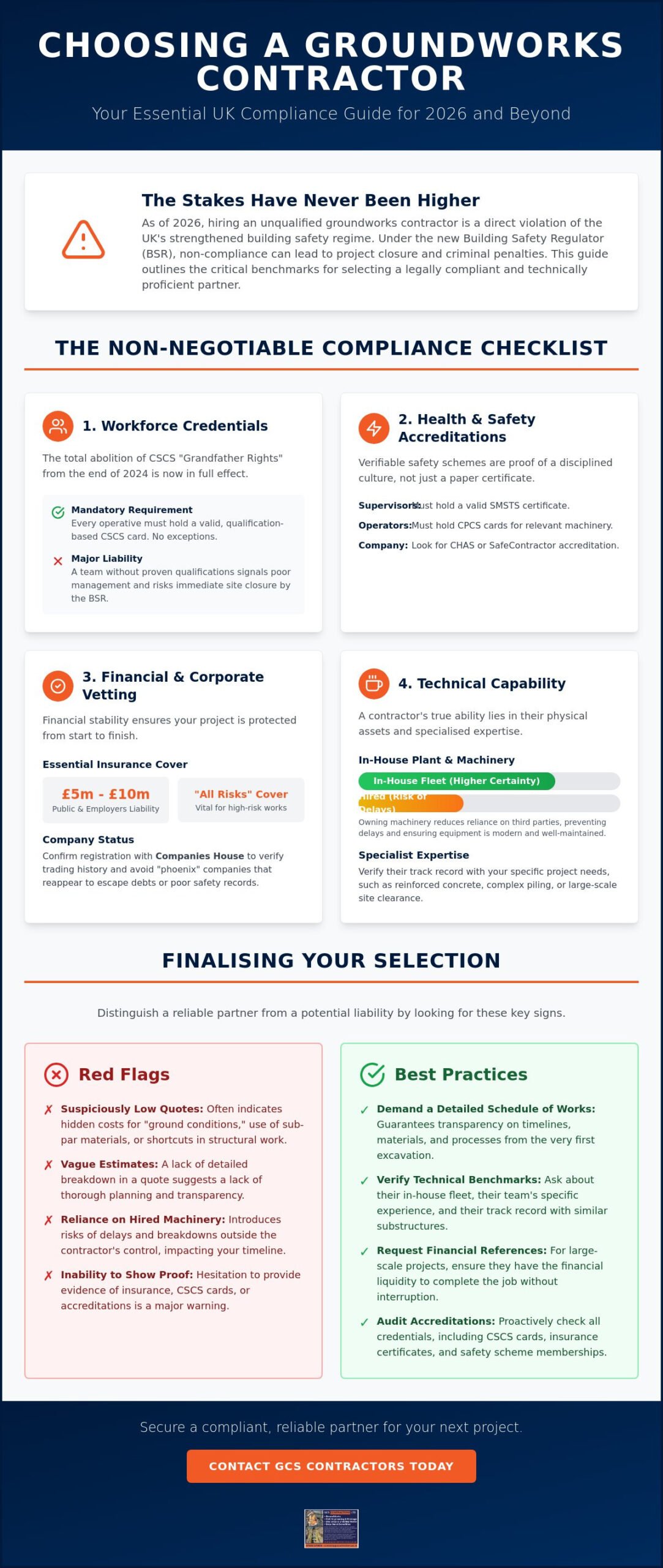
Identifying how to choose a trustworthy groundworks contractor in 2026 begins with a rigorous audit of their workforce credentials. Since the total abolition of CSCS “Grandfather Rights” at the end of 2024, every operative on your site must hold a qualification-based card. A firm that cannot prove its team is fully qualified is a major liability. It signals poor management and puts your project at risk of immediate closure by the Building Safety Regulator.
Professionalism extends beyond the site gate. You must confirm the contractor is registered with Companies House and possesses a verifiable trading history. This prevents the “phoenix” company trap, where failing firms close down only to reopen under a new name to avoid safety records or debts. Understanding what is a general contractor? provides the context needed to recognise that groundworks specialists must maintain the same level of corporate transparency as any lead provider.
To better understand the technical verification process, watch this helpful video:
UK Health and Safety Standards
Safety is an operational necessity. For any site supervisor, an SMSTS (Site Management Safety Training Scheme) certificate is essential to manage the complex risks of bulk excavation. Similarly, CPCS (Construction Plant Competence Scheme) cards are non-negotiable for excavator and dumper operators. These cards confirm that the person behind the controls has the technical skill to work safely around your site’s existing utilities and infrastructure. Look for safety-first accreditations such as CHAS or SafeContractor as proof of a disciplined safety culture.
Insurance and Financial Stability
Financial protection is paramount. Ensure the firm carries Public Liability and Employers Liability insurance with a minimum cover of £5m to £10m for commercial projects. For high-risk tasks like reinforced concrete works, “All Risks” insurance is vital. It covers damage to the works themselves during the construction phase. For large-scale civil engineering projects, always request a letter of intent or financial references to ensure the contractor has the liquidity to finish the job without interruption.
Evaluating Technical Capability: Equipment, Workforce, and Expertise
Technical capability is the physical engine of your project. When researching how to choose a trustworthy groundworks contractor, you must look beyond their digital presence and examine their actual physical assets. A contractor’s ability to deliver depends on their machinery, their team’s specific expertise, and their history with similar site conditions. Following industry best practices for choosing a contractor means digging into the details of their operational setup before signing any contract.
In-House Plant and Machinery
Reliability often depends on who owns the keys to the excavators. Firms that maintain an in-house fleet of plant and machinery offer significantly better schedule certainty. Relying on third-party hire companies introduces variables outside your contractor’s control, such as delivery delays or equipment breakdowns. Modern, well-maintained machinery isn’t just about speed; it’s about fuel efficiency and site safety. Using the latest piling rigs and excavators reduces the risk of hydraulic leaks or mechanical failures that can halt a site for days.
Specialist Sub-Structure Services
Expertise in groundworks must be specific to your site’s unique challenges. If you are dealing with unstable soils or heavy structural loads, you need concrete contractors who specialise in reinforced concrete and piling. A comprehensive provider should handle the entire sequence, from initial bulk excavation to the final installation of drainage systems. This end-to-end capability prevents the “blame game” between different trades and ensures that your foundations are a single, cohesive unit designed to prevent long-term damp or flooding. Review their portfolio for projects of a similar scale, whether that involves residential footings or large-scale commercial infrastructure. If you are planning a complex project, you can view our full range of specialist groundworks services to see how we manage site-specific technical requirements.
Red Flags and Best Practices: Finalising Your Selection
Finalising your selection requires a transition from technical verification to commercial scrutiny. When deciding how to choose a trustworthy groundworks contractor, the final contract and payment structure serve as your primary safeguards. A professional firm won’t hesitate to provide a granular breakdown of their processes and costs. They understand that transparency is the bedrock of a successful construction partnership.
Spotting Red Flags in Quotes
Learning how to choose a trustworthy groundworks contractor involves recognising that the cheapest bid is rarely the safest. Be wary of quotes that sit significantly below the market average. These often hide “unforeseen” ground condition charges that only appear once the project is underway. A major warning sign is a contractor who provides an estimate without a physical site visit. Without assessing access constraints or soil topography, an accurate price is impossible. Ensure that site clearance and “muck-away” waste disposal costs are explicitly included. Vague descriptions of waste removal often lead to budget overruns during the excavation phase.
The Importance of Local Geographic Knowledge
Geology varies wildly across East England. A contractor familiar with the heavy clay of Stevenage or the challenging silt of the Fens will provide more accurate timelines than a firm with no regional presence. Local knowledge is also vital for navigating local authority requirements. This includes securing Section 50 or Section 171 road opening licences for utility trenching and kerbing works. When choosing the right civil engineering firm, check local references in your specific area to see how they handled regional soil variations and local planning constraints.
Reliability is cemented through a clear, milestone-based payment schedule. You shouldn’t pay the full amount upfront. Instead, link payments to verified project stages, such as the completion of bulk excavation or “oversite completion.” This approach ensures you only pay for tangible progress on site. Before signing any agreement, spend time verifying a contractor’s credentials and insurance documents one last time. It’s the only way to guarantee your project rests on a stable, legally compliant foundation.
Securing Your Site’s Structural Integrity
Selecting a partner for your substructure requires a balance of technical verification and commercial transparency. You now understand the importance of checking qualification-based CSCS cards and the necessity of in-house plant ownership for schedule certainty. Avoiding vague estimates and prioritising contractors with specific geographic experience in East England will protect your project from the “ground condition” extras that often derail construction budgets.
Knowing how to choose a trustworthy groundworks contractor is about more than just reading reviews; it’s about auditing their compliance and physical assets. GCS Contractors Ltd has been delivering these professional standards since 2017. With a proven track record across East England and a comprehensive in-house plant fleet, we provide the reliability and safety your project demands. We’re fully insured and strictly compliant with all UK site safety accreditations.
Request a professional groundworks consultation with GCS Contractors Ltd to ensure your next build starts on a stable and legally compliant foundation.
Frequently Asked Questions
What is the difference between a general builder and a groundworks contractor?
A groundworks contractor is a specialist focused on everything below the damp proof course (DPC), whilst a general builder typically manages the visible superstructure. Groundworks involves technical plant operation for bulk excavation, piling, and drainage installation. General builders often lack the heavy machinery and specific technical insurance required for deep excavation or reinforced concrete works.
Should a groundworks contractor provide a soil report or site survey?
The client or their structural engineer typically provides the soil report, but a professional contractor will insist on reviewing it before finalising a quote. This report is essential for determining the correct foundation depth and drainage design. When researching how to choose a trustworthy groundworks contractor, look for firms that perform their own site survey to assess access for plant and machinery.
How much insurance should a groundworks company have in the UK?
A professional groundworks company in the UK should hold a minimum of £5 million in Public Liability insurance, though £10 million is the industry standard for commercial sites. They must also carry £10 million in Employers Liability insurance. This level of cover is necessary to protect against the high stakes of infrastructure damage or site accidents during complex substructure works.
What happens if the contractor discovers unexpected ground conditions?
If unexpected conditions like high water tables or uncharted utilities are discovered, a reliable contractor will stop work and consult your structural engineer immediately. They should provide a transparent variation to the original quote based on the new technical requirements. This disciplined approach is a key indicator of how to choose a trustworthy groundworks contractor, as it prevents hidden costs from being applied without professional justification.