New Estate Road Construction Contractors in Essex: Infrastructure Excellence for 2026
In 2026, the gap between a profitable development and a stalled site is often measured by the speed of your Section 38 technical approval. Securing the right new estate road construction contractors Essex is no longer just about sourcing a surfacing team. It’s about partnering with specialists who understand the April 2026 Development Construction Manual from the first day of site clearance. You’ve likely experienced the frustration of project delays caused by non-compliance with Essex County Council standards or the impact of hidden costs in drainage and site preparation.
We know that infrastructure excellence requires a disciplined, no-nonsense approach to groundworks and utility trenching. This professional guide provides developers and site managers with a practical framework for navigating the technical and regulatory requirements of estate road construction across the county. We’ll examine the latest highway authority standards, the seamless integration of drainage systems, and how to ensure your road network is delivered to adoption standards without the usual coordination headaches. This is your roadmap to achieving a compliant, durable finish on schedule.
Key Takeaways
- Understand the critical distinctions between Section 38 and Section 278 agreements to ensure your project meets the latest Essex County Council adoption standards.
- Discover why precision in bulk excavation and sub-base installation is essential for maintaining road structural integrity under heavy construction traffic.
- Learn how to evaluate new estate road construction contractors Essex based on their plant ownership, safety accreditations, and technical engineering expertise.
- Identify the 2026 regulatory benchmarks that dictate the design and technical approval process for all new highway works in the county.
- Reduce project friction by coordinating site clearance and enabling works with a contractor that understands the interface between groundworks and surfacing.
Navigating Section 278 and Section 38: The Foundation of Essex Estate Road Construction
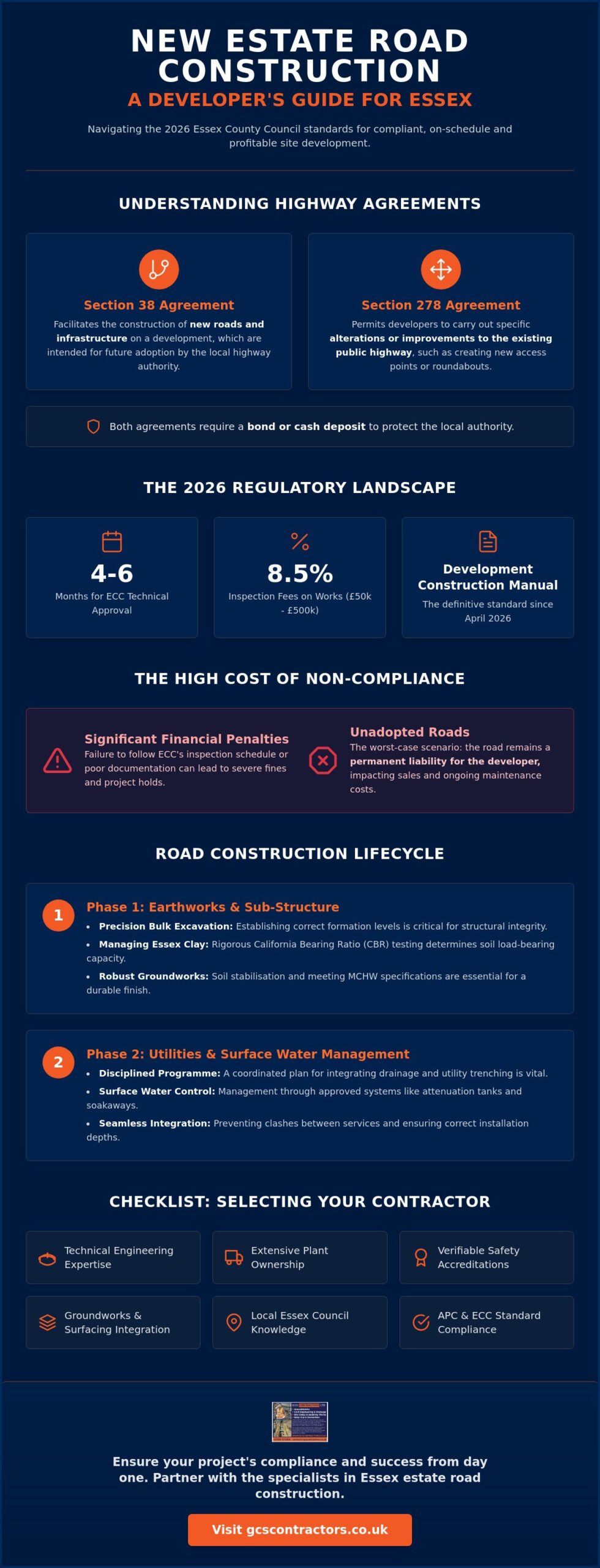
Successful infrastructure projects in the East of England start with a clear understanding of the legal framework governing the UK road network. For developers, selecting new estate road construction contractors Essex who are familiar with the Advance Payments Code (APC) is a commercial necessity. You must distinguish between Section 38 agreements, which facilitate the construction of new roads for future adoption, and Section 278 agreements, which permit specific alterations to the existing public highway. Both require a bond or cash deposit to protect the local authority and future homeowners from project abandonment.
To better understand how these elements integrate into a live development, watch this helpful video:
Early coordination with an experienced civil engineering firm is vital for project viability. Technical approval from Essex County Council (ECC) can take four to six months; any delay here ripples through your entire build schedule. Since April 2026, the Development Construction Manual has served as the definitive standard for all highway works intended for adoption. You’ll need to budget for inspection fees, which for projects between £50,000 and £500,000, currently stand at 8.5% of the works’ cost.
Essex Local Authority Compliance
Navigating the specific design requirements for Chelmsford, Colchester, and Braintree developments requires local expertise. Each district may have variations in how they interpret the Essex Design Guide, particularly regarding hard landscaping and commuted sums for non-standard features. Constant site inspections and detailed ‘as-built’ surveys are mandatory milestones in the adoption lifecycle. These documents prove that the sub-structure matches the approved drawings.
The Risks of Regulatory Non-Compliance
Poor documentation or a failure to follow the ECC inspection schedule can lead to significant financial penalties. In the worst cases, it results in unadopted roads that remain a permanent liability for the developer. Adoption is the formal transfer of road maintenance responsibility from the developer to the local authority.
Technical Execution: The Lifecycle of New Estate Road Construction in 2026
The physical lifecycle of an estate road begins long before the first layer of tarmac is laid. For new estate road construction contractors Essex, success depends on the precision of the initial bulk excavation. Establishing correct formation levels is the only way to ensure the road’s structural integrity. If these levels are off by even a few millimetres, the subsequent sub-base and base course layers won’t support heavy construction traffic. This leads to premature failure and costly remedial works before the road is even adopted.
Phase 1: Earthworks and Sub-Structure
Essex clay presents specific challenges for site stability. Contractors must conduct rigorous California Bearing Ratio (CBR) testing to determine the load-bearing capacity of the soil. In many cases, soil stabilisation is required to prevent settlement. High-quality groundworks are the absolute prerequisite for a durable surface. We focus on establishing a robust sub-structure that meets the MCHW (Manual of Contract Documents for Highway Works) specifications, ensuring the site remains operational during the build phase.
Phase 2: Utilities and Surface Water Management
Integrating drainage systems and utility trenching requires a disciplined programme of works. Surface water must be managed through attenuation tanks and soakaways to prevent estate run-off. Coordination is key when installing service ducting alongside kerbs and channels. It’s essential to follow the official guidance for Navigating Section 278 and Section 38 Agreements to ensure all underground assets are correctly positioned for future maintenance.
Final surfacing and kerbing works mark the transition from a construction site to a residential estate. This phase includes the installation of pedestrian footways and the application of the wearing course. Every detail, from the placement of grit bins to the finish of the hard landscaping, must align with the approved technical drawings. If you need a partner who understands the technical demands of infrastructure, consider professional groundworks and road construction services to keep your site on track.
Selecting Specialist Road Construction Contractors for Essex Developments
Infrastructure excellence depends as much on a contractor’s culture as it does on their machinery. When you’re evaluating new estate road construction contractors Essex, you need to look beyond the basic tender price. The most reliable partners possess three key assets: extensive in-house plant ownership, verified safety accreditations, and a dedicated team of technical engineering staff. A no-nonsense approach to site clearance and enabling works is essential to reduce project friction. This proactive mindset ensures that potential ground issues are identified and resolved before they impact the road construction schedule.
For brownfield developments, the preparation phase is often the most complex. GCS Contractors Ltd manages integrated demolition and strip out programmes to clear existing structures and prepare the land for new road infrastructure. Having a strong local presence in Essex and the surrounding counties allows for faster mobilisation and a deeper understanding of regional soil conditions and local authority nuances. It’s about being on-site when needed and maintaining clear, direct communication with site managers.
Machinery and Manpower: The GCS Advantage
Reliability on a project site is tied directly to plant ownership. By using our own machinery, we don’t rely on third-party hire availability, which gives us total control over the build programme. This certainty is vital for maintaining the pace of a multi-phase development. Every operative on our team holds relevant CSCS and CPCS qualifications for highway works. This ensures that the technical standards required for Section 38 adoption are met by skilled professionals who understand the stakes.
Safety and Quality Standards
Maintaining a disciplined site environment is a prerequisite for safety, particularly when multiple trades are operating amongst heavy plant and equipment. We prioritise order and compliance to ensure that site preparation and roadworks proceed without incident. CHAS or SMAS accreditation is a non-negotiable requirement for Essex contractors in 2026 because it provides developers with third-party verification of a firm’s health and safety competence. Our commitment to these standards ensures a seamless transition from the initial excavation to the final surfacing of a compliant, durable road network.
Securing Long-Term Infrastructure Success in Essex
Delivering a successful residential road network in 2026 requires more than just paving. It demands a disciplined adherence to the latest Essex County Council standards and a technical mastery of the ground beneath the tarmac. By prioritising early-stage coordination and selecting new estate road construction contractors Essex with in-house plant and engineering expertise, you eliminate the friction that often stalls large-scale developments. A compliant, durable road network is the result of precise execution from the first bulk excavation to the final wearing course.
GCS Contractors Ltd provides the local expertise and technical capacity needed to manage the entire infrastructure lifecycle. We are specialists in Section 278 and Section 38 infrastructure, ensuring your project meets all regulatory requirements for a seamless adoption process. Our team is fully accredited for civil engineering and groundworks; we bring a no-nonsense approach to every site across Essex and East England. Enquire about your Essex road construction project with GCS Contractors Ltd to secure a partner focused on safety, quality, and professional momentum. Let’s get your site moving correctly from day one.
Frequently Asked Questions
What is the difference between a Section 38 and a Section 278 agreement in Essex?
A Section 38 agreement facilitates the construction of new estate roads that will eventually be adopted by Essex County Council as public highways. Conversely, a Section 278 agreement allows a developer to make specific alterations or improvements to the existing public highway, such as creating a new site entrance or junction. Both legal frameworks require technical approval and a financial bond to ensure the works meet the 2026 Development Construction Manual standards.
How long does the road construction process typically take for a medium-sized estate?
The timeline is split between a four to six-month technical approval period and the physical construction phase. Once technical drawings are approved and the bond is in place, the initial earthworks and sub-base installation can take several weeks. However, the final wearing course is usually delayed until heavy building traffic has subsided. This phased approach prevents damage to the finished surface and ensures the road is in peak condition for adoption.
Can GCS Contractors handle both the initial groundworks and the final road surfacing?
Yes, we provide an integrated service that spans the entire infrastructure lifecycle. As established new estate road construction contractors Essex, we manage everything from site clearance and bulk excavation to drainage installation and final tarmac surfacing. By handling both the groundworks and the paving, we eliminate the coordination gaps that often occur between separate contractors. This end-to-end capability ensures that formation levels and sub-bases are perfectly prepared for the final surface.
What are the common challenges of constructing roads on Essex clay soil?
Essex clay is highly susceptible to volume changes and moisture, which can lead to foundation settlement if not managed correctly. We address this by conducting rigorous California Bearing Ratio (CBR) testing to determine the soil’s load-bearing capacity. If the clay is too soft, we implement soil stabilisation or use deeper sub-base layers to provide a stable platform. Effective surface water management is also vital to prevent water from saturating the sub-grade and compromising the road’s structural integrity.