How Ground Conditions Affect Foundation Costs in the UK: A 2026 Guide
The most expensive part of your build is often the part you’ll never see. While many developers focus on the structure above, understanding how ground conditions affect foundation costs uk is vital for maintaining a viable budget. Whether you’re facing shrinkable clay, peat, or a high water table, the geology of your site determines every penny spent on concrete and steel. It’s a harsh reality that the ground doesn’t care about your architectural plans; it only cares about physics and load-bearing capacity.
We understand the anxiety that comes with starting excavation, especially the fear of hitting “bad ground” that sends costs spiralling. This guide explores how soil chemistry and site history dictate your groundwork expenses and how to manage these variables effectively. We’ll break down the necessity of different foundation types, from trench fill to engineered rafts, whilst ensuring you remain compliant with the NHBC Standards 2026. By the end, you’ll know how to achieve a predictable groundwork budget and find a partner capable of handling even the most challenging terrain.
Key Takeaways
- Learn why the 450mm rule and regional soil variations like London clay dictate the minimum depth and total concrete volume of your foundations.
- Understand how ground conditions affect foundation costs uk through increased plant hire rates and complex “muck-away” disposal requirements.
- Discover how upfront site investigations and trial pits mitigate the risk of expensive mid-project variations and structural failure.
- Explore the impact of sub-surface obstacles, such as redundant utilities or old footings, on your bulk excavation and site preparation budget.
- Identify the logistical factors, including soil weight and contamination levels, that influence haulage costs and landfill fees.
Common UK Soil Types and Their Impact on Foundation Depth
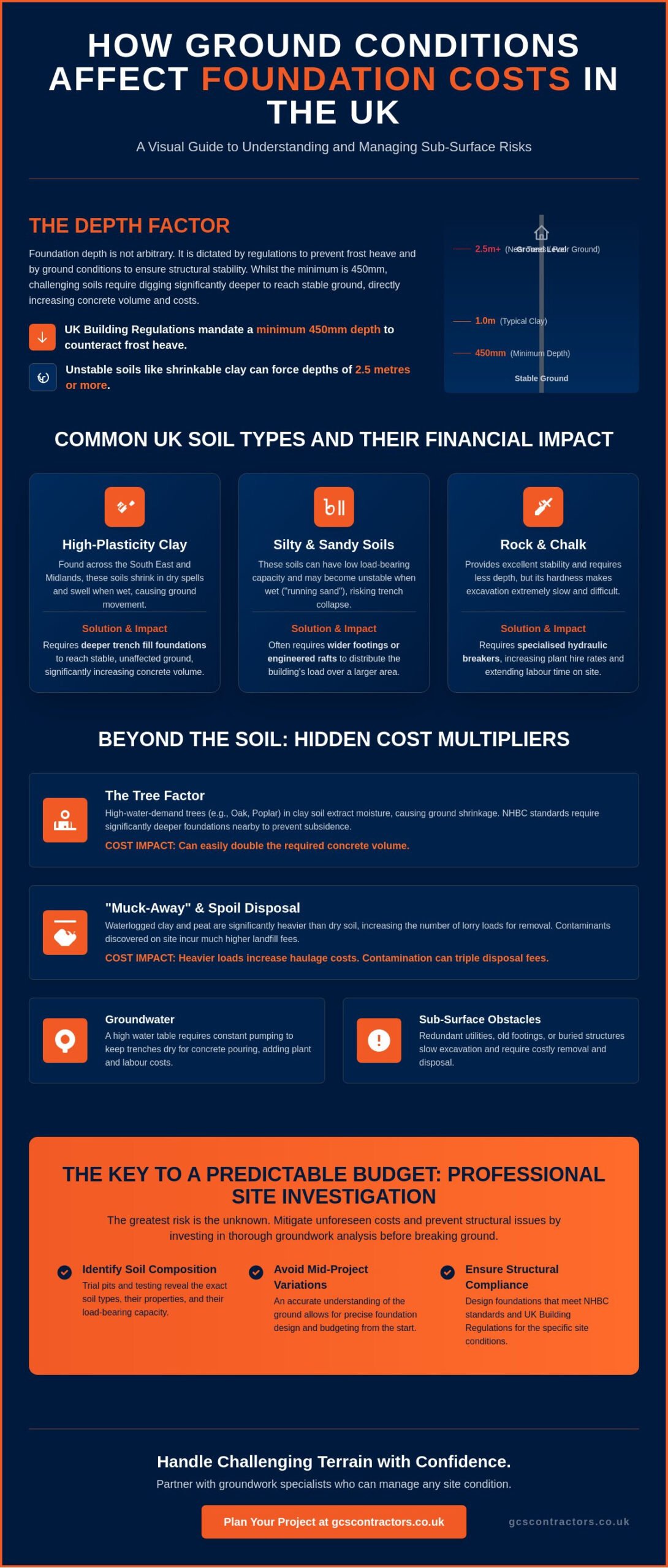
Foundation design begins with the earth itself. UK Building Regulations mandate a minimum depth of 450mm for all footings to protect against frost heave. This ensures that the moisture within the soil doesn’t freeze and expand, which would otherwise heave the structure upwards. However, this is merely the baseline. The engineering classification of soils on your site will ultimately dictate whether you dig to 600mm or 2.5 metres.
To better understand this concept, watch this helpful video:
Clay soils are the most common challenge for developers in the South East and Midlands. High-plasticity clays, such as those found in London and Essex, are prone to significant volume changes. They shrink during dry summers and swell during wet winters. This seasonal movement forces contractors to dig deeper trenches to reach stable ground, which is a primary reason how ground conditions affect foundation costs uk. Conversely, silty or sandy soils may suffer from “running sand” or low bearing capacity. These conditions often require wider footings to distribute the building’s load across a larger surface area.
Rock and chalk provide excellent stability but present a different financial hurdle. Whilst you won’t need to dig as deep, the hardness of the material requires specialised hydraulic breaking equipment. This slows down the excavation rate and increases hourly plant costs, proving that even “good” ground has its price.
The Tree Factor: Root Systems and Desiccation
Nearby trees complicate foundation depths in clay-heavy areas. Roots extract moisture, causing soil desiccation and subsequent shrinkage. NHBC standards provide strict calculations for foundation depths based on the tree species and its maturity. If you’re building near a high-water-demand tree like an Oak or Poplar, expect your trench depths to increase substantially to prevent future subsidence. It’s a technical variable that can double your concrete requirements overnight.
London Clay and East Anglian Silts
Developers in London and Cambridge deal with some of the most geologically active ground in the country. In these regions, a standard strip foundation is rarely sufficient. The high-plasticity of the clay and the presence of alluvial silts often necessitate deeper trench fill foundations or reinforced concrete rafts. Understanding these regional specifics is essential for accurate budgeting before the first bucket hits the dirt. We ensure our site preparation accounts for these variables to avoid structural failure or mid-project cost spikes.
How Challenging Ground Conditions Drive Up Labour and Plant Costs
Ground conditions aren’t just about the volume of concrete. They dictate the pace of the entire programme. When ground is stable, an operator can perform precision trenching quickly. In unstable or rocky terrain, the process slows. If you hit hard rock, a standard excavator bucket won’t suffice; you’ll need hydraulic breakers. This switch in plant increases hourly rates and extends the labour timeline. Compliance with UK building regulations for foundations ensures safety, but achieving those standards in difficult terrain requires more man-hours and specialised equipment.
The “muck-away” process is another variable where how ground conditions affect foundation costs uk becomes apparent. Heavy, waterlogged clay or peat weighs significantly more than dry soil, increasing the number of lorry loads required for site clearance. If testing reveals contaminants, disposal fees at UK landfills can triple. Additionally, unstable ground often requires shoring or trench boxes to prevent collapse. These structural supports add rental costs and labour time for installation and removal. It’s a logistical challenge that demands a disciplined approach to site management.
Groundwater Management and Drainage
High water tables demand constant attention. If a trench fills with water, it must be pumped out before any concrete is poured. This often involves 24-hour pumping and the early installation of specialised drainage systems to manage run-off. In non-porous ground, you may also need to install attenuation tanks or soakaways to meet modern environmental standards. These additions are vital for long-term site stability but add to the initial groundwork budget.
Piling and Reinforced Concrete Solutions
When traditional footings aren’t viable due to poor bearing capacity, projects often shift to more complex engineering. Our team of concrete contractors frequently handles the transition from strip foundations to piling or reinforced concrete rafts. While a reinforced slab represents a higher upfront price jump, it provides the necessary stability on sites where the ground is fundamentally unreliable. If you’re unsure about your site’s requirements, GCS Contractors Ltd can help you assess the most cost-effective path for your groundworks project.
Mitigating Foundation Costs Through Professional Site Investigation
The most effective way to manage how ground conditions affect foundation costs uk is to eliminate the “unknown” before the first load of concrete is ordered. An upfront soil analysis or a series of trial pits identifies the exact depth required for footings. For most residential projects, a standard site investigation costs between £500 and £2,000. This is a small investment that prevents mid-project variations. Without this data, you risk budget spikes when building control demands deeper excavations than originally quoted.
Strategic bulk excavation serves as a vital diagnostic tool. It allows our team to locate sub-surface obstacles like redundant utilities or old masonry footings that don’t appear on modern maps. By identifying these issues early, we create a detailed site preparation plan. This transparency allows for fixed-price groundwork quotes rather than the “estimate plus” models that often lead to budget overruns. Our local knowledge of Cambridgeshire’s gault clay and London’s geological anomalies ensures your design is correct from day one.
The Value of Enabling Works
Clearing the site properly is a prerequisite for accurate foundation work. We utilise professional demolition services to strip out existing structures and clear the footprint entirely. This thorough approach to site clearance prevents machinery damage from hidden steel or concrete. It also ensures that site levels are correct before the precision work begins, avoiding costly delays during the substructure phase.
Partnering with a Specialist Groundworks Firm
Integrated groundworks providers offer significantly better value than splitting excavation and concrete work between multiple contractors. A single specialist firm manages the interface between soil analysis, site clearance, and foundation laying. This ensures accountability and compliance with local Building Control expectations. We maintain industry-standard safety and quality certifications, providing the reassurance that your foundations are built to last on even the most difficult terrain.
Securing Your Project with Accurate Groundwork Data
Success in any build depends on moving beyond vague estimates and into data-driven site management. We have explored how soil classification dictates the technical path and how specialised plant hire impacts your bottom line. Understanding how ground conditions affect foundation costs uk allows you to transition from reactive spending to proactive budgeting. It’s the difference between a project that stalls and one that proceeds with professional momentum and structural integrity.
GCS Contractors Ltd was established in 2017 with a focus on delivering reliable infrastructure solutions. We possess deep expertise in East of England geology and specialise in reinforced concrete works and complex piling. As a fully accredited provider for demolition and civil engineering, we ensure your site is prepared to the highest professional standards. We understand the high stakes of groundwork and prioritise safety and reliability in every trench we dig.
Don’t leave your substructure to chance. Accurate site data is the only way to prevent structural failure and ensure a predictable budget. Request a professional site assessment from GCS Contractors Ltd today. We look forward to providing the technical expertise your project requires.
Frequently Asked Questions
How much does a soil test cost for a UK house extension?
A standard site investigation for a residential project typically costs between £500 and £2,000. For more complex sites, a basic investigation with a geotechnical engineer starts at approximately £1,500 plus VAT. These professional fees are essential for determining how ground conditions affect foundation costs uk, as they identify the exact soil type and bearing capacity before excavation begins.
What is the most expensive type of soil to build foundations on?
Peat and soft alluvial silts are generally the most expensive soils to build on because they lack the strength to support traditional footings. These conditions often necessitate specialised engineering solutions such as piling or reinforced concrete rafts. High-plasticity clay also incurs high costs because it requires much deeper trenches to reach stable ground beyond the zone of seasonal moisture change.
Can I build on made ground or landfill sites in the UK?
You can build on made ground or former landfill sites, but it requires rigorous site investigation and bespoke engineering. These sites often have inconsistent bearing capacities and may contain contaminants that require expensive “muck-away” disposal. Developers typically use piling or reinforced concrete slabs to bridge unstable areas and ensure the structure remains safe and compliant with Building Control standards.
How deep do foundations need to be if there are trees nearby?
Foundation depths near trees are dictated by the tree species and the soil’s shrinkability. In clay-heavy regions, roots can desiccate the soil, often forcing contractors to dig trenches deeper than 2.5 metres to reach stable earth. Professionals use specific NHBC calculations to determine the required depth based on the distance of the tree from the proposed structure and its mature height.
Will a high water table double my foundation costs?
A high water table increases groundwork expenses but rarely doubles the total cost on its own. The extra spend is driven by the need for continuous dewatering pumps, trench shoring, and specialised drainage systems. It also slows the pace of the programme, which leads to higher labour and plant hire costs as the project takes longer to reach the substructure completion phase.
What happens if a contractor finds unexpected rock during excavation?
If a contractor hits unexpected rock, they must immediately switch to specialised plant such as hydraulic breakers. This change increases hourly plant rates and significantly slows the excavation progress compared to digging in soil or clay. While rock provides an incredibly stable base for foundations, the technical difficulty of removing it usually results in a higher initial groundwork bill.