Professional SuDS Drainage Installation in Essex: A 2026 Guide
An unapproved drainage strategy is now the fastest way to stall a high-value development. With the 2026 National SuDS Standards making Schedule 3 mandatory, simply “getting by” with traditional runoff methods is a risk your timeline cannot afford. We understand that navigating Essex County Council’s specific design guides whilst managing tight margins is a constant pressure for developers. Achieving a compliant SUDS drainage installation Essex project requires more than just digging trenches; it demands a precise, technical approach to rainfall management that satisfies the SuDS Approval Body (SAB) before the first spade hits the dirt.
You don’t have to face the threat of non-compliance or the high costs of retrofitting poorly designed systems. This guide provides the technical roadmap you need to master current regulations and secure long-term flood resilience for your site. We’ll break down the mandatory requirements for GIS layer submissions, the necessity of yearly maintenance logs, and the practical installation of nature-based solutions like swales and attenuation ponds. By the end of this article, you’ll have a clear strategy for delivering a planning-approved drainage system that protects both your investment and the local environment.
Key Takeaways
- Understand the mandatory 2026 National SuDS Standards and how to navigate the Essex County Council SuDS Approval Body (SAB) process for seamless planning approval.
- Identify the core technical components of a high-performance SUDS drainage installation Essex strategy, including attenuation tanks, soakaways, and silt traps.
- Evaluate the cost-effectiveness of nature-based solutions like swales and permeable paving to enhance site biodiversity whilst meeting strict surface water runoff regulations.
- Learn the critical phases of a successful installation programme, from initial site clearance and preparation to final civil engineering sign-off and adoption.
- Discover how a disciplined, professional groundworks approach prevents the high costs of retrofitting and ensures your development remains resilient against future flood risks.
Understanding SuDS Requirements for Essex Developments
In Essex, a compliant Sustainable drainage systems (SuDS) strategy is now a prerequisite for any major development. These systems provide a mandatory framework for managing surface water runoff, moving away from traditional piped networks that often overwhelm local infrastructure. Essex County Council, acting as the Lead Local Flood Authority (LLFA), oversees the approval of these strategies through the SuDS Approval Body (SAB). Their primary objective is to ensure that every SUDS drainage installation Essex project manages water at the source rather than shifting the problem downstream.
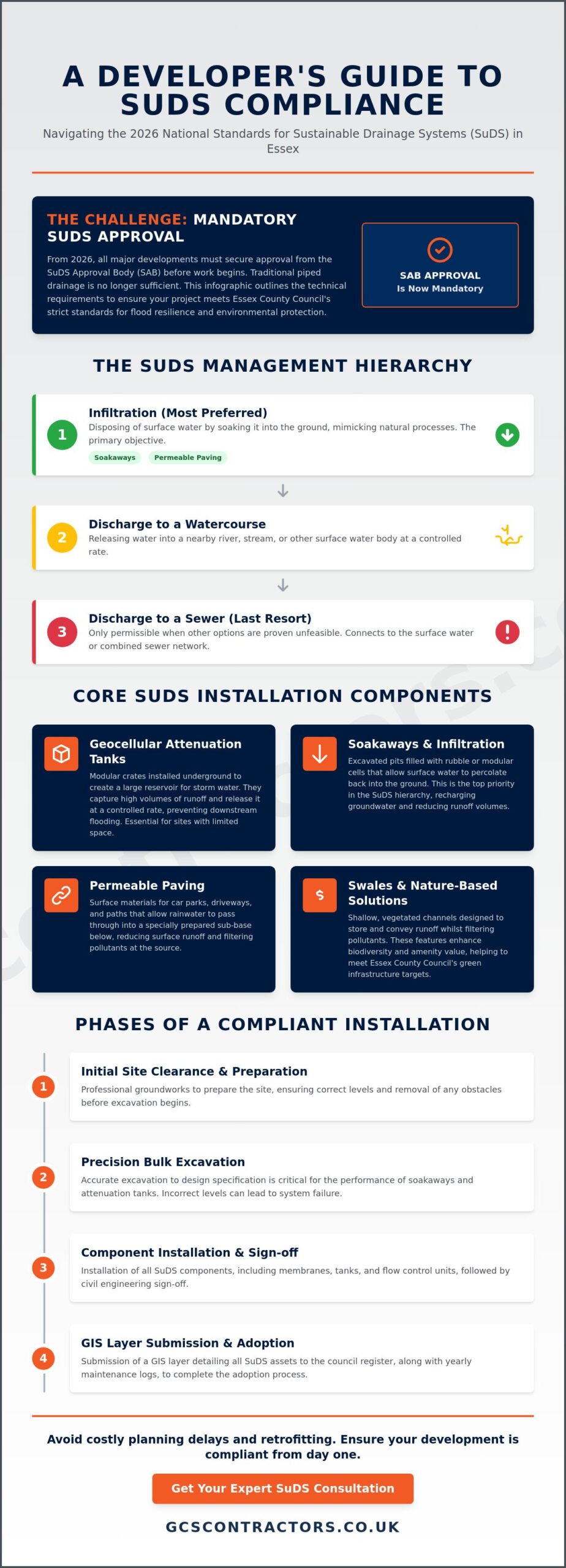
The core of this regulatory framework is the “SuDS Hierarchy.” This sequence prioritises infiltration methods, such as soakaways and permeable surfaces, before considering discharge to watercourses or sewers. The Essex Design Guide 2020 remains the gold standard for local compliance in 2026, providing the technical benchmarks required for every site-specific drainage strategy. To see how these systems are physically constructed on-site, watch this technical overview:
Why Traditional Drainage is No Longer Enough
Rapid urbanisation across the Essex landscape has replaced natural soil with impermeable surfaces like concrete and asphalt. This shift prevents rainwater from soaking into the ground, leading to flash flooding and pollution of local watercourses. SuDS installations mitigate this by mimicking natural water cycles, using attenuation and slow-release mechanisms to control flow rates. Under current planning law, integrating these systems isn’t just best practice; it’s a legal requirement for all major developments to ensure long-term flood resilience.
The Essex Design Guide and LLFA Standards
Essex County Council maintains strict expectations regarding biodiversity and water quality. A successful drainage scheme must do more than just hold water; it should improve the environment through green infrastructure like swales or rain gardens. Early-stage site preparation and bulk excavation are vital for successful SuDS adoption. Developers must also submit a GIS layer of all SuDS assets to the council’s register at suds@essex.gov.uk. This ensures that the infrastructure is documented and maintained, preventing the high costs of system failure or planning delays.
Technical Components of SuDS Drainage Installation
A successful SUDS drainage installation Essex relies on the precise integration of several technical components. Whilst these systems often look straightforward on a plan, their real-world efficacy is dictated by precision excavation and accurate level management. In high-density urban centres like Chelmsford or Southend, where space is at a premium, geocellular crates are essential. These modular units provide high-void storage volumes beneath car parks or roads, ensuring that the development meets the National SuDS standards without sacrificing valuable surface area. Beyond underground storage, surface-level features like permeable paving and swales are used to filter pollutants and slow water velocity naturally.
Attenuation Tanks and Flow Control
Geocellular attenuation tanks act as a temporary reservoir during peak Essex storms. They capture high volumes of runoff and release it at a controlled rate. This process is managed by vortex flow control units, which limit the discharge velocity into the main sewer or local watercourse. Getting these levels wrong can lead to site-wide flooding or regulatory fines. Ensuring you have professional drainage systems residential developers can rely on is critical for the long-term health of any new-build project.
Soakaways and Infiltration Systems
Soakaways are the preferred method of water disposal under the SuDS hierarchy. The installation process begins with deep excavation, followed by lining the pit with geotextile membrane and backfilling with specialist clean stone or crates. Because much of Essex sits on heavy clay, percolation tests are a non-negotiable step to determine if the soil can actually handle infiltration. During this phase, bulk excavation must be handled with care to avoid soil compaction, which would otherwise ruin the system’s permeability. If you’re starting a new project, consulting a specialist in drainage installation and repairs ensures your technical strategy is sound from day one.
Navigating the Installation Process with GCS Contractors Ltd
Efficient site delivery depends on an integrated approach. We don’t treat drainage as an isolated task; it’s a core component of the site lifecycle. A high-quality SUDS drainage installation Essex project should be executed whilst the heavy plant is already mobilised for site clearance. This “no-nonsense” strategy keeps projects on schedule and avoids the high costs of retrofitting systems later. By adhering to the UK National SuDS Standards, GCS Contractors Ltd provides the technical assurance required for final civil engineering sign-off.
Integrating SuDS during the groundworks phase is a strategic choice that saves money. It streamlines the excavation process and ensures that all sub-structure elements work in harmony from the start. This prevents redundant digging and ensures that attenuation features are correctly positioned before foundations are laid.
From Site Preparation to Infrastructure Sign-off
- Step 1: Initial site clearance and bulk excavation following the approved drainage plan. We prepare the ground to create the precise voids needed for attenuation tanks and swales.
- Step 2: Precision installation of sub-surface components. This includes the placement of geocellular crates and utility trenching to manage water flow across the site.
- Step 3: Final hard landscaping. We finish the project with permeable paving and kerbing works to ensure runoff is directed into the SuDS features as intended.
Why Specialist Groundworks Contractors are Essential
Non-specialists often overlook the nuances of soil compaction and hydraulic pressure. This neglect can lead to tank collapse or total drainage failure. GCS Contractors Ltd offers specialised expertise in reinforced concrete works to support heavy-duty drainage infrastructure. Our team acts as a reliable partner for complex Essex developments, ensuring every component is compliant and durable. To ensure your Essex development meets LLFA standards, contact GCS Contractors Ltd for a technical consultation.
Secure Your Development’s Future with Compliant Infrastructure
Mastering the technicalities of a SUDS drainage installation Essex project is essential for navigating the mandatory 2026 National Standards. By prioritising infiltration through soakaways and managing runoff with geocellular attenuation tanks, you ensure your site remains both flood-resilient and planning-compliant. It’s clear that the most cost-effective strategies are those integrated directly into the early groundworks phase. This approach prevents the high stakes of non-compliance or structural failure that often arise from poorly designed systems.
Since 2017, GCS Contractors Ltd has specialised in bulk excavation and drainage systems that meet the rigorous demands of Essex County Council and the LLFA. Our expertise spans both residential and commercial infrastructure, ensuring that every project we touch is built on a foundation of reliability and safety. We understand the physical and technical challenges of modern engineering and focus on getting the job done correctly the first time. Our disciplined approach keeps your project on schedule and your site fully compliant with local flood authority expectations.
Request a SuDS Installation Quote from GCS Contractors Ltd today to secure a specialist partner who speaks the language of developers and engineers. We’re ready to ensure your next Essex project is an operational success.
Frequently Asked Questions
Is SuDS mandatory for all new developments in Essex?
SuDS is mandatory for most new developments in Essex under the 2026 National SuDS Standards. This regulation requires pre-construction approval from the SuDS Approval Body (SAB) for any project that impacts local water runoff. Developers must integrate these systems to comply with the Lead Local Flood Authority (LLFA) requirements, ensuring that surface water is managed on-site through nature-based or engineered solutions.
How much does SuDS drainage installation cost per square metre?
Costs for a SUDS drainage installation Essex project depend on site-specific factors like soil permeability and the complexity of the design. A standard rubble-based soakaway is generally more affordable than high-capacity geocellular attenuation tanks or permeable paving systems. You should also account for professional design fees and the mandatory SuDS report, which are essential for securing planning approval from Essex County Council.
Can I install a soakaway in Essex clay soil?
Installing a soakaway in heavy Essex clay is often challenging because clay has low permeability. A mandatory percolation test must be conducted to determine the soil’s infiltration rate. If the soil fails this test, alternative SuDS components like attenuation tanks or swales are used to store and release water at a controlled rate rather than relying on ground infiltration.
What happens if my SuDS system fails an LLFA inspection?
Failure to pass an LLFA inspection can result in significant project delays and enforcement notices from the Local Planning Authority. Non-compliant systems often require expensive retrofitting or complete re-installation to meet the Essex Design Guide standards. Ensuring your SUDS drainage installation Essex is documented with yearly maintenance logs and accurate GIS layer submissions is vital for maintaining compliance and avoiding legal penalties.
How often do attenuation tanks need maintenance?
Attenuation tanks typically require a formal inspection at least once a year to ensure they remain free of silt and debris. Silt traps and filters should be checked more frequently, especially after heavy storm events, to prevent blockages. Keeping detailed maintenance logs is a requirement in Essex, as these records must be available for inspection by the Local Planning Authority to prove the system’s continued effectiveness.
Do I need a specialist contractor for SuDS installation in Essex?
Engaging a specialist contractor is highly recommended due to the technical precision required for levels and soil management. Non-specialists risk system failure, such as tank collapse or poor infiltration, which leads to long-term liability. A qualified groundworks partner ensures the installation meets all safety certifications and LLFA standards, providing a planning-approved drainage strategy that protects your development’s infrastructure.
Need drainage work in Cambridge? GCS Contractors Ltd installs soakaways, attenuation tanks and foul & surface water drainage to Building Regulations Part H. See our drainage services in Cambridge or call 07500 570 926 for a free quote.