Deep Excavation Safety & Planning: A Professional Checklist for UK Construction
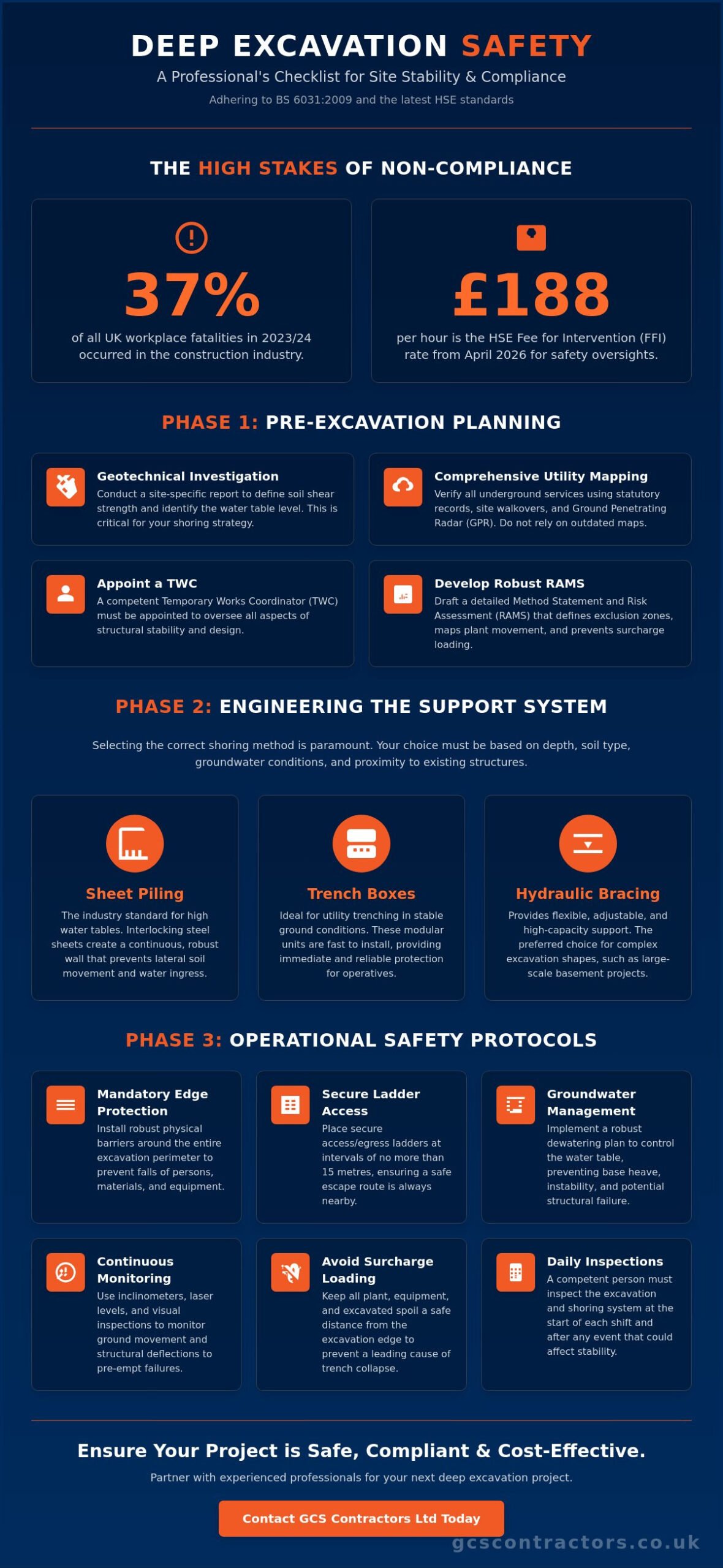
Did you know that the construction industry accounted for 37% of all UK workplace fatalities in 2023/24? With the HSE now charging a Fee for Intervention (FFI) rate of £188 per hour as of April 2026, the financial and human cost of a safety oversight during a deep excavation is higher than ever. It’s a high-stakes environment where geotechnical precision must meet disciplined, no-nonsense site management to prevent life-changing injuries and costly legal repercussions.
You likely recognise that these works are amongst the most hazardous phases of any civil engineering project. Whether you’re dealing with the unpredictable groundwater of East of England soils or installing complex drainage systems, the risk of structural failure is a constant pressure. This guide provides a professional checklist to help you maintain strict compliance with BS 6031:2009 and the latest Building Safety Regulator standards. We’ll examine essential shoring options, temporary works designs, and stability protocols to ensure your project remains safe, stable, and cost-effective from the first dig to the final inspection.
Key Takeaways
- Establish essential pre-excavation requirements, including geotechnical investigations and comprehensive utility mapping to identify underground hazards.
- Understand how to select shoring and structural support systems that ensure your deep excavation remains stable and compliant with UK standards.
- Implement rigorous on-site safety protocols, from mandatory edge protection to the strategic placement of ladder access points.
- Manage groundwater risks effectively with robust dewatering plans designed to prevent base heave and structural failure.
Pre-Excavation Checklist: Planning and Geotechnical Requirements
Success in any deep excavation starts long before the first bucket hits the ground. It requires a disciplined approach to site preparation and a technical understanding of the subsurface environment. Rushing this stage often leads to project delays or catastrophic structural failure. You must verify all underground services using a combination of statutory records, site walkovers, and Ground Penetrating Radar (GPR) surveys. Relying on outdated maps is a risk no professional contractor should take.
Beyond utilities, you need a site-specific geotechnical investigation. This report defines soil shear strength and identifies the water table level, which are the primary factors in determining your shoring strategy. Understanding Trench excavation and safety principles is vital here; without accurate soil data, your temporary works design is based on guesswork rather than engineering fact. You should also appoint a Temporary Works Coordinator (TWC) at this stage to oversee structural stability and ensure all permits, such as S278 highway works permissions, are fully secured.
To better understand the risks associated with improper planning, watch this helpful video:
Soil Analysis in Cambridge and the East of England
The local geology in Cambridge presents unique challenges. You’ll often encounter Gault Clay or Chalk, both of which have distinct behaviours under load. Gault Clay is notorious for its high plasticity and tendency to shrink or swell, whilst Chalk can hide unexpected voids or suffer from instability when saturated. These factors directly influence your Bulk Excavation strategy. In areas with ‘running sand’ or high water tables, standard techniques won’t suffice. You’ll need specialised dewatering or more robust shoring to prevent wall collapse.
Statutory Compliance and Risk Assessment
Compliance isn’t just about ticking boxes. It’s about protecting lives and your firm’s reputation. Draft a robust Method Statement and Risk Assessment (RAMS) that addresses the specific hazards of deep works. This document must define strict exclusion zones for plant and materials. Placing heavy machinery too close to the edge creates surcharge loading, which is a leading cause of trench failure. Your plan should clearly map out plant movement to keep the excavation perimeter clear and stable at all times.
Engineering the Support System: Shoring and Structural Integrity
Once the geotechnical data is clear, you must design a support system that effectively counters lateral earth pressure. A deep excavation isn’t a static environment; it is a dynamic structure that reacts to weather, vibration, and time. Choosing the right support method depends on the depth, soil type, and proximity to existing buildings. You must follow HSE excavation safety guidelines to ensure the temporary works are fit for purpose and fully compliant with UK law.
Safety is a continuous process on site. Every piece of shoring equipment needs a thorough inspection for fatigue or damage before it enters the trench. Once work is underway, implement robust edge protection and secure ladder access points at intervals of no more than 15 metres. This ensures operatives have a clear, safe route out of the working area at all times. You should also monitor ground movement and structural deflections using inclinometers or laser levels to catch potential failures before they occur.
Selecting the Right Shoring Method
- Sheet Piling: These are the standard for high water tables. They create a continuous steel wall that prevents lateral soil movement and water ingress.
- Trench Boxes: Best for utility trenching in stable ground. They are fast to install and provide immediate protection for workers.
- Hydraulic Bracing: This provides flexible, high-capacity support for complex shapes, such as large basement projects.
Basement Excavation and Underpinning
Working near existing foundations requires specialised care and technical precision. You may need professional underpinning to transfer loads to deeper, more stable strata before you begin the main dig. It is often best to integrate concrete contractors early in the process. This allows for the rapid installation of reinforced concrete slabs or retaining walls to seal the excavation and lock in structural stability.
If you notice even minor shifts in the surrounding ground or adjacent structures, stop work immediately. If you’re looking for a reliable partner to manage these risks, our team provides expert groundworks support to keep your project on track and safe.
Operational Safety and Groundwater Management
Managing a deep excavation requires a transition from engineering theory to disciplined site management. Once the dig begins, the environment changes hourly. You must perform daily inspections before every shift. A competent person should examine the shoring, the base, and the surrounding ground for any signs of distress. Don’t let these checks become a paper-shuffling exercise; they’re your primary defence against collapse. You also need a dedicated emergency rescue plan. This must include specialised confined space equipment and a team trained to use it. Following the industry’s good practice for shoring helps you maintain these standards throughout the project’s duration.
Controlling Groundwater and Surface Runoff
Groundwater is one of the biggest threats to excavation stability. Without a robust dewatering plan, you risk base heave or a total loss of soil shear strength. Utilise sump pumps for minor ingress or wellpoint dewatering for more significant water tables. It’s essential that your discharge methods comply with Environment Agency standards. Silt management is particularly important; discharging muddy water into local watercourses can lead to immediate site shutdowns and heavy legal penalties. Keep the base dry to ensure your foundations or drainage systems are installed on stable ground. A dry deep excavation is a safe one.
Plant Safety and Exclusion Zones
Plant movement near the dig is a leading cause of failure. You must establish a clear ‘no-go’ zone for all heavy machinery. Position excavators and dumpers at a safe distance to prevent surcharge pressure from overloading the shoring. Even the best support system has limits. Ensure every operator on site is CPCS or NPORS qualified. They need to understand the specifics of your site preparation plan and the risks associated with surcharge loading. Site discipline is the only way to prevent avoidable accidents during high-risk groundworks.
Secure Your Site and Your Reputation
Successful deep excavation requires more than just heavy plant and a digger operator. It demands technical expertise, rigorous planning, and a commitment to safety that never wavers. By prioritising geotechnical analysis, selecting the correct shoring systems, and maintaining strict site discipline, you protect both your workforce and your project’s bottom line. We’ve established that soil conditions in Cambridge and the East of England can be unpredictable, making professional oversight essential from the initial site clearance to the final foundation pour.
As a CHAS Elite approved contractor with ISO 9001 certification for quality management, GCS Contractors Ltd brings a disciplined approach to every groundworks project. We understand the specific challenges of Gault Clay and high water tables that developers face across Cambridgeshire. Our team ensures your project remains fully compliant with the latest HSE standards whilst delivering stable, cost-effective results. We provide the safe pair of hands you need for complex civil engineering works.
Ready to start your deep excavation project? Contact our Cambridge groundworks specialists today. We look forward to helping you build on solid ground.
Frequently Asked Questions
At what depth is an excavation considered ‘deep’ in the UK?
An excavation is technically considered ‘deep’ when it exceeds 4.5 to 6 metres, though safety protocols begin much earlier. In the UK, any trench deeper than 1.2 metres must be supported or battered back if a risk of collapse exists. Projects reaching these greater depths require a formal temporary works design. This ensures the structural support can withstand the significant lateral earth pressures found in a deep excavation environment.
What are the primary causes of deep excavation failure?
The primary causes of failure are surcharge loading and unmanaged groundwater ingress. Surcharge occurs when heavy plant or materials are positioned too close to the excavation edge, exerting downward pressure the shoring wasn’t designed to hold. In regions like the East of England, ignoring the impact of hydrostatic pressure or failing to identify ‘running sand’ during the geotechnical phase often leads to sudden structural instability and trench collapse.
Who is responsible for inspecting a deep excavation on-site?
A competent person appointed by the contractor is responsible for conducting all on-site inspections. These checks must happen at the start of every shift, after any incident that might affect stability, or following adverse weather. You are legally required to document these inspections in a site report. This process confirms that the support systems remain fit for purpose and the working environment is safe for your operatives.
How do I choose between sheet piling and trench boxes?
Base your choice on ground conditions and project duration. Sheet piling is the superior option for high water tables and sites where you must prevent ground movement near existing buildings. It creates a continuous, watertight barrier for complex groundworks. Trench boxes are better suited for rapid utility installations in stable soil. They offer excellent operative protection and speed of movement but do not provide the same level of structural or groundwater control.