15 Critical Questions to Ask a Groundworks Contractor Before Your 2026 Project
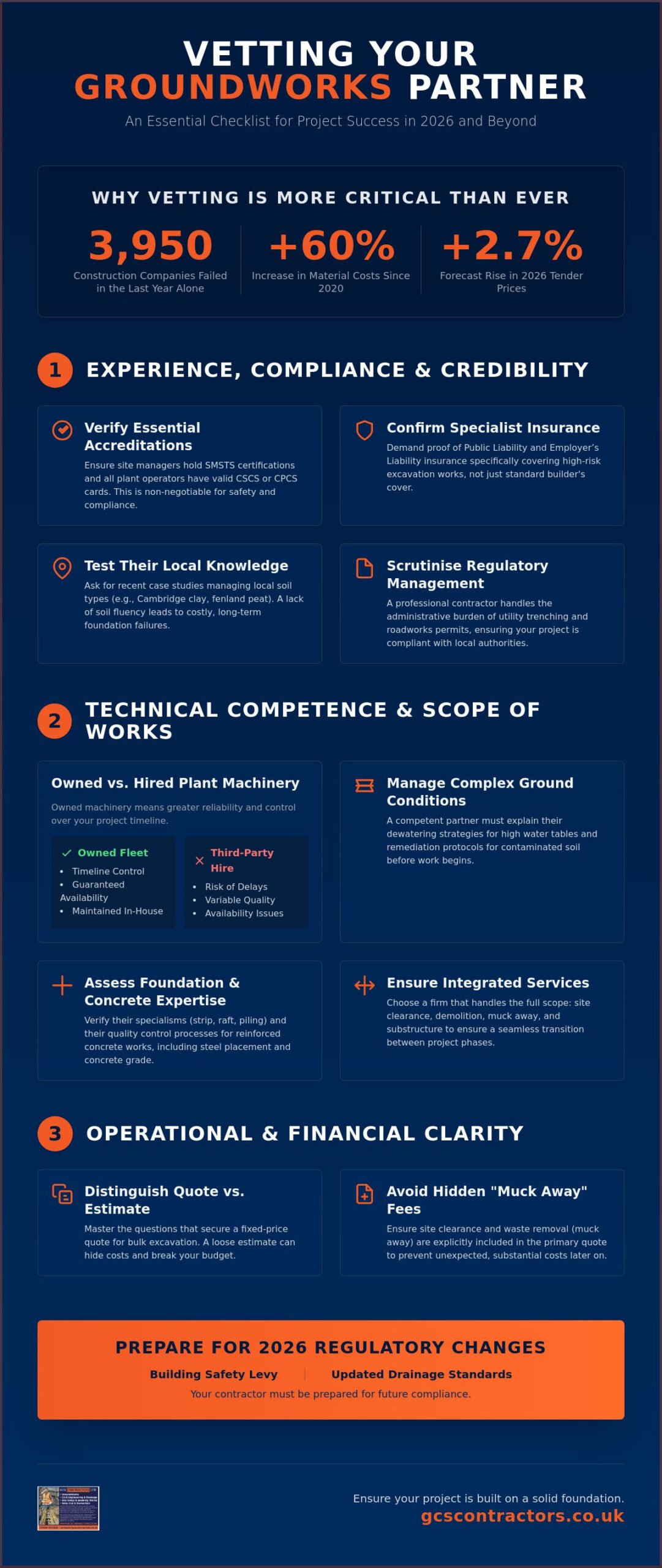
Groundworks is the most risk-heavy phase of any construction project, yet many developers spend more time choosing finishes than vetting the team digging their foundations. Failing to vet your partner properly leads to sinking slabs, drainage failures, and budget-breaking delays. Before you sign a contract, knowing the specific questions to ask a groundworks contractor is your only defence against the high insolvency rates currently hitting the sector, where 3,950 companies failed in the last year alone.
It’s understandable to feel uneasy about the 2026 market. With tender prices forecast to rise by 2.7% and material costs sitting 60% higher than 2020 levels, you need a partner who values precision over guesswork. This article provides a comprehensive checklist to help you vet technical expertise, ensure safety compliance, and avoid the costly foundation errors that ruin builds. We will preview the critical 2026 regulatory changes, including the Building Safety Levy and updated drainage standards, so your site remains compliant and your timeline stays on track.
Key Takeaways
- Verify essential UK industry accreditations like CSCS and CPCS to ensure your contractor meets high safety and technical standards.
- Understand why owned plant machinery is often more reliable than third-party hire for maintaining your 2026 project timeline.
- Master the specific questions to ask a groundworks contractor to distinguish between a loose estimate and a fixed-price quote for bulk excavation.
- Learn how to vet a specialist’s ability to manage complex ground conditions, such as high water tables or contaminated soil, before work begins.
- Ensure site clearance and muck away are integrated into your primary quote to avoid hidden waste removal fees.
Qualifying the Specialist: Experience, Compliance, and Local Credibility
Hiring the wrong firm for your substructure leads to structural failure and severe legal liability. One of the most vital questions to ask a groundworks contractor is whether they carry specific Public Liability and Employer’s Liability insurance for high-risk excavations. Standard builder’s insurance often falls short of the technical requirements needed for complex Earthworks (engineering). You must also demand proof of industry-standard accreditations. Ensure site managers hold SMSTS certifications and that every operator on-site carries a valid CSCS or CPCS card for the plant they handle.
To better understand the vetting process, watch this guide on hiring reliable contractors:
Soil fluency is non-negotiable. If you’re building in the East of England, your contractor must understand the unique behaviour of Cambridge clay or fenland peat. Ask for recent case studies of groundworks in Cambridge to verify they have managed similar geological challenges. A firm that doesn’t understand heave or settlement in local soils will likely cause foundation errors that appear years after the project completes.
Safety Protocols and Regulatory Compliance
Safety management isn’t just about high-vis vests; it’s about rigorous risk management during deep excavations. Ask how they secure trenches and if they manage the temporary works designs required for safety. Operators must be fully certified for specific plant machinery to prevent on-site accidents. They should also handle the administrative burden of utility trenching and roadworks permits, ensuring your project complies with local authority regulations from the first dig.
Local Knowledge and Enabling Works
The gap between clearing a site and starting foundations is where many projects stall. A specialist should manage the transition from professional demolition services to the groundworks phase seamlessly. This requires a deep understanding of local soakaway regulations and drainage requirements specific to your council area. Choosing a firm that handles both site clearance and substructure ensures no technical detail is lost during the handover between trades.
Technical Competence: Digging into the Scope of Works
Technical competence goes beyond simply moving soil. When preparing your list of questions to ask a groundworks contractor, start with plant machinery. Does the firm own its fleet or rely on third-party hire? Contractors who own their machinery, such as 360 excavators and dumpers, maintain better control over project timelines and avoid the delays associated with hire availability. This reliability is essential for complex bulk excavation and site preparation on large-scale sites where equipment failure can stall an entire build.
You also need to verify how they handle technical surprises. High water tables or contaminated soil can halt a project instantly. A competent contractor should explain their dewatering strategies and soil remediation protocols clearly. You can verify a contractor by checking their track record with these specific geological challenges. If you’re planning a complex build, ensure they offer end-to-end infrastructure, including utility trenching and complete drainage systems, rather than just basic digging.
Foundations and Structural Concrete
Concrete isn’t just about pouring liquid; it’s about engineering. Ask which foundation types they specialise in, whether it’s standard strip footings, raft foundations, or piling. Quality control is paramount for reinforced concrete works and slabs. The contractor must manage the placement of steel reinforcement and ensure the correct concrete grade is used for the specific load requirements. If structural issues are found amongst existing footings, they should have the capability to provide underpinning services to stabilise the site before the main build continues.
Drainage and Infrastructure Management
Infrastructure must be perfectly aligned with the main build to avoid future failures. Ask how they coordinate the installation of call to action/link to prevent clashing with other utilities. They should use rigorous pressure testing or CCTV surveys to check systems before they are buried under concrete slabs or hard landscaping. If you need a partner who understands these technical nuances, you can view our full range of groundworks services to see how we manage site-specific risks.
Operational Logistics and Financial Clarity
Financial transparency is the difference between a successful build and a legal dispute. When compiling your list of questions to ask a groundworks contractor, start with the quote structure. You must know if the figure provided is a fixed price or a loose estimate. Groundworks projects often encounter “unforeseens” like hidden utilities or shifting soil. A professional firm will define exactly what is excluded from the primary quote to prevent budget creep.
Waste management is another area where costs spiral. Ask specifically how they manage “muck away” and site clearance. Is the removal of bulk excavation materials included in the primary quote, or is it an extra cost? You also need to understand your legal duties as a domestic client under CDM 2015 regulations. Most residential developers transfer these health and safety responsibilities to the contractor, but you must confirm they accept this role in writing.
Logistics matter as much as the digging. Identify the dedicated site manager who will be your point of contact whilst work is underway. Ask about lead times and their strategy for mitigating weather-related delays. A disciplined contractor doesn’t just hope for sun; they plan for rain with proper site drainage and temporary access roads to keep the project moving.
Project Management and Communication
Reliable communication prevents site friction. Ask how often you’ll receive progress updates and if they provide digital reports or site walk-rounds. They must also explain how they organise site access for large plant machinery. Minimising disruption to neighbours and local traffic is a hallmark of a professional outfit. If the project brief changes, ensure they have a formal process for handling variations to avoid verbal agreements that lead to billing disputes.
Handoff and Completion
The job isn’t finished when the holes are dug. You need to know the exact state the site will be left in for the next trades, such as bricklayers or civil engineers. A clean handoff ensures the follow-on teams can start without delay. Finally, confirm they provide all necessary completion certificates. These documents are vital for building control inspections and ensuring your 2026 project meets every regulatory standard from the ground up.
Securing Your Site for a Successful 2026 Build
Choosing a contractor for your substructure is the most consequential decision of your build. By focusing on technical soil fluency and plant reliability, you protect your project from the costly delays and structural failures that plague poorly planned sites. A professional quote must include clear provisions for site clearance and muck away to avoid hidden fees during the excavation phase. Refining your final list of questions to ask a groundworks contractor ensures you hire a disciplined partner who understands the specific geological challenges of the East of England.
At GCS Contractors, we provide the technical expertise and operational precision required for complex infrastructure. We are specialists in reinforced concrete works and deep excavation, utilising fully certified CPCS and CSCS operators to maintain the highest safety standards on every site. With a proven track record across Cambridge and the wider East England region, we deliver stable foundations built on transparency and professional momentum. Get a professional, no-nonsense quote for your groundworks from GCS Contractors and ensure your project starts on solid ground.
Your project deserves a foundation that lasts. By vetting your partner with rigour today, you secure the structural integrity of your build for decades to come.
Frequently Asked Questions
What is the difference between an estimate and a fixed-price quote in groundworks?
An estimate is a preliminary ballpark figure subject to change; a fixed-price quote is a binding agreement for a defined scope of work. In the groundworks sector, estimates often fluctuate as soil conditions reveal themselves during the dig. A fixed-price quote provides significantly more financial security, provided the contract clearly defines what constitutes an “unforeseen” ground condition.
How do I check if a groundworks contractor is properly insured for deep excavation?
Request a copy of their insurance schedule and check specifically for depth limit exclusions. Many standard builder’s policies exclude excavations deeper than two metres. If your project requires deep foundations, piling, or basement works, the contractor’s Public Liability and Employer’s Liability insurance must explicitly cover these high-risk activities to ensure you aren’t left legally exposed.
What happens if my contractor finds unexpected soil issues or buried obstructions?
A professional contractor will pause work, document the discovery, and issue a formal variation order for your approval. This process prevents disputes by providing a clear cost and timeline adjustment before any further digging occurs. This is one of the most vital questions to ask a groundworks contractor during the tender stage to gauge their transparency and site management protocols.
Why is it important for a groundworks firm to have their own plant machinery?
Owning plant machinery ensures the contractor has total control over equipment availability and maintenance standards. Firms that rely on third-party hire are vulnerable to external delivery delays and mechanical failures that can stall your project. By using their own 360 excavators and dumpers, a contractor can maintain a steady operational rhythm and keep your 2026 build programme on schedule.
Can a groundworks contractor help with the initial site clearance and demolition?
Yes, many specialists offer site clearance and demolition as part of an integrated enabling works package. Combining these services ensures a seamless transition from clearing the land to digging the footings. It simplifies site logistics and ensures that muck away and waste removal are managed by a single team, reducing the risk of technical errors during the handover between different trades.