Soft strip demolition: what it is and how it works
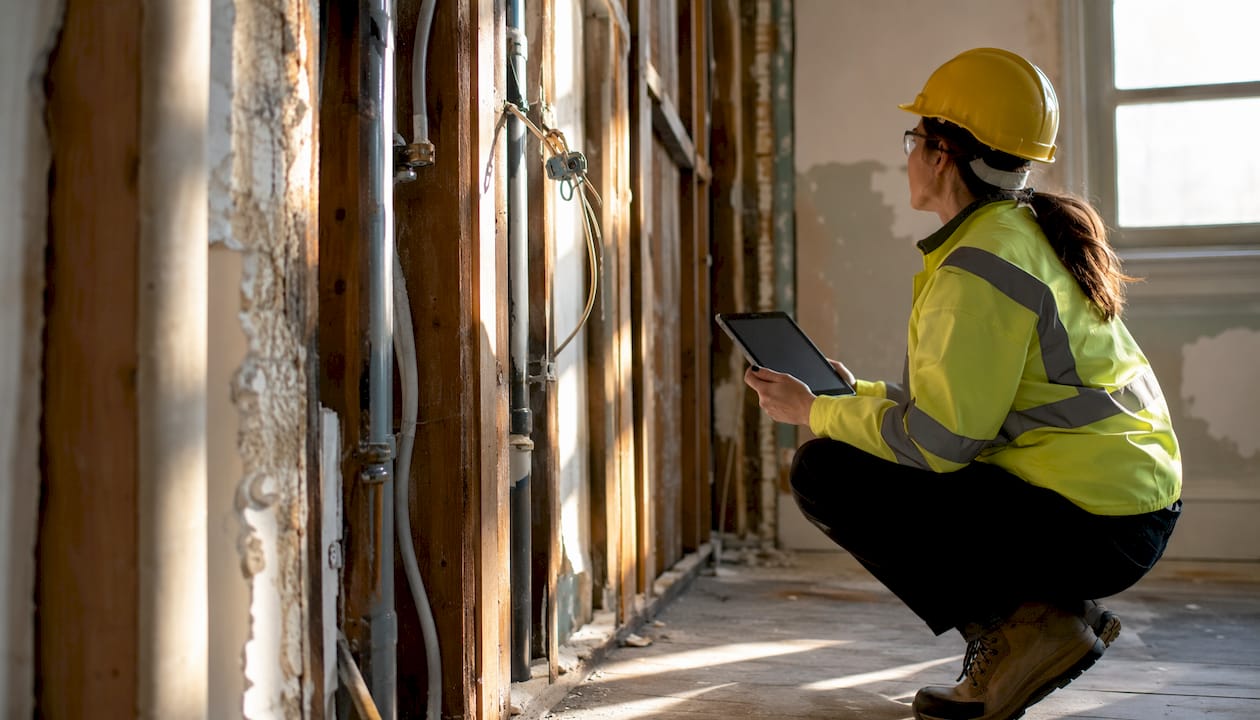
Soft strip demolition is the systematic removal of non-structural elements from a building’s interior while leaving the structural frame completely intact. The result is a clean shell, ready for refurbishment, fit-out, or full structural demolition. Under BS 6187:2011, the UK code of practice for demolition, soft stripping is explicitly classified as demolition work, not minor clearance. That classification matters because it triggers a full set of legal obligations before a single ceiling tile comes down.
Typical elements removed during a soft strip include:
- Internal partitions (non-load-bearing walls)
- Suspended ceilings and ceiling tiles
- Floor finishes and raised access floors
- Mechanical and electrical (M&E) services: HVAC ductwork, wiring, plumbing, and data cabling
- Fixtures and fittings: sanitaryware, kitchen units, and joinery
- Doors, frames, and non-structural staircases
How does soft strip demolition differ from hard demolition?
The core distinction is scope. Soft strip demolition targets only non-structural elements, preserving the building’s load-bearing frame throughout. Hard demolition goes further, removing structural components such as columns, beams, and external walls, often bringing the building down entirely.
| Aspect | Soft strip demolition | Hard (structural) demolition |
|---|---|---|
| Primary focus | Non-structural interior elements | Load-bearing structure and fabric |
| Structural frame | Preserved throughout | Removed or demolished |
| Typical stage | Early project phase | Later phase, after preparation |
| Main applications | Refurbishment, fit-out, change of use | Full site clearance |
| Key advantages | Controlled, lower risk, material recovery | Complete clearance, site reset |
| Key disadvantages | Labour-intensive, detailed planning required | Higher risk, greater waste volume |
Soft strip is the preferred starting point when a building’s shell has value, whether for reuse, sale, or phased redevelopment. Hard demolition follows only when the structure itself is no longer required. Choosing the wrong method at the outset creates both programme delays and unnecessary cost.
Where is soft strip demolition used in practice?
Soft strip demolition prepares buildings for refurbishment, fit-out, or the next phase of a demolition programme. It is the standard first step across commercial offices, retail units, industrial facilities, and residential conversions.
Common applications include:
- Clearing outdated office layouts before a full commercial refurbishment
- Removing redundant M&E systems in buildings undergoing change of use
- Preparing a shell for a new tenant fit-out without touching the structural frame
- Stripping a residential property ahead of a full internal reconfiguration
- Creating safe access for investigative works, such as structural surveys or asbestos sampling
One practical benefit that is often underestimated: soft strip exposes hidden defects such as concealed service routes, previous unauthorised alterations, and water damage that are invisible during a pre-purchase survey. Discovering these issues at strip-out stage, rather than mid-refurbishment, gives the project team time to respond without derailing the programme.
Pro Tip: Sequence the strip-out by zone rather than by trade. Working zone by zone reduces double handling, keeps access clear, and gives supervisors better control over site safety at each stage.
What are the advantages and disadvantages of soft strip demolition?
Soft strip demolition offers clear advantages, but it also carries operational demands that clients should plan for from the outset.
Advantages:
- Preserves the structural frame, reducing the risk of unplanned structural damage
- Allows controlled waste segregation and material recovery, supporting recycling targets
- Exposes building defects early, improving project sequencing and cost control
- Creates a safer working environment before heavier demolition or construction begins
- Supports phased programmes where parts of a building remain in use
Disadvantages:
- Labour-intensive by nature, particularly in buildings with complex M&E installations
- Requires detailed planning, risk assessments, and legal compliance before work starts
- May carry higher initial costs than a straightforward clearance approach
- Longer duration on site compared with mechanical demolition of the same area
The environmental case for soft strip is strong. Separating materials at source, timber, metal, plasterboard, and plastics, means a far greater proportion reaches recycling streams rather than landfill. That matters both for environmental compliance and for reducing skip costs on larger projects.
Legal and safety requirements for soft strip demolition in the UK
Treating soft strip as minor clearance is a legal and practical mistake. BS 6187:2011 places soft stripping within the scope of demolition activities, and CDM 2015 Regulation 20 requires written demolition arrangements before work begins. A construction phase plan and an engineering survey are both mandatory, regardless of whether any load-bearing structure is being touched. For CDM 2015 compliance, these documents must be in place before the first operative sets foot on site.
A fully intrusive Refurbishment and Demolition (R&D) asbestos survey is also a legal requirement prior to any soft strip work. This is a more thorough survey than a standard management survey and must be carried out by a competent surveyor.
The HSE identifies soft strip demolition as a high-dust activity. Controls must follow the hierarchy: water suppression or on-tool extraction first, then respiratory protective equipment (RPE) with an Assigned Protection Factor of 20, such as an FFP3 disposable mask or a half mask with a P3 filter. For work lasting over an hour without a break, powered RPE such as a TH2 hood or helmet is recommended. Natural ventilation and, where necessary, mechanical ventilation must also be provided.
Regulatory note: Risk assessment in construction is not a box-ticking exercise. On soft strip projects, updated risk assessments and method statements must be reviewed before execution begins, not filed away after the pre-start meeting.
Common hazards specific to soft strip include silica dust from concrete and masonry, wood dust, and legacy materials such as asbestos-containing floor tiles or pipe lagging. Waste must be segregated on site. Plasterboard, for example, requires separate handling because gypsum waste produces toxic hydrogen sulphide gas when disposed of in landfill alongside biodegradable material.
What does the soft strip demolition process involve?
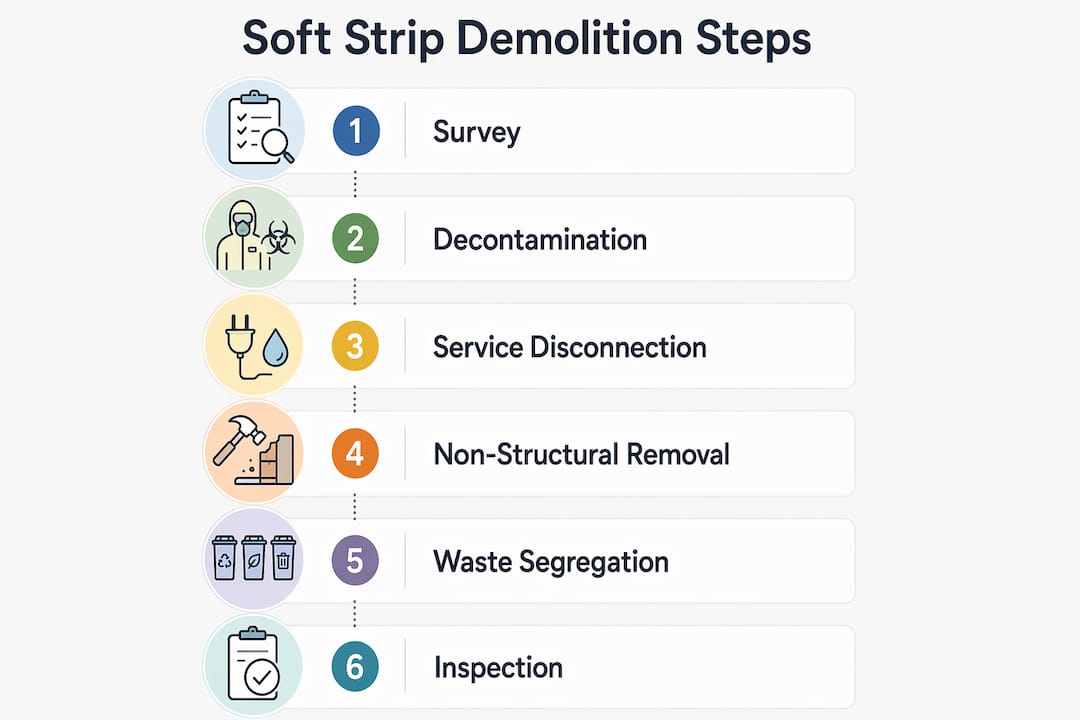
A well-run soft strip follows a clear sequence. Skipping steps, particularly at the survey and planning stage, creates hazards and legal exposure.
-
Pre-start surveys and planning. A structural engineer reviews the building to confirm which elements are non-structural. The R&D asbestos survey is completed. Risk assessments, method statements, and the construction phase plan are finalised. A pre-demolition survey at this stage prevents costly surprises later.
-
Site setup and isolation. Services are isolated and made safe: electricity, gas, water, and data. Welfare facilities, waste skips, and access routes are established.
-
Selective dismantling. Internal partitions, suspended ceilings, floor finishes, doors and frames, M&E services, and fixtures are removed in a planned sequence, zone by zone. Light hand tools are standard; heavier equipment is used only where the structural survey confirms it is safe.
-
Concrete cutting where required. Some projects require slab sawing, wall sawing, or core drilling to remove concrete floors or create new openings. These techniques are applied only where the engineering survey has confirmed it is structurally safe to do so.
-
Waste segregation and removal. Materials are sorted on site into separate streams: timber, metal, plasterboard, plastics, and hazardous waste. Each stream is removed and disposed of in accordance with current waste regulations.
-
Final clean and inspection. The stripped shell is cleaned, inspected, and formally handed over to the project team for the next phase.
How does soft strip demolition affect the environment and waste management?
Soft strip demolition, done properly, produces far less landfill waste than unplanned clearance. Because materials are removed selectively and by hand or light tools, they arrive at the skip in a condition suitable for sorting and recycling. Metal pipework, copper wiring, steel partitioning, and timber joinery all have recoverable value.
Waste segregation is not optional. Plasterboard must be kept separate from general waste to prevent the production of hydrogen sulphide in landfill, a requirement under the Environmental Permitting (England and Wales) Regulations. Hazardous materials, including any asbestos-containing items identified during the R&D survey, must be removed by licensed contractors and disposed of at a licensed facility.
Sequencing work by zone, rather than stripping the entire building floor by floor, also reduces vehicle movements and the number of skips on site at any one time. That has a direct effect on both the project’s carbon footprint and its programme efficiency.
Key takeaways
Soft strip demolition is a legally classified demolition activity under BS 6187:2011, requiring engineering surveys, CDM 2015 compliance, and an R&D asbestos survey before any work begins.
| Point | Details |
|---|---|
| Legal classification | BS 6187:2011 classifies soft strip as demolition, triggering CDM 2015 obligations. |
| Mandatory asbestos survey | A fully intrusive R&D survey is required before work starts, not after. |
| Dust control hierarchy | HSE requires water suppression or on-tool extraction, plus FFP3 RPE as a minimum. |
| Waste segregation | Plasterboard must be kept separate from general waste to prevent toxic gas in landfill. |
| Structural preservation | The structural frame remains intact throughout, reducing project risk and enabling phased works. |
Work with a team that treats soft strip as demolition
Gcscontractors delivers strip-out and demolition services across commercial, residential, and industrial projects, with full compliance under CDM 2015 and BS 6187:2011. Every project begins with the correct surveys, documented demolition arrangements, and a clear sequencing plan.

If you are planning a refurbishment, fit-out, or phased demolition and need a contractor who understands the legal and practical demands of soft strip work, contact Gcscontractors. You can also explore our strip-out services in Cambridge for local project support.