
A single delay in the S278 agreement process can inflate your project overheads by over 15% before a single spade hits the ground. Most developers recognize that navigating local authority backlogs and opaque commuted sum calculations feels like aiming at a moving target. It’s a high-stakes phase where a single technical oversight can stall a multi-million pound development for 12 weeks or more. GCS Contractors understands that you need a reliable, disciplined partner to manage these complexities efficiently.
We’ve built this guide to serve as your definitive roadmap, providing the clarity you need to move from initial technical submission to final highway adoption with confidence. You’ll gain a clear understanding of the financial liabilities involved, including how to handle the 10% to 20% bond requirements that often tie up vital capital. We’ll walk you through every critical milestone, from the first design check to the final maintenance period, ensuring your infrastructure works meet strict building standards. This structured approach helps you bypass common technical hurdles and secures a successful handover to the Highway Authority.
Key Takeaways
- Gain a clear understanding of the Section 278 legal framework to accurately distinguish these requirements from S38 agreements.
- Streamline your S278 agreement process by mastering the technical submission phase and the critical Technical Audit (TA) requirements.
- Identify mandatory financial commitments, including bonds and commuted sums, to ensure full compliance and budget security throughout the project.
- Secure project momentum by appointing accredited contractors and effectively managing street works permits under the Traffic Management Act.
- Navigate the final path to highway adoption with expert guidance on the provisional certificate and the 12-month maintenance period.
Understanding the S278 Agreement Process and Legal Framework
Section 278 of the Highways Act 1980 serves as the primary legal mechanism for developers to modify the existing public road network. We manage this S278 agreement process to ensure that any proposed changes, such as new site entrances or signalised junctions, meet the rigorous safety standards set by the Local Highway Authority (LHA). This legal framework functions as a temporary licence to work on land that remains under public ownership. It protects the public interest by ensuring that private development doesn’t degrade the quality or safety of the UK’s 245,000 miles of paved roads.
The LHA acts as the primary stakeholder throughout the project lifecycle. They hold the authority to approve designs, inspect construction phases, and ultimately sign off on the finished assets. Developers don’t gain ownership of the land through this process; instead, they receive permission to execute specific, pre-approved engineering works. Our team delivers these projects with a focus on compliance, ensuring that every kerb alignment and drainage run aligns with the local authority’s specific technical requirements.
S278 vs S38: Defining the Scope of Works
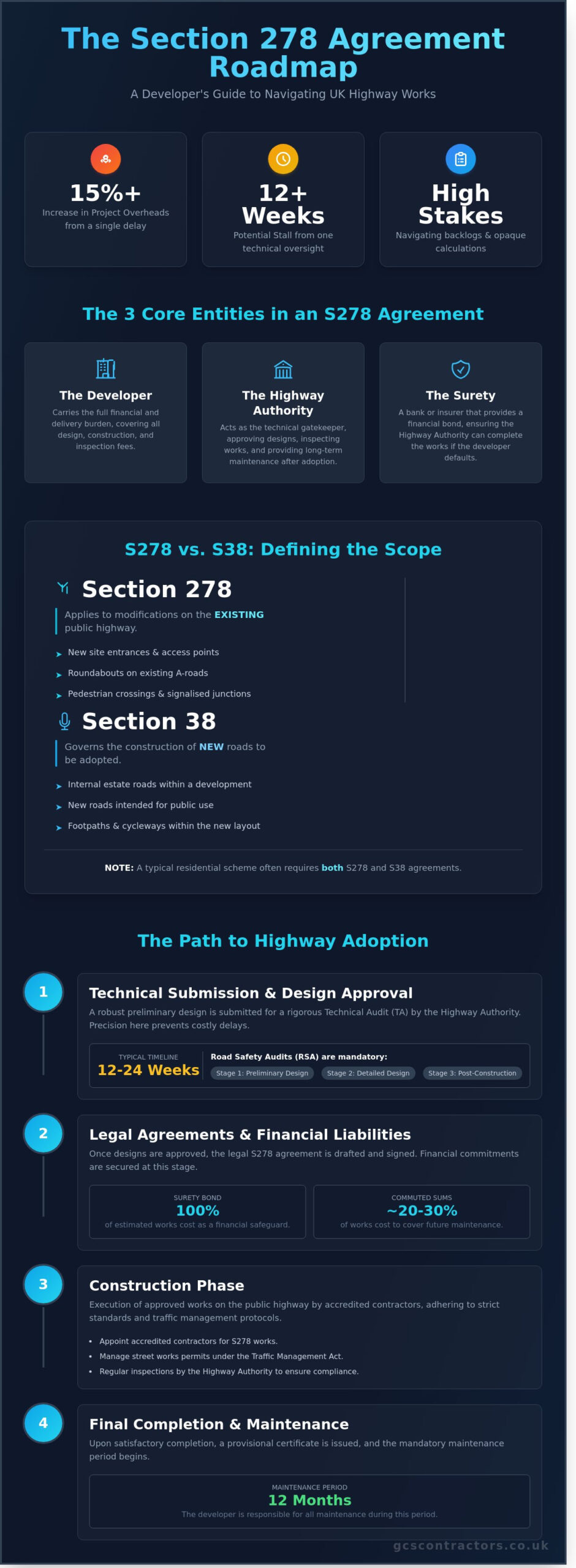
Distinguishing between these two sections is vital for project budgeting and scheduling. An S278 agreement applies exclusively to existing highways. If your project requires a new roundabout on an A-road or the installation of pedestrian crossings, you’re looking at an S278. Conversely, Section 38 governs the construction of entirely new roads within your site boundary that the LHA will eventually adopt. A typical 50-unit residential scheme often requires both agreements; an S278 for the main access point and an S38 for the internal estate roads. We provide the technical expertise to manage these overlapping requirements simultaneously.
The Legal Parties Involved in the Process
Three core entities drive the S278 agreement process to completion. The Developer carries the full financial and delivery burden, covering all design, construction, and inspection fees. The Highway Authority acts as the technical gatekeeper, providing the necessary approvals and providing long-term maintenance once the 12-month maintenance period expires. Finally, the Surety, usually a bank or insurance company, provides a financial bond often valued at 100% of the estimated works cost. This bond acts as a safeguard, ensuring the LHA can complete the works if the developer fails to meet their contractual obligations. Our role as a dedicated partner is to navigate these relationships, ensuring transparency and momentum from the initial technical submission to the final certificate of completion.
Phase One: Technical Submission and Design Approval
The initial step in the S278 agreement process involves the preparation of a robust preliminary design for formal consultation with the Local Highway Authority (LHA). This phase is critical because it sets the technical foundation for the entire project. We prioritize a thorough Technical Audit (TA) at this stage. The TA acts as a rigorous vetting process where council engineers examine the scheme’s viability, safety, and future maintenance implications. It isn’t just a box-ticking exercise; it’s a deep dive into the engineering integrity of your proposal. Highway authorities often require a 20% or 30% commuted sum for future maintenance, and the TA helps determine these final costs early.
Project timelines often hinge on this approval. A typical technical submission takes between 12 and 24 weeks to clear, depending on the complexity of the junction or road layout. We manage these schedules by ensuring every drawing complies with the Manual for Streets (2007) or specific local design guides provided by the county council. This precision prevents the iterative “back and forth” that frequently stalls development starts. Our team delivers designs that respect these standards while meeting your commercial objectives.
The Three Stages of Road Safety Audits (RSA)
Safety remains our primary focus throughout the design phase. The RSA process is split into three distinct checkpoints to mitigate risk. Stage 1 occurs during the preliminary design phase, focusing on the basic layout and junction visibility. Stage 2 involves a detailed design audit before any works begin on the public highway; this stage scrutinizes specific elements like signage and tactile paving. Finally, Stage 3 is the post-construction audit. Our team conducts this on-site once the scheme is “as-built” to verify that the finished product operates safely for all road users. We don’t consider a design complete until it passes these rigorous safety benchmarks.
Technical Drawing Requirements for Submission
A successful submission requires a comprehensive pack of technical data to satisfy the S278 agreement process. This includes standard details for SuDS-compliant drainage systems, street lighting lux levels, and specific surfacing materials that meet local skid-resistance requirements. We also coordinate traffic signal specifications and statutory undertaker diversion plans to account for existing gas, water, or electric mains. Precise coordination here prevents costly utility strikes during the construction phase.
Precision is non-negotiable. Our setting out engineers use GPS and total station technology to ensure design accuracy on the ground. This level of detail ensures that the transition from paper to pavement is seamless. If you require assistance with these complex technical requirements, our dedicated civil engineering team can guide your project through the approval phase with quiet confidence and proven expertise.
Navigating Legal Agreements, Bonds, and Financial Liabilities
The S278 agreement process carries significant financial weight that extends far beyond the physical construction of a junction or footway. Developers must account for inspection fees, legal costs, and commuted sums during the earliest planning phases. These figures often represent 10% to 15% of the total infrastructure budget, making precise estimation essential for project viability. We provide the technical oversight needed to ensure these costs don’t spiral due to administrative delays or design revisions.
Securing the Cash or Surety Bond
Highway Authorities require a financial guarantee to protect public funds if a developer fails to complete the agreed works. The bond value typically sits at 100% or 110% of the total estimated construction cost, including a contingency buffer. While a cash deposit is an option, it often ties up vital working capital that could be better deployed elsewhere on the site. A surety bond is a financial guarantee that the works will be completed to the authority’s satisfaction. Most developers prefer this route because it preserves liquidity while satisfying the council’s risk requirements. Our team delivers the detailed costings required by bondsmen to secure these guarantees quickly.
Legal Fees and Administrative Charges
Council technical reviews and site inspections aren’t free services; they’re funded by the developer through standard percentage-based fees. These charges usually range between 7% and 10% of the total project value. Managing the legal turnaround requires a disciplined approach to communication between your solicitors and the local authority. Delays in the legal sign-off can stall your entire project timeline and increase interest costs on land loans. Understanding the cost of S278 works helps you build a realistic contingency into your development appraisal.
Negotiating the commuted sum is a critical part of the S278 agreement process. If your design includes non-standard materials like bespoke granite sets or specialized street lighting, the council will demand a payment to cover 20 years of future maintenance. You can reduce these liabilities by following these steps:
- Standardize Materials: Use local authority-approved palettes to minimize or eliminate commuted sum requirements.
- Early Engagement: Discuss material choices with the highway engineer before the formal submission to avoid late-stage design changes.
- Accurate Calculations: Challenge inflated maintenance life-cycle estimates with data-backed evidence from manufacturers.
Financial liabilities don’t end when the tarmac is laid. The developer remains responsible for the works during a formal 12-month maintenance period. Only after a final inspection and the end of this period is the bond fully released. We ensure your project meets every technical standard to guarantee a seamless hand-over and the prompt return of your financial securities.
Construction Phase: Executing S278 Works to Standard
Once the legalities of the S278 agreement process conclude, the focus shifts to physical delivery. Developers must appoint a contractor who holds New Road and Street Works Act (NRSWA) accreditation. We ensure our teams maintain a minimum of £10 million public liability insurance to meet the stringent requirements of most UK Highway Authorities. This phase demands strict adherence to the Traffic Management Act 2004 to minimize disruption. Our approach prioritizes safety and precision, ensuring that every excavation and surfacing layer meets the local authority’s technical specifications.
Pre-Commencement Requirements
Before the first excavator arrives, you must submit a formal Notice of Intent. Local authorities typically require this notification 12 weeks before work starts on strategic routes. A Section 50 licence is necessary if your project involves installing new private apparatus, such as drainage or telecommunications, under the public highway. We facilitate a mandatory pre-start meeting with the council inspector to finalize the construction programme and agree on traffic management phases. For expert guidance on selection, consult our guide on S278 highways works contractors UK.
On-Site Delivery and Quality Control
Quality control is non-negotiable during the S278 agreement process. The Highway Authority’s Clerk of Works will conduct regular inspections to verify compliance with approved drawings. Our team manages on-site testing, including California Bearing Ratio (CBR) tests for sub-base stability and core sampling for asphalt density. If we encounter unmapped utility diversions, which occur in approximately 15% of urban projects, we handle the technical liaison immediately to prevent delays. We use the Street Manager system to update permits in real-time, keeping the council informed of our progress and any necessary permit extensions.
Compliance with the Construction (Design and Management) Regulations 2015 (CDM 2015) is central to our operation. We maintain a detailed Health and Safety File throughout the build, documenting every material change and safety inspection. As work nears completion, we produce accurate as-built drawings. These documents are vital for the final adoption stage, proving that the infrastructure meets the exact specifications set by the council. Our meticulous record-keeping ensures a seamless transition from the construction phase to the maintenance period.
Final Completion: Maintenance Periods and Highway Adoption
Reaching the end of the physical construction phase is a major milestone, but the S278 agreement process continues until the local authority officially adopts the works. This transition begins with the issuance of the Provisional Certificate. This document confirms that the Highway Authority is satisfied with the initial installation and allows the 12-month maintenance period to commence. At this stage, the road is open to the public, but it’s not yet the council’s responsibility to maintain or repair.
The 12-Month Maintenance Period Explained
The developer stays liable for all defects for a minimum of 365 days. This period allows the new infrastructure to settle and face real-world traffic conditions across all four seasons. During this window, you must organize a Stage 3 Road Safety Audit. This involves an independent team observing the site during daylight and hours of darkness to identify any safety risks that weren’t apparent during the design phase. If the authority issues a snagging list, our team manages the repairs quickly to keep the project on track. We ensure every defect, from minor surface cracks to drainage adjustments, meets the technical specifications required for final handover.
Achieving Final Adoption
Final adoption occurs once the 12-month period expires and a final inspection proves the works are durable. When the Highway Authority is satisfied, they issue the Final Certificate. This legal handover means the road is now a highway maintainable at public expense. This is the critical moment for your financial security. The bond release typically follows a strict schedule:
- Provisional Certificate: The bond reduces from 100% to 10% of the total value once works are initially accepted.
- Final Certificate: The remaining 10% is released, returning your full financial security once the maintenance period ends.
For a project with a £500,000 bond, this final step returns the remaining £50,000 to your cash flow. Navigating these closing stages requires a disciplined partner to ensure no technicalities delay the return of your funds. You can find more detail on managing these requirements in our resource on S278 works for developers. Our team provides the technical rigor needed to close out the S278 agreement process efficiently, ensuring your infrastructure stands the test of time while protecting your commercial interests.
Streamline Your Path to Highway Adoption
Successfully navigating the S278 agreement process requires a meticulous approach to technical design and a clear understanding of legal financial liabilities. From securing initial design approval to managing the mandatory maintenance period, every stage demands precision to ensure the local highway authority adopts the works without delay. It’s a complex journey that shouldn’t be left to chance, as technical errors often lead to significant project setbacks. Moving from the legal framework to physical execution requires a partner who understands the high stakes involved.
GCS Contractors delivers over 10 years of civil engineering expertise to every development. As approved contractors for major UK highways works, our team provides a full turnkey delivery service that spans from initial site setup to final adoption. We manage the technical rigour and compliance requirements so you can focus on your broader development goals. Our disciplined approach ensures your infrastructure meets every building standard while mitigating long-term financial risks. We’ve built our reputation on being a safe pair of hands for complex infrastructure projects.
Partner with GCS Contractors for your next S278 project and benefit from a dedicated partner who values precision and long-term results. We’re ready to help you move your project forward today.
Frequently Asked Questions
How long does the S278 agreement process typically take from start to finish?
The S278 agreement process typically takes between 6 and 12 months to complete from the initial application to the final signed legal document. This timeline includes 3 to 4 months for technical design approval and a further 2 to 3 months for legal drafting by the Highway Authority. We recommend starting this process at least 9 months before your scheduled site start date to avoid infrastructure delays.
What is the difference between an S278 and an S38 agreement?
An S278 agreement covers alterations to existing public highways, while an S38 agreement relates to the adoption of new roads within a development. For example, if you’re adding a new junction to an A-road, you’ll need to navigate the S278 agreement process. If you’re building a new residential cul-de-sac that the council will eventually maintain, you’ll require an S38. Both processes ensure all infrastructure meets 2024 local authority standards.
Can I start construction on the highway before the S278 agreement is signed?
You can’t legally begin any works on the public highway until the S278 agreement is fully executed and the bond is in place. Starting without a signed agreement is a breach of the Highways Act 1980 and can result in a complete site shutdown or a fine exceeding £5,000. Our team ensures all legal paperwork is finalized before we mobilize, protecting your project from costly enforcement actions or delays.
What happens if my S278 contractor fails to meet the council’s standards?
If a contractor fails to meet the required standards, the Highway Authority will issue a formal notice requiring remedial works at the developer’s expense. The council’s inspectors conduct 100% check-ins on critical stages like sub-base installation and surfacing. If the faults aren’t corrected, the council can call upon the S278 bond to fund the repairs themselves. We maintain a 0% failure rate on inspections to prevent these financial risks.
How much does a Section 278 agreement cost in legal and inspection fees?
Developers should budget between 8% and 12% of the total estimated construction cost for local authority fees. This typically includes a non-refundable technical audit fee of approximately £2,500 and inspection fees that average 6% of the bond value. Legal costs for drafting the agreement often range from £3,000 to £7,000 depending on the complexity of the highway works. These figures ensure the council can monitor compliance throughout the project.
What is a commuted sum in an S278 agreement?
A commuted sum is a one-off payment made by the developer to the Highway Authority to cover the long-term maintenance of new assets. This payment usually covers a 15 to 20 year period for items like traffic lights, soakaways, or non-standard paving. For instance, a new set of signalized crossings might require a commuted sum of £40,000. These funds ensure the council has the resources to keep your infrastructure safe and functional.
Is a Road Safety Audit mandatory for all S278 works?
A Road Safety Audit is mandatory for almost all S278 projects that involve permanent changes to the highway layout. You’ll typically need to complete a Stage 1 and Stage 2 audit during the design phase and a Stage 3 audit once the works are finished. Each audit must be performed by an independent team of 2 qualified auditors. This rigorous process identifies potential hazards before they cause accidents on the completed scheme.
How do I get my S278 bond released after the works are finished?
Bond release happens in two stages, starting with a 50% to 80% reduction once the council issues a Provisional Certificate of Completion. The remaining percentage is held during a 12 month maintenance period to ensure no defects appear. After a final inspection at the end of month 12, the council issues a Final Certificate, and the bond is fully released. We manage this entire handover to ensure your capital is returned promptly.