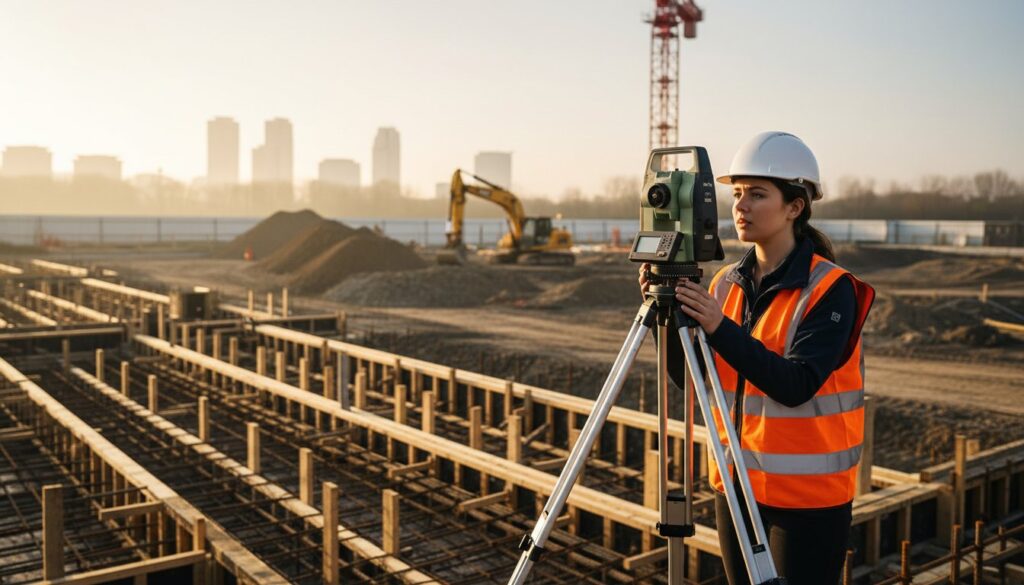
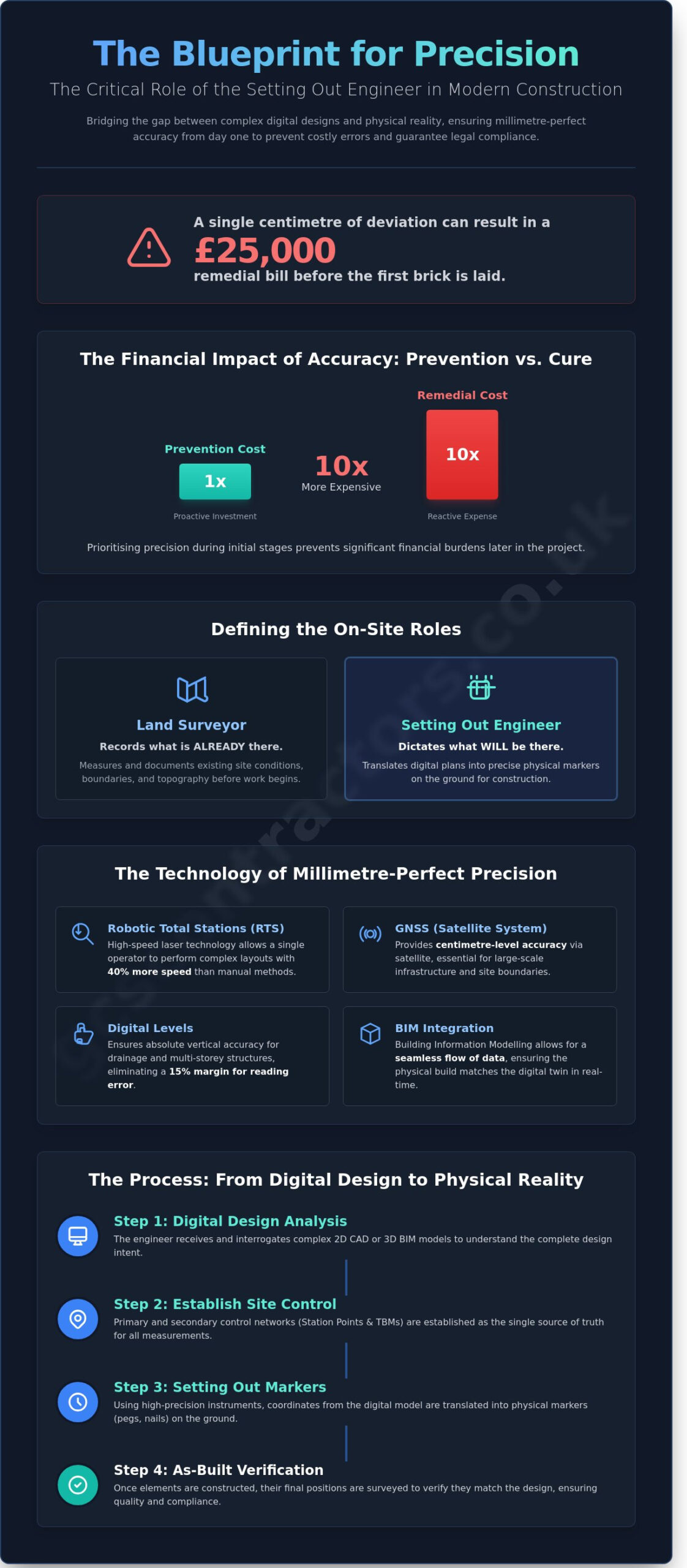
A single centimetre of deviation on a foundation plan can result in a £25,000 remedial bill before the first brick is even laid. You’ve likely felt the pressure of ensuring that every pile, wall, and boundary line sits exactly where the planning permission dictates. In this high-stakes environment, a professional setting out engineer acts as your primary safeguard against boundary disputes and costly spatial errors. We understand that you value precision and reliability above all else when breaking ground on a new project.
This guide explores how these specialists ensure site precision, mitigate structural risk, and bridge the gap between architectural drawings and physical reality. You’ll learn how to maintain full confidence in your site dimensions while ensuring total legal compliance with UK building standards. We’ll provide a clear overview of the transition from design to construction, helping you achieve a seamless project delivery that stands the test of time.
Key Takeaways
- Understand how a professional setting out engineer translates complex 2D and 3D digital designs into precise physical markers on-site.
- Discover the advanced technology, such as Robotic Total Stations and GNSS, used to achieve millimetre-perfect accuracy on large-scale infrastructure projects.
- Learn why prioritising accuracy during the initial stages prevents the significant financial burden of remedial works, which can cost ten times more than prevention.
- Explore the vital link between engineering precision and groundworks to ensure a seamless transition from architectural drawings to physical excavation.
- Gain insights into selecting a compliant engineering partner with the proven track record and insurance necessary to mitigate long-term structural risks.
What is a Setting Out Engineer? Defining the Role in 2026
The setting out engineer acts as the vital link between a designer’s digital vision and the physical reality of a construction site. While many people confuse this role with land surveying, the two disciplines serve different stages of a project. A land surveyor records what is already there; a setting out engineer dictates what will be there. They take complex CAD files or 3D Building Information Modelling (BIM) data and translate those coordinates into physical markers on the ground.
Accuracy is the foundation of every successful build. On a modern UK site, the engineer is the single point of truth. If a structural column is misplaced by even 10mm, it can trigger a cascade of costly remedial works and legal delays. Our team provides the technical rigour needed to prevent these errors, ensuring that every element of the infrastructure aligns with the approved plans from day one.
The core responsibilities of the role include:
- Establishing primary and secondary site control networks.
- Setting out foundations, drainage, and structural steelwork positions.
- Conducting as-built surveys to verify that finished works match the design.
- Providing precise vertical control for multi-storey developments.
The Link Between Design and Reality
Modern construction relies on high-level digital integration. In 2026, engineers work primarily with BIM Level 2 and 3 protocols to interpret design intent. We don’t just read drawings; we interrogate digital models to ensure structural elements fit within millimetre-perfect tolerances. This precision is essential for maintaining the golden thread of information required by the Building Safety Act 2022. By documenting every marker, the engineer ensures a transparent, high-quality record of the building’s evolution exists for the lifetime of the asset.
Key Terminology Every Developer Should Know
Understanding the language of site engineering helps developers manage risk more effectively. Station Points are the fixed coordinates from which all other measurements are taken. These must remain undisturbed throughout the project. Temporary Benchmarks (TBMs) provide the vertical reference points for height and depth. These are often established on permanent features like nearby buildings or fixed concrete posts.
Precision requires protection. Offsetting is a common technique where we place markers a specific distance away from the actual build line. This prevents the markers from being destroyed during heavy groundworks or excavation. Distinguishing between horizontal control (the footprint) and vertical control (the height) is critical. Both must be checked daily to account for site movement or environmental changes. It’s a disciplined process that ensures the project stays on track and within budget.
The Technology of Precision: Tools Used by Modern Engineers
Our team delivers accuracy on site by utilizing a suite of high-spec instruments that have transformed the construction site into a highly controlled digital environment. The role of the setting out engineer has evolved from manual measurement to the management of sophisticated spatial data. We provide our clients with the certainty that every foundation, bolt, and wall sits exactly where the architects intended, down to the last millimetre.
- Robotic Total Stations (RTS): These instruments use high-speed laser technology to track prisms automatically. This allows a single operator to perform complex layouts with 40% more speed than traditional manual methods.
- GNSS (Global Navigation Satellite System): For large-scale infrastructure and earthworks, GNSS technology provides centimetre-level accuracy via satellite networks. This is essential for establishing site boundaries and road alignments across vast distances.
- Digital Levels: We use these to ensure absolute vertical accuracy for drainage and multi-storey structures. Digital readouts eliminate the 15% margin for reading error often found with older optical equipment.
- BIM Integration: Building Information Modelling (BIM) allows for a seamless flow of data. Our engineers feed real-time site measurements back to the design team, ensuring the physical build matches the digital twin throughout the project lifecycle.
From Theodolites to Robotics
Automation has significantly reduced human error in site measurements since the widespread adoption of robotic technology in 2014. The transition from traditional two-person crews to one-man robotic stations has redefined site efficiency. This shift isn’t just about productivity; it’s a vital safety measure. By reducing the number of personnel required to stand in high-traffic zones or near heavy plant machinery, we create a safer working environment for everyone involved.
Data Management and Reporting
Modern construction workflows rely on seamless electronic data transfer. Our engineers move CAD files from the office to field controllers without manual transcription, which removes the risk of data entry mistakes. Once a task is finished, we provide as-built surveys as digital proof of compliance. These quality assurance (QA) records are essential for building control and insurance purposes, providing a clear audit trail for every structural element. For those seeking a dedicated partner in construction management, these digital records offer peace of mind that the project meets all UK building standards and long-term maintenance requirements.
Why Accuracy Matters: The Commercial Risks of Poor Setting Out
Relying on basic tapes or “eyeballing” site positions is a high-stakes gamble that rarely pays off in modern construction. While a manual tape measure might suffice for a small domestic extension, commercial builds demand millimetre precision that human sight cannot achieve. A minor 20mm deviation in a foundation trench can lead to structural misalignments that compromise the entire steel frame. We’ve seen cases where correcting a single misplaced pile cap cost upwards of £8,500 in remedial plant hire, labour, and materials. This is the “10x Rule” in action. It’s nearly ten times more expensive to rectify a structural error than it’s to prevent one through professional verification.
Health and safety remains our absolute priority. Structural integrity depends entirely on intended load paths. If a weight-bearing column sits just 50mm off-centre from its foundation, the resulting eccentric loading can cause uneven settlement or structural cracking. Our team ensures every load-bearing element aligns perfectly with the structural engineer’s original calculations, maintaining the safety of the build for its entire lifecycle.
Mitigating Structural and Legal Liability
Precision protects your bottom line from the courtroom. Encroaching on a public highway or a neighbouring property by as little as 25mm can trigger a legal injunction, halting a multi-million pound project indefinitely. Hiring a professional setting out engineer provides a rigorous audit trail for compliance with S278 highways agreements and local authority boundary requirements. The cost of error serves as the primary driver for hiring professional engineers to ensure that financial risks remain controlled and structural integrity is never compromised.
Time Efficiency and Project Flow
Speed on site comes from certainty. When groundworks teams have clear, accurate markers, they work with 20% greater efficiency because they don’t have to pause to verify drawings. We eliminate “clashes” where drainage runs might otherwise intersect with foundation footings. A setting out engineer keeps the project programme on track by resolving these spatial conflicts before the first spade hits the dirt. This proactive approach reduces downtime by an average of 12 hours per week on complex, multi-service sites. By providing a “safe pair of hands” for the technical layout, we allow the site manager to focus on logistics and labour management rather than troubleshooting geometry.
- Reduces the risk of costly S278 compliance failures.
- Prevents clashes between sub-surface utilities and foundations.
- Ensures 100% adherence to legal site boundaries.
- Protects the project timeline from remedial work delays.
Integrating Setting Out with Groundworks and Civil Engineering
A setting out engineer acts as the vital link between digital designs and physical reality. They’re often the first professionals on-site after the initial survey, transforming complex CAD drawings into tangible markers. This stage is the foundational pillar of any civil engineering project. Without these precise references, ground crews lack the necessary roadmap to begin earthworks safely.
Effective collaboration with groundworks contractors prevents costly delays and rework. During enabling works and site clearance, engineers establish primary control points that remain active throughout the build. They mark out excavation limits with tolerances as tight as +/- 5mm. This ensures that 100% of the initial site preparation aligns with the structural plan, allowing heavy machinery to operate with total confidence in the footprint.
Setting Out for Foundations and Drainage
Precision remains non-negotiable when establishing centre-lines for footings and pile caps. Our team delivers exact coordinates to ensure structural loads transfer correctly into the ground. When managing drainage systems, the setting out engineer calculates invert levels to guarantee consistent gravity-fed flow. This prevents the standing water issues that affect roughly 15% of poorly managed commercial sites. We also coordinate with utility providers, using GPR data to mark existing underground services and eliminate the risk of accidental strikes. This coordination is particularly crucial when managing builders work in connection requirements, where precise openings and penetrations must be accurately positioned for mechanical and electrical installations.
Roadworks and Infrastructure Precision
Highways infrastructure requires a higher level of geometric accuracy to ensure safety and longevity. We set out kerb lines, cambers, and drainage channels for new roads and large-scale car parks. This is particularly critical for S278 works, where projects must meet strict local council standards for adoption. By managing site levels with robotic total stations, we ensure surfacing depths are consistent. This level of detail can extend the lifespan of a road by up to 10 years by preventing premature surface failure and water ingress.
Choosing a Professional Engineering Partner: Quality and Compliance
Selecting a professional setting out engineer is a decision that dictates the structural integrity and legal compliance of your entire build. You need a partner with verified qualifications, typically a degree in civil engineering or a relevant CSCS Gold Card for Site Supervision. Professional indemnity insurance is non-negotiable for modern projects. We recommend a minimum cover of £5 million to protect all parties involved in commercial civil engineering works. GCS Contractors provides a comprehensive approach, managing everything from initial enabling works to final site preparation. This end-to-end service eliminates the friction often found when juggling multiple subcontractors.
Precision is the cornerstone of our operations because it directly impacts your bottom line. Data from the UK construction industry suggests that setting out errors contribute to nearly 15% of project delays and significant budget overruns. By prioritising accuracy from day one, we help you avoid these costly remedial works. Our team delivers results that are both high-quality and cost-effective, ensuring your project remains on programme and within its original financial scope.
Standards and Accreditations
Every project we undertake adheres strictly to the Construction (Design and Management) Regulations 2015. It’s essential to verify that your engineering partner operates within these UK health and safety frameworks to mitigate site risks. We ensure that every setting out engineer on our team uses modern, calibrated equipment, such as robotic total stations and GNSS receivers. These tools are serviced every 6 to 12 months to maintain sub-millimetre precision on site. Clear communication between the engineer and the site manager is vital. We provide detailed digital data files and physical markers that your groundworks team can trust implicitly, creating a seamless workflow from the office to the trench.
Next Steps for Your Project
Initiating the process starts with a formal site visit and an initial survey to establish primary control points. These benchmarks act as the permanent reference for every subsequent stage of construction. We suggest integrating these engineering services into your fixed-price tender. This strategy offers 100% budget certainty and prevents the “hidden extras” that often plague complex commercial or domestic developments. Our team is ready to guide you through the technical requirements of your site, ensuring a disciplined and meticulous start to your build.
Ready to secure the precision your project demands? Contact GCS Contractors to discuss your project’s engineering requirements and ensure your site is prepared to the highest professional standards.
Securing Excellence for Your Next Build
Modern construction leaves no room for error. A single millimetre of deviation often results in thousands of pounds in remedial costs and significant programme delays. By integrating advanced digital tools with deep civil engineering knowledge, a professional setting out engineer ensures your site transitions seamlessly from a digital model to a physical reality. This technical accuracy protects your commercial interests and ensures full compliance with UK building standards across every phase of development.
Our team delivers over 10 years of civil engineering expertise to every site we manage. We’re specialists in complex S278 highways works, ensuring that even the most demanding infrastructure requirements are met with absolute precision. GCS Contractors operates as a fully accredited, health and safety focused partner. We provide the reliable oversight your project needs to succeed without compromise. We’re ready to help you move forward with confidence and clarity on your next major scheme.
Secure your project’s precision with GCS Contractors’ expert engineering services
Frequently Asked Questions
What is the difference between a site engineer and a setting out engineer?
A setting out engineer focuses on the high-precision transfer of design data from digital drawings to the physical ground. While a site engineer manages broader project elements like health and safety or materials procurement, the setting out specialist ensures every foundation and wall sits exactly where the architect intended. They act as the primary link between the digital model and the physical construction site.
How much does it cost to hire a setting out engineer in the UK?
Hiring a setting out engineer in the UK typically costs between £350 and £550 per day for a fully equipped professional. This rate covers their technical expertise and the use of advanced surveying technology like Robotic Total Stations. For larger infrastructure projects, many contractors offer fixed-price packages that provide better cost certainty over a 6-month or 12-month period.
When should a setting out engineer first arrive on site?
An engineer should arrive on site at least 3 days before any groundworks or excavation begins. This early arrival allows our team to establish primary control points and verify the site boundaries against the original plans. It’s a critical step that prevents errors in the initial footprint, which can be nearly impossible to correct once concrete is poured.
Can a setting out engineer help with boundary disputes?
Yes, they provide the technical data needed to resolve boundary disputes by accurately mapping Land Registry documents onto the physical site. By using GNSS technology, they pinpoint exact coordinates to within 10mm to 20mm of accuracy. This professional evidence helps resolve conflicts quickly, saving clients thousands of pounds in potential legal fees or rework costs.
What equipment is essential for setting out a construction site?
The most essential tools are a Robotic Total Station, a GNSS rover, and a high-precision digital level. These instruments allow the engineer to maintain tolerances of 2mm across a 50-metre span. We also utilise ruggedised tablets to access CAD files on-site, ensuring that the team works from the most recent 2024 design revisions at all times.
Do I need a setting out engineer for a small residential extension?
You should consider hiring a professional if your extension is within 200mm of a boundary or features a complex footprint. While a builder might use basic tapes, an engineer ensures the structure is perfectly square and level according to the 2010 Building Regulations. This precision is vital for seamless roof connections and avoids the risk of encroaching on a neighbour’s land.
How often does an engineer need to revisit the site during construction?
Most projects require an engineer to visit at 5 distinct stages: initial setup, foundation trenches, floor slabs, drainage installation, and structural steelwork. For complex high-rise builds, an engineer might be on-site 4 days a week to monitor verticality. Regular visits ensure that any minor deviations are caught and corrected before they impact the next stage of the build.
What happens if a setting out marker is moved or damaged?
You must cease work in the affected area immediately and request a re-survey to re-establish the marker. Using a moved peg can lead to structural misalignments of 50mm or more, which often leads to expensive remedial work. Our engineers typically install secondary offset markers 2 metres away from the work zone to allow for rapid re-verification and minimal downtime.