Strip out procedure in Cambridge: your practical guide
What does an internal strip out procedure involve in Cambridge?
An internal strip out, sometimes called a soft strip or soft strip demolition, is the systematic removal of all non-structural elements from a building before refurbishment or demolition begins. In Cambridge, this covers partitions, suspended ceilings, flooring, fixtures, fittings, and full mechanical and electrical (M&E) systems. Structural elements such as load-bearing walls and columns are left untouched.
Getting this right from the outset matters. Cambridge properties range from Victorian terraces to modern commercial offices, and each type presents its own compliance requirements under the Construction (Design and Management) Regulations 2015. Licensed contractors must also manage environmental obligations, including segregated waste disposal and hazardous material controls.
Key elements covered in a Cambridge strip out typically include:
- Removal of internal partitions, stud walls, and glazed dividers
- Floor lifting: carpets, tiles, raised access floors, and concrete pads
- Full M&E removal: wiring, controls, HVAC ductwork, and ventilation units
- Suspended ceiling grid dismantling
- Kitchen and bathroom strip-outs, including plumbing connections
- Safe removal of hazardous materials such as asbestos and lead paint by certified operatives
- Licensed disposal of regulated waste streams, including fluorescent lighting and fire extinguishers
Gcscontractors specialises in all of the above across residential, commercial, and public sector properties throughout Cambridge, including CB1 through CB5 and surrounding postcodes such as CB22 and CB23.
How to carry out a Cambridge stripping service: step by step
A well-managed Cambridge renovation stripping project follows a clear sequence. Cutting corners at any stage creates safety risks, compliance failures, and costly delays.
1. Site survey and condition assessment
Every project starts with a full site survey to assess building condition, identify non-structural elements for removal, locate utilities, and flag hazards such as asbestos or lead paint. This survey informs the scope of works and the project programme.
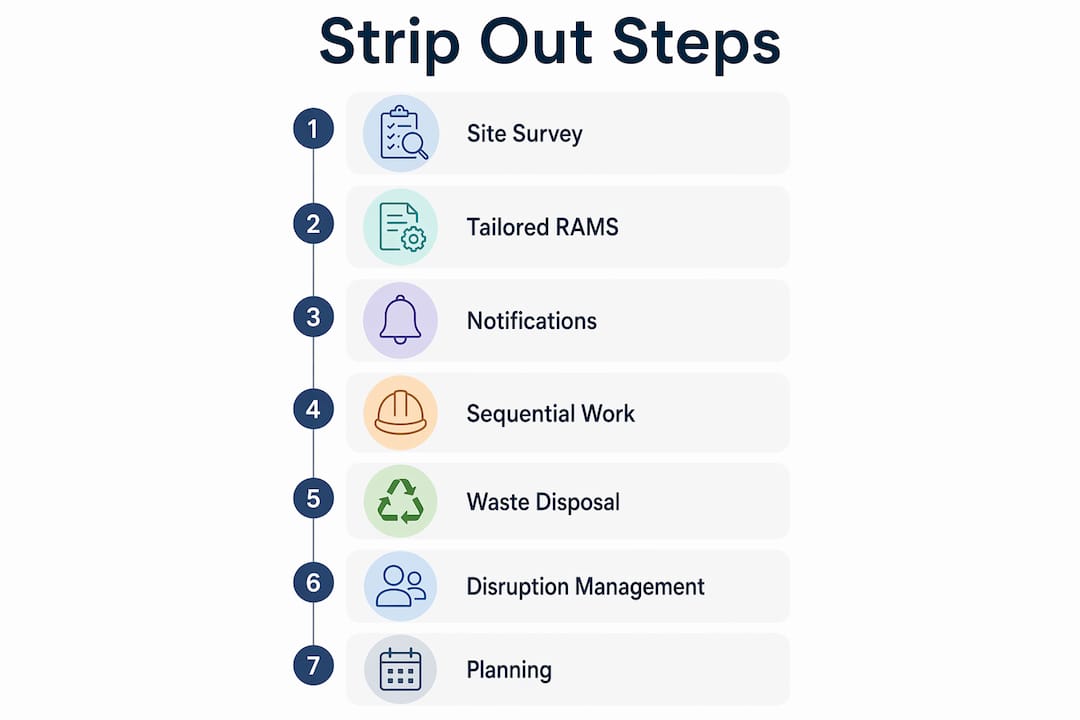
2. Creating tailored RAMS
Site-specific Risk Assessment and Method Statements (RAMS) are prepared before any work begins. These documents cover dust, noise, vibration, live electrical services, and any hazards unique to the site. In live or occupied environments, RAMS also detail out-of-hours working procedures and access controls.
Pro Tip: Ask your contractor to share the RAMS before work starts. A well-written RAMS document tells you exactly how risks will be controlled and gives you a clear basis for approving the programme.
3. Notifying local authorities and neighbours
Notification to local authorities and adjoining neighbours is required before strip out works commence in Cambridge. This maintains good community relations and prevents unforeseen disruptions, particularly on shared sites or in residential areas.
4. Sequential removal works
Operatives work through a defined sequence: partition clearance first, then floor lifting, followed by M&E removal, ceiling dismantling, and finally hazardous material handling. Certified operatives manage asbestos and lead paint under strict controls, with full documentation.

5. Waste segregation and licensed disposal
Licensed waste carriers handle all waste streams. Recyclables, general building debris, and hazardous items are sorted at source and disposed of separately, in line with environmental guidelines. Full paperwork is provided for compliance records.
6. Managing disruption on live sites
Scheduling strip out works outside regular business hours, including early mornings, evenings, and weekends, reduces disruption on busy or sensitive Cambridge sites. Noise, dust, and vibration controls are implemented throughout, with construction site safety standards maintained at all times.

7. Cost and timeline planning
Timelines and costs depend on building size, complexity, access, and waste handling requirements. Gcscontractors provides fixed pricing based on a detailed schedule of works, giving you a clear basis for project planning.
Ready to plan your strip out in Cambridge?

Gcscontractors delivers professional strip out services across Cambridge for residential, commercial, and public sector clients. From initial site survey to licensed waste clearance, every stage is managed with health and safety compliance and minimal disruption as standard. Contact Gcscontractors to arrange a site visit and fixed-price quote.
Key takeaways
A compliant Cambridge strip out requires tailored RAMS, licensed waste disposal, and sequential removal of all non-structural elements before any refurbishment or demolition work begins.
| Point | Details |
|---|---|
| Start with a site survey | Assess building condition, utilities, and hazards before any removal work begins. |
| RAMS are mandatory | Site-specific RAMS must cover dust, noise, live services, and hazardous materials for every project. |
| Notify before you start | Local authorities and neighbours must be informed prior to works commencing in Cambridge. |
| Licensed waste disposal | All waste streams, including hazardous materials, require licensed carriers and full documentation. |
| Flexible scheduling reduces disruption | Out-of-hours working, including evenings and weekends, is available for live or occupied sites. |
Recommended
- Professional Strip Out in Cambridge: A How-To Guide for Site Preparation – GCS Contractors Ltd
- Strip-Out Contractors Cambridge – GCS Contractors Ltd
- Commercial Strip Out Contractors Cambridge: A Guide to Professional Enabling Works – GCS Contractors Ltd
- Reduced level dig Cambridge: the 2026 contractor’s guide