S278 Works for Developers: A Strategic Guide to Highway Infrastructure in 2026
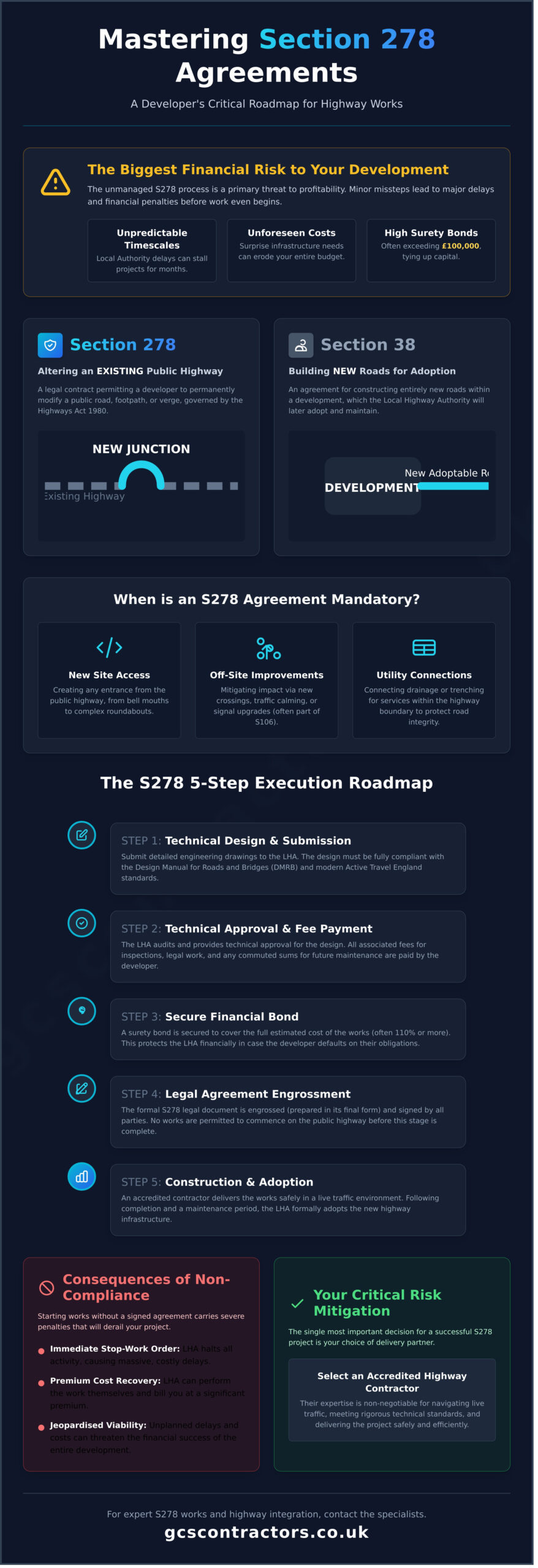
The biggest financial risk to your development’s profitability isn’t securing planning permission; it’s the unmanaged Section 278 process. We know you’ve felt the frustration. Unpredictable local authority timescales can stall a project for months, while unforeseen infrastructure costs and the high price of surety bonds, often exceeding £100,000, can erode your budget before a single spade hits the ground. It’s a complex, high-stakes phase where a minor misstep leads to significant delays and financial penalties.
This is why mastering the strategy behind effective S278 works for developers is no longer optional; it’s essential for success in 2026. This guide provides the expert insights you need to navigate the legal complexities, meet rigorous technical standards, and ensure efficient project delivery from day one. We will break down the critical steps for achieving a signed S278 agreement with minimal friction, securing technical approval on your first submission, and delivering a high-quality highway interface that enhances your development’s value.
Key Takeaways
- Grasp the legal fundamentals of Section 278 agreements to ensure your project starts on a compliant and secure footing with the Local Highway Authority.
- Understand the full project scope of S278 works for developers, from major junction remodelling to integrating active travel infrastructure into local networks.
- Master the 5-step execution roadmap, from technical design submission to legal engrossment, to effectively manage project timelines and financial liabilities like performance bonds.
- Learn why selecting an accredited highway contractor is your most critical risk mitigation strategy for delivering works safely and efficiently in a live traffic environment.
What are S278 Works? Defining the Developer’s Legal Obligation
For any developer, understanding your legal obligations is the first step toward a successful project. An S278 Agreement is a formal contract between a developer and the Local Highway Authority (LHA) that permits you to permanently alter the public highway. This legal instrument is established under Section 278 of the Highways Act 1980, the foundational legislation governing road infrastructure in the UK. Without this agreement, any modification to a publicly maintained road, footpath, or verge is unlawful. It ensures all works meet stringent safety, quality, and construction standards, protecting the public asset and its users.
It’s crucial to distinguish this from a Section 38 (S38) Agreement. While both relate to highway adoption, their purposes are distinct. An S278 agreement covers modifications to an existing public highway, such as creating a new junction. In contrast, an S38 agreement is used when a developer builds entirely new roads within a development, which the LHA will later adopt and maintain. Understanding which agreement applies is fundamental to project planning.
Looking ahead to 2026, the requirements for S278 works for developers are becoming more rigorous. Evolving safety standards, heavily influenced by Active Travel England’s guidance and updates to the Design Manual for Roads and Bridges (DMRB), now place greater emphasis on cyclist and pedestrian safety. This means modern S278 schemes frequently require integrated cycleways, wider footpaths, and more sophisticated pedestrian crossings, adding a layer of complexity to design and compliance that didn’t exist five years ago.
When is an S278 Agreement Mandatory?
An S278 agreement is not optional; it’s a legal prerequisite for a range of common development activities. Our team delivers compliant solutions for all mandatory scenarios, which typically include:
- New Site Access Points: Any new entrance to your development from the public highway requires an S278 agreement. This covers everything from simple bell mouths and priority T-junctions to the construction of complex roundabouts or signalised intersections designed to manage increased traffic flow.
- Off-Site Improvements: Planning permission often includes conditions (under a Section 106 agreement) that require you to mitigate your development’s impact on the local road network. These works, such as installing traffic calming measures, upgrading traffic signals, or creating new pedestrian crossings, all fall under Section 278.
- Utility Connections and Drainage: Works that may seem minor, like connecting new drainage systems to existing highway drains or trenching for utility services within the highway boundary, also require a formal agreement to ensure they don’t compromise the integrity of the road structure.
The Legal Framework for Developers
Navigating the legal process is critical to avoiding costly delays. The LHA acts as the ultimate approving body, safeguarding the public highway as a valuable asset. It’s their responsibility to ensure your proposed works are safe, durable, and built to adoptable standards. A common misconception is that receiving planning permission grants authority to begin highway alterations. This is incorrect. Planning permission and an S278 agreement are entirely separate legal approvals; you must secure both before breaking ground.
Attempting to start works without a signed S278 agreement carries severe consequences. The LHA will issue an immediate stop-work order, which can derail project timelines by months. They also hold the legal power to undertake the works themselves and recover all associated costs from you, often at a significant premium. Protecting your project means engaging a dedicated partner who understands this framework inside and out, ensuring every step is fully compliant.
The Scope of S278 Highway Works: Infrastructure and Urban Integration
A Section 278 agreement encompasses far more than simply creating a new access point to a development. It represents the physical and legal mechanism for integrating a private project into the public realm. The scope is broad, covering every element required to ensure the new highway infrastructure is safe, durable, and cohesive with the surrounding environment. From remodelling complex junctions to installing future-proofed drainage systems, the success of these works dictates the long-term viability and public acceptance of a new development.
This integration often includes defining new boundaries with permanent fencing, a critical component for both security and aesthetics. Developers managing their own material procurement can find trade suppliers online, with regional specialists like Romford Fencing Ltd serving the South East.
The works can range from constructing a simple priority T-junction to delivering multi-million-pound signalised roundabouts and link roads. As we move towards 2026, there is an increasing emphasis on integrating with Local Cycling and Walking Infrastructure Plans (LCWIPs). This means S278 works now routinely include dedicated pedestrian footways, segregated cycle lanes, and controlled crossings. This ensures new developments actively contribute to local active travel networks rather than existing as isolated islands accessible only by car.
Junction and Access Construction
Our teams engineer junctions and access points with meticulous attention to detail. This begins with designing for heavy vehicle tracking to ensure service and delivery vehicles can manoeuvre safely without mounting kerbs or verges. We design visibility splays that meet or exceed the standards set out in the Design Manual for Roads and Bridges (DMRB). Pavement design is critical for longevity; we construct carriageways to withstand a specified traffic load, often calculated for a 20-year design life, preventing premature failure and costly maintenance for the adopting authority.
Sustainable Drainage and Utilities
The environmental mandates for 2026 place a heavy focus on water management. We integrate Sustainable Drainage Systems (SuDS) directly within the highway design, using features like permeable block paving and vegetated swales to manage surface water runoff at the source. This aligns with the mandatory SuDS requirements established in 2024. A critical, often underestimated, aspect of S278 works for developers is managing statutory utility diversions. Unforeseen clashes with gas, water, or telecoms infrastructure account for over 25% of project delays. This process, coupled with securing the necessary cash deposit or institution-backed surety bond with the highway authority, demands meticulous forward planning. Our comprehensive utility searches and coordination services are designed specifically to de-risk this complex phase.
Beyond drainage, the scope includes the entire street scene. We deliver and commission street lighting systems that meet modern energy-efficiency standards, utilising LED luminaires that can achieve over a 70% energy reduction compared to older sodium lamps. This is complemented by the installation of all necessary traffic signs, road markings, and street furniture, ensuring every detail complies with the local highway authority’s standard specifications and contributes to a safe, legible, and welcoming public space.
Financial Realities: Bonds, Fees, and Commuted Sums
Successfully delivering S278 works for developers requires a firm grasp of the associated financial commitments beyond the direct construction costs. These are not hidden charges; they are fundamental components designed to protect public assets and ensure the long-term viability of the new infrastructure. A clear understanding of the cost structure from the outset is essential for accurate project forecasting and risk management. The primary financial elements you’ll encounter are the performance bond, commuted sums, and various council fees.
Our team provides dedicated support in navigating these financial agreements, ensuring your project remains commercially sound. The costs can be broken down into three main categories:
- Performance Bond: A financial guarantee to the highway authority.
- Council Fees: Charges to cover the authority’s administrative, legal, and inspection costs.
- Commuted Sums: A one-off payment for the future maintenance of non-standard or enhanced assets.
Securing the Performance Bond
A performance bond is a non-negotiable requirement. It acts as a financial security for the highway authority, guaranteeing that the works will be completed to the agreed standard, even if the developer defaults. The bond value is calculated based on the full estimated cost of the works, typically with an added contingency, often set at 110%. For a scheme with an estimated construction cost of £400,000, a bond of £440,000 would be required. Developers can secure this through a cash deposit or, more commonly, via a surety provider. Using a surety bond is often preferable as it doesn’t tie up valuable working capital. The bond is released in stages: a partial reduction (usually 50-75%) is granted upon issuing the certificate of practical completion, with the final amount released after the successful completion of the 12-month maintenance period.
Managing Commuted Sums
Commuted sums are a critical financial consideration, representing a payment to the council to cover the future maintenance costs of any new assets that are considered ‘non-standard’. The legal framework provided by Section 278 of the Highways Act 1980 allows authorities to secure these funds to prevent new infrastructure from placing an undue burden on the public purse. These sums are calculated based on the difference in whole-life maintenance cost between a standard asset and the high-specification alternative proposed by the developer. Items that commonly trigger commuted sums include:
- Decorative paving, such as natural stone or granite setts.
- Bespoke street furniture and lighting columns.
- Certain sustainable urban drainage systems (SuDS) with specialist cleaning requirements.
Effective value engineering is key to managing this liability. By engaging with an experienced contractor early in the design phase, it’s often possible to select materials and assets that meet planning and aesthetic requirements while also being on the local authority’s list of standard, adoptable materials. This strategic approach can significantly reduce or even eliminate the need for commuted sum payments, directly protecting your project’s bottom line.
The S278 Agreement Process: A 5-Step Execution Roadmap
Successfully delivering highway alterations under a Section 278 agreement is not a single action but a structured, multi-stage process. For developers, navigating this journey from initial design to final adoption demands precision and proactive management. Our team breaks it down into a clear, five-step execution roadmap, ensuring compliance and minimising costly delays for any project involving S278 works for developers. For a more detailed exploration of each stage and the critical milestones involved, our comprehensive guide to the S278 agreement process provides the in-depth analysis developers need to navigate complex local authority requirements.
Technical Approval and Design Audit
The process begins with the technical submission, where detailed engineering designs are provided to the Local Highway Authority (LHA) for a rigorous audit. Designs are frequently rejected for avoidable reasons, such as inadequate drainage calculations, non-compliance with the latest Design Manual for Roads and Bridges (DMRB) standards, or poorly justified visibility splays. Proactive engagement with the LHA’s engineers, often 8-12 weeks before formal submission, can pre-empt these issues. It’s also critical to coordinate S278 designs with internal site groundworks; ensuring levels, drainage outfalls, and service crossings align between the site entrance and the public highway from day one prevents expensive remedial works later on.
Once technical approval is granted, the process moves to the legal and preparatory stages. First is the legal engrossment, where the formal S278 agreement is signed and a bond is secured. This bond, typically set at 110% of the LHA’s estimated works cost, indemnifies the authority against default. Following this, the pre-commencement phase begins. This involves notifying stakeholders, securing necessary road space permits, and applying for any Temporary Traffic Regulation Orders (TTROs), which often require a 12-week lead time. A pre-start meeting with the LHA inspector is essential to agree on the programme and inspection regime.
Construction Phase and Maintenance Period
With approvals in place, the construction and inspection phase can commence. The physical works are delivered on the ground, strictly adhering to the approved specifications, with the LHA conducting regular site inspections to monitor quality. Upon practical completion, the LHA issues a ‘Provisional Certificate’, triggering the start of the 12-month maintenance and adoption period. During this year, your organisation remains responsible for rectifying any defects. A successful joint inspection at the end of this period leads to the ‘Final Certificate of Completion’, at which point the LHA formally adopts the new infrastructure and releases the bond. Coordinating this is critical; working with a dedicated partner like GCS Contractors ensures seamless site-to-highway transitions, managing everything from traffic management to final surfacing with expert oversight.
To ensure your S278 construction phase is managed with precision and expertise, contact our team to discuss your project requirements.
Choosing an S278 Contractor: Why Experience is Your Best Risk Mitigation
Selecting a partner for your Section 278 agreement is one of the most critical decisions in the development lifecycle. The transition from your site boundary to the public highway represents a significant shift in risk, regulation, and required expertise. It’s a common misconception that any competent groundworks contractor can deliver these works. In reality, the difference between general site works and accredited highway works is substantial, and failing to recognise this can lead to costly delays, budget overruns, and significant legal liabilities.
Managing risk effectively extends across the entire project, and modern tools are available for every stage. For example, when planning the building envelope itself, a detailed ESX roof measurement report can significantly reduce material waste and ensure accurate costings, complementing the precision required for groundwork.
On-site groundworks operate within a controlled environment. Once your team steps onto the public highway, they enter a live, dynamic space governed by the Highways Act 1980 and the New Roads and Street Works Act 1991 (NRSWA). This isn’t just about technical skill; it’s about a deep, procedural understanding of traffic management, public safety protocols, and the specific engineering standards of the Local Highway Authority (LHA). Working safely alongside live traffic requires rigorous planning and operatives who hold specific NRSWA qualifications, a legal requirement for any work on the public highway. A specialist contractor doesn’t just build the infrastructure; they manage the entire high-risk interface, ensuring every action is compliant and meticulously documented for final adoption.
A turnkey provider offers developers the most robust form of risk mitigation. Instead of juggling a design consultant, a traffic management company, and a construction team, you have a single, accountable partner. We manage the entire process, from initial consultations and securing technical approval from the LHA to coordinating with statutory utility providers and overseeing the final surfacing. This integrated approach is fundamental to delivering successful S278 works for developers, eliminating the communication gaps and scheduling conflicts that can jeopardise project timelines.
Accreditation and Technical Competence
Our team’s competence is proven, not just promised. Every GCS operative holds the necessary Street Works (NRSWA) accreditation, a non-negotiable requirement for legal compliance. We have a long-standing and demonstrable track record of delivering complex S278 schemes for LHAs across East Anglia and the South East, including Norfolk, Suffolk, and Cambridgeshire County Councils. We are the ‘safe pair of hands’ developers trust to navigate intricate technical approvals and deliver compliant infrastructure right, the first time.
The GCS Advantage for Developers
We provide a dedicated, end-to-end service designed to deliver certainty. From initial enabling works to securing the final completion certificate and facilitating the release of your bond, our team manages every stage. Our commitment to fixed-price transparency ensures you have financial clarity from the outset, supported by meticulous project management that keeps you informed. GCS Contractors acts as a dedicated partner, invested in the successful, timely, and on-budget completion of your highway works.
Ready to de-risk your next project? Contact our team today to schedule an initial S278 feasibility review and discover how we deliver certainty in a complex regulatory environment.
Securing Your Development’s Future with Strategic S278 Execution
Navigating the Section 278 agreement is a critical milestone, not just a procedural hurdle. Successfully managing the legal obligations, financial bonds, and the 5-step execution roadmap ensures your project integrates seamlessly into the public highway, safeguarding its long-term value. The right partner isn’t a luxury; it’s your most effective risk mitigation strategy.
Executing compliant and efficient S278 works for developers demands proven expertise. At GCS Contractors, we bring over 10 years of dedicated civil engineering experience to every project. Our teams are fully NRSWA accredited for all highway works, and our dedicated project management provides the clarity and control needed to navigate complex infrastructure requirements. We don’t just complete the job; we deliver the confidence and quality your investment deserves.
Ready to ensure your project’s highway infrastructure is in safe hands? Partner with GCS Contractors for your next S278 project and let’s build a successful future, together.
Frequently Asked Questions About S278 Agreements
How long does it take to get an S278 agreement in place?
A Section 278 agreement typically takes between 6 and 12 months to secure, from initial application to final execution. The process involves a technical approval stage, which can last 3 to 6 months depending on the scheme’s complexity and the local authority’s responsiveness. The subsequent legal process to draft and agree on the final document with all parties often takes an additional 3 to 6 months. Early engagement with the highway authority is critical to managing these timelines effectively.
Who is responsible for the cost of S278 works?
The developer is responsible for 100% of the costs associated with the works. This financial obligation is comprehensive, covering everything from the initial design and road safety audits to the local authority’s legal and administration fees, which can range from 5% to 15% of the construction cost. The developer also pays for the construction itself, site supervision fees, any necessary land acquisition, and all future maintenance costs covered by commuted sums. Proper budgeting is essential for any development project.
Can I use my own contractor for S278 works?
Yes, you can use your own contractor, provided they are approved by the local highway authority. The authority will require evidence that the contractor has the necessary accreditations, such as NRSWA (New Roads and Street Works Act) certification for supervisors and operatives. They must also hold adequate public liability insurance, typically a minimum of £10 million. The authority needs assurance that the contractor can deliver the works to the required adoptable standards and in a safe manner.
What is the difference between S278 and S38?
The primary difference relates to the ownership of the land. A Section 278 agreement permits a developer to alter or improve the existing public highway to service their development. In contrast, a Section 38 agreement is used when a developer builds new roads on their own land, such as on a new housing estate, and wants the local highway authority to ‘adopt’ them as public highways upon completion. S278 modifies what’s already public; S38 makes something new public.
What happens if a developer goes into liquidation during S278 works?
The S278 bond protects the local highway authority if a developer goes into liquidation. Before work begins, the developer must secure a bond, or surety, for the full estimated cost of the works. If the developer defaults, the authority can ‘call in’ this bond. This provides the necessary funds for the authority to appoint another contractor to complete the works to the agreed standard or make the site safe, protecting the public purse from financial loss.
What are commuted sums in a Section 278 agreement?
Commuted sums are a one-off payment made by the developer to the local highway authority to cover the future maintenance costs of new assets installed on the public highway. These sums are calculated to cover the expected lifecycle cost of non-standard items that require more than routine upkeep. Examples include traffic signals, specialist anti-skid surfacing, landscaped areas, or complex drainage systems. The payment ensures the council isn’t financially burdened by the new infrastructure in the long term.
Do I need an S278 agreement for a small dropped kerb?
No, an S278 agreement is not typically required for a simple dropped kerb servicing a single residential property. This type of minor alteration is usually handled through a more straightforward vehicle crossover application or a minor works licence directly with the local council’s highways department. The complex legal and technical process of an S278 is reserved for more substantial highway alterations required by larger commercial or residential developments.
How much does an S278 bond typically cost?
The cost to secure an S278 bond is typically between 1.5% and 3% of the bond’s total value, paid as an annual premium to a surety provider. The bond’s value itself is set by the highway authority and is usually 110% of the estimated total cost of the works. For example, for works estimated at £200,000, the bond value would be £220,000, and the developer’s annual premium to the surety company would likely be between £3,300 and £6,600.