Professional Workshop Concrete Slab Contractors in Bedford: 2026 Engineering Guide
A workshop slab in Bedfordshire is a structural engineering project, not just a floor. You likely understand that the region’s heavy clay soil poses a constant threat to structural integrity, often causing the shifting and cracking that ruins a precision workspace. Finding professional workshop concrete slab contractors Bedford who specialise in these local ground conditions is the only way to avoid long-term failure. It is often difficult to coordinate separate teams for site clearance, bulk excavation, and the final pour, yet getting this sequence right is critical for a level, damp-proofed finish.
This 2026 guide ensures you master the technical requirements and local soil considerations for a high-performance workshop base. We will detail the specific sub-base preparation needed for Bedford’s clay, the selection of appropriate concrete grades, and the necessary compliance with updated Building Regulations. You will gain a clear preview of the entire process, from professional site preparation and drainage installation to the delivery of a reinforced, crack-free slab that stands up to heavy machinery and constant use.
Key Takeaways
- Understand why a workshop slab must be treated as a reinforced structural element, requiring professional site clearance and bulk excavation for long-term stability.
- Identify the specific concrete grades, such as C35 or C40, and damp-proofing requirements needed to protect your workspace from chemicals, oils, and rising moisture.
- Learn the benefits of partnering with workshop concrete slab contractors Bedford who manage the entire process, from initial groundworks to the final precision pour.
- Discover why completing enabling works, including drainage systems and utility trenching, is a critical prerequisite for a high-performance, durable concrete base.
- Gain insights into managing local soil conditions to ensure your finished slab remains level and crack-free under heavy machinery and significant point loads.
Planning Your Workshop Concrete Slab in Bedford
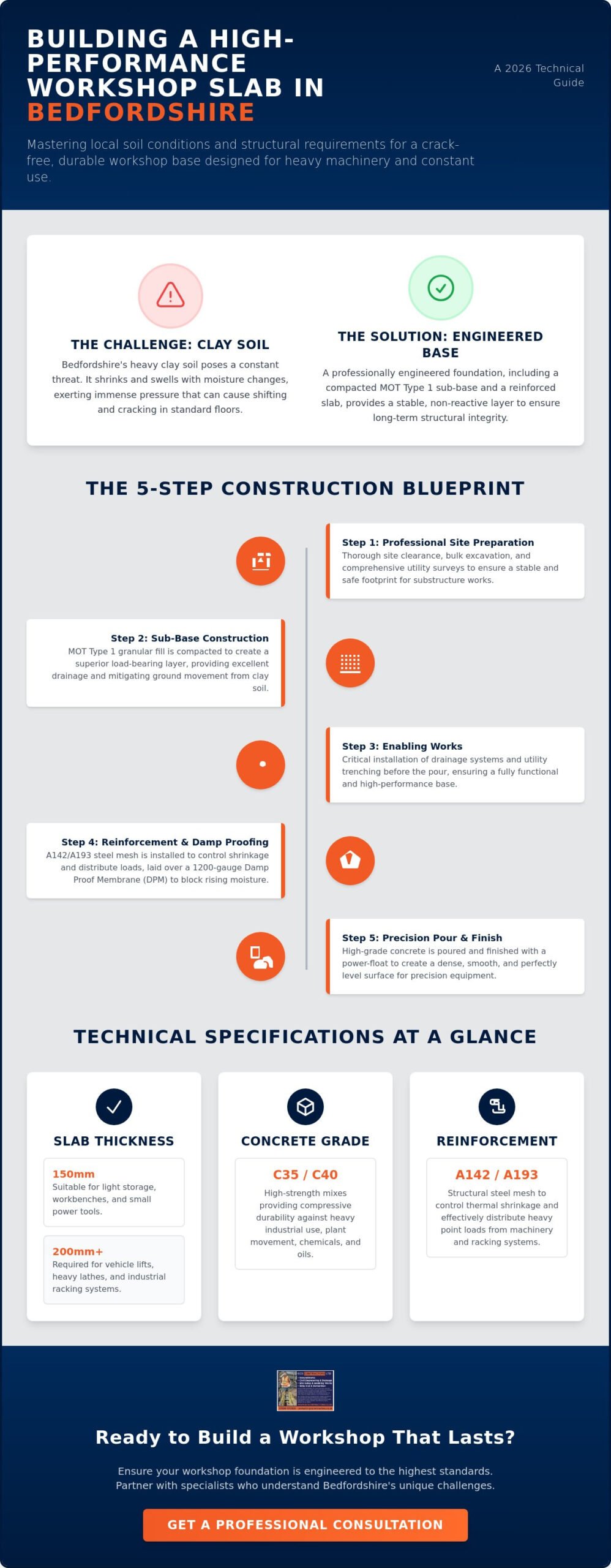
A workshop concrete slab is a reinforced structural element designed to support significant point loads from machinery, vehicle lifts, or heavy racking. It’s not a standard garden floor; it’s a precision-engineered foundation. Professional workshop concrete slab contractors Bedford prioritise thorough site preparation, including site clearance and bulk excavation, to ensure a stable footprint. Before any plant machinery touches the ground, a comprehensive survey of existing utilities and drainage is mandatory to prevent service strikes and ensure the site is ready for substructure works.
Navigating Bedfordshire Clay Soil Conditions
Bedfordshire clay soil presents unique engineering challenges due to its high plasticity. This material shrinks and swells with moisture changes, which exerts immense pressure on rigid structures. A well-compacted sub-base mitigates this ground movement by providing a stable, non-reactive layer between the soil and the concrete. MOT Type 1 granular fill is the industry standard for Bedfordshire sub-bases because it offers superior load-bearing capacity and excellent drainage properties.
Determining Load Requirements and Thickness
Your workshop’s intended use determines the slab’s final thickness. While a standard 100mm slab might suit a domestic shed, it’s insufficient for a professional engineering environment. We typically categorise requirements as follows:
- 150mm Thickness: Suitable for light storage, workbenches, and small power tools.
- 200mm+ Thickness: Required for vehicle lifts, heavy lathes, and industrial racking systems.
For bespoke commercial or industrial designs, you should consult a structural engineer. They will calculate the exact reinforcement mesh and concrete depth needed for your specific machinery. This ensures the slab doesn’t crack under the pressure of concentrated point loads, protecting both your equipment and the building’s structural integrity.
Technical Specifications for High-Performance Slabs
High-performance workshop slabs require engineering precision that goes beyond basic residential standards. To resist the corrosive effects of oils, coolants, and chemicals, we recommend using C35 or C40 concrete grades. These high-strength mixes provide the compressive durability necessary for heavy industrial use and frequent plant movement. A 1200-gauge Damp Proof Membrane (DPM) must be installed beneath the slab to prevent rising damp from damaging sensitive machinery or inventory. For larger workshop footprints, strategic expansion joints are vital to manage thermal movement and prevent uncontrolled cracking. Specialist workshop concrete slab contractors Bedford ensure these technical details are managed from the start of the project.
Reinforcement and Concrete Grades
Both concrete contractors in Cambridge and Bedford specialists prioritise structural steel mesh, such as A142 or A193, to control shrinkage and distribute heavy loads. While traditional steel rebar mesh remains the gold standard for supporting machinery, modern macro-fibre reinforced concrete offers an alternative for specific applications where impact resistance is a priority. During the pour, we conduct slump tests to verify the consistency and workability of the mix, ensuring it meets the exact design specification. Adhering to rigorous safety standards, such as OSHA requirements for cast-in-place concrete, ensures structural reliability and site safety throughout the build.
Surface Finishes and Levelling
A power-float finish is the preferred choice for professional workshops. This process creates a dense, smooth, and hard-wearing surface that is virtually dust-free. Achieving tight tolerance levels is essential if you plan to install precision equipment, heavy-duty racking, or vehicle lifts. A perfectly level floor prevents uneven wear on machinery and ensures the safety of your operational environment. If you are planning a project that requires expert reinforced concrete works, selecting a team with the correct finishing equipment and technical expertise is paramount for a successful outcome.
Working with experienced workshop concrete slab contractors Bedford ensures your facility is built to handle the rigours of 2026 engineering standards. Proper material selection and finishing techniques result in a floor that is both functional and durable.
Hiring Professional Concrete Contractors in Bedford
Selecting the right workshop concrete slab contractors Bedford requires looking beyond a basic quote for materials. You need a partner who maintains a fleet of in-house machinery to handle the heavy lifting. We own and operate our own plant, which ensures that site preparation and bulk excavation are handled with precision and reliability. Relying on contractors who own their equipment eliminates the risk of delays caused by third-party rental availability. Before any concrete is poured, it’s vital that enabling works such as drainage systems and utility trenching are fully installed. This integrated approach ensures your workshop has the necessary infrastructure built directly into its foundation.
Safety and compliance are non-negotiable in groundworks. Any reputable contractor must carry comprehensive public liability insurance and strictly adhere to health and safety regulations. GCS Contractors Ltd provides a disciplined, compliant service that manages the high stakes of structural engineering. We specialise in delivering integrated foundation solutions across Bedfordshire, ensuring every stage of the build meets industry-standard quality certifications.
The Integrated Groundworks Advantage
Combining bulk excavation with the final slab installation significantly reduces project timelines and overall costs. This streamlined process allows for better coordination of concrete delivery and site access, whether your project is located in the narrow streets of Bedford town centre or a more spacious rural site. Managing the entire workflow under one team ensures that the transition from site clearance to the final pour is seamless and efficient.
Project Management and Quality Control
A typical project timeline moves from initial site clearance to a cured, usable slab in a matter of weeks, depending on the scale. Professional groundworks are essential for maintaining structural stability whilst working amongst the unpredictable British weather. Our project management focuses on results-driven execution, ensuring that your workshop concrete slab contractors Bedford deliver a level, durable finish that is ready for 2026 engineering requirements. By maintaining high standards of quality control throughout the excavation and pouring phases, we guarantee a foundation that supports your operations for decades.
Securing Your Workshop Foundation for the Long Term
Building a high-performance workspace requires more than just pouring concrete; it demands a disciplined approach to engineering and site preparation. You’ve seen how Bedfordshire’s clay soil necessitates robust sub-base compaction and why high-strength concrete grades are essential for industrial durability. By integrating bulk excavation with precision reinforced concrete works, you ensure a stable, level, and damp-proofed environment for your machinery and operations. This technical foresight prevents the structural failures that often ruin precision work areas.
Choosing experienced workshop concrete slab contractors Bedford is the final step in guaranteeing project success. GCS Contractors Ltd brings extensive experience across Bedfordshire and East England to every site. Our fully insured and accredited groundworks team specialises in both reinforced concrete and bulk excavation, providing a single point of accountability for your build. We focus on delivering results-driven infrastructure that meets the rigorous standards of 2026. Contact GCS Contractors Ltd for a Professional Workshop Slab Quote to discuss your project requirements. We look forward to helping you build a workspace that stands the test of time.
Frequently Asked Questions
How thick should a concrete slab be for a workshop with a vehicle lift?
A workshop slab intended for a vehicle lift typically requires a thickness of 150mm to 200mm. This depth ensures there is enough structural mass to securely anchor the lift’s base plates and manage high point loads. You should also include heavy-duty steel reinforcement mesh to distribute the weight and prevent the concrete from cracking under the concentrated stress of a lifted vehicle.
Do I need planning permission for a workshop concrete slab in Bedford?
Planning permission isn’t always required for a concrete slab if the project falls under permitted development rules. This usually applies to domestic workshops that stay within specific height and boundary limits. However, you should check with Bedford Borough Council if your project is for commercial use or located in a conservation area. Expert workshop concrete slab contractors Bedford can often provide guidance on the necessary site preparation and compliance steps.
How long does it take for a new workshop slab to cure before I can move machinery in?
You must allow the concrete to cure for a full 28 days before moving heavy machinery onto the surface. Although the slab feels solid enough for foot traffic after a few days, it takes four weeks to reach its specified compressive strength. Moving heavy equipment too early can cause permanent structural damage or surface indentations that compromise the level finish of your workspace.
What is the best concrete mix for a workshop floor subject to oil spills?
We recommend using a C35 or C40 concrete mix for workshops where oil or chemical spills are likely. These higher grades are denser and less porous than standard mixes, which helps prevent liquids from soaking into the slab and causing degradation. Combining this grade with a power-float finish creates a smooth, hard-wearing surface that is easy to wipe clean and resistant to industrial staining.