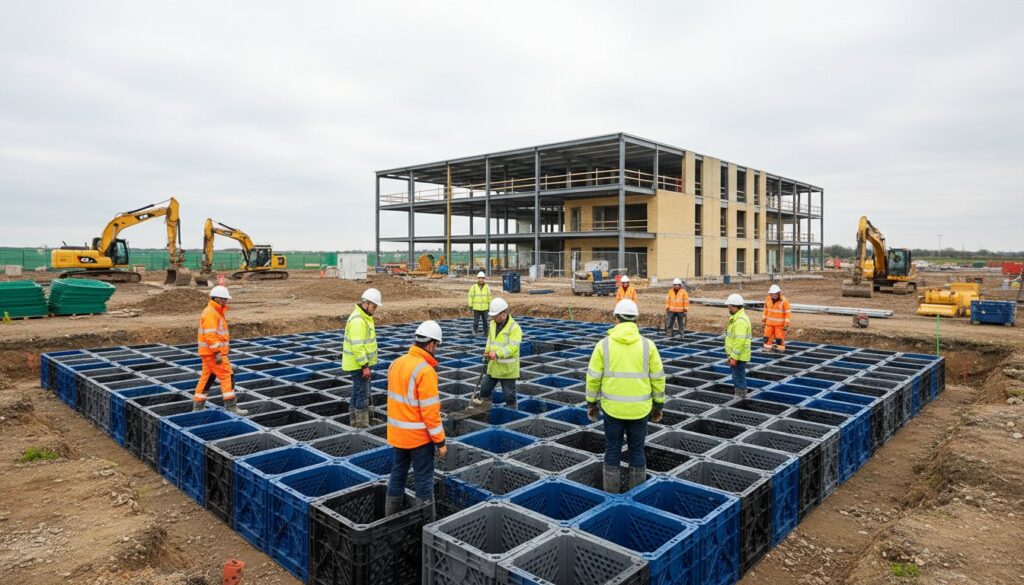
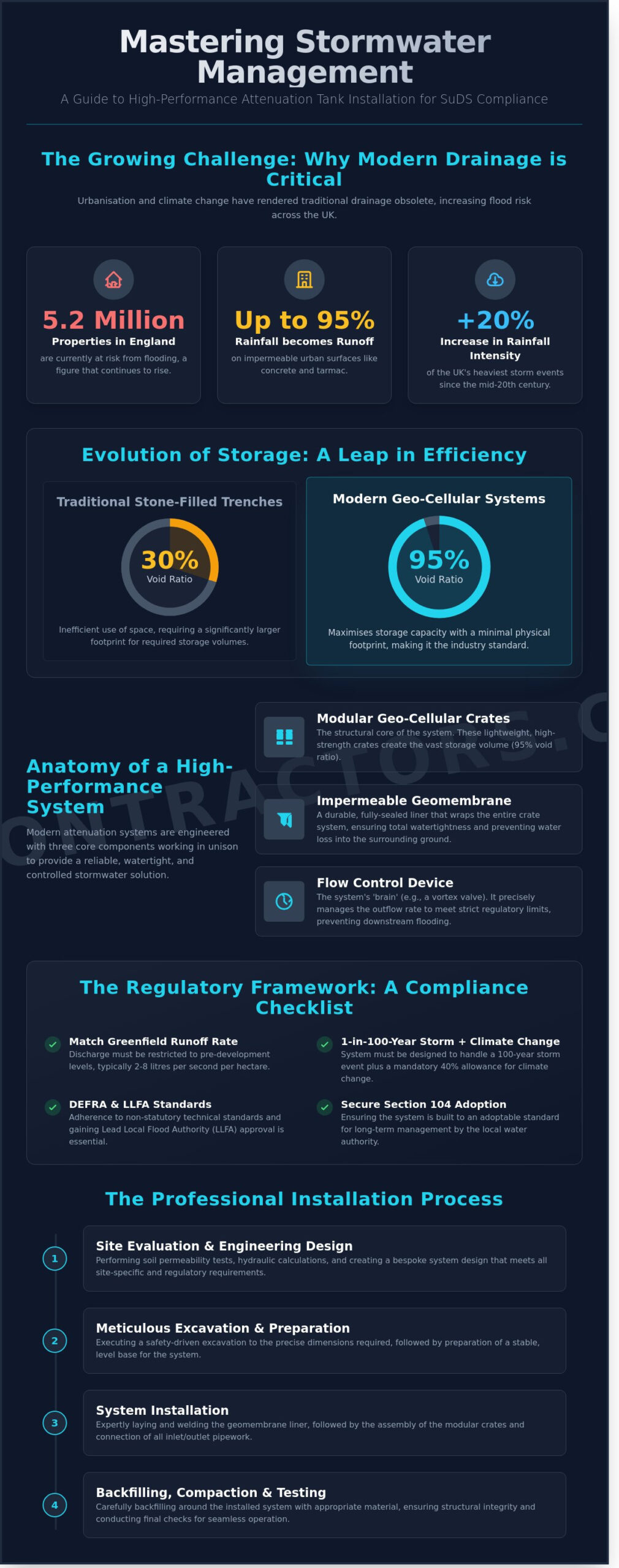
Over 5.2 million properties in England are currently at risk from flooding according to the Environment Agency, a figure that continues to rise as extreme weather events become more frequent. You likely recognise that a robust drainage strategy is the foundation of any successful commercial development, yet the pressure to meet stringent Sustainable Drainage Systems (SuDS) requirements often feels like a moving target. A poorly executed plan doesn’t just risk site flooding; it threatens your project’s legal standing and the long-term structural integrity of your buried infrastructure.
Professional attenuation tank installation is more than just burying a crate. It’s a high-stakes engineering task that protects your investment and ensures site safety. We provide the technical expertise needed to navigate these complexities with quiet confidence and proven reliability. This guide details how to achieve a compliant, durable system that satisfies local water authorities and secures seamless Section 104 adoption. Our team delivers a clear breakdown of technical load-bearing requirements, regulatory standards, and the meticulous installation processes we use to deliver bespoke results that stand the test of time.
Key Takeaways
- Understand the essential role of attenuation within Sustainable Urban Drainage Systems (SuDS) to ensure controlled surface water release and regulatory compliance.
- Discover why modular geo-cellular crate systems have replaced traditional concrete tanks as the industry standard for high-performance stormwater management.
- Follow our professional methodology for attenuation tank installation, focusing on meticulous site preparation and safety-driven excavation techniques.
- Learn how to evaluate soil permeability and site constraints to determine whether attenuation or a soakaway is the most effective solution for your development.
- Gain insights into the Section 104 adoption process and the long-term maintenance requirements necessary to protect your infrastructure investment.
The Role of Attenuation Tank Installation in Modern SuDS
Attenuation is the process of collecting surface water during periods of heavy rainfall and releasing it into the drainage network at a strictly controlled rate. This mechanism sits at the heart of Sustainable Drainage Systems (SuDS) across the United Kingdom. A professional attenuation tank installation acts as a vital buffer. It ensures that the volume of water entering local sewers or natural watercourses doesn’t exceed their hydraulic capacity. By managing these flow rates, these systems prevent downstream flooding and protect critical local infrastructure from the destructive power of uncontrolled runoff.
The Environment Agency plays a fundamental role in this process by setting discharge rate limits for all new developments. These limits are designed to ensure that a completed project doesn’t increase the flood risk to the surrounding area. In many cases, developers are required to restrict discharge to the original “greenfield” runoff rate, which typically ranges between 2 and 8 litres per second per hectare. We provide the technical expertise to calculate these requirements accurately, ensuring that every attenuation tank installation we deliver functions as a reliable safeguard for the built environment.
Why Traditional Drainage is No Longer Sufficient
Urbanisation has significantly altered the natural water cycle. Between 2001 and 2018, urban areas in the UK expanded by 1.6%, replacing permeable soil with hard surfaces like concrete and tarmac. This shift means that up to 95% of rainfall becomes immediate surface runoff rather than soaking into the ground. The traditional “pipe-to-river” model, which focused on moving water away from a site as quickly as possible, is no longer viable. It simply transfers the flood risk to communities further downstream.
The Met Office has recorded a 20% increase in the intensity of the UK’s heaviest rainfall events since the mid-20th century. These extreme weather patterns demand larger storage capacities that traditional piped systems cannot provide. Modern attenuation tank installation offers a managed approach, holding back thousands of litres of water during a storm and releasing it only when the wider network has the capacity to handle it.
Regulatory Framework and Compliance Standards
Navigating the regulatory landscape is a critical part of any construction project. Developers must adhere to the non-statutory technical standards for SuDS published by DEFRA. These standards dictate that for a 1-in-100-year storm event, plus a mandatory allowance for climate change—often set at 40% in current planning guidelines—the site’s runoff must remain under control. Failure to meet these standards can lead to the refusal of planning permission or significant fines.
Matching the pre-development greenfield runoff rate is the benchmark for success. Achieving this requires a combination of precise engineering and high-quality components. Our team acts as a dedicated partner, guiding clients through the complexities of Lead Local Flood Authority (LLFA) approvals. Engaging professional drainage contractors is the most effective way to ensure that your infrastructure is compliant, safe, and built to stand the test of time.
The Anatomy of a High-Performance Stormwater Attenuation System
Modern attenuation tank installation has moved away from the traditional use of heavy, cast-in-situ concrete chambers. We now utilise modular geo-cellular systems that offer a 95% void ratio, which is significantly more efficient than the 30% void space provided by older stone-filled trenches. This increased efficiency means developers can achieve required storage volumes with a much smaller physical footprint. A high-performance system consists of three fundamental elements: the modular crates that provide the structure, the geomembrane that ensures watertightness, and the flow control device that manages the discharge rate.
The flow control device, often a vortex valve like a Hydro-Brake, acts as the system’s mechanical brain. It restricts the outflow to a specific rate, often as low as 2 or 5 litres per second, to comply with local water authority requirements. Engineers rely on precise hydraulic calculations to ensure the system handles 1-in-100-year storm events plus an allowance for climate change. This process often involves simulating rainfall data using EPA’s Storm Water Management Model (SWMM) to predict how the storage volume will perform under peak pressure. Our team ensures every component is calibrated to these specific site requirements.
Geo-cellular Crates: Modular Flexibility
We select crates based on the specific load-bearing requirements of the site. For landscaped areas, a crate with a vertical load capacity of 20 tonnes per square metre is typically sufficient. However, for areas under car parks or access roads, we install heavy-duty units capable of sustaining 60 tonnes per square metre or more. We distinguish between ‘inspectable’ and ‘non-inspectable’ designs; inspectable crates feature internal channels that allow CCTV cameras to monitor silt build-up. These components are manufactured from recycled polypropylene and carry a 50-year design life, providing a durable infrastructure solution that stands the test of time.
Geomembranes and the Art of Watertightness
The distinction between a soakaway and an attenuation tank lies in the lining. While soakaways use permeable geotextiles to let water escape, an attenuation tank requires a 100% impermeable geomembrane, usually a 2mm thick High-Density Polyethylene (HDPE) liner. We don’t rely on adhesive tapes, which can degrade and leak over time. Instead, our technicians use professional hot-wedge or extrusion welding at temperatures reaching 400°C to create seamless, permanent bonds. To prevent punctures during the backfilling process, we wrap the sealed membrane in a 300gsm non-woven protective fleece. This multi-layered approach ensures the system remains watertight for its entire operational life.
If you are currently designing a drainage strategy for a new development, our team can provide a bespoke technical consultation to help you select the most efficient components for your site’s specific geology and load requirements.
Attenuation vs. Soakaway: Choosing the Right Solution for Your Site
The choice between attenuation and a soakaway isn’t a matter of preference; it’s a decision dictated by the SuDS (Sustainable Drainage Systems) hierarchy. UK planning authorities require developers to follow a clear priority list where infiltration to the ground is the first choice. However, surface water drainage solutions must reflect the physical reality of your site. While a soakaway allows water to percolate directly into the soil, a professional attenuation tank installation holds storm water and releases it at a controlled rate into a watercourse or sewer.
Financial implications vary across the full project lifecycle. Soakaways are generally less expensive to install initially because they require less complex hardware. However, if your site lacks the required permeability, forcing a soakaway design can lead to catastrophic flooding and legal liabilities. Our team often refers to sustainable drainage resources to ensure our designs align with current UK best practices and environmental standards. We focus on providing a system that offers the best long-term value by reducing maintenance risks and protecting your infrastructure.
Soil Testing and Infiltration Rates
Our team never finalises a drainage design without a BRE 365 soakage test. This procedure measures how quickly water disperses into the ground. If your site sits on heavy clay, which covers approximately 40% of England and Wales, the infiltration rate will likely be too slow for a soakaway. High groundwater tables also pose a risk. If the water table is within 1 metre of the bottom of your proposed system, a soakaway will fail. In these instances, we deliver a sealed attenuation model to ensure site safety and compliance.
Space Constraints and Site Planning
Site geometry often makes attenuation the more commercially viable choice. Soakaways must typically be located at least 5 metres away from any building foundations to prevent structural damage. This requirement can significantly reduce the developable area on smaller plots. By contrast, a robust attenuation tank installation can be positioned beneath car parks or heavy-duty access roads. On low-lying sites where gravity flow is impossible, we integrate these systems with drainage pumping stations to move water effectively to the discharge point. This approach maximises your land use while ensuring total compliance with local building regulations.
The Professional Installation Process: A Step-by-Step Methodology
Site preparation is the foundation of a successful attenuation tank installation. We begin every project with comprehensive safety inductions to ensure all personnel understand the site-specific risks. Our teams prioritise battering the slopes of the excavation to prevent soil collapse, adhering strictly to the HSE’s HSG150 standards for health and safety in construction. This disciplined approach protects both our workforce and the integrity of the surrounding ground.
Excavation and Base Preparation
The depth of the excavation depends on the final surface use. For landscaped areas, we maintain a minimum cover of 0.5 metres. If the system sits beneath heavy goods vehicle (HGV) loading areas, we increase this cover to at least 1.2 metres to distribute vertical loads safely. We manage groundwater ingress using 3-inch submersible pumps to keep the formation level dry and stable. Our team then installs a 150mm compacted base of 20mm single-sized angular stone. This provides a level, debris-free platform that won’t puncture the protective geomembrane.
Crate Assembly and Pipe Connections
We organise the geocellular crates in the exact configuration specified by the project engineer’s drawings. Our technicians install pre-fabricated ‘top hats’ for all pipe entries to guarantee a secure, watertight fit. We seal every inlet, outlet, and vent pipe connection to prevent soil migration into the system. Industry data from 2023 indicates that 15% of system failures stem from poor jointing; therefore, we perform rigorous vacuum or pressure testing to ensure 100% watertightness before the burial phase begins. This meticulous detail ensures the tank remains a bespoke, high-quality asset for the lifetime of the development.
Backfilling and Surface Restoration
Using the correct specification of backfill material is vital to prevent crate deformation. We utilise MOT Type 1 or specific rounded gravel, depending on the engineer’s requirements. Our team applies backfill in 200mm layers, using vibrating plate compactors to achieve the necessary density without compromising the crates’ structural integrity. We protect the site during subsequent construction phases by installing high-visibility fencing, preventing heavy plant machinery from traversing the tank before the final surface is laid. This end-to-end management style delivers a seamless transition from excavation to a fully operational drainage solution.
Our commitment to technical excellence and safety ensures your project meets all regulatory requirements. Partner with GCS Contractors for your next attenuation tank installation to secure a durable, professional result.
Compliance, Adoption, and Long-Term Maintenance
Successful attenuation tank installation doesn’t end when the final crate is positioned or the last backfill layer is compacted. The final phase involves a rigorous compliance process to ensure the system meets the standards required for adoption by local water authorities. Under Section 104 of the Water Industry Act 1991, developers enter into a legal agreement to ensure the infrastructure is built to a vestable standard. Until the water company issues the final certificate, the developer remains 100% liable for the system’s performance and any remedial costs. This liability period typically lasts a minimum of 12 months following the completion of the site.
Choosing an accredited contractor reduces long-term commercial risk significantly. We provide the technical expertise required to navigate these legal hurdles, ensuring that every attenuation tank installation we undertake is fully compliant with Ciria C754 and local water authority specifications. This proactive approach protects your maintenance bond, which often represents 10% of the estimated construction cost, from being withheld due to installation errors.
The Section 104 Adoption Process
For a water company to adopt a system, the technical requirements are exacting. Our team delivers a comprehensive handover package that includes precise as-built drawings and high-definition CCTV surveys. These surveys must prove the system is free from debris and structural defects. We manage the maintenance bond during the initial 12-month period, ensuring that any minor adjustments are handled swiftly. This disciplined approach ensures a seamless transition of responsibility from the developer to the water authority.
Routine Maintenance and Silt Management
Long-term functionality relies on a strict maintenance schedule. Silt is the primary enemy of any SuDS (Sustainable Drainage System) infrastructure. We install catch pits and silt traps upstream of the main tank to capture 85% of suspended solids before they enter the attenuation crates. These components extend the system’s life beyond its standard 50-year design window. Annual inspections are vital to ensure flow controls, such as hydro-brakes, remain unblocked and operational.
Expertise matters when managing these assets. Professional commercial drainage in Cambridge and throughout the UK requires dedicated oversight to prevent catastrophic flooding events. Our maintenance programmes include:
- Silt removal: Vacuuming catch pits every 6 to 12 months.
- Jetting: Cleaning pipework to maintain design flow rates.
- Visual inspections: Checking for structural integrity via access shafts.
- Flow control testing: Ensuring the vortex or orifice plate is clear of obstructions.
Our commitment to building standards ensures your project stands the test of time. We act as a dedicated partner, removing the logistical burden of drainage management so you can focus on your core operations with total peace of mind.
Securing Your Site’s Future with Compliant Stormwater Infrastructure
Effective stormwater management isn’t just a regulatory hurdle; it’s a critical investment in your site’s long-term structural integrity. Choosing a SuDS-compliant system protects your commercial assets from flood risks while meeting strict UK environmental standards. Our team brings over 10 years of civil engineering expertise to every project. This ensures that your attenuation tank installation is handled with technical precision from the initial excavation to final adoption. We understand the complexities of S278 works and commercial infrastructure, providing a seamless transition between planning and physical results. By prioritising high-performance materials and disciplined maintenance schedules, you’ll avoid the costly pitfalls of drainage failure. GCS Contractors acts as your dedicated partner, removing the logistical burden from your shoulders. Don’t leave your site’s safety to chance. Whether you’re navigating difficult soil conditions or seeking a turnkey solution for a new commercial build, we provide the grounded reliability your project deserves. We’re ready to help you build infrastructure that stands the test of time.
Contact GCS Contractors for professional groundworks and attenuation installation to start your project with a safe pair of hands.
Frequently Asked Questions
How much does attenuation tank installation cost per cubic metre?
An attenuation tank installation typically costs between £150 and £350 per cubic metre for a complete professional setup. This estimate covers the geocellular crates, impermeable membranes, excavation, and structural backfilling required for a robust system. Prices fluctuate based on site-specific factors like soil stability or the presence of high groundwater levels. Our team provides detailed, fixed-price quotes after a site survey to ensure your project remains within budget.
Do I need planning permission for a stormwater attenuation tank?
You generally need planning permission for a stormwater attenuation tank as part of a wider Sustainable Drainage Systems (SuDS) strategy. Local Planning Authorities in the UK require these systems for most new developments to comply with the 2024 National Planning Policy Framework standards. We handle the technical documentation and compliance measures needed to satisfy these regulatory requirements. This ensures your project meets all legal obligations while managing surface water runoff effectively.
How long does a modular attenuation tank system last?
A high-quality modular attenuation tank system lasts for 50 years or more when installed to professional standards. These systems use virgin polypropylene geocellular crates that resist chemical degradation and structural fatigue over decades of service. We select materials that meet CIRIA C753 SuDS Manual guidelines to guarantee long-term performance. Regular maintenance schedules further extend the life of the installation by preventing the buildup of silt and debris.
Can you install an attenuation tank under a driveway or car park?
You can install an attenuation tank under a driveway or car park if you use heavy-duty, load-rated crates. For domestic driveways, we specify crates with a 20-tonne vertical load capacity, while commercial car parks require units rated for 60 tonnes or more. Proper structural backfilling and a reinforced concrete slab or specialist sub-base are essential to prevent surface settlement. Our engineers ensure the installation handles heavy vehicle traffic without compromising the tank’s integrity.
What is the difference between a soakaway and an attenuation tank?
The primary difference is that a soakaway infiltrates water into the surrounding soil, whereas an attenuation tank stores water before releasing it at a controlled rate into a sewer or watercourse. Soakaways require permeable soil with high infiltration rates, often tested via a BRE Digest 365 percolation test. If your site has heavy clay soil, a professional attenuation tank installation is the mandatory solution to prevent flooding. We design each system based on your specific site geography.
How often should an attenuation system be inspected and maintained?
You should inspect and maintain your attenuation system at least once every 12 months to ensure peak performance. These annual checks focus on clearing silt traps and verifying that flow control devices, such as vortex valves, remain free from obstructions. Following a major storm event with over 25mm of rainfall, we recommend a rapid visual inspection of the intake points. Our maintenance teams provide comprehensive service reports to keep your site compliant with environmental regulations.
What happens if an attenuation tank fails or leaks?
If an attenuation tank fails or leaks, it often leads to localised flooding and potential subsidence of the surrounding ground. Excess water escaping into the subsoil can saturate the foundations of nearby buildings, causing structural cracks or instability. We use high-frequency welding for impermeable membranes to create a 100% watertight seal that prevents these issues. Our rigorous testing protocols identify potential leaks before the system is commissioned, protecting your property and your investment.
Can attenuation tanks be used for rainwater harvesting?
Attenuation tanks can be adapted for rainwater harvesting by adding a pump system and specialist filtration units. This allows you to repurpose stored stormwater for non-potable uses such as toilet flushing or landscape irrigation, which can reduce mains water consumption by 40%. We design these dual-purpose systems to meet both SuDS requirements and sustainability goals. It’s a practical way to turn a regulatory necessity into a long-term cost-saving asset for your facility.