Muck Away Service Prices in Cambridge: A 2026 Guide to Site Clearance Costs
The most expensive mistake on a Cambridge construction site isn’t the volume of soil you move, but the chemical classification of the waste you leave behind. Whilst most project managers focus on load counts, the reality of 2026 site clearance is that waste chemistry and narrow-street logistics dictate your bottom line far more than simple tonnage. It’s frustrating to watch a budget disappear into unexpected disposal surcharges or transport delays caused by poor vehicle selection. We understand that managing muck away service prices Cambridge requires more than just a quote; it demands a precise strategy for handling inert, non-hazardous, and hazardous materials without stalling your programme.
This guide provides the clarity you need to optimise your site clearance budget for the current year. You’ll learn how to choose between the rapid self-loading capability of a grab hire and the high-volume efficiency of a tipper. We also break down the critical impact of mandatory digital waste tracking introduced in April 2026 and how to ensure your site remains fully compliant with the latest Environment Agency standards. By the end of this article, you’ll have a practical framework for selecting the right machinery and avoiding the hidden costs that frequently derail local projects.
Key Takeaways
- Understand how waste classification, ranging from inert soil to hazardous materials, dictates disposal fees and impacts your bottom line.
- Learn to select the most efficient machinery by comparing the self-loading versatility of grab lorries with the high-volume capacity of tipper hire.
- Identify how site logistics and transport distances to local transfer stations influence muck away service prices Cambridge for 2026.
- Discover how integrating muck removal into your broader site clearance and preparation phase reduces double-handling and lowers operational costs.
Factors Influencing Muck Away Service Prices in Cambridge
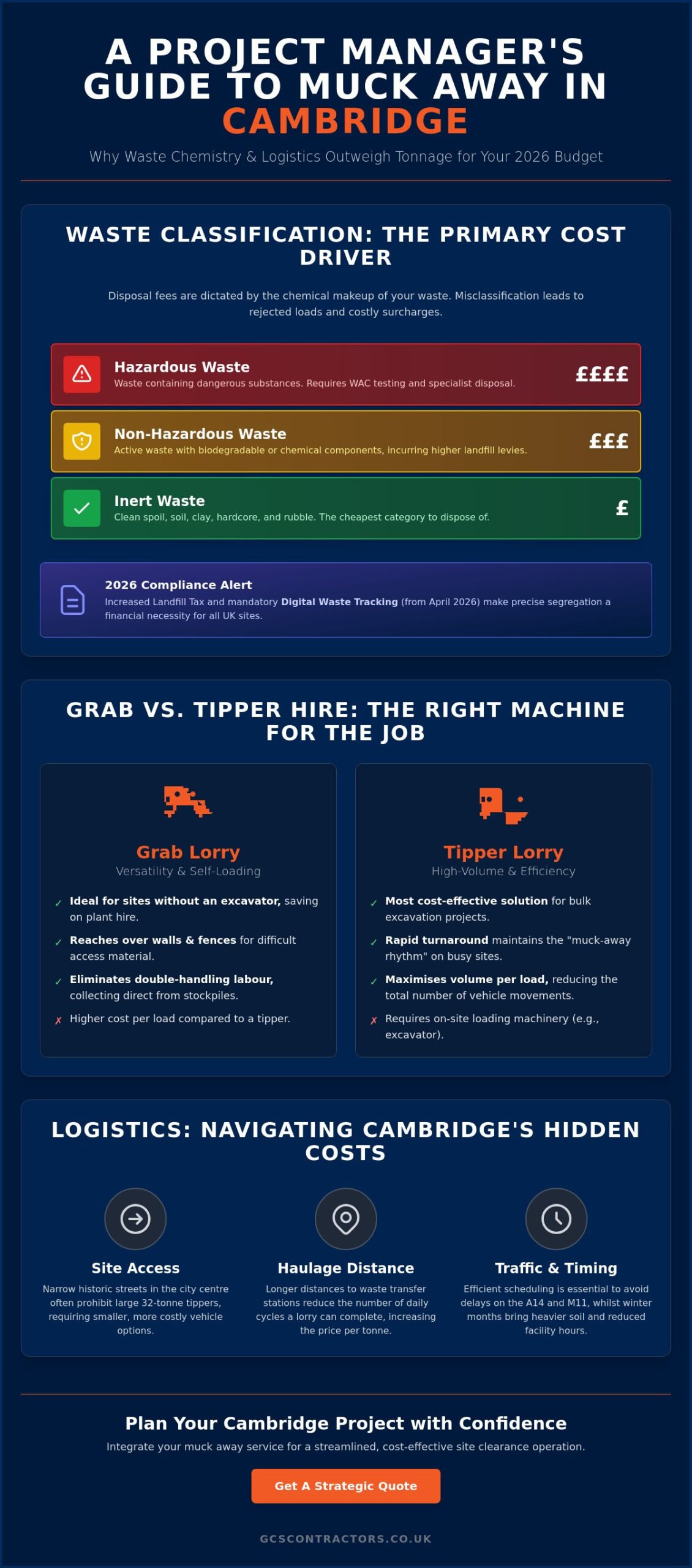
Calculating muck away service prices Cambridge requires a detailed assessment of material composition and logistical constraints. Waste classification is the primary driver of disposal fees. Inert materials like clean soil and hardcore are significantly cheaper to process than non-hazardous or hazardous waste. As of 2026, Landfill Tax rates have increased. This makes precise waste segregation a financial necessity for any site manager. Seasonal demand also fluctuates; winter projects often face higher costs due to heavier, wet soil and reduced tipping facility hours.
To better understand the physical process of soil removal on-site, watch this helpful video:
Understanding Waste Classification and Testing
Accurate pricing on brownfield sites relies on Waste Acceptance Criteria (WAC) testing. This laboratory analysis determines how waste will behave once landfilled. Clean inert spoil attracts the lowest rates, but active waste, which contains biodegradable or chemical components, incurs higher disposal levies. Proper construction and demolition waste management ensures that materials are correctly categorised before leaving the site. This prevents the costly surprise of a load being rejected at the weighbridge or reclassified as hazardous during the disposal process.
Logistics and Access in Cambridgeshire
Site location dictates the efficiency of vehicle movements. Projects in the historic Cambridge centre often face narrow access routes that prohibit large 32-tonne tippers. In these scenarios, smaller vehicles or wait and load services are required. These specialised movements can increase the overall muck away service prices Cambridge for residential developments. Conversely, large-scale bulk excavation projects outside the city core often benefit from better per-load rates. When space allows for rapid turnaround tipper services, the price per tonne typically drops. Distance to local waste transfer stations also plays a role; longer haulage times reduce the number of daily cycles a driver can complete.
Comparing Disposal Methods: Grab Hire vs Tipper Hire Costs
Selecting the right vehicle is as critical as waste classification. It directly impacts your muck away service prices Cambridge. Grab lorries and tippers serve different operational needs. Grabs are versatile self-loaders. Tippers are high-capacity movers. Your choice depends on the available plant and the physical footprint of your site. Using the wrong machinery often leads to inefficient loading times and inflated transport bills.
When to Choose a Grab Lorry
Grabs are ideal for sites lacking an excavator. An 8-wheel grab lorry can reach over walls or fences to collect material directly from a stockpile. This eliminates the need for additional labour to move muck to the roadside. Whilst the per-load price is generally higher than a tipper, you save on plant hire and man-hours. You must follow official waste classification guidelines to ensure your grab load isn’t rejected due to contamination, which can lead to expensive double-handling.
The Economics of Tipper Hire for Large Developments
For projects involving bulk excavation, tippers are the most cost-effective solution. They require a machine on-site to load them, but their turnaround is significantly faster. Professional groundworks firms prefer tippers to maintain a constant site rotation. This “muck-away” rhythm prevents material from stockpiling and obstructing the progress of other trades on a busy construction site.
Cycle times in the East of England are sensitive to traffic on the A14 and M11. Efficient scheduling is paramount to maintaining competitive muck away service prices Cambridge. If you’re managing a large-scale project, coordinating a back-fill rotation where lorries arrive with aggregates and leave with muck can drastically reduce your per-tonne expenses. If you need assistance with complex site logistics, consulting with experienced contractors can help streamline the removal process and protect your project margins.
Why Professional Site Clearance Saves Money on Large Projects
Professionalism in site clearance isn’t just about moving soil; it’s about strategic integration. When you combine muck away with the broader preparation phase, you eliminate operational friction. GCS Contractors Ltd manages complex muck away as a core component of a total groundworks package. This unified approach ensures that excavation, drainage, and waste removal happen in a synchronised sequence. It avoids the common pitfall where one trade waits for another to clear the way, which often causes costly project stagnation.
Reducing double-handling is the fastest way to lower your muck away service prices Cambridge. Moving material once from the ground directly to the lorry saves fuel, plant hours, and labour costs. If you stockpile material incorrectly, you pay twice to move the same tonne of earth. We focus on “live” loading wherever possible to keep the project moving forward without unnecessary delays. This efficiency is particularly vital on restricted Cambridge sites where space for stockpiling simply doesn’t exist.
The Hidden Costs of Non-Compliance
Using unlicensed “man and van” services for site waste is a high-stakes gamble. If waste is fly-tipped or incorrectly disposed of, the site owner remains legally liable for the cleanup and potential prosecution. Adhering to UK regulations for site clearance is essential for environmental compliance and corporate responsibility. Professional civil engineering firms protect clients through rigorous waste auditing and mandatory digital transfer notes. This ensures every load is tracked from your site to a licensed facility, providing a clear paper trail for local authorities.
Maximising Efficiency in Site Preparation
There is a distinct advantage to using one contractor for excavation, drainage, and muck away. It centralises accountability and simplifies communication across the site. You don’t have to coordinate between multiple firms to ensure the right lorry arrives at the right time. Coordinated plant hire reduces the total muck away service prices Cambridge developers pay by ensuring that the right size of excavator is always available to load the waiting lorries without idle time.
Securing Cost-Effective Site Clearance for Your 2026 Project
Managing muck away service prices Cambridge effectively requires disciplined waste classification and precise logistical planning. Accurate WAC testing and the correct selection between grab and tipper hire are the primary methods for protecting project margins. Integrating waste removal into a total groundworks package eliminates the hidden costs of double-handling and ensures compliance with 2026 digital tracking standards. This structured approach provides the reliability needed for complex developments where safety and efficiency are paramount.
GCS Contractors Ltd has served Cambridge, Ely, and the surrounding East of England since 2017. As a fully licensed waste carrier, we are specialists in hazardous soil removal and bulk excavation. We understand the high stakes of site preparation and provide the technical expertise required to handle materials correctly. Our focus remains on safety, disciplined execution, and maintaining professional standards for every client, regardless of project scale.
Request a technical quote for your Cambridge muck away project. We look forward to providing the professional support and reliable machinery your next development requires.
Frequently Asked Questions
What is the average capacity of a muck away lorry in Cambridge?
A standard 8-wheel grab lorry typically carries between 12 and 15 tonnes of material per load. Tipper lorries offer a larger payload, usually ranging from 18 to 20 tonnes. The exact capacity depends on the moisture content and density of the spoil. For example, wet clay is significantly heavier than dry hardcore, which may reduce the total volume a vehicle can legally transport under UK weight limits.
Do I need a permit for a grab lorry to park on a Cambridge street?
You generally don’t need a permit if the lorry performs a “wait and load” service on the public highway. Because the vehicle remains manned and is actively loading, it’s treated differently to a stationary skip. However, if the site access is within a restricted zone or a narrow historic centre, you should consult Cambridgeshire County Council. They can advise on specific traffic management requirements or the temporary suspension of parking bays to ensure safe operation.
What is the difference between clean muck and contaminated muck away prices?
The price difference is driven by disposal levies and treatment requirements at the waste transfer station. Clean muck consists of inert materials like soil, stone, and concrete that don’t react chemically. Contaminated muck contains “active” waste or hazardous substances that require specialist landfill cells. These factors significantly increase muck away service prices Cambridge developers must pay, as hazardous waste attracts the highest tier of Landfill Tax and requires rigorous testing.
Can you remove green waste and concrete in the same muck away load?
You can combine these materials, but it’s rarely cost-effective. Mixing green waste with inert concrete reclassifies the entire load as mixed non-hazardous waste. This prevents the material from being tipped at cheaper inert facilities. To keep your budget efficient, it’s better to segregate concrete for recycling as hardcore and handle green waste separately. This practice ensures you aren’t paying premium disposal rates for materials that could otherwise be processed as clean, inert spoil.