Mini piling in Cambridge: a developer’s guide
Mini piling is defined as the installation of small-diameter piles, typically under 300mm, using compact rigs to form deep foundations where access or ground conditions prevent conventional piling methods. For property developers and contractors working in Cambridge, this technique is the standard answer to constrained urban sites, variable ground conditions, and structures requiring reliable load transfer to stable strata below. The industry term “micropiling” is used interchangeably with mini piling in British Standards and engineering specifications. Understanding which technique suits your site, and how Cambridge’s specific ground conditions affect the outcome, is what separates a well-planned foundation from a costly remediation job.
What are the main mini piling techniques used in Cambridge construction?
Three methods dominate mini piling services in Cambridge: screw piles, Continuous Flight Auger (CFA) piling, and drilled micropiling. Each suits different site conditions and structural requirements.
Screw piles are helical steel shafts rotated into the ground using a hydraulic head. They require no excavation, generate no spoil, and can be installed in hours rather than days. Cambridgeshire infrastructure projects use screw piles supporting loads up to 35 tonnes, with embedment depths of 3–4 metres. That load capacity makes screw piles viable for plant rooms, extensions, and light industrial structures, not just temporary works.
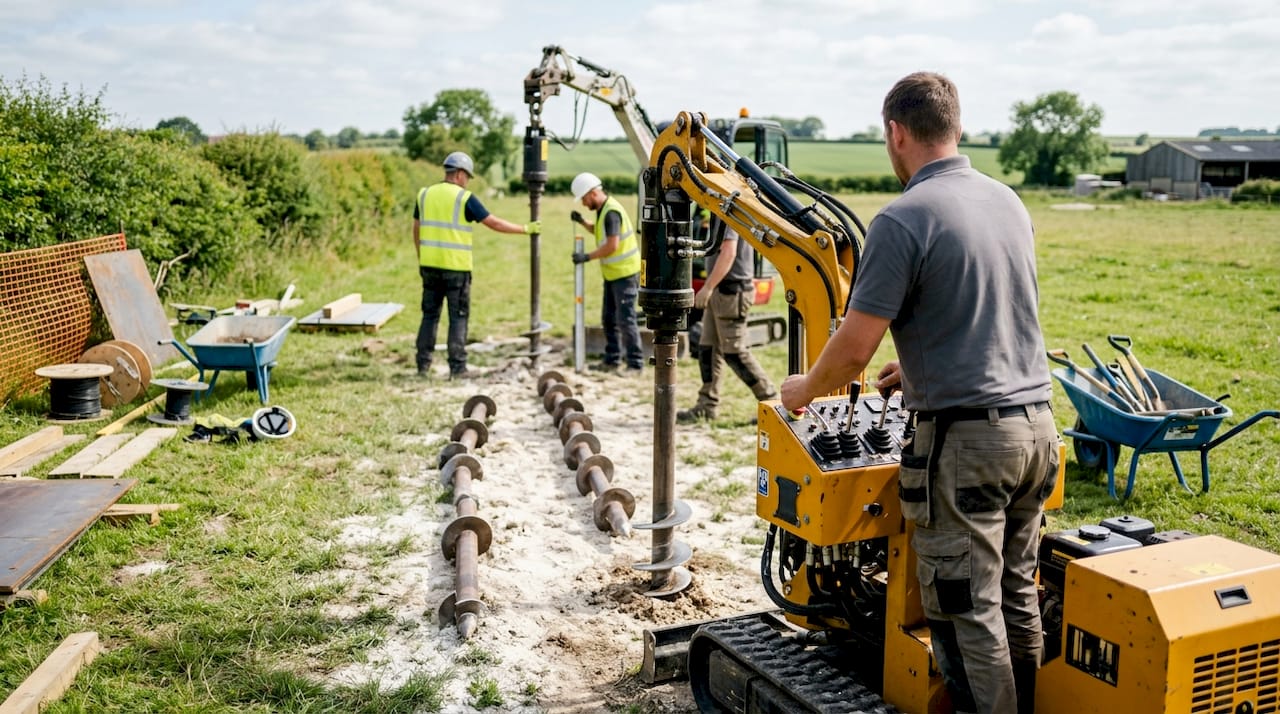
CFA piling uses a continuous flight auger drilled to depth, then filled with concrete as the auger is withdrawn. The process is fast and produces minimal vibration, which matters on sites adjacent to existing occupied buildings. CFA is well suited to Cambridge’s mixed ground profiles, where made ground overlies chalk or gravel at varying depths.
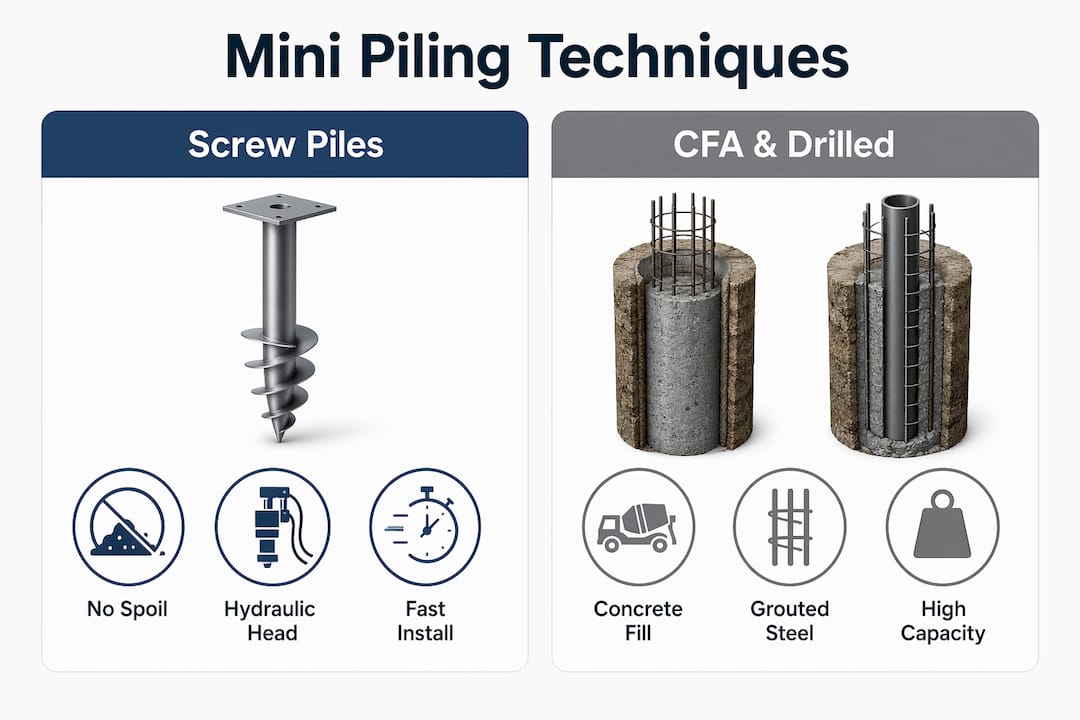
Drilled micropiling involves drilling a small-diameter hole, inserting a steel bar or tube, and grouting under pressure. This method achieves the highest load-to-pile-diameter ratio and works in the tightest access conditions, including internal basement work and underpinning. For a broader overview of deep foundation methods across Cambridge, the range of techniques available extends well beyond these three.
| Technique | Typical diameter | Key advantage | Best use case |
|---|---|---|---|
| Screw piles | 76–139mm | No spoil, fast install | Open sites, light to medium loads |
| CFA piling | 150–300mm | Low vibration, high output | Adjacent to existing structures |
| Drilled micropiling | 100–250mm | Tight access, high load ratio | Basements, underpinning, restricted sites |
Pro Tip: Always confirm the rig’s working height against any overhead restrictions before mobilisation. A standard mini piling rig requires 4–6 metres of clearance, but low-headroom variants exist for basement and internal work.
How do site conditions and restrictions in Cambridge affect mini piling projects?
Cambridge’s ground conditions vary considerably across the city and surrounding areas. The city centre sits on chalk and gravel river terraces, while outer districts often feature made ground, peat lenses, and alluvial deposits. Each ground type affects pile design, embedment depth, and the choice of technique.
Urban sites in Cambridge present additional constraints beyond ground conditions. Dense utility networks, narrow access routes, and proximity to listed buildings all affect how a piling programme is planned and executed. Pre-installed trenching and ducting constrained piling locations at the Burwell BESS site in Cambridgeshire, and the solution relied on mini piling’s small footprint and precise placement to avoid conflicts. That example is directly transferable to Cambridge city developments where utility corridors are equally dense.
The key site constraints developers and contractors encounter include:
- Made ground and variable fill: Common in Cambridge’s historic core, requiring ground investigation to confirm pile toe levels.
- Shallow utilities: Gas, water, and telecoms infrastructure often sits within 600mm of the surface, limiting rig positioning.
- Restricted access: Many Cambridge sites are accessible only through narrow gateways or existing structures, ruling out large conventional rigs.
- Proximity to listed buildings: Vibration limits apply near heritage structures, favouring CFA or screw pile methods over driven piling.
- Groundwater: The chalk aquifer beneath Cambridge means groundwater levels can be high, affecting bore stability in CFA work.
Utility surveys must be integrated into the initial design phase, not treated as a pre-construction afterthought. Developers who commission utility mapping alongside their ground investigation save significant programme time and avoid costly pile repositioning on site.
Pro Tip: Commission a CAT scan and genny survey before any trial pit or borehole work. Knowing where services run at the investigation stage shapes pile layout from the outset and prevents abortive design work.
For sites with particularly challenging clay profiles, the foundations for clay soil guide for Cambridgeshire covers the specific design considerations that apply across the region.
What are the structural benefits and load capacities of mini piling solutions?
Mini piling delivers structural performance that matches or exceeds conventional shallow foundations in most Cambridge ground conditions. The key advantage is load transfer to competent strata, bypassing weak or variable near-surface soils entirely.
Screw pile systems installed in Cambridgeshire have demonstrated loads up to 35 tonnes per pile, supporting heavy battery storage and inverter equipment at the Burwell BESS site. That figure represents the working load, not the ultimate capacity, meaning the actual pile resistance carries a further safety factor. For residential and commercial Cambridge developments, working loads of 10–25 tonnes per pile are typical, which covers the majority of new-build and extension projects.
Mini piling systems designed to British Standards can achieve design lives of up to 50 years, with screw pile systems allowing structural alterations and upgrades without full re-foundation. That longevity makes mini piling a sound long-term investment, not a compromise solution.
Durability depends on material specification and corrosion protection. Steel screw piles in aggressive ground require hot-dip galvanising or sacrificial anode protection. Concrete CFA piles are inherently durable in most Cambridge ground conditions, provided the concrete mix meets the sulphate class requirements of the site.
| Foundation type | Typical working load | Vibration impact | Access requirement |
|---|---|---|---|
| Mini piling (screw) | Up to 35 tonnes | Negligible | Compact rig, 1.5m width |
| Mini piling (CFA) | 10–40 tonnes | Low | Compact rig, 2m width |
| Driven sheet piling | Variable | High | Large plant, open access |
| Pad and strip foundations | Soil-dependent | None | Excavator access |
Screw pile systems allow structural alterations without full re-foundation, supporting up to 50-year design lives. That adaptability is particularly valuable for Cambridge commercial developments where future change of use or building extension is likely.
What are the practical advantages of choosing mini piling for Cambridge developments?
The operational case for mini piling in Cambridge is strong. The technique reduces programme time, minimises disruption to neighbouring occupiers, and cuts material volumes compared with conventional alternatives.
Mini piling installations significantly reduce earthworks and material use compared with driven piling or pre-cast foundations. Less excavation means less spoil to remove from site, which directly reduces haulage costs and programme duration. On Cambridge city centre sites where skip access is restricted and lorry movements are controlled, that reduction is a genuine commercial advantage.
The practical benefits for developers and contractors include:
- Reduced site footprint: Compact rigs operate in widths as narrow as 1.5 metres, accessing sites that exclude conventional plant.
- Faster installation: Screw piles and CFA piles are installed in a fraction of the time required for traditional strip or raft foundations in poor ground.
- Lower material volumes: No mass concrete, no large excavations, and minimal formwork reduce both cost and waste.
- Minimal disruption: Low vibration and noise levels allow work to continue adjacent to occupied buildings, schools, and hospitals.
- Future adaptability: Mini piling can adapt throughout the asset life to support future modifications or upgrades, enhancing long-term foundation flexibility.
For developers budgeting foundation costs, the new build foundation cost calculator for Cambridge and the East of England provides a useful reference point for comparing mini piling against alternative foundation types.
Residential mini piling in Cambridge is increasingly common on infill plots and rear garden developments where access through an existing property is the only option. A compact screw pile rig can pass through a standard doorway in some configurations, making it the only viable foundation solution for certain urban plots.
George’s view on getting mini piling right in Cambridge
Cambridge is not a forgiving city for foundation work. The combination of historic infrastructure, a high water table in places, and ground conditions that change within metres of each other means that what works on one site can fail on the next. I have seen projects where the utility mapping was treated as a box-ticking exercise, only for the piling contractor to arrive on site and find a live gas main directly beneath the intended pile position. Repositioning piles at that stage costs time and money that no programme can absorb comfortably.
The single most effective thing a developer or contractor can do is commission a full utility search and ground investigation before the structural engineer finalises the pile layout. That sequence sounds obvious, but the pressure to move quickly means it is regularly reversed. Pile positions get fixed in the design, then the survey reveals conflicts, and the redesign costs more than the survey would have.
Rig access is the second area where early planning pays off. Mini piling rigs are compact, but they are not weightless. Soft ground, narrow gateways, and overhead obstructions all need to be assessed before mobilisation. A site visit with the piling contractor at the design stage, rather than the week before they are due on site, resolves most of these issues without programme impact.
Cambridge piling contractors who understand the local ground conditions and utility environment are worth engaging early. Their input on pile type, embedment depth, and rig selection at the design stage saves far more than their preliminary fee.
— George
Gcscontractors: foundation and groundworks expertise in Cambridge
Gcscontractors delivers groundworks and civil engineering services across Cambridge and the surrounding region, with direct experience on constrained urban sites requiring precise foundation solutions.
Whether your project requires site preparation, enabling works, or specialist foundation support, Gcscontractors brings the technical knowledge and local understanding to keep programmes on track. The team works within live environments, coordinating with existing services and neighbouring occupiers to minimise disruption. For developers and contractors planning foundation work in Cambridge, the groundworks and foundation services page covers the full scope of what Gcscontractors offers. For projects that also require site clearance or strip-out ahead of foundation work, the site preparation guidance provides a clear starting point.
Key takeaways
Mini piling is the most reliable deep foundation solution for Cambridge’s constrained urban sites, combining compact installation, high load capacity, and long design life.
| Point | Details |
|---|---|
| Technique selection matters | Choose between screw piles, CFA, and drilled micropiling based on access, load, and ground conditions. |
| Utility mapping is non-negotiable | Integrate utility surveys into the design phase to avoid costly pile repositioning on site. |
| Load capacity is proven | Screw piles in Cambridgeshire have supported working loads up to 35 tonnes per pile. |
| Design life reaches 50 years | Mini pile systems allow future structural alterations without full re-foundation. |
| Compact rigs open constrained sites | Rigs as narrow as 1.5 metres access plots that exclude all conventional foundation plant. |
FAQ
What is mini piling used for in Cambridge?
Mini piling is used to form deep foundations on sites where access, ground conditions, or proximity to existing structures prevents conventional piling. Common applications include residential extensions, infill developments, and commercial new builds on constrained urban plots.
How deep do mini piles go in Cambridge ground conditions?
Embedment depth depends on the ground profile, but screw piles in Cambridgeshire are typically installed to 3–4 metres, with deeper installations where weak or variable soils extend further below the surface.
How long does mini piling installation take?
Screw pile installation is typically completed within one to two days for a standard residential project. CFA piling programmes vary by pile count and site conditions, but both methods are significantly faster than traditional mass concrete foundations.
Do mini piles work in clay soil?
Mini piles perform well in clay soil when designed correctly, with pile toe levels set below the zone of seasonal moisture movement. CFA piling is particularly effective in Cambridge’s clay-bearing ground conditions.
What planning or regulatory approvals does mini piling require?
Mini piling forms part of the foundation design, which must comply with Building Regulations Approved Document A and any site-specific structural engineer specifications. Permitted development rights do not remove the requirement for Building Regulations approval on foundation work.
Recommended
- Piling in Cambridge: A Specialist Guide to Deep Foundations (2026) – GCS Contractors Ltd
- Construction Foundations in Cambridge: A Professional How-To Guide (2026) – GCS Contractors Ltd
- Basement Excavation in Cambridge: A Specialist Guide to Sub-Structure Works – GCS Contractors Ltd
- Groundworks in Cambridge: A Comprehensive Guide to Site Preparation – GCS Contractors Ltd