Managing Excavation Spoil on Site: UK Regulations and Best Practices 2026
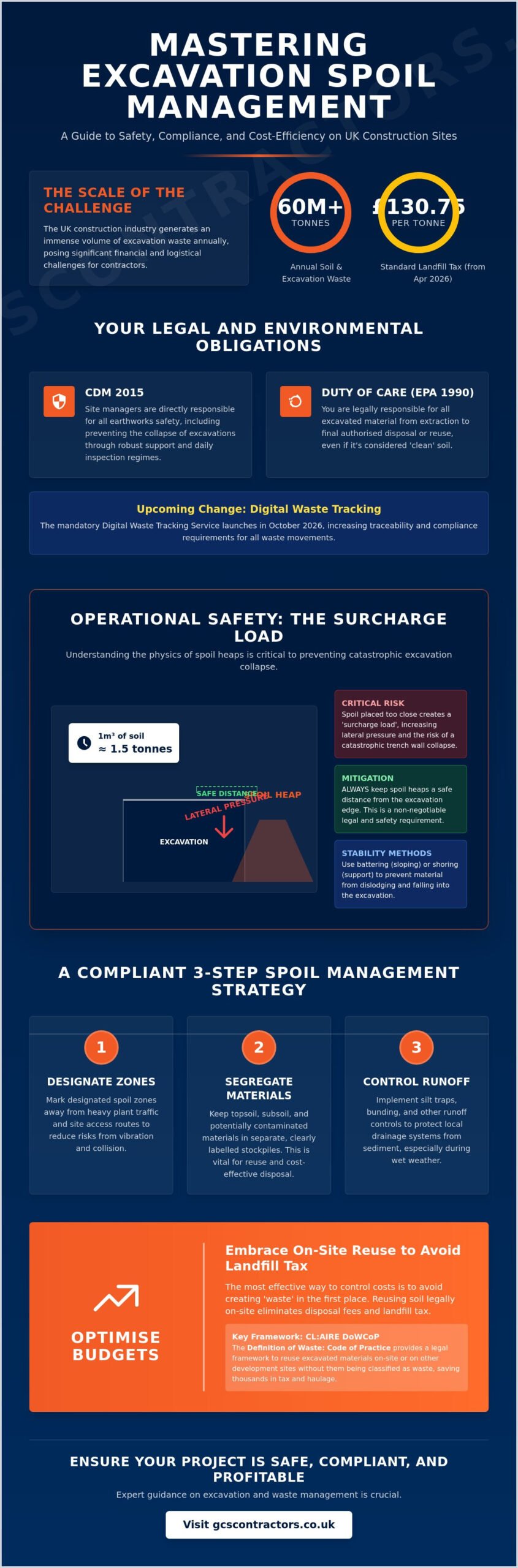
With the UK construction industry generating over 60 million tonnes of soil and excavation waste annually, the financial stakes for your project have never been higher. As of April 2026, the standard rate for Landfill Tax has risen to £130.75 per tonne, making any error in waste classification an expensive liability. Navigating the complex landscape of managing excavation spoil on site regulations requires more than just a basic understanding of muck-away; it demands a precise strategy to balance structural safety with environmental compliance.
You likely feel the pressure of rising disposal costs whilst worrying about the potential for HSE interventions or heavy fines for illegal waste disposal. It’s a common frustration to find yourself caught between conflicting safety mandates and waste management laws. This article will help you master the legal requirements and safety standards needed to keep your site running efficiently. We will cover the mandatory Digital Waste Tracking Service launching in October 2026, detail the latest U1 waste exemptions, and explain how to apply the Duty of Care to ensure your soil reuse remains both legal and profitable.
Key Takeaways
- Understand your legal obligations under CDM 2015 to ensure all earthworks and site clearance activities meet stringent safety and environmental standards.
- Learn how to calculate surcharge loads and why positioning spoil heaps away from excavation edges is critical to maintaining structural stability.
- Optimise project budgets by applying the waste hierarchy, focusing on legal methods for reusing soil on-site to avoid rising landfill tax costs.
- Ensure full compliance with managing excavation spoil on site regulations by implementing the CL:AIRE Definition of Waste Code of Practice (DoWCoP) for material management.
- Recognise the physical impact of excavated materials, noting that a single cubic metre of spoil weighs approximately 1.5 tonnes and requires specialist handling.
UK Regulatory Framework for Excavation Spoil Management
Effective spoil management involves the safe handling, stockpiling, and legal disposal of excavated materials. Under the Construction (Design and Management) Regulations 2015 (CDM 2015), site managers hold direct responsibility for earthworks safety. This framework requires you to prevent the collapse of excavations through suitable support and rigorous inspection regimes. The Environmental Protection Act 1990 further establishes a strict ‘Duty of Care’ for all excavated soil. You remain legally responsible for the material from the point of extraction until its final authorised disposal or reuse.
It is a common mistake to assume that naturally occurring, ‘clean’ soil is exempt from waste legislation. If soil is surplus to the requirements of the specific project where it was excavated, UK law classifies it as waste. Managing excavation spoil on site regulations dictates that even uncontaminated material must be handled according to specific environmental permits or exemptions to avoid illegal disposal charges. To better understand these safety and compliance standards, watch this helpful video:
Waste Classification and Soil Testing
Accurate classification is the only way to avoid excessive landfill tax charges. As of April 2026, the standard rate for landfill tax is £130.75 per tonne. Before moving any spoil off-site, you must conduct Waste Acceptance Criteria (WAC) testing. This process differentiates between inert, non-hazardous, and hazardous waste. Detailed testing allows you to plan logistics effectively whilst ensuring you don’t pay standard rates for inert materials. Proper testing is a cornerstone of compliant groundworks and site clearance operations.
The Role of the Competent Person
Legal standards require a competent person to carry out daily inspections of all excavations and spoil heaps. This individual must be trained to identify ‘signs of distress’ in soil stockpiles, such as tension cracks, bulging, or unexpected water seepage. These risks increase significantly amongst changing weather conditions or heavy rainfall. The industry remembers the catastrophic consequences of improper spoil management through the Aberfan disaster, which underscores why stability is a safety priority. You must maintain accurate, written records of every inspection to demonstrate full compliance with managing excavation spoil on site regulations.
Operational Standards for Stockpiling and Soil Stability
A single cubic metre of excavated soil weighs approximately 1.5 tonnes. This massive weight creates a “surcharge load” that can easily compromise the integrity of a trench wall. To comply with UK law on excavation safety, you must keep spoil heaps a safe distance from the edge of any cut. If you place heavy materials too close, the lateral pressure increases the risk of a catastrophic collapse. Maintaining this clear zone is a non-negotiable requirement of managing excavation spoil on site regulations.
Stability involves more than just distance. You must use methods like battering or shoring to prevent material from dislodging and falling back into the excavation. Battering involves sloping the sides of the spoil heap to a safe angle, whilst shoring provides physical restraint. In regions like East Anglia, managing water inflow is critical. Heavy rains can quickly turn stable spoil piles into unstable slurries. These liquid-like heaps are difficult to move and pose a significant risk to site drainage and safety.
Stockpile Logistics and Site Segregation
Effective management requires a structured approach to site organisation. Follow these three steps to maintain a compliant site:
- Step 1: Identify and mark designated spoil zones away from heavy plant traffic. This reduces the risk of accidental collision or vibration-induced shifts in the soil.
- Step 2: Segregate topsoil, subsoil, and contaminated materials. Proper segregation allows for potential reuse and keeps disposal costs manageable.
- Step 3: Implement silt traps and runoff controls. These protect local drainage systems from being overwhelmed by sediment during wet weather.
Mitigating the Risk of Collapse
The “1.2m rule” is a dangerous myth. Many site workers believe support is only needed for trenches deeper than 1.2 metres, but ground can fail at any depth. Managing excavation spoil on site regulations requires a risk-based assessment for every project regardless of the trench size. High-vibration machinery operating nearby can destabilise even shallow excavations. For professional standards in site preparation, consider reviewing our guide on Bulk Excavation in Cambridge. Maintaining a disciplined site is the only way to protect your workforce. If you need assistance with complex earthworks, our team provides expert groundworks and site preparation services.
Sustainable Spoil Disposal and the CL:AIRE Framework
Adhering to the waste hierarchy is the most effective strategy for project cost control. This framework prioritises on-site reuse over landfill disposal, turning what was once a liability into a valuable resource. The CL:AIRE Definition of Waste: Code of Practice (DoWCoP) provides the legal mechanism to achieve this reclassification. By developing a robust Materials Management Plan (MMP), you can legally treat excavated spoil as a non-waste resource. This approach offers significant commercial benefits. It eliminates high haulage fees and reduces the need to purchase expensive primary aggregates for backfilling or sub-base layers.
Following managing excavation spoil on site regulations correctly ensures your project remains both compliant and profitable. Reusing soil on-site supports a circular economy and prevents the environmental impact of unnecessary transport. It transforms site logistics from a disposal problem into a disciplined material recovery programme. This proactive management is essential for large-scale infrastructure and smaller residential developments alike.
Implementing an On-Site Soil Reuse Strategy
To reuse soil legally, you must demonstrate it is suitable for its intended purpose and will not cause environmental harm. A Qualified Person (QP) must review and sign off on your MMP before any material movement begins. This independent audit provides the regulatory assurance needed to avoid waste fines. Our expertise in Groundworks in Cambridge provides a solid foundation for these sustainable site development strategies, ensuring every cubic metre of soil is accounted for correctly.
Professional Site Clearance and Spoil Removal
Off-site disposal is sometimes unavoidable. In these cases, you must select accredited waste carriers to maintain your legal Duty of Care. Every load leaving the site must be accompanied by a valid Waste Transfer Note (WTN) to track the material’s journey. Managing excavation spoil on site regulations requires these records to be kept for at least two years to satisfy environmental audits. Our Professional Demolition Services integrate seamlessly with site clearance and enabling works. We ensure all spoil is handled with professional precision, from initial excavation to final authorised disposal.
Securing Your Site and Protecting Your Bottom Line
Mastering managing excavation spoil on site regulations is more than a legal hurdle; it’s a strategic advantage for any modern project. By prioritising the waste hierarchy and implementing the CL:AIRE framework, you transform potential liabilities into reusable resources. Maintaining rigorous stability standards and surcharge load calculations ensures your workforce remains safe whilst your project stays on schedule. These disciplined site processes are the difference between a profitable build and one plagued by avoidable fines or regulatory delays.
Expertise in earthworks requires a partner who understands the high stakes of infrastructure and engineering. We provide specialist sub-structure and bulk excavation services with a focus on reliability and safety. As accredited groundworks contractors for Cambridge and London, we maintain rigorous adherence to HSE and EA compliance standards at every stage. For your next project, contact GCS Contractors Ltd for professional bulk excavation and site clearance. We have the technical expertise and operational capacity to handle your requirements with professional momentum. Let’s ensure your groundworks are delivered correctly from the very first dig.
Frequently Asked Questions
When does excavated soil legally become classified as waste in the UK?
Excavated soil is classified as waste the moment the holder discards it or intends to discard it. If the material is surplus to the specific requirements of the project where it was extracted, it’s considered waste under UK law. This classification applies even to uncontaminated soil. To keep material outside the waste regime, you must have a pre-defined and certain use for it, typically documented within a Materials Management Plan.
What is the minimum safe distance to store spoil from the edge of a trench?
Industry standards recommend storing spoil at least 1.5 metres away from the edge of an excavation. However, the exact distance must be determined by a competent person based on the depth of the cut and the soil’s stability. Storing material too close creates a surcharge load that can trigger a trench collapse. You must also account for the weight of plant machinery operating near these heaps to maintain site safety.
Do I need a permit from the Environment Agency to reuse soil on my own site?
You typically require an environmental permit or a registered waste exemption, such as a U1 exemption, to reuse soil. The CL:AIRE Definition of Waste: Code of Practice (DoWCoP) provides a professional alternative that allows for reuse without a permit if specific criteria are met. Adhering to managing excavation spoil on site regulations through this framework requires a Qualified Person to sign off on your site strategy and materials management plan.
What are the penalties for improper management of excavation spoil?
Improper management leads to unlimited fines, custodial sentences, and severe financial penalties for Landfill Tax evasion. HMRC can apply the standard rate of £130.75 per tonne to illegally disposed waste plus an additional penalty of up to 100% of that tax. The HSE also has the power to issue stop notices. These halt all site operations immediately until safety and environmental compliance is fully demonstrated, causing massive project delays.