Foundations for Clay Soil in Cambridgeshire: A Specialist Groundworks Guide
In certain pockets of the county, Gault clay can expand or contract by as much as 150mm during a single seasonal cycle. This dramatic volume change makes the local ground some of the most volatile in the UK for any construction project. You likely already know that a standard footing won’t suffice when dealing with the high plasticity of Kimmeridge or Gault formations found across the region. The fear of future subsidence is a constant worry, and the pressure to meet strict NHBC requirements often leads to uncertainty about the most cost-effective technical approach.
This guide shows you how to navigate these technical hurdles to install foundations for clay soil Cambridgeshire that remain structurally sound for decades. We’ll explain why deep trench fill or specialist piling is often the only safe way forward; we also detail the necessity of heave protection systems. From interpreting site investigations to choosing the right contractor, you’ll gain a clear understanding of how to achieve a stable build that passes building regulations the first time. We’ll break down the practical steps required to manage these ground conditions effectively, ensuring your project starts on a solid, compliant footing.
Key Takeaways
- Understand why Gault and Kimmeridge clay belts pose significant “shrink-swell” risks that cause standard footings to fail.
- Compare the technical applications of trench fill, piling, and raft foundations for clay soil Cambridgeshire to ensure long-term structural integrity.
- Learn why deep trench fill depths of 1.5m to 2.5m are often necessary to bypass unstable soil layers and reach a competent bearing strata.
- Recognise the necessity of a professional site investigation (SI) to mitigate risks and determine the correct foundation design before any soil is moved.
- Leverage specialist groundworks expertise tailored to the specific geological challenges found in Cambridge city centre, St Neots, and Newmarket.
Understanding Cambridgeshire Clay: Why Standard Footings Often Fail
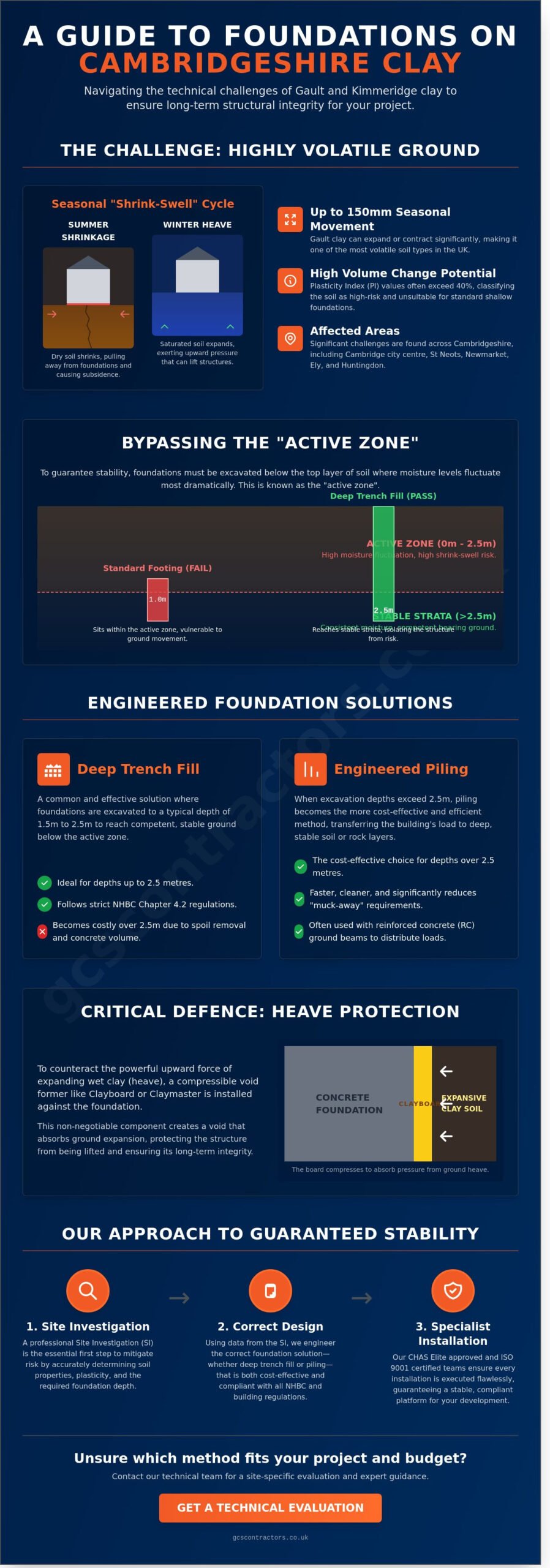
Cambridgeshire’s landscape is defined by the Gault and Kimmeridge clay belts. These geological formations consist of expansive clay soils that present significant risks to traditional construction methods. Shrink-swell clay is a soil type that changes volume based on moisture content, potentially leading to subsidence. We determine the severity of this risk using the Plasticity Index (PI). In Cambridgeshire, PI values often exceed 40% or 50%, which classifies the soil as having high volume change potential. Standard shallow footings can’t cope with this. Specifying the correct foundations for clay soil Cambridgeshire is the only way to prevent the structural movement that occurs when these soils react to environmental changes.
The High Plasticity Challenge in Ely and Huntingdon
In locations like Ely and Huntingdon, the Gault clay is particularly treacherous. Engineers identify an “active zone,” typically the top 2.5 metres of soil, where moisture levels fluctuate most violently due to evaporation and vegetation. While standard footings in other UK regions might only require a depth of 1.0 metre, these Cambridgeshire sites often demand excavations exceeding 2.0 metres. This ensures the foundation sits in stable, non-reactive soil. We use site-specific soil analysis to map these depths accurately before any concrete is poured, ensuring the foundations for clay soil Cambridgeshire meet NHBC standards.
Seasonal Movement: The Risks of Summer Shrinkage and Winter Heave
The variable climate in the East of England exacerbates soil instability. During record-breaking dry summers, such as in 2022, clay soils lose moisture and shrink. This causes the ground to pull away from footings, leading to subsidence. In winter, the process reverses. Heavy rainfall causes the clay to hydrate and expand, creating “heave” that can lift entire floor slabs. If you don’t account for these cycles during the groundworks phase, the structural integrity of the build is compromised. We mitigate these risks by using void formers and deeper trench fills that isolate the structure from seasonal ground pressure.
Selecting the Right Foundation Type for Clay Groundworks
Cambridgeshire ground conditions require specific engineering to manage the high plasticity of local clay. Trench fill foundations are a standard choice; however, they often reach depths of 1.5m to 2.5m to reach stable strata. We follow NHBC Chapter 4.2 strictly. These regulations dictate foundation depth based on the proximity of trees and their water-demand category. High-water-demand species like Oak or Poplar can necessitate deeper excavations to prevent subsidence during dry spells. For any foundations for clay soil Cambridgeshire project, we assess these environmental factors before the first bucket hits the ground.
Professional engineering resources like this guide on designing foundations for expansive clay highlight why specific structural solutions are required to counteract soil movement. We prioritise heave protection in every build. This involves installing clayboard or similar compressible materials against the inner face of the foundation. These products create a physical void that absorbs ground expansion, ensuring the structure remains unaffected by the natural “breath” of the clay.
Trench Fill vs. Piling: Finding the Cost-Effective Balance
The choice between deep trench fill and piling usually comes down to a clear break-even point. When excavation exceeds 2.5m, the volume of spoil removal and the quantity of concrete required often make trench fill less viable. Bulk excavation costs in Cambridge are a significant factor; moving hundreds of tonnes of wet clay is expensive. In these scenarios, we switch to engineered piling. It’s a faster, cleaner method that reduces the “muck-away” requirements. If you’re unsure which method fits your budget, contact our technical team for a site-specific evaluation.
Engineered Solutions for High-Risk Clay Sites
On high-risk sites, we utilise reinforced concrete (RC) ground beams to distribute structural loads effectively. These beams sit on top of piles and work in tandem with “claymaster” systems. We don’t cut corners with these materials; they’re non-negotiable for deep clay groundworks. From foundations to finishing, our CHAS Elite approved teams ensure every installation meets ISO 9001 standards. This disciplined approach guarantees a stable platform for any residential or commercial development in the region.
The GCS Contractors Approach: Foundation Excellence in Cambridgeshire
Clay soil doesn’t forgive mistakes. Before a single bucket of earth is moved, a professional site investigation (SI) is mandatory to determine the plastic limit of the ground. We don’t guess at soil mechanics; we rely on hard data. Our team brings local expertise to projects across St Neots, Newmarket, and Cambridge city centre. We operate as a CHAS Elite and ISO 9001 accredited contractor, ensuring every site meets rigorous safety and quality standards. GCS Contractors Ltd manages the entire process from bulk excavation to reinforced concrete finishing.
Precision Excavation and Spoil Management
Managing spoil on clay-heavy projects in East Anglia requires strict logistical planning. We organise efficient site clearance and muck-away services to prevent site congestion or water logging. By maintaining structural tolerances within 10mm, we reduce unnecessary site disturbance. Our fleet handles bulk earthworks with precision, ensuring the ground remains stable for the foundations for clay soil Cambridgeshire developers require. We focus on the tangible outcomes of our labour to keep projects moving.
Once the primary groundworks are complete, the focus often shifts to the final surfacing that will protect and enhance the property. For those looking for professional exterior solutions, you can explore Block Paving Driveways or research flexible alternatives; for instance, ResinBound Dublin provides a comprehensive guide on how resin-bound materials offer a durable, permeable finish that works in harmony with a correctly engineered sub-base.
Liaising with Building Control and Structural Engineers
We use a no-nonsense communication style with building control officers and structural engineers. This direct approach speeds up the approval process for modern Cambridgeshire developments. We provide the full suite of technical documentation, including load-bearing calculations and reinforced concrete specifications. This transparency ensures that your project stays on schedule. We speak the language of developers and engineers, providing a safe pair of hands for every build. Our disciplined approach ensures 100% compliance with current UK building regulations.
Secure Your Build with Cambridgeshire Groundworks Experts
Building on Gault clay demands a technical approach that standard footings can’t provide. Success depends on identifying the right engineering solution, whether that involves deep-trench fill or engineered raft systems, to counteract seasonal ground movement and heave. You’ve seen why professional soil analysis is non-negotiable for site safety and long-term structural integrity. GCS Contractors Ltd delivers this precision on every project, operating as a CHAS Elite approved contractor with a proven track record across the region.
We specialise in the specific challenges of foundations for clay soil Cambridgeshire projects require. Our team provides a seamless, comprehensive service from foundations to finishing, ensuring your site meets all ISO 9001 quality standards. We don’t just dig trenches; we provide the professional oversight needed to navigate complex ground conditions and strict regulatory requirements. It’s about giving your development a stable start with a partner who speaks the language of civil engineering and understands the local landscape.
Ready to secure your site? Contact our Cambridgeshire foundation specialists today
We’re ready to help you move your project forward with confidence and technical excellence.
Frequently Asked Questions
How deep should foundations be in clay soil in Cambridgeshire?
Foundations in Cambridgeshire clay typically require a minimum depth of 1.0 metre, though NHBC Chapter 4.2 standards often demand depths between 1.5 and 2.5 metres in high-shrinkage areas. Local clay types, such as Kimmeridge or Gault Clay, are highly volume-sensitive. We assess the specific plasticity index of your site to determine the exact depth. This ensures your foundations for clay soil Cambridgeshire meet all building control requirements.
What is heave protection and do I need it for my Cambridge extension?
Heave protection is a compressible material, such as Claymaster or Heaveguard, installed against the foundation to absorb soil expansion. You’ll need it if your project involves high-plasticity clay where moisture levels fluctuate. Standard practice in the UK construction industry requires these void-formers when foundation depths exceed 1.5 metres. It prevents the soil from exerting upward or lateral pressure on your structure; it’s a vital safety measure.
Can I build on clay soil without piling?
You can build on clay soil using deep strip or trench fill foundations if the load-bearing capacity is sufficient. Most residential extensions in the region use trench fill at depths between 1.0 and 2.5 metres. However, if the clay is soft or the required depth exceeds 2.5 metres, piling becomes the more cost-effective and stable option. From foundations to finishing, we evaluate every site individually to find the most efficient engineering solution.
How do trees affect foundations in clay-heavy areas like Ely?
Trees significantly impact foundations by extracting moisture from the soil, which causes the clay to shrink and the ground to subside. In Ely, where Gault Clay is prevalent, foundation depths must increase based on the tree species and its mature height. According to NHBC standards, a high-water-demand tree like an Oak can influence soil stability at a distance equal to its full height. We calculate these distances to ensure your foundations for clay soil Cambridgeshire remain secure.