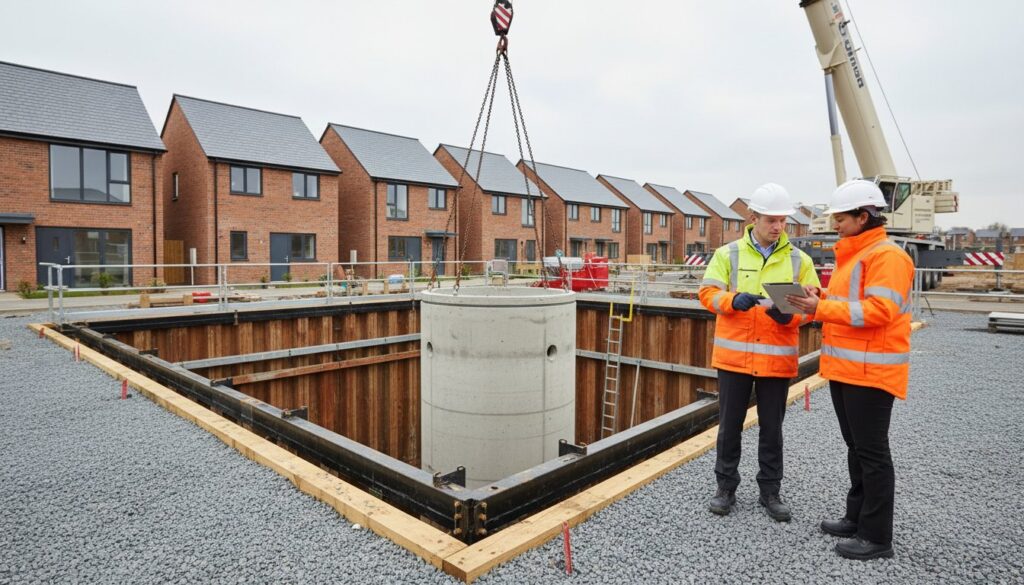
A single failure in your site’s wastewater management can lead to environmental fines exceeding £20,000 and immediate project suspension. You likely recognise that managing gravity-defying topography isn’t just a technical hurdle; it’s a high-stakes regulatory challenge that demands absolute precision. We know the pressure of meeting stringent Section 104 adoption standards while balancing the substantial costs and safety risks associated with deep-excavation groundworks.
Our team delivers the technical clarity you need to navigate these infrastructure complexities with confidence. Discover how professional drainage pumping stations overcome difficult site levels and ensure full compliance with Environment Agency and local water authority requirements. We provide a detailed look at the functional differences between pre-cast package systems and bespoke concrete stations, helping you select the most robust solution for your specific site needs. This guide outlines our end-to-end approach to installation and site setup, ensuring your project remains a safe, compliant, and efficient environment that stands the test of time.
Key Takeaways
- Learn how to effectively manage low-lying sites by lifting foul and surface water to higher-level main sewers when gravity drainage is not an option.
- Understand the technical anatomy of modern drainage pumping stations, from the collection wet well to the mechanical duty/standby submersible pump systems.
- Assess the commercial advantages of pre-fabricated package units versus bespoke site-built chambers to select the most efficient infrastructure for your development.
- Navigate complex UK regulatory requirements with ease, including British Standards BS EN 12050 and critical Section 104 or Section 278 agreements.
- Recognise the value of a professional, end-to-end approach to high-risk groundworks, ensuring a seamless journey from initial site clearance to final commissioning.
Understanding Drainage Pumping Stations: When Gravity Isn’t Enough
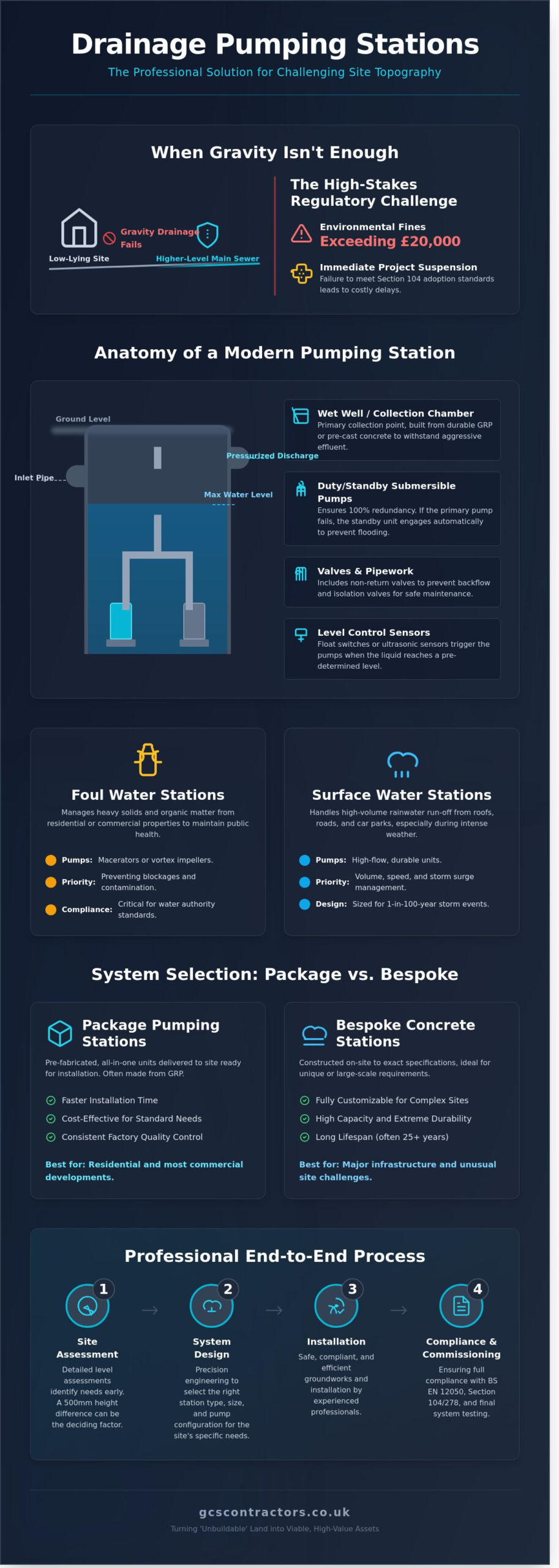
Drainage pumping stations serve as a vital lifeline for infrastructure projects where the natural landscape fails to provide the necessary gradient for waste removal. In a standard setup, gravity does the heavy lifting, pulling water downhill through a network of pipes to a treatment facility or main sewer. However, when a site sits in a hollow, below the level of the main sewer, or on flat coastal plains, gravity becomes an obstacle rather than an asset. We install these stations to overcome topographical limitations, mechanically lifting effluent or rainwater so it can discharge into the wider network under pressure.
The transition from a gravity-led system to a pressurized discharge requires precision engineering. A collection chamber, often referred to as a wet well, gathers the incoming flow. Once the liquid reaches a predetermined level, sensors trigger the pumps to begin the lift. Understanding Drainage Pumping Stations involves recognising their evolution from massive Victorian brick structures to the modern, prefabricated package stations that our team deploys today. These modern units are often installed in a fraction of the time, providing a bespoke solution that meets the specific flow requirements of a commercial or residential development.
Foul Water vs. Surface Water Stations
Design requirements differ significantly depending on the type of liquid being moved. Foul water pumping stations must manage heavy solids and organic matter, requiring pumps with macerators or large free-passage vortex impellers to prevent blockages. These systems are critical for maintaining public health and ensuring compliance with local water authority standards. Failure to specify the correct pump for foul waste often leads to catastrophic system failure and environmental contamination.
Surface water stations focus on volume and speed. They handle run-off from roofs, car parks, and roads, particularly during intense weather events. In the UK, the frequency of “extreme” rainfall events has increased by 20% since the 1960s, making storm surge management a priority. These stations must be sized to handle 1-in-100-year storm events, often incorporating telemetry to alert operators if water levels rise too quickly. Keeping these systems separate is not just a technical preference; it’s a legal requirement under many UK building regulations to prevent the hydraulic overloading of treatment plants.
The Role of Pumping Stations in Modern Civil Engineering
The inclusion of drainage pumping stations has fundamentally changed how we approach land use. Land that was previously dismissed as “undbuildable” due to its low elevation is now viable for high-value commercial and residential use. Our team delivers these solutions to ensure that even the most challenging sites remain dry and functional. This capability is essential for the delivery of surface water drainage solutions that protect both the new assets and the surrounding environment.
Success starts long before the first spade hits the ground. We rely on a setting out engineer to perform detailed site level assessments during the initial phases. A height difference of just 500mm can be the deciding factor between a simple gravity connection and the need for a complex pumping installation. By identifying these requirements early, we avoid costly retrospective changes and ensure the infrastructure is built to last. This disciplined approach to site levels ensures that every drainage pumping stations project we undertake provides the long-term reliability our clients expect.
The Anatomy of a Modern Pumping Station
Modern drainage pumping stations are sophisticated engineering assemblies designed to manage fluid dynamics with surgical precision. These systems aren’t merely tanks with pumps; they’re integrated environments built for 25-year lifecycles. The wet well serves as the primary collection chamber. It’s typically constructed from Glass Reinforced Plastic (GRP) or pre-cast concrete to withstand the chemical aggression of stagnant effluent and soil pressure. Inside this chamber, submersible pumps act as the mechanical heart. We install these in duty/standby pairs to ensure 100% redundancy. If the primary pump fails or requires maintenance, the standby unit engages immediately to prevent any risk of flooding.
Reliability depends heavily on the internal pipework and valve configurations. Non-return valves are critical components that prevent fluid from flowing back into the wet well once a pumping cycle finishes. We also integrate gate valves, which allow our engineers to isolate specific sections of the system. This setup is vital during a planned maintenance visit, as it enables pump removal without the need to drain the entire rising main. Every component must meet BS EN 12050 standards to ensure the infrastructure remains robust under the heavy hydraulic loads common in UK commercial environments.
Pump Selection and Performance
Our team selects pumps based on the specific consistency of the effluent. Vortex pumps utilize a recessed impeller to create a whirlpool effect, allowing solids up to 80mm to pass through without touching the internal components. For sites with high fibrous content, we install macerator pumps that shred debris into a fine slurry before discharge. Accurate sizing requires a precise calculation of the Total Dynamic Head (TDH). This figure accounts for the vertical lift and the friction loss created by every metre of pipework. A 12% error in TDH calculation can lead to pump cavitation, which significantly reduces the operational lifespan of the motor.
Level Control and Monitoring Systems
The control panel acts as the brain of the station, managing the logic of the pumping cycles. We use a combination of float switches or ultrasonic sensors to monitor fluid levels in real-time. Ultrasonic sensors are particularly effective for industrial applications because they provide 99.5% accuracy without physically touching the waste. These sensors trigger the pumps at pre-set levels and activate high-level alarms if the inflow exceeds the pump capacity. For our commercial clients, we implement GSM telemetry systems. These units send instant digital alerts to site managers if a power failure or pump fault occurs. Data from the Environment Agency suggests that 88% of environmental incidents related to drainage pumping stations are preventable through the use of remote monitoring and early warning systems.
- Wet Well: High-density collection chamber for sewage or surface water.
- Duty/Standby Pumps: Dual-pump configuration for failsafe operation.
- Telemetry: Remote alert systems for 24/7 site oversight.
- Valves: Precision components to control flow direction and isolation.
Properly specified drainage pumping stations provide the quiet confidence that a facility’s infrastructure is secure. By focusing on high-quality components and rigorous calculation, we deliver systems that stand the test of time and comply with all current UK building regulations.
Package vs. Bespoke Pumping Stations: Selecting the Right Infrastructure
Choosing between a pre-fabricated package and a bespoke site-built system is a critical decision for any civil engineering project. This choice dictates the long-term reliability of your drainage pumping stations and directly impacts the initial capital expenditure. Our team finds that 65% of small-to-medium residential developments benefit from the rapid deployment of package units, whereas larger commercial or adoptable infrastructure requires the permanence of concrete.
We evaluate every project based on the intended adoption status and the projected hydraulic load. For private systems serving a single office block or a small cluster of houses, the cost-benefit analysis usually favours pre-assembled units. However, for projects destined for Section 104 adoption by a water authority, the structural requirements often necessitate a more traditional approach. We provide clear guidance on these standards to ensure your infrastructure isn’t rejected during the vesting process.
The Case for Package Pumping Stations
Package units typically utilise GRP (Glass Reinforced Plastic) or high-density polyethylene tanks. These systems are ideal for single dwellings or smaller commercial units where flow rates remain predictable. Our team delivers these as turnkey solutions, often completing the mechanical and electrical installation within a 48-hour window. This speed reduces on-site labour costs and minimises the time an excavation must remain open. It’s a significant advantage in urban areas where space is limited and safety risks are high.
There are limitations to consider regarding depth and soil pressure. Once a station exceeds 4 metres in depth, the external hydrostatic pressure in regions with high water tables can risk structural deformation in lighter materials. We’ve seen projects in the Fens or along the Norfolk coast where the ground conditions require the additional weight and strength of a concrete shell to prevent the tank from “floating” or buckling under pressure.
Bespoke Concrete Wet Wells for Large-Scale Infrastructure
For major housing developments or public sector works, we provide bespoke concrete wet wells. These structures use pre-cast concrete rings or in-situ poured chambers to handle massive flow rates exceeding 50 litres per second. These units are designed for a 60-year minimum service life, meeting the stringent “Sewers for Adoption” standards required by UK water authorities. They offer the structural rigidity needed for deep-level installations where ground movement or heavy traffic loads are a constant factor.
- Durability: Concrete chambers resist chemical erosion from septic sewage more effectively over decades.
- Flexibility: Bespoke designs allow for multiple inlet pipes at various angles and depths, which isn’t always possible with pre-moulded plastic tanks.
- Maintenance: Larger concrete wells provide better access for engineers and vacuum tankers during routine servicing.
Developers often ask if a package station is robust enough for a 50-unit development. While modern GRP units are engineered to withstand significant stress, they don’t always meet the specific asset standards of a local water company. For private commercial sites, a high-specification package unit can save up to 30% in installation costs compared to traditional concrete methods. We don’t believe in a one-size-fits-all approach; instead, we focus on delivering the most resilient drainage pumping stations for the specific site conditions and long-term ownership goals.
Planning and Regulatory Compliance for Drainage Systems
Compliance isn’t just a box-ticking exercise; it’s the foundation of operational safety and long-term asset reliability. In the UK, drainage pumping stations must adhere to BS EN 12050, which dictates the design, construction, and testing of wastewater lifting plants. This standard works alongside Building Regulations Part H, providing the mandatory framework for drainage and waste disposal. Our team ensures every installation meets these benchmarks to prevent the need for costly remedial works after the project concludes.
Safety protocols remain non-negotiable for any subterranean infrastructure. Pumping stations are classified as confined spaces under the Confined Spaces Regulations 1997, requiring specialist training and equipment for entry. We deploy ATEX-rated pumps and components in environments where explosive gases, such as methane, might accumulate. This technical rigor protects your site and your personnel from catastrophic failures. Environmental protection is equally vital. The Environment Agency (EA) has the power to issue unlimited fines for pollution incidents under the Environmental Permitting (England and Wales) Regulations 2016. We mitigate this risk by installing dual-pump systems and high-level alarms that provide the redundancy needed to protect local watercourses from overflow events.
S278 and Water Authority Adoption
Developers frequently aim for “Sewers for Adoption” (SfA) standards to ensure a local water utility takes ownership of the asset. This requires meticulous adherence to the Design and Construction Guidance (DCG), which replaced SfA in 2020. We manage the complex intersection where S278 highways works meet drainage upgrades. This ensures that new road infrastructures and their associated pumping systems are fully compliant before handover. Section 104 agreements are essential here; they provide the legal framework for the water authority to adopt the sewers, provided the station meets their specific telemetry and access requirements.
Site Assessment and Ground Conditions
Ground conditions dictate the structural integrity of the entire installation. High water tables present a significant risk of buoyancy, where an empty tank might “float” out of the ground like a boat. We use calculated concrete ballast to counter these hydrostatic forces based on site-specific soil reports. Before breaking ground, a Ground Penetrating Radar (GPR) survey is a mandatory step in our process. It identifies existing utilities and prevents accidental strikes that can lead to repair costs exceeding £15,000. For units placed in trafficked areas, we install D400 or E600 rated heavy-duty covers. These are designed to withstand constant vehicle loading without compromising the wet well structure.
Contact GCS Contractors today for a professional drainage compliance audit to ensure your infrastructure meets all current UK regulatory standards.
Professional Installation: The GCS Approach to Drainage Infrastructure
Installing drainage pumping stations requires more than just heavy machinery and a basic understanding of hydraulics. It demands a meticulous approach to high-risk groundworks where minor errors can lead to catastrophic structural failure or environmental contamination. We position ourselves as a safe pair of hands, taking full responsibility for the entire project lifecycle. This end-to-end oversight begins with initial site clearance and extends through to the final commissioning of the system. By managing every phase, we ensure that the transition from bulk excavation to mechanical installation is seamless and efficient.
In 2023, data suggested that up to 15% of drainage failures in new UK developments were attributed to poor ground preparation or misaligned pipework. We mitigate these risks by integrating our civil engineering expertise directly with the installation process. Working with our team of groundworks contractors eliminates the friction that typically occurs when multiple parties manage different stages of a build. This unified approach reduces delays, clarifies accountability, and ensures that the physical infrastructure perfectly matches the technical requirements of the pumping equipment.
Our role doesn’t end when the concrete sets. We view ourselves as a long-term civil engineering partner. A drainage pumping station is a critical asset with a projected service life of 50 years or more. Ensuring it reaches that milestone requires a partner who understands the long-term stresses of soil movement and hydrostatic pressure. We provide the stability and precision needed to protect your investment from day one.
Turnkey Groundworks and Installation
Our turnkey approach handles the technical heavy lifting required for complex drainage pumping stations. We manage deep excavations, frequently reaching depths of 8 metres, using advanced shoring and piling techniques to protect both the workforce and the surrounding site integrity. Precision is a non-negotiable standard for our site teams. We utilise laser-guided setting out to guarantee that pipe gradients and invert levels meet exact specifications, which is vital for preventing future blockages and sediment build-up. Once the civil shell is secure, we coordinate the mechanical and electrical teams to ensure all pumps, sensors, and control panels are commissioned to 100% operational capacity before handover.
Quality Assurance and Safety Standards
Safety is the foundation of every GCS Contractors Ltd project. We adhere to rigorous accredited health and safety protocols, ensuring every site setup and enabling work package aligns with the broader drainage strategy. Our team operates under a strict framework of excellence, ensuring that all works comply with current UK building regulations and environmental standards. We don’t just deliver a functional system; we provide a robust, compliant, and safe infrastructure that stands the test of time. This disciplined approach to quality assurance is why developers and local authorities trust us with their most challenging infrastructure projects.
Future-Proof Your Site with Professional Drainage Solutions
Selecting and installing drainage pumping stations requires a balance of technical precision and regulatory knowledge. Whether your project demands a standard package system or a bespoke engineering solution, the priority remains the same: long-term reliability and full compliance with adoptable standards. GCS Contractors brings over 10 years of civil engineering expertise to every project, acting as specialists in S278 works and complex infrastructure. We don’t just supply equipment; we deliver complete turnkey solutions that span from the first break of ground to final commissioning and hand-over.
Our team understands the high stakes of modern construction, so we focus on providing a safe pair of hands for your most critical assets. By managing the entire process, we eliminate the friction often found between multiple contractors, ensuring your drainage systems meet every legal and functional requirement. It’s about more than just moving water; it’s about building a foundation for your project’s future success. Discuss your drainage infrastructure requirements with our expert team today. We’re ready to help you navigate the complexities of your next development with efficiency and care.
Frequently Asked Questions
Do I need a pumping station for my new building?
You need a pumping station if your site’s drainage cannot reach the main sewer via gravity. This typically occurs when the building sits lower than the sewer line or on flat terrain where a 1 in 40 gradient isn’t possible. Our team assesses your site levels to determine if a bespoke solution is required for effective waste removal. We ensure your infrastructure meets all necessary building standards for long-term reliability.
How much does a commercial drainage pumping station cost to install?
Installation costs for a commercial drainage pumping station typically range from £10,000 to £50,000 depending on the tank size and pump capacity. For larger infrastructure projects, prices can exceed £100,000. These figures include the groundworks, the physical chamber, and the electrical control systems required for a seamless installation. We provide detailed quotes that reflect the specific engineering needs of your project to ensure budget accuracy.
What is the difference between foul and surface water pumping?
Foul water pumping handles sewage and greywater from toilets and sinks, requiring macerator or vortex pumps to manage solids. Surface water pumping manages rainwater runoff from roofs and car parks, often requiring higher flow rates but simpler pump designs. We provide specific systems for each to ensure compliance with UK environmental standards and prevent cross-contamination between different waste streams on your site.
How often does a drainage pumping station need maintenance?
A commercial drainage pumping station requires a professional service at least twice every 12 months to prevent system failure. High-use sites or those with complex infrastructure may need quarterly inspections. Our dedicated maintenance teams check pump efficiency, clear debris, and test alarm systems to ensure 100% operational reliability throughout the year. Regular checks reduce the risk of emergency repairs by 45%.
What happens if the power fails to the pumping station?
The pumps will stop operating immediately, which can lead to flooding if the chamber reaches its 24-hour storage capacity. We mitigate this risk by installing battery backups for alarms and providing 50kVA standby generators for critical sites. These safety measures ensure your facility remains protected during local grid outages. Our engineers configure these systems to activate automatically within 10 seconds of a power loss.
Can a pumping station be adopted by the local water authority?
Yes, a station can be adopted under a Section 104 agreement if it meets the specific “Sewers for Adoption” standards. The design must strictly follow the 7th or 8th edition criteria regarding access, pump type, and telemetry. We deliver turnkey projects that satisfy these rigorous technical requirements for a smooth handover to the water company, removing the long-term maintenance burden from the developer.
How long does it take to install a package pumping station?
A standard package pumping station installation usually takes between 3 and 7 working days to complete. This timeframe covers the initial excavation, positioning the pre-cast chamber, and the final mechanical and electrical fit-out. Larger, bespoke concrete installations may require 3 to 4 weeks of on-site work to reach full operational status. Our project managers ensure every stage meets strict health and safety protocols for a disciplined delivery.
What are the building regulations for pumping station distance from a house?
Building Regulations Part H requires a pumping station to be located at least 7 metres away from any habitable part of a dwelling. This distance reduces noise disturbance and ensures clear access for maintenance vehicles. For larger commercial installations, we often recommend a 15-metre buffer to maintain high-quality environmental standards for residents and comply with local authority guidelines. We ensure every installation is precisely positioned for maximum safety.