Cost of Foundations for House Extension in Cambridge: 2026 Price Guide
Industry data suggests that groundworks can account for up to 25% of your total construction budget before a single brick is laid above the damp proof course. In our experience across Cambridgeshire, calculating the cost of foundations for house extension Cambridge projects is rarely straightforward due to the region’s notorious Gault clay and restricted access sites. You likely understand that the ground beneath your garden is the most unpredictable variable in your build, and the fear of a “money pit” is a valid concern for any homeowner or developer.
We’ve produced this guide to remove that uncertainty by providing a technical breakdown of current 2026 pricing structures, local soil factors, and the specific logistics involved in Cambridge groundworks. You’ll gain a clear understanding of different foundation types, from traditional strip to engineered piles, alongside practical advice on navigating local building control. We’ll show you how to budget accurately and what to look for when selecting a specialist contractor to ensure your project starts on a solid, compliant footing.
Key Takeaways
- Understand how Cambridge’s unique geology and local soil conditions dictate specific excavation depths and concrete volumes for your project.
- Benchmark your project budget using our 2026 price breakdown for the cost of foundations for house extension Cambridge developments.
- Compare structural options, from standard strip foundations to reinforced concrete rafts, to find the most cost-effective solution for your ground conditions.
- Learn why specialist accreditations like CHAS Elite and ISO 9001 are essential when selecting a groundworks contractor to ensure site safety and compliance.
- Discover how professional groundworks logistics can streamline your build from foundations to finishing, avoiding common delays in the Cambridgeshire area.
Understanding Foundation Costs for Cambridge House Extensions
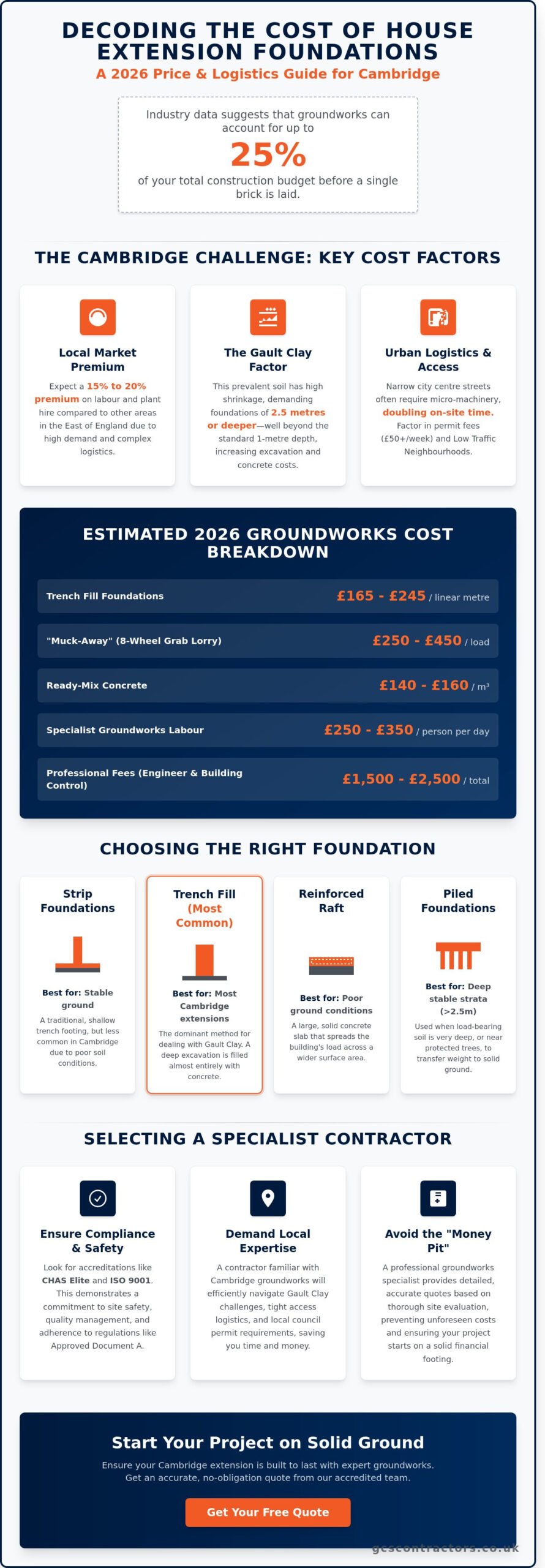
Calculating the cost of foundations for house extension Cambridge projects requires a detailed look at local variables. Cambridge groundworks often exceed national averages due to high demand and complex logistics. The local market currently sees a 15% to 20% premium on labour and plant hire compared to other regions in the East of England. Site-specific factors like geology and waste disposal regulations further influence the final invoice.
Geology dictates excavation depth and concrete volume. In Cambridgeshire, strict waste disposal regulations mean ‘muck-away’ costs are a significant budget line. Removing inert or non-hazardous waste requires specific permits. As of late 2024, a standard 8-wheel grab lorry load typically costs between £250 and £450 depending on the material classification and transport distance to the tip.
To better understand these cost variables, watch this helpful breakdown of extension expenses:
The Cambridge Soil Factor: Gault Clay and Footing Depth
Gault Clay is prevalent across CB1 to CB5 postcodes. This soil has high shrinkage potential, meaning it expands when wet and contracts when dry. When moisture levels change or nearby trees draw water, foundations must go deeper to find stable ground. Standard 1-metre trenches often fail building control inspections in these areas. We frequently see requirements for footings at 2.5 metres or more. This depth forces a shift from standard strip foundations to deep trench fill. Applying professional Foundation engineering principles is essential here to ensure the extension doesn’t suffer from subsidence in future years.
Logistics and Access in the Cambridge City Centre
Site access is a primary cost driver in historic areas like the Kite or De Freville. Narrow Victorian terraces often prevent the use of 13-tonne excavators. Using micro-machinery or manual labour can double the time spent on-site. You must also factor in Cambridge City Council permit fees for skips or grab lorries on restricted streets. These permits often start at £50 per week. The logistics of coordinating deliveries in “Low Traffic Neighbourhoods” (LTNs) adds further complexity. These constraints directly impact the total cost of foundations for house extension Cambridge developments, as smaller loads and slower excavation speeds increase the labour hours required.
Estimating Footing Prices and Foundation Types in 2026
Standard strip foundations remain a common choice for stable ground, yet trench fill is the dominant method for most Cambridge rear extensions. Trench fill involves filling a deep excavation almost entirely with concrete, which reduces the need for narrow-trench brickwork and speeds up the build. When ground conditions are poor or unpredictable, reinforced concrete rafts offer a solution by spreading the extension’s load across a wider surface area. All foundation designs must adhere to the safety standards outlined in Approved Document A: Structure to pass building control inspections.
Typical Cambridge Extension Groundworks Cost Breakdown
Calculating the cost of foundations for house extension Cambridge projects involves balancing material price hikes with local labour rates. By 2026, trench fill foundations are estimated to cost between £165 and £245 per linear metre. This rate covers excavation, muck-away, and concrete pouring. In the East of England, ready-mix concrete prices hover around £140 to £160 per cubic metre. Specialist groundworks gangs typically command day rates of £250 to £350 per person. You must also budget for professional oversight. Structural engineer fees for a standard extension range from £850 to £1,550, while building control notification and inspection fees add approximately £650 to £950 to the total.
Piling and Specialist Substructures
Simple footings aren’t always viable. Piling becomes the most cost-effective route if firm load-bearing strata are deeper than 2.5 metres, a common scenario in Cambridge due to shrinkable clay soils and protected trees. For large-scale kitchen extensions, reinforced concrete slabs provide the necessary rigidity to prevent cracking. A site-specific soil survey costing roughly £1,400 is a vital investment. It identifies these issues before the diggers arrive, preventing £11,000 budget shocks mid-build. From foundations to finishing, our civil engineering experts ensure your substructure is built to last.
Choosing a Groundworks Contractor in Cambridge
Selecting between a general builder and a specialist groundworks firm determines the long-term stability of your project. While a general builder might offer to dig footings as part of a wider package, they often lack the heavy plant machinery and technical precision required for complex soil conditions. GCS Contractors Ltd operates as a specialist firm, bringing industrial-grade expertise to residential sites. We hold CHAS Elite and ISO 9001 accreditations, which signal a disciplined approach to safety and quality management that generalists rarely match.
Our “Foundations to Finishing” process reduces client risk by keeping the entire substructure phase under one roof. This management style eliminates the friction often found when transitioning between different sub-contractors. To keep the cost of foundations for house extension Cambridge predictable, we provide fixed-price quotes. This protects your budget from ground-level surprises, such as unmapped Victorian drainage or varying soil strata, which can otherwise cause costs to spiral once the first bucket hits the dirt.
Why Professional Groundworks Save Money Long-Term
Cheap footings are a false economy. Structural failure due to poor ground preparation can lead to remedial costs exceeding £25,000. We ensure every trench and slab complies strictly with Cambridge City Council building regulations, specifically Part A (Structure). By using modern 360 excavators and bulk excavation techniques, we accelerate the build programme. Professional excavation is typically 40% faster than manual digging, allowing your bricklayers to start weeks earlier.
Getting an Accurate Quote for Your Cambridge Project
To provide a definitive cost of foundations for house extension Cambridge, our team requires your architectural drawings and structural calculations. These documents specify the depth and steel reinforcement needed. We also conduct a site visit to assess narrow access points and existing utility connections. This technical assessment ensures the price we quote is the price you pay.
Get Your 2026 Cambridge Extension Off the Ground
Navigating the technical requirements for a home extension in Cambridgeshire requires a practical approach to groundworks. You must account for the unique shrink-swell properties of Cambridge Gault Clay, which frequently determines the choice between traditional trench fill and engineered piling systems. Establishing a realistic budget for the cost of foundations for house extension Cambridge projects ensures your build stays on track throughout the 2026 construction season.
GCS Contractors Ltd provides the professional expertise needed for a stable and compliant start. We’re CHAS Elite and ISO 9001 accredited, maintaining a full fleet of specialist excavation machinery to manage projects of any scale. Our team understands the high stakes of civil engineering and delivers a safe pair of hands for your residential groundwork. From foundations to finishing, we focus on technical precision and efficiency.
Request a Professional Foundation Quote for Your Cambridge Extension
Your project deserves a solid start, and we’re ready to help you build with total confidence.
While this guide focuses on the technical groundwork required for Cambridge extensions, the quality of the subsequent renovation is just as vital. For those seeking premium building expertise to complete their project, you can learn more about Horns Construction and their high-quality property services.
Frequently Asked Questions
How deep do foundations need to be for an extension in Cambridge?
Foundations in Cambridge typically require a minimum depth of 1 metre. However, because of the heavy clay soil prevalent across the region, Building Control often mandates depths of 1.5 metres or even 2.5 metres if established trees are nearby. Our team ensures all excavations meet the specific requirements of the NHBC Standards Chapter 4.2 for building near trees and vegetation.
Is piling always necessary for extensions in Cambridgeshire?
Piling isn’t always necessary but becomes essential when traditional trench fill foundations exceed 2.5 metres in depth. In areas like the Fens or sites with significant peat deposits, piling provides the required structural integrity where standard footings would fail. As a CHAS Elite approved contractor, we assess soil conditions to determine if mini-piling or reinforced ground beams offer the most reliable solution for your project.
How much does it cost to move drainage during foundation laying?
Relocating a standard 110mm drainage run typically costs between £600 and £1,200 depending on the depth and length of the diversion. This includes the cost of new pipework, inspection chambers, and the necessary “build over” agreements with Anglian Water. We manage these technical adjustments from foundations to finishing to keep your project compliant and on schedule. For the subsequent internal fit-out, specialists like NBS Plumbing & Heating provide the high-quality expertise needed for complex plumbing and heating installations.
What is the average cost per metre for foundations in Cambridge in 2026?
The cost of foundations for house extension Cambridge projects in 2026 averages between £130 and £190 per linear metre for standard trench fill. These figures fluctuate based on muck-away rates and the current market price of ready-mixed concrete. We provide precise, transparent quotes that reflect these variables while maintaining our high standards of safety and professional efficiency.
Do I need a soil survey before digging footings in Cambridge?
You should always conduct a soil survey before digging footings to identify shrinkable clays or high water tables common in Cambridgeshire. A site investigation report usually costs approximately £800 to £1,500 but prevents the risk of foundation failure or unexpected costs later. This technical data allows us to design the most cost-effective and stable groundworks solution for your specific site.
How long does it take to dig and pour foundations for a 30m2 extension?
Digging and pouring foundations for a 30m2 extension usually takes 3 to 5 working days. This timeline includes site setup, excavation, installing steel reinforcement, and the final concrete pour. Weather conditions and soil stability affect this duration, but our disciplined approach ensures we complete the BWIC elements quickly to move your build into the next phase.