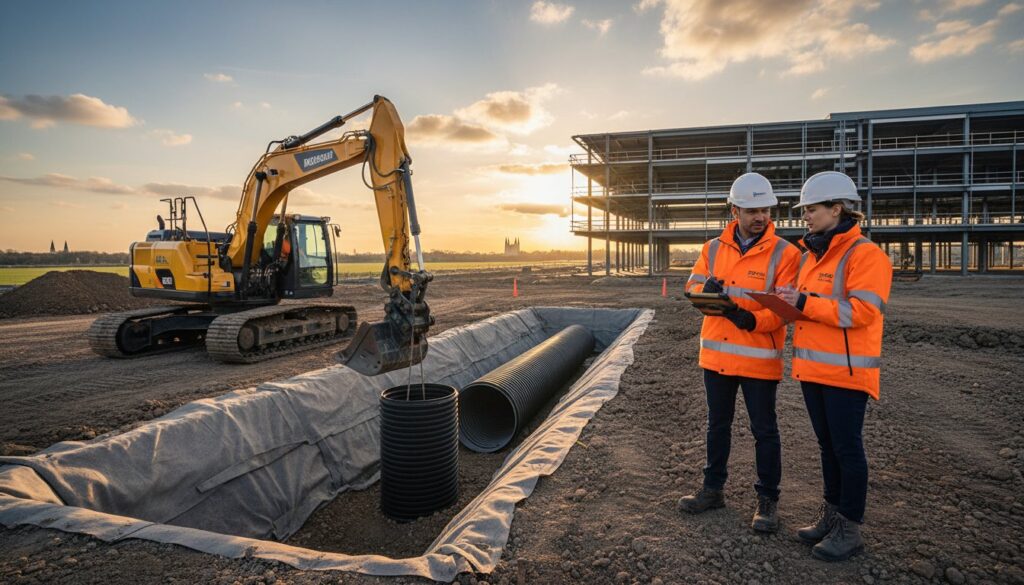
A single non-compliant pipe run or a miscalculated Section 104 agreement can stall a multi-million pound development for over 90 days. You understand that the success of any large-scale project depends entirely on the integrity of the infrastructure buried beneath the surface. For developers overseeing commercial drainage Cambridge projects, the transition from design to adoption requires more than just a contractor; it demands a partner with the heavy plant machinery and technical foresight to prevent costly delays. Selecting the wrong firm often leads to hidden expenses in S278 agreements that can inflate your groundworks budget by as much as 15%.
We’ve developed this comprehensive 2026 selection checklist to help you identify a civil engineering partner who delivers a truly turnkey solution. You’ll learn how to audit a contractor’s plant inventory, verify their compliance history with local water authorities, and ensure seamless integration with your wider groundworks schedule. This guide details the essential benchmarks for long-term infrastructure reliability and legal handover, ensuring your project remains on track and fully compliant from the first day on site.
Key Takeaways
- Define your project’s technical scope by distinguishing between basic maintenance and the complex civil engineering required for large-scale commercial infrastructure.
- Understand the critical role of Sustainable Drainage Systems (SuDS) and attenuation tanks in managing high-volume runoff for modern commercial developments.
- Assess contractor competency by verifying essential accreditations and owned-plant capabilities necessary for high-stakes commercial drainage Cambridge projects.
- Identify the regulatory milestones and survey requirements, such as GPR mapping and Section 104 agreements, that prevent costly delays and utility conflicts.
- Discover the strategic advantage of partnering with an integrated groundworks provider to ensure a seamless, turnkey transition from site preparation to drainage installation.
The Commercial Drainage Infrastructure Checklist: Defining Your Project Scope
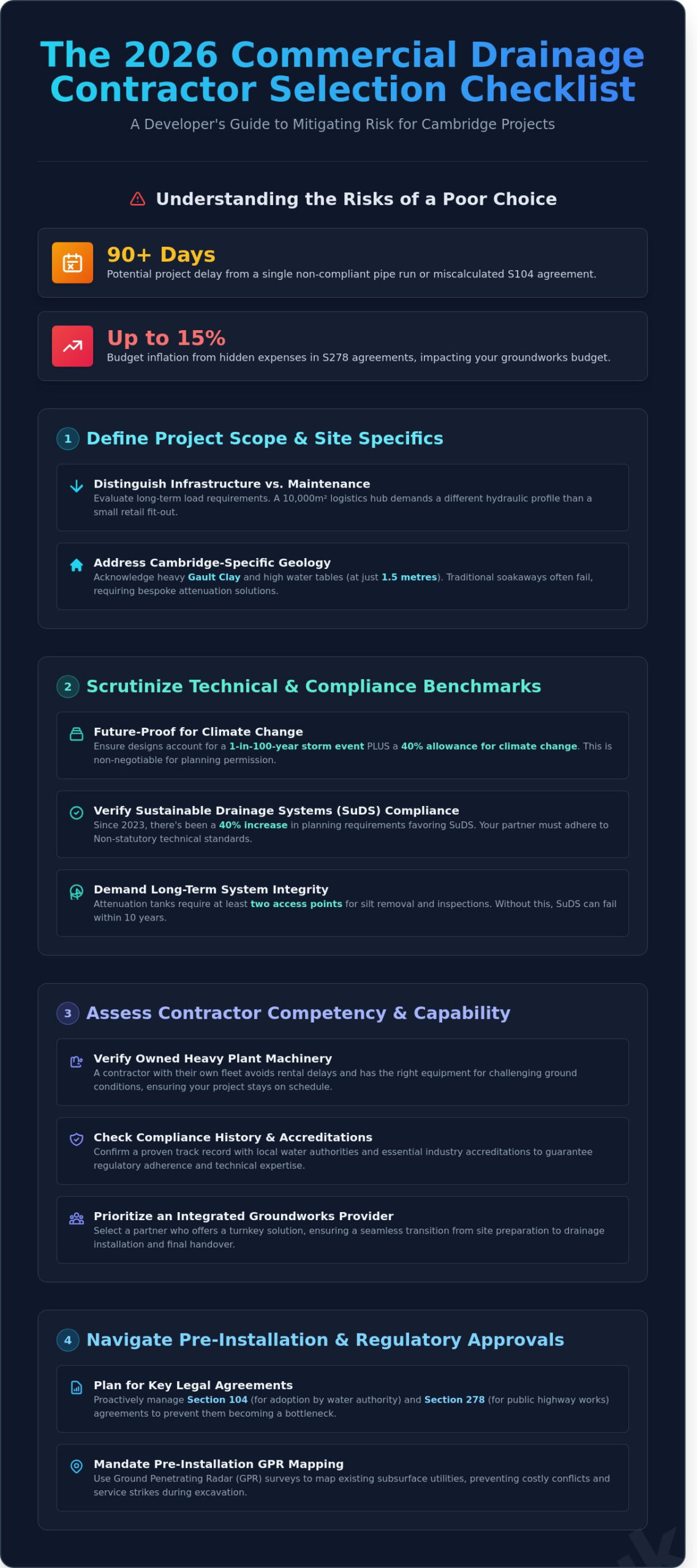
Selecting the right partner for commercial drainage Cambridge requires a clear distinction between reactive maintenance and civil engineering infrastructure. While a simple blockage might require a quick fix, commercial developments in 2026 demand a comprehensive approach to sub-surface assets. We distinguish between these needs by evaluating the long-term load requirements of the site. A 10,000 square metre logistics hub requires a vastly different hydraulic profile than a small retail fit-out. Our team ensures that every pipe diameter and gradient is calculated to handle the specific discharge rates of your industrial operations.
Successful projects begin with total integration. We recommend engaging groundworks contractors Cambridge during the initial design phase rather than treating drainage as an afterthought. This prevents costly retrofitting and ensures that the structural integrity of the building’s foundations isn’t compromised by poorly placed utility runs. Cambridge presents unique geological hurdles, specifically the heavy Gault Clay and high water tables often found at depths of just 1.5 metres. These conditions mean traditional soakaways often fail; you’ll need bespoke attenuation solutions that manage water on-site before a controlled release into the mains network.
Surface Water vs. Foul Water Requirements
Modern compliance demands a strict separation between surface runoff and sewage systems. Our checklist for new developments focuses on preventing cross-contamination, which is a major focus for the Environment Agency. We integrate complex surface water drainage solutions that include oil-water separators and silt traps, ensuring that discharge limits stay within the standard 2 litres per second per hectare. This technical precision protects your site from legal liabilities and environmental fines.
Capacity and Future-Proofing the Site
We calculate peak flow rates based on the maximum possible usage of your facility, not just the average. By 2026 standards, every commercial drainage Cambridge project must account for 1-in-100-year storm events plus a 40% allowance for climate change. This level of future-proofing is non-negotiable for securing planning permission. To meet these rigorous benchmarks, we design and install sustainable drainage systems (SuDS) that use permeable paving, swales, and attenuation tanks to mimic natural water cycles. This approach reduces the pressure on the local Cambridge infrastructure while providing a robust, long-term asset for the property owner. Our goal is to deliver a system that remains functional and compliant for the next 50 years.
Technical Specification Checklist: Essential Infrastructure Components
Selecting the right infrastructure for commercial drainage Cambridge projects requires a balance between traditional capacity and modern environmental compliance. We’ve observed a 40% increase in local planning requirements favoring Sustainable Drainage Systems (SuDS) over direct mains connections since 2023. Contractors must adhere to the Non-statutory technical standards for SuDS to manage peak flow rates effectively. This transition ensures that runoff doesn’t overwhelm local networks during intense rainfall events. It’s about protecting your assets and the wider community through disciplined engineering.
Attenuation and Water Management
Modular crate systems offer a 95% void ratio, making them a space-efficient choice for tight urban sites. However, we recommend concrete attenuation tanks for heavy-duty car parks where structural longevity is the priority. Our team ensures all installations meet Eurocode 2 standards for liquid-retaining structures. For comprehensive guidance on implementing these critical systems, our professional attenuation tank installation guide details the engineering requirements and regulatory compliance needed for successful stormwater management. Maintenance access is a non-negotiable requirement. You need at least two access points per tank to allow for silt removal and robotic inspections. Without these, your SuDS infrastructure can fail within 10 years due to sediment buildup.
Pumping Stations and Rising Mains
Gravity isn’t always on your side in low-lying areas across East Anglia. When your site sits below the invert level of the public sewer, we install drainage pumping stations to bridge the gap. These systems must comply with ‘Sewers for Adoption’ standards to ensure they’re robust enough for commercial use. We specify dual-pump configurations for 100% redundancy. This prevents operational downtime if a single pump fails. Modern telemetry systems provide 24/7 monitoring, alerting maintenance teams to issues before they cause a flood. If you’re unsure about your site’s elevation needs, our engineers can conduct a full topographical survey to determine the most cost-effective solution.
Industrial sites require hardware that withstands constant HGV traffic. We install D400 or E600 rated heavy-duty manhole covers to prevent cracking under 40-tonne loads. Additionally, interceptors are vital for any site handling vehicles to capture oils and silt. We recommend Class 1 full retention separators for high-risk areas like fuel stations or loading bays. These components form the backbone of a reliable commercial drainage Cambridge system. They ensure your facility remains compliant and operational year-round. Our approach focuses on delivering physical results that stand the test of time through meticulous planning and high-quality materials.
Contractor Competency Checklist: Assessing Civil Engineering Rigour
Selecting a partner for commercial drainage Cambridge projects requires more than a glance at a quote. You need a contractor with the civil engineering rigour to handle complex sub-surface infrastructure. Non-negotiable accreditations include CECA (Civil Engineering Contractors Association), CHAS, and SafeContractor. These aren’t just badges; they represent a commitment to 2026 safety standards and technical proficiency. We recommend verifying that your contractor owns their plant and machinery. Relying on third-party hire leads to delays on 15% of projects due to equipment availability or logistics failures. Owning a dedicated fleet of 360-degree excavators and vacuum tankers ensures immediate response and consistent maintenance of the gear used on your site.
A “safe pair of hands” is proven through history. Reviewing past commercial infrastructure case studies from the last 24 months provides a transparent look at their capability. You should verify they carry at least £10 million in Public Liability insurance and Professional Indemnity insurance for design-and-build works. This level of coverage protects your investment during high-value civil engineering operations where the cost of error is substantial. We suggest requesting certificates directly from the broker to confirm the policy is active and specific to deep-drainage risks.
Health, Safety, and Environmental Compliance
Safety is the cornerstone of every excavation. Every project must have site-specific RAMS (Risk Assessments and Method Statements) that align with Approved Document H regulations. This ensures compliance with UK building standards for drainage and waste disposal. Our teams utilize environmental protection measures, such as silt traps and bunded fuel storage, to prevent site runoff from contaminating local Cambridge watercourses. Deep drainage installation requires 100% of the on-site team to hold valid confined space training certificates to mitigate risks in trenches exceeding 1.2 meters.
Turnkey Project Management Capabilities
Efficiency improves when you integrate services. Evaluating how a contractor manages site setup contractors Cambridge alongside drainage works can reduce project timelines by up to 10 working days. A single point of contact for groundworks and civil engineering eliminates communication gaps between different trades. For multi-phase commercial construction, we implement 24-hour communication protocols. This ensures developers receive real-time updates through dedicated project portals, keeping every stakeholder aligned from the first break of ground to the final inspection. This meticulous approach to project management is what separates a standard contractor from a long-term infrastructure partner.
Pre-Installation Checklist: Surveys and Regulatory Approvals
Preparation defines the success of commercial drainage Cambridge projects. We don’t rely on guesswork or outdated utility maps that often miss 30% of buried assets. Our team starts with a comprehensive Ground Penetrating Radar (GPR) survey to create a high-definition map of the sub-surface environment. This non-invasive technology reduces the risk of accidental service strikes by 85%, ensuring that gas, electric, and fiber optic lines remain undisturbed during excavation.
Securing legal permissions is the next critical hurdle. We manage the technical vetting for Section 104 adoption agreements and Section 106 connection applications with Anglian Water. These processes typically require a 6-week lead time for approval. For any project impacting public roads, we guide clients through the S278 highways works contractors UK framework to ensure off-site connections meet stringent local authority standards. Finally, we conduct percolation testing in accordance with BRE 365. This data determines if the soil can support soakaways or if the site requires attenuated discharge systems to manage surface water runoff effectively.
Utility Mapping and Site Clearance
Before the first trench is dug, we establish a clear safety perimeter. Our team utilizes CAT and Genny scans alongside GPR to verify service locations. We integrate our specialized demolition services Cambridge to clear legacy drainage systems and redundant concrete footings. This phase includes a strict “Permit to Dig” protocol:
- Identify and label all “live” versus “dead” utility feeds.
- Hand-dig trial holes within 500mm of any identified sensitive service.
- Review 2026 digital site records to cross-reference with physical markings.
These steps prevent costly delays and keep your site compliant with HSE standards.
Local Authority and Water Company Liaison
Navigating the bureaucracy of Cambridgeshire County Council and regional water authorities requires a disciplined approach. We align every commercial drainage Cambridge installation with the latest Sustainable Drainage Systems (SuDS) requirements. Our timeline checklist ensures no stage is missed:
- 21-day minimum notice for Section 50 street works licenses.
- Weekly site inspections during the pipe-laying phase for Section 104 compliance.
- Submission of “As-Built” drawings within 14 days of project completion.
This proactive communication ensures a smooth handover and eventual adoption of the system by the water authority, protecting your long-term liability.
Ready to secure your site’s infrastructure? Contact GCS Contractors today to arrange a professional site survey and regulatory consultation.
Final Selection: Why GCS Contractors is the Safe Choice for Drainage
Since 2014, GCS Contractors has delivered over 250 civil engineering projects across the East of England. We’ve built our reputation on being a safe pair of hands for commercial drainage Cambridge projects. Our team brings a decade of technical rigor to every site; we ensure that subsurface infrastructure isn’t just functional but fully compliant with all current UK building regulations. We don’t just lay pipes; we engineer systems that protect your property’s long-term value.
We offer a distinct advantage by integrating groundworks with drainage delivery. This unified approach eliminates the friction often found between separate contractors. By managing both the excavation and the pipework installation, we reduce project timelines by an average of 15% compared to multi-vendor setups. Our commitment to quality is backed by several core pillars:
- Fixed-Price Tenders: We provide binding quotes that protect your capital expenditure from unexpected variations.
- Transparent Bill of Quantities: Every line item is detailed, ensuring you know exactly where your investment is going.
- Regulatory Compliance: We handle all necessary liaison with local authorities and water companies to ensure adoption standards are met.
- Safety First: Our 100% safety record on commercial sites reflects our disciplined approach to site management.
Our team understands the specific geological and planning requirements for commercial drainage Cambridge. We focus on creating infrastructure that stands the test of time, utilizing high-grade materials and precision engineering to prevent future failures or costly maintenance issues.
The GCS Turnkey Approach
We manage the entire lifecycle of your drainage project. This begins with site enabling and continues through to final surfacing and roadworks. Our dedicated project managers handle complex commercial drainage schemes with a focus on meticulous discipline. We provide professional reassurances through rigorous health and safety audits, ensuring every 1,000mm manhole or attenuation tank meets exact engineering standards. This end-to-end service removes the logistical burden from your team, providing a seamless transition between project phases.
Next Steps: Requesting a Professional Tender
To secure an accurate fixed-price quote, please provide your detailed project specifications and site plans. Our technical review process includes an initial site consultation where we identify potential logistical hurdles before they become costly delays. You can contact GCS Contractors for your commercial drainage tender to begin this professional review. We’ll deliver a comprehensive proposal within 7 working days, giving you the clarity and confidence needed to move forward with your development.
Securing Your Infrastructure for 2026 and Beyond
Navigating the complexities of commercial drainage Cambridge requires more than just a standard contractor. It demands a partner who understands the intersection of civil engineering rigor and strict regulatory compliance. You’ve now seen how defining precise technical specifications and conducting thorough pre-installation surveys mitigates the risks of project delays or infrastructure failure. Choosing a specialist who provides end-to-end management ensures your site remains compliant and operational for the long term. It’s about building resilience into the ground from day one.
GCS Contractors brings over 10 years of civil engineering expertise to every site. We operate as fixed-price tender specialists to eliminate the uncertainty of budget creep, providing the financial clarity your stakeholders require. Our team delivers comprehensive turnkey groundworks and drainage solutions that handle everything from the initial survey to the final inspection. We’re a safe pair of hands for your next development project, ensuring every pipe and culvert meets the highest industry standards.
Partner with GCS Contractors for your commercial drainage project to ensure your infrastructure is built to last. We’re ready to help you deliver a successful project on time and within budget.
Frequently Asked Questions
What is the difference between foul and surface water drainage on a commercial site?
Foul water drainage carries wastewater from toilets, sinks, and kitchens to a treatment plant, while surface water drainage manages rainwater from roofs and car parks. It’s vital to keep these systems separate because mixing them is illegal under the Water Industry Act 1991. We ensure your commercial drainage Cambridge project complies with these regulations to prevent environmental contamination and system overloads.
Do I need an S278 agreement for my commercial drainage connection?
You need a Section 278 agreement if your project requires making permanent alterations to the public highway to facilitate a new drainage connection. This legal contract between the developer and the Local Highway Authority ensures that all works on public land meet specific safety standards. Our team manages these complex applications to ensure your project remains compliant with local council requirements.
How much does a commercial attenuation tank installation cost in the UK?
Commercial attenuation tank installation typically costs between £150 and £250 per cubic metre of storage capacity in 2024. A standard 200 cubic metre system often requires a budget of £30,000 to £50,000 for the tank units alone, excluding the costs for excavation and professional backfilling. Prices vary based on whether you choose plastic crates, concrete tanks, or large diameter pipes for your storage solution.
Why is a GPR survey necessary before starting drainage works?
A Ground Penetrating Radar (GPR) survey is necessary to identify buried utilities and hidden voids that don’t appear on historical site plans. We use this technology to map the 35% of underground assets that are frequently missing from statutory records. This proactive step prevents accidental utility strikes, ensuring site safety and avoiding the high costs associated with damaging high-voltage cables or gas mains.
What are SuDS and are they mandatory for new developments in Cambridge?
Sustainable Drainage Systems (SuDS) are mandatory for all new developments in Cambridge under the 2018 Great Ouse Catchment management policy. These systems use natural processes to manage flood risks and improve water quality before it enters the local environment. We design bespoke SuDS solutions, including permeable paving and attenuation ponds, to meet the strict 1 in 100-year storm event requirements set by local planning authorities.
How long does it take to get a Section 104 agreement approved?
Obtaining a Section 104 agreement for sewer adoption generally takes between 3 and 6 months from the initial technical submission. This timeline depends on the responsiveness of the local water authority, such as Anglian Water, and the complexity of the site design. We recommend starting the application at least 24 weeks before your intended start date to ensure all legal protections are in place before construction begins.
Can GCS Contractors handle both the groundworks and the final drainage installation?
GCS Contractors provides a complete turnkey service that covers both the initial groundworks and the final drainage installation. Our team delivers end to end solutions, which means we manage everything from the first excavation to the final compliance certification. This integrated approach reduces the logistical burden on your project manager and ensures a seamless transition between different construction phases on your site.
What happens if our site has a high water table or clay soil?
Sites with high water tables or heavy clay soil require specialized engineering, such as the installation of pump stations, because traditional soakaways won’t work. Clay soil often has an infiltration rate of less than 0.01 metres per hour, making it impossible for water to drain naturally. We implement robust water management strategies, including reinforced attenuation and mechanical pumping, to ensure your commercial drainage Cambridge infrastructure remains stable and efficient.