Avoiding Groundworks Budget Overruns: A Developer’s Guide to Financial Certainty
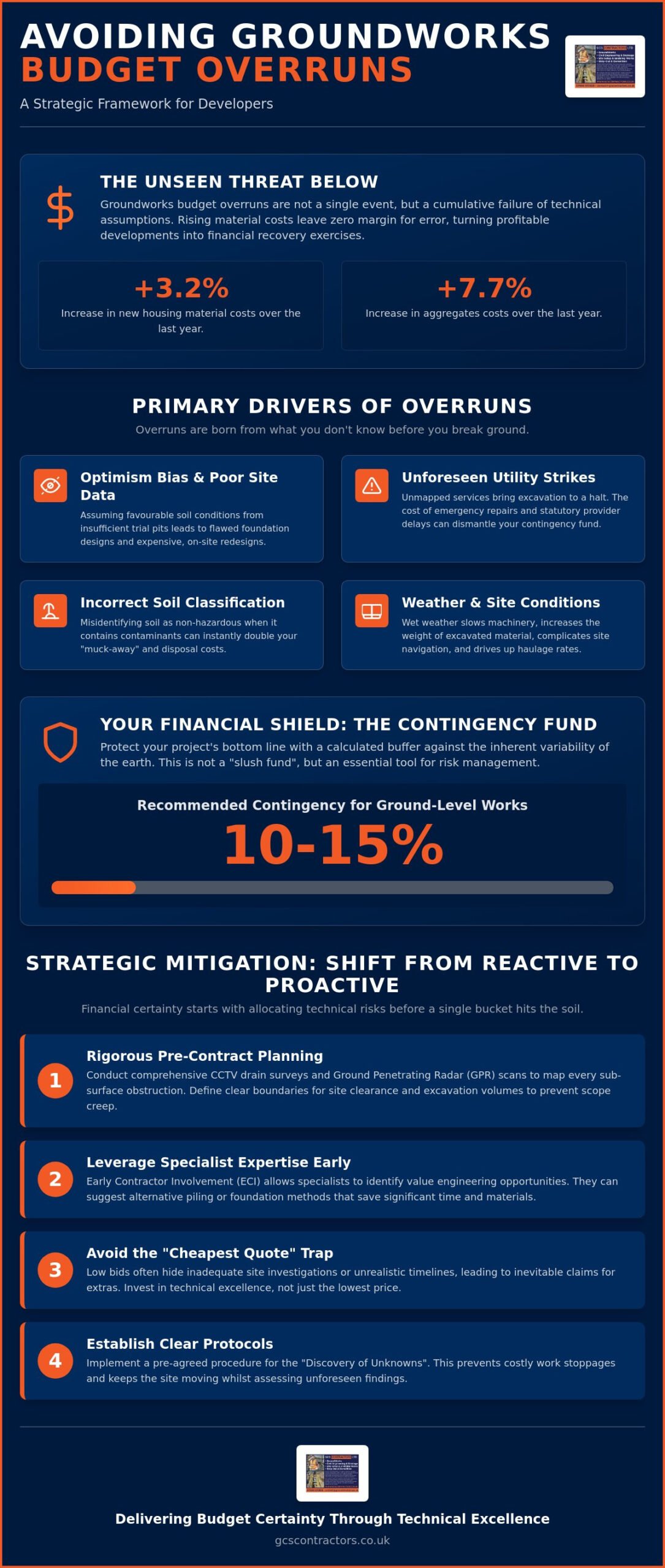
A groundworks budget doesn’t fail because of a lack of software; it fails because of a lack of technical due diligence before the first bucket hits the soil. For any developer, the priority of avoiding groundworks budget overruns is the difference between a profitable development and a financial recovery exercise. With construction material costs for new housing rising by 3.2% over the last year and aggregates increasing by 7.7%, there’s no margin for error when managing site preparation. One unmapped utility strike or a patch of contaminated soil can dismantle your contingency fund in a single afternoon.
You likely recognise the frustration of scope creep during bulk excavation or the delays caused by inadequate site clearance. It’s a common pain point that often feels like an inherent risk of the industry. However, technical peace of mind is possible through a disciplined approach to engineering and specialist contractor alignment. This guide provides the strategic framework you need to eliminate hidden costs and keep your substructure project on budget. We’ll examine how to navigate the foundation stage with zero surprises, ensuring your project timeline remains predictable from the very first day on site.
Key Takeaways
- Identify how “optimism bias” regarding soil conditions often leads to significant expenditure deviations during the substructure phase.
- Learn why maintaining a dedicated 10-15% contingency fund specifically for ground-level works is essential for protecting your project’s bottom line.
- Discover how shifting from reactive cost tracking to proactive technical risk allocation is the most effective method for avoiding groundworks budget overruns.
- Understand the importance of technical site readiness and modern machinery in ensuring bulk excavation and site preparation remain on schedule.
- Recognise how early specialist contractor alignment prevents common delays caused by unmapped utilities and unforeseen soil contamination.
The Primary Drivers of Groundworks Budget Overruns
In a groundworks context, a cost overrun is the specific deviation between your initial substructure estimate and the actual final expenditure. It’s rarely the result of a single catastrophic event. Instead, it’s usually a cumulative failure of technical assumptions. Developers often fall victim to optimism bias; they assume site conditions match the most favourable soil reports. This mindset is a significant hurdle to avoiding groundworks budget overruns.
The first 1.5 metres of soil are often the most expensive to move. This layer contains the highest concentration of “the unknown”, including historic debris and varied soil classifications. When you combine this with unpredictable seasonal site behaviour, costs escalate quickly. Wet weather doesn’t just slow down heavy machinery; it increases the weight of material and complicates site navigation, driving up haulage rates.
To better understand how to manage these financial risks, watch this helpful video:
Inaccurate Site Investigations and Soil Profiles
Insufficient trial pits create a false sense of security. If you don’t accurately map “made ground” or high water tables, your foundation designs and piling requirements will be flawed. These errors lead to expensive site-side redesigns. Soil classification directly dictates waste disposal and haulage rates. Misidentifying soil as non-hazardous when it contains contaminants can double your muck-away costs instantly.
The Financial Risk of Unforeseen Utility Strikes
Unmapped service ducting or historic drainage systems bring bulk excavation to a standstill. These strikes aren’t just safety hazards; they’re financial drains. The compounding costs of emergency repairs and waiting for statutory providers to attend site can derail your critical path. Technical due diligence in mapping services is the only way to protect your contingency fund and maintain project momentum.
Strategic Mitigation: How to Organise for Substructure Stability
Financial certainty starts with a shift in management philosophy. You shouldn’t just track costs as they happen; you must allocate technical risks before the project begins. A fundamental part of this strategy is maintaining a robust contingency fund. For ground-level works, we recommend a reserve of 10-15%. This isn’t a “slush fund” but a calculated buffer against the inherent variability of the earth. Proactive risk management is the most reliable method for avoiding groundworks budget overruns.
The “cheapest quote” is often the most expensive mistake a developer can make. Low bids frequently hide inadequate site investigations or unrealistic timelines. These gaps inevitably lead to claims for extras once the soil is open. Seeking expert advice on preventing budget overruns suggests that early alignment with specialists is far more effective than aggressive procurement. By utilising specialist groundworks expertise, you can identify value engineering opportunities that reduce the overall project cost without compromising structural integrity.
Rigorous Pre-Contract Planning and Scope Definition
A well-defined scope is your best defence against financial drift. Start by conducting comprehensive CCTV drain surveys and GPR (Ground Penetrating Radar) scans to map every sub-surface obstruction. Next, define clear boundaries for site clearance and bulk excavation volumes. This precision prevents scope creep and ensures every tonne of material is accounted for in the initial quote. Finally, establish a clear protocol for the “Discovery of Unknowns”. Having a pre-agreed procedure prevents work stoppages and keeps the site moving whilst you assess any unforeseen findings.
Leveraging Specialist Expertise in the Procurement Phase
Early contractor involvement (ECI) is particularly beneficial for complex reinforced concrete works. When a specialist firm is involved in the design phase, they can suggest alternative piling or foundation methods that save both time and materials. These technical adjustments often represent the largest potential for avoiding groundworks budget overruns. If you’re planning your next substructure phase, consulting with an experienced groundworks contractor during the design stage can reveal significant savings through practical engineering solutions.
The GCS Approach: Delivering Budget Certainty through Technical Excellence
GCS Contractors Ltd focuses on technical site readiness to protect your capital from day one. We don’t rely on guesswork. Instead, we use modern machinery and highly skilled labour to maintain the rigorous pace required for bulk excavation. By integrating the management of drainage systems and utility trenching, we ensure your infrastructure is “right first time”. This precision is the cornerstone of avoiding groundworks budget overruns.
We serve as a reliable partner for residential and commercial builds across the East of England. Our team understands that groundworks isn’t just about moving soil; it’s about engineering a stable platform for the entire build. A government report on construction cost overruns highlights that poor site management is a primary cause of financial drift. We mitigate this risk by maintaining absolute control over site logistics and technical standards.
Integrated Infrastructure and Site Preparation
Managing demolition, site clearance, and foundations under a single specialist umbrella reduces operational friction. You won’t have to coordinate between multiple subcontractors who might blame each other for delays. Professional site clearance ensures that obstructions are removed before they can halt the infrastructure installation phase. This continuity keeps the programme on track and prevents the “stop-start” nature that drains contingency funds.
Reliability, Safety, and Certified Standards
A compliant, safety-first culture has tangible financial value. It prevents costly site accidents and avoids the delays associated with HSE interventions. Our deep local expertise in Cambridge and London allows for superior logistical planning. We manage haulage and material deliveries with precision, ensuring that avoiding groundworks budget overruns remains a reality rather than an aspiration. We provide the technical certainty that modern developers demand for their substructure projects.
Securing Your Substructure Investment
Financial certainty in ground-level works is the result of disciplined technical preparation. Avoiding groundworks budget overruns depends on replacing optimism with rigorous site investigations and proactive risk allocation. By defining clear scopes for site clearance and leveraging early contractor involvement, you protect your contingency fund from the very first dig. A successful build relies on technical peace of mind and specialist alignment before any machinery arrives on site.
GCS Contractors Ltd delivers comprehensive sub-structure and infrastructure solutions across Cambridge, London, and the East of England. We’re specialists in bulk excavation and reinforced concrete, ensuring your project remains compliant and on schedule. Our integrated approach removes the friction between demolition and foundations, providing a stable platform for your commercial or residential development.
Get a professional, no-nonsense quote for your groundworks project from GCS Contractors Ltd. We’re ready to help you achieve budget certainty on your next project.
Frequently Asked Questions
What is the single biggest cause of groundworks budget overruns?
The primary cause is inadequate site investigation leading to unexpected ground conditions. Developers often rely on limited borehole samples that fail to represent the entire site. This oversight leads to the discovery of “made ground”, high water tables, or contamination during the dig. These surprises necessitate rapid redesigns and specialised waste disposal, which are the main obstacles to avoiding groundworks budget overruns.
How much contingency budget should I allow for groundworks?
You should allow a contingency of 10% to 15% specifically for the substructure phase of your project. This range accounts for the inherent variability of working below ground level where technical risks are highest. Whilst a 5% contingency might suffice for the superstructure, the groundworks stage requires a larger buffer to handle unforeseen utility strikes or soil classification changes without jeopardising the overall development’s financial viability.
Can a CCTV drain survey really save money on a new development?
Yes, a CCTV drain survey identifies unmapped drainage systems and structural defects that could otherwise cause immediate work stoppages. Discovering a collapsed pipe or an unknown service duct during active excavation is far more expensive than identifying it during the planning phase. Early detection allows for integrated infrastructure planning, ensuring your drainage installation is right first time and preventing the need for costly emergency remedial works.
Why is bulk excavation often more expensive than originally estimated?
Bulk excavation costs often escalate because of soil expansion factors and inaccurate classification. Soil expands when excavated; for example, clay can increase in volume by up to 30% once dug. If your estimates don’t account for this “bulking”, you’ll face significantly higher haulage and muck-away fees. Additionally, discovering hazardous materials after work has commenced can double disposal rates, making the process of avoiding groundworks budget overruns much more challenging.