Choosing the Right Civil Engineering Firm for Your 2026 Construction Project
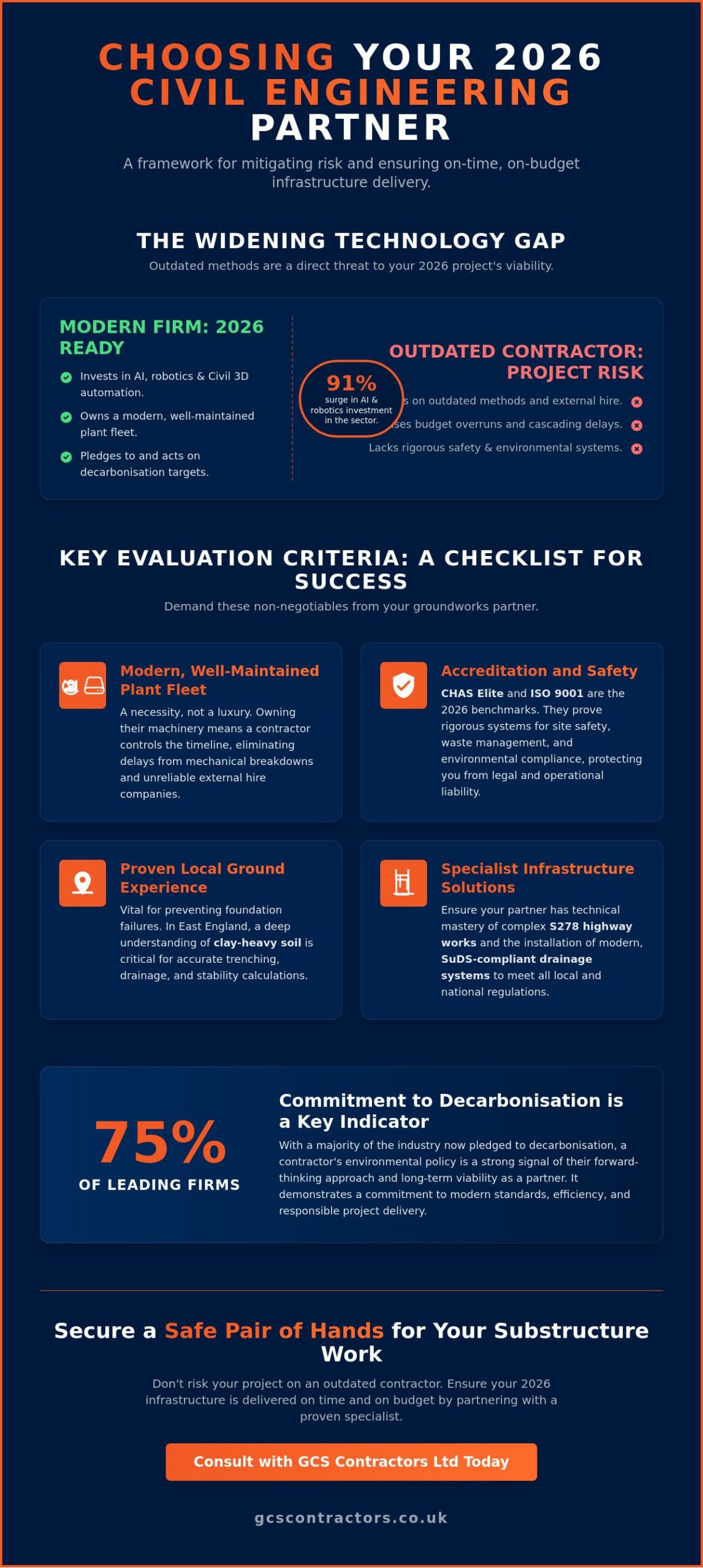
Can you afford to risk your 2026 project on a contractor still operating with 2020 methodologies? With a 91% surge in industrial AI and robotics investment across the sector this year, the gap between a modern civil engineering firm and an outdated one has become a significant project risk. You already understand that the integrity of your build rests entirely on the quality of the groundworks, yet technical failures in complex soil and unreliable subcontractors remain the leading causes of budget overruns.
Discover how to evaluate a partner based on their technical mastery of 2026 tools, such as Civil 3D automation, and their commitment to decarbonisation, which 75% of leading firms have now pledged. We’ll show you how to find a safe pair of hands for substructure work that ensures full compliance with S278 works and local building regulations. This article provides a clear, no-nonsense framework for assessing safety standards, practical execution, and the specialist equipment required for on-time, on-budget infrastructure delivery.
Key Takeaways
- Understand the vital role of a civil engineering firm as the technical bridge between your architectural drawings and a structurally sound physical reality.
- Learn why a modern, well-maintained plant fleet and CHAS Elite accreditation are essential for avoiding mechanical delays and ensuring site safety.
- Discover how specific experience in local ground conditions, particularly the clay-heavy soils of East England, prevents foundation failures and budget overruns.
- Identify the technical requirements for managing complex S278 highway works and installing modern, SuDS-compliant drainage systems.
- Evaluate how a “safe pair of hands” approach ensures your 2026 infrastructure is delivered on time, from bulk excavation to the final concrete slab.
What Does a Civil Engineering Firm Actually Do?
A professional civil engineering firm serves as the vital link between an architect’s conceptual drawings and the physical structural reality of a project. While architects focus on the “what,” we focus on the “how,” ensuring the ground can actually support the intended loads. To understand the broader academic and historical context of the discipline, you can read more about What is Civil Engineering? This role is about transforming abstract plans into a buildable site through technical rigour and heavy-duty execution.
To better understand how this partnership works on a practical level, watch this helpful video:
The scope of work is extensive, moving far beyond simple digging. It begins with Bulk Excavation to level the terrain and extends to the installation of complex, high-capacity drainage systems. We distinguish between horizontal infrastructure, such as roads and utility service ducting, and the vertical construction of the building itself. Achieving site readiness is the most critical phase in the overall project timeline. If the ground isn’t prepared correctly, every subsequent trade faces costly delays.
Contractors vs. Consultants: Knowing the Difference
Many clients confuse consultants with contractors. Consultants provide the “how” through designs and calculations, but a civil engineering firm like GCS Contractors Ltd provides the “do” through skilled labour and a modern plant fleet. Hiring an execution-focused firm early in the process prevents common design-to-site discrepancies that often occur when plans don’t account for actual ground conditions. You need a partner that speaks the language of both design engineers and site managers to keep the project moving forward without technical friction.
Key Criteria for Selecting a Civil Engineering Partner
Selecting a civil engineering firm requires more than just comparing quotes. You need a partner with the physical assets and local intelligence to deliver results. A modern, well-maintained plant fleet isn’t a luxury; it’s a necessity. Mechanical breakdowns on site cause cascading delays that can derail an entire construction programme. When evaluating key criteria for a civil engineering firm, prioritise those who invest in their own machinery rather than relying on external hire companies.
Proven experience in local ground conditions is equally vital. In East England, the clay-heavy soil presents specific drainage and stability challenges that an inexperienced contractor might overlook. A firm that doesn’t understand these nuances will struggle to provide accurate Utility Trenching estimates or manage complex basement excavation. You need a team with a practical “can-do” attitude for high-stakes tasks like underpinning. They must offer transparent, detailed cost breakdowns to ensure your project remains financially viable. If you’re planning a complex build, consulting with a specialist groundworks contractor early can help identify these ground risks before they become expensive problems.
Accreditation and Safety: The Non-Negotiables
Safety isn’t just a box-ticking exercise. It’s about protecting you from legal and operational liability. For 2026 projects, CHAS Elite and ISO 9001 certifications are the industry benchmarks. These accreditations prove a firm has the rigorous systems needed to manage site waste, environmental impact, and on-site hazards correctly. A professional civil engineering firm takes full ownership of site clearance and waste management, ensuring the project meets strict environmental regulations. This disciplined approach reduces the risk of HSE interventions and keeps your site running smoothly; it ensures your project stays on the right side of the law while protecting every person on the ground.
Specialist Infrastructure and Civil Engineering Solutions
Executing highway works requires more than just heavy machinery; it demands a civil engineering firm that understands the legal intricacies of S278 agreements. These works involve alterations to the public highway, requiring precise coordination with local authorities to meet strict safety and quality standards. Our team manages the entire process of Roadworks and Paving, ensuring that every kerb and asphalt layer complies with national specifications.
Modern developments also face rigorous environmental hurdles. We install robust drainage systems designed to meet Sustainable Drainage Systems (SuDS) requirements, which are mandatory for new UK developments to manage surface water run-off effectively. From attenuation tanks to soakaways, we ensure your site remains compliant and flood-resilient. This focus on sustainability is essential, especially as 75% of construction and engineering firms have now committed to decarbonisation. Whether your project requires standard strip footings or complex piling solutions for unstable ground, we provide the structural integrity required for a “safe pair of hands” delivery across the South East.
From Foundations to Finishing: End-to-End Delivery
Choosing a single-point contractor for groundworks and civil engineers near me significantly streamlines the build process. It eliminates the friction often found between different subcontractors, reducing the risk of technical errors during the transition from substructure to superstructure. Our expertise extends to technical reinforced concrete works, including high-tolerance commercial slabs and retaining walls designed to withstand significant lateral loads.
Local knowledge is our primary logistical advantage. Operating extensively in Cambridge, Ely, and Huntingdon means we understand the specific transport constraints and planning nuances of these areas. This ensures smoother project logistics, from the timely delivery of reinforced concrete to the efficient removal of site waste. By combining technical precision with regional expertise, GCS Contractors Ltd delivers infrastructure that supports long-term commercial and residential growth.
Secure Your 2026 Project Foundations
A successful build relies on the technical precision and regulatory compliance established during the initial groundworks phase. By prioritising a civil engineering firm with a modern plant fleet and deep local geological knowledge, you mitigate the risks of mechanical delays and foundation failures. You’ve seen how specialist expertise in S278 highway works and SuDS-compliant drainage protects your project from legal and environmental liabilities. It’s about finding a partner who understands the high stakes of infrastructure delivery across Cambridge and the South East.
GCS Contractors Ltd is a CHAS Elite approved contractor and ISO 9001 certified for quality management. We’re specialists in S278 highway works and complex groundworks; we provide a “safe pair of hands” from foundations to finishing. We’re ready to help you navigate the technical demands of your next site with efficiency, discipline, and a results-driven approach. Ready to start your project? Contact GCS Contractors Ltd for a professional consultation today. We look forward to delivering your 2026 project on time and on budget.
Frequently Asked Questions
How do I choose between different civil engineering companies near me?
You should prioritise firms that maintain their own plant fleet and have a proven track record with local soil conditions, such as the heavy clays found across Cambridgeshire. A contractor that manages everything from bulk excavation to finishing provides a “safe pair of hands” and reduces the risk of delays between subcontractors. Always verify that they have experience in the specific infrastructure you require, whether that’s utility trenching or complex piling.
What is the typical lead time for starting a civil engineering project in 2026?
For most 2026 construction projects, you should allow a lead time of 8 to 14 weeks for mobilisation. This timeframe accounts for current labour shortages and allows for thorough site preparation, including utility mapping and soil analysis. Engaging a contractor during the early design phase can often reduce this lead time by 15% as it allows for better resource scheduling and plant allocation.
Do civil engineering firms handle both residential and commercial projects?
Yes, a versatile civil engineering firm manages a broad spectrum of work ranging from residential extension foundations to large-scale commercial reinforced concrete slabs. The core technical requirements for structural integrity and drainage remain consistent across both sectors. The best contractors adapt their heavy plant and technical expertise to suit the specific load-bearing requirements and scale of your particular site.
What technical accreditations should a reputable civil engineering firm hold?
A reputable firm must hold CHAS Elite and ISO 9001 certifications as the minimum benchmark for safety and quality management in 2026. These accreditations prove the contractor has the disciplined systems required to manage site risks and environmental compliance. You should also check for specific technical proficiencies, such as being authorised for S278 highway works or having the expertise to install SuDS-compliant drainage systems.