Basement Excavation in Cambridge: A Specialist Guide to Sub-Structure Works
In the historic streets of Cambridge, the difference between a successful subterranean expansion and a structural disaster is often found in the first three metres of clay. While many developers focus on the final aesthetic, the real challenge lies in the high water table and the complex soil profiles that define our local landscape. You’re likely wondering what the safest and most cost-effective way to manage Basement Excavation is in such a sensitive environment. With costs for digging new basement spaces now reaching up to £4,250 per square metre in 2026, there’s no room for technical error.
We recognise the stress of protecting neighbouring historic properties whilst navigating the rigid requirements of the Party Wall etc. Act 1996. It’s a high-stakes environment where uncertainty about structural integrity can be paralysing for any property owner. This guide provides a clear roadmap to mastering these complexities. You’ll gain a technical understanding of excavation methodologies and the confidence to choose a contractor who understands local geology. From foundations to finishing, we’ll examine how to integrate precision reinforced concrete works with BS 8102:2022 waterproofing standards to ensure your project remains safe and compliant.
Key Takeaways
- Understand how Gault Clay and the high water tables of the Fens dictate specific foundation designs and site drainage requirements.
- Compare Open-Cut and Top-Down methodologies to select the most efficient sub-structure strategy for your commercial or residential project.
- Master the technical requirements of Basement Excavation by implementing robust temporary works and propping systems to ensure total structural equilibrium.
- Learn how to transition from bulk excavation to precision reinforced concrete works that meet BS 8102:2022 waterproofing standards.
- Gain a clear roadmap for navigating complex Party Wall Agreements and local regulatory standards to keep your project on schedule.
Technical Challenges of Basement Excavation in Cambridge and East England
Cambridge’s geology presents a unique set of obstacles that can derail a project before the first bucket of earth is moved. The region is defined by Gault Clay, a heavy, over-consolidated material known for its high volume change potential. This soil expands significantly when wet and shrinks during dry spells, creating immense lateral pressure on temporary works. In historic centres like Ely or Saffron Walden, these geological risks are compounded by narrow access routes and the proximity of fragile, centuries-old foundations. Successful Basement Excavation in these environments requires a “geology-first” approach, starting with a comprehensive site-specific soil report to map these variables.
To better understand the mechanical process of moving earth in these conditions, watch this helpful video:
Navigating the “Cambridge Clay” and Water Table
The expansive nature of Gault Clay necessitates rigid shoring techniques to prevent heave or subsidence. We often utilise contiguous piled walls or ground anchors to maintain structural equilibrium. Water management is the second major hurdle, particularly for sites near the River Cam or the Great Ouse where the water table is notoriously high. Basement design and structural considerations must include robust dewatering strategies, such as wellpoint systems or deep wells, to ensure the dig remains dry and stable. Without these specialist interventions, hydrostatic pressure can cause base heave, a catastrophic failure where the floor of the excavation literally rises. It’s also worth noting that ground erosion on construction sites is frequently underestimated as a structural risk, with surface-level treatments masking deeper instability in clay-heavy soils like those found across Cambridgeshire.
Regulatory Compliance and Party Wall Agreements
In the dense urban fabric of Cambridge, the Party Wall etc. Act 1996 is a critical piece of legislation. It’s the Site Manager’s responsibility to ensure all notices are served and awards are in place before Basement Excavation begins. For projects adjacent to Grade II listed buildings, we conduct detailed pre-condition surveys. These surveys document every existing crack and level, providing a baseline that protects both the client and the neighbour. As a CHAS Elite approved contractor, we prioritise these compliance steps to mitigate legal risks and build trust with local stakeholders.
Core Methodologies: Choosing the Right Excavation Strategy
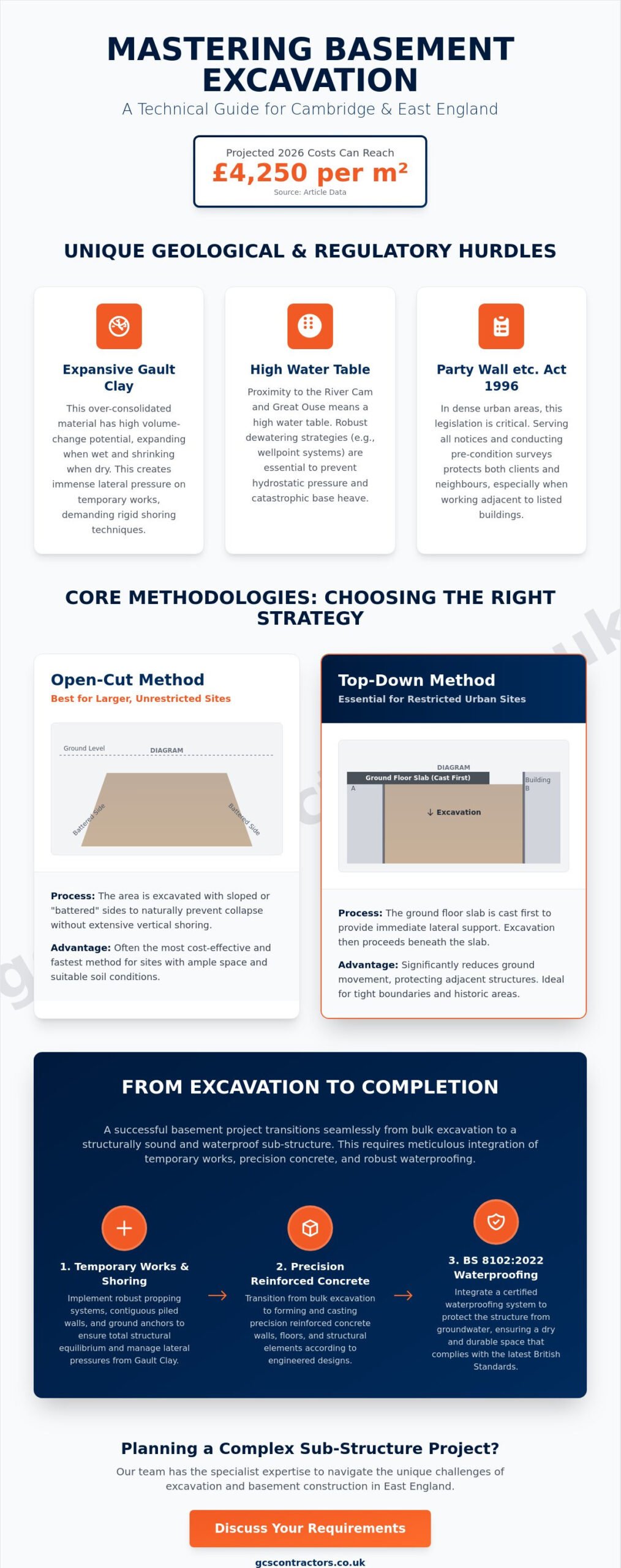
Selecting the correct approach for Basement Excavation isn’t just about moving soil; it’s about maintaining the structural integrity of the entire site. For larger commercial sites or open residential plots, the open-cut method is often the most cost-effective. This involves excavating the area with sloped or “battered” sides to prevent collapse. However, in restricted urban areas like central Cambridge or Hitchin, we must deploy more sophisticated strategies to manage the lateral loads of the surrounding ground. Site access in towns like Stevenage often requires specialised plant. We select bulk excavation machinery, ranging from 1.5-tonne micro-excavators to 20-tonne long-reach machines, based on the physical constraints and specific BWIC requirements. Safety is paramount during these works. All our methodologies strictly follow HSE excavation safety guidelines to prevent undermining nearby structures. If you’re planning a complex build, it’s worth speaking to our team to discuss your sub-structure requirements early in the design phase.
The Top-Down Method for Restricted Urban Sites
Tight site boundaries in London or central Cambridge often dictate a top-down sequence. We cast the ground floor slab first, providing immediate lateral support to the perimeter walls. Excavation then continues beneath the slab. This method significantly reduces ground movement, protecting adjacent Grade II listed buildings from settlement. It’s a disciplined, high-stakes process that requires precise temporary works and hydraulic propping to maintain equilibrium throughout the dig. We’ve found this approach essential for managing the high-risk environments found in historic town centres.
Integrating Piling and Underpinning
Enabling works often involve a combination of piling and underpinning. Mass concrete underpinning remains superior for shallow foundations on stable ground, but deep basement levels in Gault Clay often require contiguous or secant piled walls. These provide a robust vertical support and an essential water barrier before bulk excavation begins. We ensure every pile is positioned with millimetre-precision to accommodate the reinforced concrete slabs that follow. This integration of piling ensures the structure can withstand the hydrostatic pressures common in the Cambridgeshire river valleys.
From Excavation to Reinforced Concrete: Ensuring Structural Integrity
Once the bulk Basement Excavation is complete, the focus shifts immediately to structural containment. Leaving an open excavation exposed to Cambridge’s unpredictable weather is a significant risk. We transition rapidly from earthmoving to steel fixing. This seamless handover prevents soil relaxation and maintains the integrity of the shoring systems installed during the dig. Engaging specialist concrete contractors ensures that the sub-structure is built to withstand decades of hydrostatic pressure. We utilise Type B waterproofing, which involves adding crystalline admixtures directly into the concrete mix. This makes the structure itself water-resistant. It’s a core part of our “foundations to finishing” philosophy. This integrated approach eliminates cold joints, which remain the most common points of failure in subterranean builds.
Waterproofing and Reinforced Concrete Slabs
Constructing Concrete Slabs in sub-grade environments requires more than just high-strength mixes. We install heavy-duty waterbars and hydrophilic strips at every construction joint. These materials expand upon contact with moisture, creating a physical seal that prevents water ingress. In the high water table areas of the East of England, this secondary protection is mandatory for compliance with BS 8102:2022, the updated standard from March 2022. Every pour is meticulously planned to minimise the number of joints, ensuring a monolithic and robust tanking system.
Quality Control and CHAS Elite Standards
Safety and precision are non-negotiable during high-risk groundworks. Our ISO 9001 and CHAS Elite accreditations provide a disciplined framework for managing the transition from digging to casting. We conduct rigorous slump tests and take cube samples for every batch of concrete to verify structural strength. BWIC (Builder’s Work in Connection) in this context refers to the essential provision of service entries, drainage penetrations, and structural openings required for the building’s mechanical and electrical infrastructure. By managing the entire scope, we ensure no technical detail is overlooked during the final structural phase.
Securing Your Sub-Structure Investment
Successful subterranean construction in East England depends on more than just moving earth. It requires a deep understanding of Gault Clay behaviour and precise water management strategies near the River Cam. We’ve explored how selecting the right methodology, whether Top-Down or Open-Cut, protects neighbouring properties and maintains structural equilibrium. Integrating reinforced concrete with BS 8102:2022 waterproofing standards ensures your Basement Excavation project remains dry and structurally sound for the long term. This technical approach is the only way to mitigate the risks associated with Cambridge’s high water table and sensitive historic sites.
GCS Contractors Ltd provides a “safe pair of hands” for complex civil engineering and infrastructure works. As a CHAS Elite and ISO 9001 accredited organisation, we specialise in the unique geology of Cambridge and the surrounding river valleys. We handle the entire scope from foundations to finishing, ensuring all works are compliant with the Building Safety Act and local planning requirements. Our team brings the technical expertise needed to manage restricted access sites in historic town centres safely. Ready to start your basement project? Contact GCS Contractors for expert groundworks in Cambridge and London. We look forward to delivering a robust foundation for your next development.
Frequently Asked Questions
How much does basement excavation cost per square metre in the UK?
2026 estimates for digging a new basement space using underpinning range from £2,000 to £4,250 per square metre. If you’re lowering the floor of an existing cellar, the cost typically falls between £1,500 and £2,250 per square metre. These figures reflect the technical complexity of the work and current material price indexes, which saw a 2.1% increase in February 2026.
Do I need planning permission for a basement excavation in Cambridge?
Yes, you’ll almost certainly require full planning permission for Basement Excavation in Cambridge. A High Court ruling established that extensions involving significant engineering works cannot be completed under Permitted Development rights. As of April 2026, the national planning application fee for altering a single dwellinghouse is £548, and your project must also meet the 2026 Building Regulations for energy efficiency.
How long does a typical residential basement excavation take to complete?
A standard residential sub-structure phase usually takes between 12 and 20 weeks to finish. This timeline covers everything from site setup and bulk digging to the installation of the reinforced concrete shell. Complexities like dewatering near the River Cam or managing Gault Clay can extend this period, so we provide a specific programme of works before any machinery arrives on-site.
What are the biggest risks associated with deep basement excavation?
The primary risks include structural settlement of neighbouring properties and hydrostatic pressure from the high water table found in the Fens. Gault Clay is highly expansive, meaning it can shift or heave if the Basement Excavation isn’t supported by robust temporary works. We mitigate these risks through strict adherence to BS 8102:2022 waterproofing standards and the Party Wall etc. Act 1996 to ensure total site stability.