Piling in Cambridge: A Specialist Guide to Deep Foundations (2026)
Why is your structural engineer insisting on deep foundations when the site next door used standard trench fill decades ago? In Cambridge and Cambridgeshire, the transition from heavy Gault clay to unpredictable fen silt means standard footings often can’t guarantee long-term stability. You’re likely concerned about the £4,000 starting cost for residential projects or the strict 7 am to 7 pm noise limits enforced by the City Council. Piling isn’t an optional extra in 2026; it’s a geological necessity for any build that needs to meet UK Building Regulations and BS 8004 standards.
We understand the high stakes of civil engineering in East Anglia. This guide will help you choose between Continuous Flight Auger (CFA) and driven techniques whilst managing costs that typically range from £125 to £400 per linear metre. You’ll gain a clear understanding of how to secure a stable foundation and find a specialist contractor who knows this landscape inside out. We’ll take you through the technical requirements to ensure your project moves from foundations to finishing without the risk of settlement or regulatory delays.
Key Takeaways
- Identify the structural risks posed by “shrink-swell” in Cambridge Gault Clay and the unstable silt profiles characteristic of the Fens.
- Evaluate the technical differences between CFA and Driven Piling to select the most efficient, low-vibration method for your specific site.
- Discover the critical site preparation steps, including bulk excavation and the installation of certified piling mats using recycled 6F2 aggregate.
- Navigate local compliance standards, from Cambridge City Council’s strict noise control hours to national BS 8004 safety regulations.
What is Piling and Why is it Essential in Cambridge?
Piling is the process of installing vertical columns deep into the earth to transfer a building’s load to more stable strata. In East Anglia, this often means bypassing soft surface layers to reach load-bearing chalk or dense gravels. To fully grasp What is Piling?, you must consider it a structural bridge between your project and the solid ground below. Before a single rig arrives on-site, a professional Ground Investigation (GI) is mandatory. This technical report dictates the pile depth and diameter required to prevent structural failure.
To better understand this concept, watch this helpful video:
The Cambridge Soil Profile: Clay, Silt, and Chalk
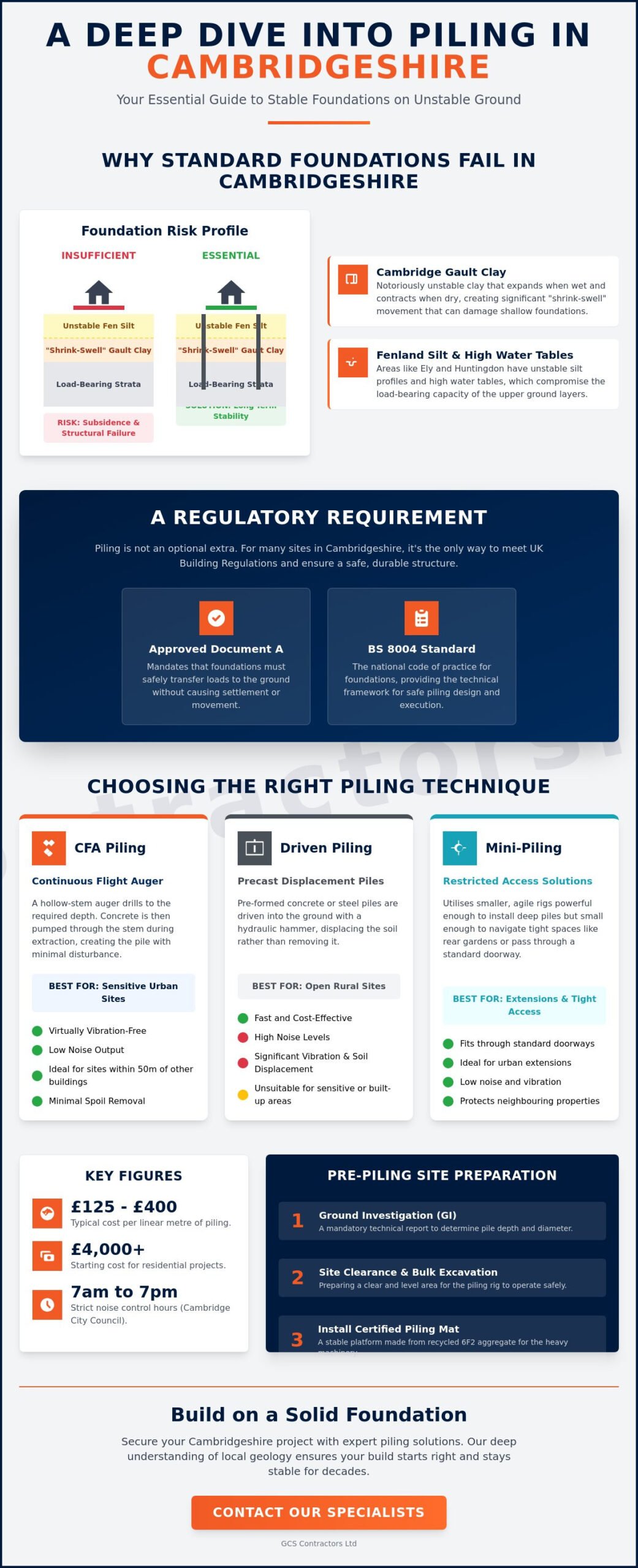
The geology of this region is notoriously varied. Areas like Ely and Huntingdon sit on a high water table and unstable silts, which often require waterproofed solutions to maintain integrity. Further south in Saffron Walden and Royston, the challenge shifts to heavy clay soils that are prone to seasonal movement. Gault Clay in Cambridgeshire is notoriously unstable, expanding when wet and contracting during dry spells, which creates a high risk of subsidence for shallow foundations. Deep foundations ensure your structure remains anchored regardless of surface moisture levels.
When Building Regulations Demand Piling
Approved Document A of the Building Regulations mandates that foundations must safely transmit loads to the ground without causing movement. Whilst standard groundworks are sufficient for many UK sites, Cambridge projects often hit “red flag” conditions that make deep foundations mandatory. These include the presence of made-up ground, sites with low bearing capacity, or proximity to large trees with high water demand. Piling becomes the only viable route to compliance when the soil cannot support a traditional trench fill foundation at a standard depth of 1.0 to 2.5 metres.
Common Piling Techniques for Cambridgeshire Developments
Selecting the right method is a balance between ground conditions and local constraints. Common Piling Techniques in East Anglia are chosen to satisfy both structural engineers and local planning officers. Continuous Flight Auger (CFA) is the standard for urban Cambridge because it’s quiet and virtually vibration-free. For projects in Peterborough or open rural sites, driven piling remains a faster, cost-effective alternative where noise and soil displacement are less of a concern.
CFA piling uses a hollow-stem auger to drill to the design depth. Concrete is pumped through the stem whilst the auger is extracted, meaning no temporary casing is required. This “drill and grout” process is vital for working near historic colleges or residential areas in St Albans where vibration risks are high. Once the concrete cures, a pile cap is installed. This reinforced block distributes the building’s load and connects the deep foundation to the reinforced slabs provided by our concrete contractors.
CFA Piling: Low Noise for Sensitive Urban Sites
In high-density areas, CFA piling is the gold standard for meeting Cambridge City Council’s strict noise control hours. It eliminates the percussive impact associated with driven piles, making it the preferred choice for projects situated within 50 metres of existing structures. The method is efficient and produces minimal spoil, which keeps your site cleaner and reduces the need for extensive waste removal.
Mini-Piling for Extensions and Restricted Access
Cambridge city centre is full of narrow mews and terraced properties with limited rear-garden access. Large rigs simply won’t fit. Mini-piling rigs are designed for these restricted spaces. They are agile enough to pass through a standard doorway but powerful enough to reach the stable strata identified in your ground investigation. It’s a clean, efficient way to secure an extension without risking the structural health of your neighbours’ homes. If you’re planning a project in a tight urban spot, speak with a specialist about our small-rig capabilities.
Preparing Your Site: From Clearance to Piling Mats
Successful piling starts long before the rig arrives. The site must be cleared and levelled to create a safe environment for heavy machinery. This usually begins with Bulk Excavation to reach the formation level required for your piling platform. If you’re building on a brownfield site, a professional demolition service is essential to remove old footings or buried slabs that could obstruct the new pile positions. These enabling works ensure that the piling process is precise and uninterrupted.
Once the site is clear, we construct a piling mat. This is a temporary working platform designed to support the weight of the rig. We typically use recycled 6F2 aggregate or Type 1 crushed stone to build a stable base. This isn’t just about convenience; it’s a critical safety requirement. The “Darwin Green” approach to foundation integrity serves as our benchmark, ensuring that every stage of site preparation is documented and tested before structural work begins. Efficient removal of excavated material at this stage is essential; using a grab hire near me service can significantly reduce the time and cost of clearing spoil from your Cambridge site compared to traditional skip hire.
The Importance of a Stable Working Platform
Rig instability on soft Cambridgeshire ground can lead to catastrophic failure. We design our mats to meet BRE 470 standards, which provide the framework for safe working platforms in the UK. This involves calculating the “T-Value” of the ground to determine the necessary thickness and reinforcement of the aggregate layer. A well-engineered mat prevents the rig from tilting or sinking during the high-torque drilling process, protecting both the machinery and the site team.
Managing Underground Utilities and Obstructions
Striking a buried utility line causes delays and significant safety risks. We use Ground Penetrating Radar (GPR) to map out service ducts and old infrastructure before any boring starts. Lessons from the Darwin Green Cambridge project highlight the importance of rigorous oversight. Identifying obstructions early avoids the need for costly pile redesigns or site stand-stills, keeping your project on schedule and within budget.
Secure Your Structural Integrity in Cambridge
Cambridge’s unique geology demands a precise approach to sub-structure engineering. You now understand why the presence of Gault Clay and Fenland silts makes deep foundations a necessity rather than an optional extra. From the initial bulk excavation to the final pile cap, every stage must align with British Standards to ensure long-term stability. These technical requirements are the critical first step in a complex build process that requires specialist oversight to meet UK Building Regulations.
We bring a grounded, no-nonsense approach to every site we manage. As a CHAS Elite and ISO 9001 certified contractor, we maintain the highest safety and quality standards across Cambridge, Essex, and London. We apply the same Darwin Green-standard foundation integrity to small residential extensions as we do to large-scale commercial developments. Our team ensures your project moves efficiently from foundations to finishing without the risk of settlement or regulatory delays.
Ready to move forward with a partner you can trust? Get a Professional Piling Quote for Your Cambridge Project and ensure your build starts on solid ground. We’re here to help you navigate East Anglia’s challenging soil profiles with confidence.
Frequently Asked Questions
How much does piling cost compared to traditional trench foundations in the UK?
Piling usually carries a higher upfront cost than shallow trench foundations due to the specialised machinery and technical expertise required. For a small residential project in Cambridgeshire, costs typically start from £4,000, whereas standard trench fill might be cheaper in stable ground. However, if your soil investigation shows unstable strata deeper than 2.5 metres, piling becomes the more cost-effective choice. It avoids the massive excavation and concrete volumes required for deep trenching in Cambridge Gault clay.
How long does the piling process usually take for a standard residential site?
A standard residential piling project in Cambridgeshire is typically completed within 2 to 5 days. This schedule covers the rig mobilisation, the boring or driving of the piles, and the placement of steel reinforcement. Whilst the setup for deep foundations takes longer than a standard dig, the actual installation is fast and efficient. Larger commercial sites or projects with significant underground obstructions may require several weeks to finish the full foundation package.
Will piling vibrations cause damage to my neighbour’s property in Cambridge?
CFA piling is a virtually vibration-free technique that poses minimal risk to neighbouring structures. It is the preferred method for historic town centres like Ely or St Ives where older buildings are sensitive to ground movement. We strictly follow Cambridge City Council guidelines, which restrict noisy works to between 7 am and 7 pm on weekdays. By using low-vibration augered methods, we ensure your project remains compliant whilst protecting the structural integrity of adjacent properties.
Do I need a party wall agreement for piling works near a boundary?
You will likely need a Party Wall Agreement if your piling activity is within 3 or 6 metres of a neighbour’s building or structure. This depends on the depth of your new foundations compared to the depth of theirs. Under the Party Wall etc. Act 1996, you must serve formal notice to your neighbours before the rig arrives on-site. Failing to secure this agreement can lead to legal injunctions that halt your construction project and increase costs.
What is the difference between an end-bearing pile and a friction pile?
End-bearing piles act like columns that transfer the building’s load directly onto a solid, load-bearing layer such as chalk or rock. Friction piles work by transferring the load through the surface of the pile into the surrounding soil using skin friction. In the soft, silty ground found across the Fens, friction piles are often the only practical solution when a solid rock layer is too deep to reach economically. Our ground investigation determines which type is required for your specific soil profile.
Can piling be carried out in wet weather or high water tables?
Piling can be successfully carried out in wet weather and areas with high water tables, which is a common challenge in Huntingdon and the Fens. CFA piling is particularly suited for these conditions because the hollow-stem auger supports the hole whilst concrete is pumped in. This prevents the bore from collapsing or filling with groundwater before the pile is cast. We use specific weather-hardened rigs and piling mats to maintain safety and precision regardless of the East Anglian weather.