Utility Trenching in Cambridge: A Professional Guide to Service Installation
Utility strikes cost the UK economy an estimated £2.4 billion every year in repairs and project delays. You already know that breaking ground in Cambridgeshire is never as simple as it looks on the plans. Between the heavy clay of the north and the stubborn chalk deposits across the south, local ground conditions demand more than just a standard excavator. Successful Utility Trenching requires a disciplined, professional approach to avoid the high stakes of service damage and regulatory failure.
It’s a challenge we understand well. We’ll show you how to master the technical requirements and safety protocols necessary for efficient, strike-free service installation. You’ll learn the exact steps to ensure your gas, water, and electrical mains comply with UK building regulations and NJUG standards. This guide provides a clear roadmap through the complexities of Cambridge groundworks, from soil management to final backfilling, to keep your project on track and fully compliant.
Key Takeaways
- Understand how to navigate the complex transition between Gault Clay and chalk subsoils unique to Cambridge construction sites.
- Master the professional Utility Trenching process by using CAT and Genny surveys to map services accurately before breaking ground.
- Ensure full compliance with HSG47 guidelines to prevent dangerous service strikes and maintain site safety during excavation.
- Learn professional shoring techniques to maintain trench integrity and protect essential service installations in unstable ground.
- Discover why partnering with a CHAS Elite and ISO 9001 accredited contractor ensures the highest standards for your infrastructure project.
What is Utility Trenching and Why is it Critical for Cambridge Sites?
Utility Trenching is the precise process of excavating narrow channels to house essential service infrastructure, including water, gas, electricity, and telecommunications. For developers and site managers, understanding What is Utility Trenching involves more than just simple earthmoving; it’s about creating a safe, compliant corridor for life-critical services. In Cambridge, this stage is a fundamental part of enabling works. It secures the site’s infrastructure before any vertical construction begins.
Cambridge sites present unique geological challenges that require expert navigation. Groundworkers must manage the transition between heavy, expansive Gault Clay and chalky subsoils. These conditions demand specific technical expertise to maintain trench integrity. While open-cut trenching remains the standard for most new-build sites, specialist trenchless technology is often used in congested urban developments to minimise surface disruption and protect existing assets.
Common Utilities Managed in Modern Groundworks
Effective site preparation involves coordinating multiple service runs simultaneously to maximise efficiency:
- Mains water and sewerage: These installations require deep excavations that align with Bulk Excavation and drainage strategies to ensure correct falls and flow rates.
- Electrical ducting: We manage high-voltage cable runs for commercial developments across Peterborough and Stevenage, adhering to strict DNO (Distribution Network Operator) specifications.
- Telecommunications: Installing high-speed fibre-optic ducting is now a standard requirement for all new residential hubs to meet modern connectivity demands.
The Impact of Cambridge Strata on Trench Stability
Managing “heave” in Cambridge clay is a constant priority. Trench depths must be calculated with precision because seasonal moisture changes cause the ground to swell or shrink. This movement can displace service pipes if they aren’t bedded correctly. In the Fens and areas surrounding Ely, high water tables often require active dewatering solutions during the Utility Trenching phase. We use SHW (Specification for Highway Works) compliant backfill to ensure long-term stability and prevent future subsidence. Precision at this stage prevents costly remedial works once the final surfacing is complete.
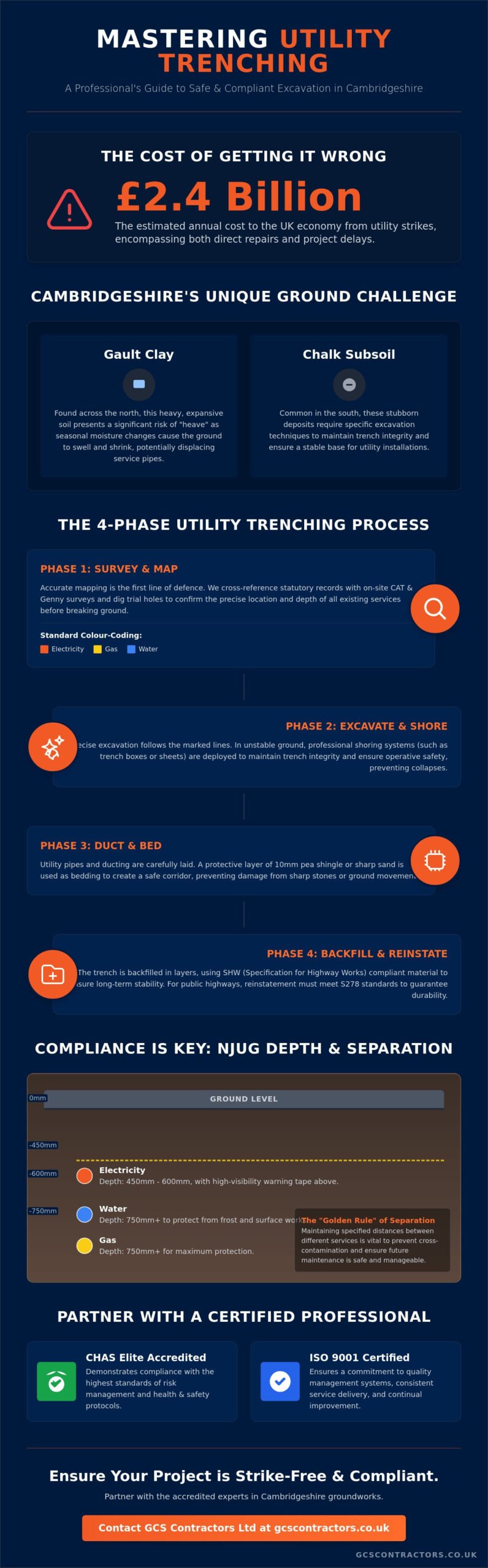
How-To: The Step-by-Step Utility Trenching Process
Successful utility trenching relies on a disciplined, four-phase delivery model. We start with Phase 1, using CAT and Genny equipment to cross-reference site realities against utility maps. Phase 2 involves the physical excavation. If the ground is unstable, we implement shoring systems to maintain trench integrity and operative safety. Phase 3 focuses on ducting and bedding. We use 10mm pea shingle or sharp sand to create a protective layer that prevents stone chips from damaging the utility pipework. Finally, Phase 4 covers backfilling and reinstatement. On public highways, this must meet S278 standards to ensure the road surface remains durable under heavy traffic loads.
Surveying and Marking Out
Our team begins by obtaining Statutory Undertaker records for existing services in Saffron Walden or Newmarket. These maps provide a baseline, but they aren’t always perfect. We use electromagnetic locators to identify live cables and pipes. Marking the dig zone is a non-negotiable safety step. We use industry-standard colour-coding: blue for water, yellow for gas, and orange for electricity. A hand-dug trial hole must be completed to verify the precise depth and position of services before bulk mechanical excavation starts. This proactive approach is why many developers choose to work with GCS Contractors Ltd for complex site starts.
Standard Depths and Separation (NJUG Guidelines)
We strictly follow National Joint Utilities Group (NJUG) guidelines to ensure long-term site safety. Different services require specific burial depths to function correctly:
- Electricity: These cables are typically installed at depths of 450mm to 600mm and must include high-visibility warning tapes.
- Water and Gas: These require deeper burial, often 750mm or more, to protect against frost damage and accidental strikes during future surface works.
The “Golden Rule” of separation is vital. We maintain specific distances between different utility types. This prevents cross-contamination and ensures that a future repair on a water main doesn’t accidentally compromise a nearby high-voltage cable. It’s a technical requirement that keeps the infrastructure manageable for decades.
Safety Standards: Avoiding Service Strikes and Ensuring Compliance
Safety in Utility Trenching starts with strict adherence to HSG47. This HSE guidance is the industry standard for avoiding danger from underground services during excavation. GCS Contractors integrates these requirements into every project, backed by our CHAS Elite and ISO 9001 certifications. These accreditations prove our commitment to quality and rigorous safety management. Managing Street Works under the New Roads and Street Works Act (NRSWA) is a critical part of our operations in Cambridge city centre. We coordinate closely with local authorities to manage traffic and pedestrian flow whilst minimising disruption. Our team also prioritises the environmental impact of every dig, ensuring excavated spoil is managed responsibly and site footprints are kept as small as possible.
Essential Safety Equipment for Trenching Teams
Collapses represent a significant risk in deep excavations. We utilise certified trench boxes and shoring solutions to secure trench walls throughout East England. When working near live electrical cables, our teams use fully insulated tools and specific PPE as a non-negotiable standard. These measures prevent injuries and keep projects on schedule. We don’t take shortcuts with safety equipment because the physical risks of excavation are too high to ignore.
Why Professional Groundworks Contractors are Vital
The cost of a service strike goes far beyond the immediate repair bill. Fines, increased insurance premiums, and project downtime can quickly escalate costs. Hiring expert civil engineers near me provides the necessary safe pair of hands for complex infrastructure. Selecting the right civil engineering firm for your project ensures you benefit from modern methodologies, full regulatory compliance, and the technical mastery required to deliver complex substructure work on time and within budget. We ensure every Utility Trenching run is correctly positioned and integrated into the broader groundworks. This provides a clean transition from service installation to the main building phase, protecting your budget and your timeline.
Secure Your Infrastructure with Professional Groundworks
Successful utility installation requires more than just digging. It demands a disciplined approach to safety and technical precision to avoid service strikes that can stall a project for weeks. In Cambridge, where infrastructure density and ground conditions vary, following a structured, compliant process ensures long-term site stability. Utility Trenching is the backbone of any modern development. Getting it right from the start saves costs and prevents future maintenance headaches on busy East England sites.
GCS Contractors Ltd provides the professional oversight needed for complex groundworks. As a CHAS Elite and ISO 9001 certified firm, we maintain the highest industry standards throughout every phase of construction. We handle every stage with a grounded, no-nonsense attitude, ensuring your site remains fully compliant with current safety regulations. Our team delivers end-to-end expertise for both domestic and commercial developments, managing everything from foundations to finishing. It’s the most reliable way to protect your investment and keep your project on schedule.
Contact GCS Contractors for professional utility trenching in Cambridge
We look forward to bringing our specialist expertise to your next site.
Frequently Asked Questions
How deep does a utility trench need to be in the UK?
Utility trenching depths follow NJUG Volume 7 guidelines to ensure site safety and prevent service damage. For gas mains, the standard depth is 750mm in footways and 600mm in private property. Water pipes require a minimum cover of 750mm to protect against frost. Low voltage electricity cables sit at 450mm, whilst telecommunications lines are shallower at 250mm to 450mm. These precise measurements ensure a safe vertical separation between different service types.
What are the different colours for utility ducting?
Standardised colour coding under BS 1710 ensures our contractors identify services quickly and safely. Black ducting is used for electricity cables, whilst blue indicates water mains. Yellow signifies gas pipes, and purple is reserved for motorway communications or street lighting. Grey or white ducts typically house telecommunications and fibre optic lines. We use these specific colours on every Cambridge site to maintain strict safety standards and prevent accidental strikes during future excavations.
Do I need planning permission for utility trenching on my property?
Most utility trenching projects on private property fall under Permitted Development Rights and don’t require formal planning permission. This applies to the installation, repair, or replacement of underground pipes and cables as defined in the Town and Country Planning Order 2015. You’ll need a Section 50 Street Works licence if the work extends onto a public highway in Cambridgeshire. Always check if your property is a listed building before starting any groundworks.
What is the difference between a service trench and a drainage trench?
The primary difference lies in the gradient and the specific type of infrastructure being installed. Service trenches house utilities like gas, water, or electricity, which often run in sealed ducts or under pressure. Drainage trenches are engineered with precise falls, such as a 1 in 40 or 1 in 80 gradient, to allow wastewater to flow via gravity. Our team manages both types from foundations to finishing, ensuring correct pipe bedding and backfill materials for each requirement.