Concrete Slabs in Cambridge: A Professional Guide to Structural Installation
If you treat structural concrete slabs like garden patios, you’re building on borrowed time, especially in the shifting soils of Cambridgeshire. Most developers recognise that a solid foundation is the backbone of any build. However, the heavy clay content found across the East of England presents unique challenges that lead to catastrophic cracking if your initial specification is wrong. Since the 2023 updates to Building Regulations Part A, the requirements for structural integrity have never been more stringent.
This guide provides the technical clarity you need to specify and install structural foundations that withstand local ground conditions and meet all UK building regulations. We’ll outline the entire installation process from groundworks to finishing, covering the specific requirements for both residential extensions and large scale commercial projects whilst explaining why partnering with a CHAS Elite approved contractor ensures your project remains built to last. From foundations to finishing, we’ll show you how to get the job done correctly.
Key Takeaways
- Understand why the heavy clay soils of Cambridge and Ely necessitate specific reinforcement depths to ensure long-term structural integrity.
- Master the professional installation sequence, from initial bulk excavation through to achieving a high-quality power float finish.
- Learn how to specify structural Concrete Slabs that accommodate the unique drainage requirements of high-water-table areas like the Fens.
- Identify the critical safety and quality accreditations, such as CHAS Elite and ISO 9001, required for compliant groundworks and civil engineering.
Understanding Concrete Slabs for Cambridge Construction Projects
Structural Concrete Slabs form the essential foundation for modern builds across Cambridgeshire. While many property owners confuse these with decorative paving, a structural slab is a precision-engineered element designed to carry significant weight. It’s vital to understand what a concrete slab is in a technical context: a horizontal, reinforced surface that provides a stable base for extensions, commercial units, and heavy infrastructure. From foundations to finishing, our team ensures every project meets ISO 9001 standards for durability and safety.
Professional installation is the only way to prevent long-term issues like subsidence or heave. In the East of England, structural slabs are the industry standard for sub-structure works, providing a level, damp-proof platform for everything from industrial warehouses to residential new builds. As a CHAS Elite approved contractor, we provide a safe pair of hands for these complex civil engineering tasks.
To better understand the practical steps involved in this process, watch this helpful video:
Structural vs Decorative: Which Slab Do You Need?
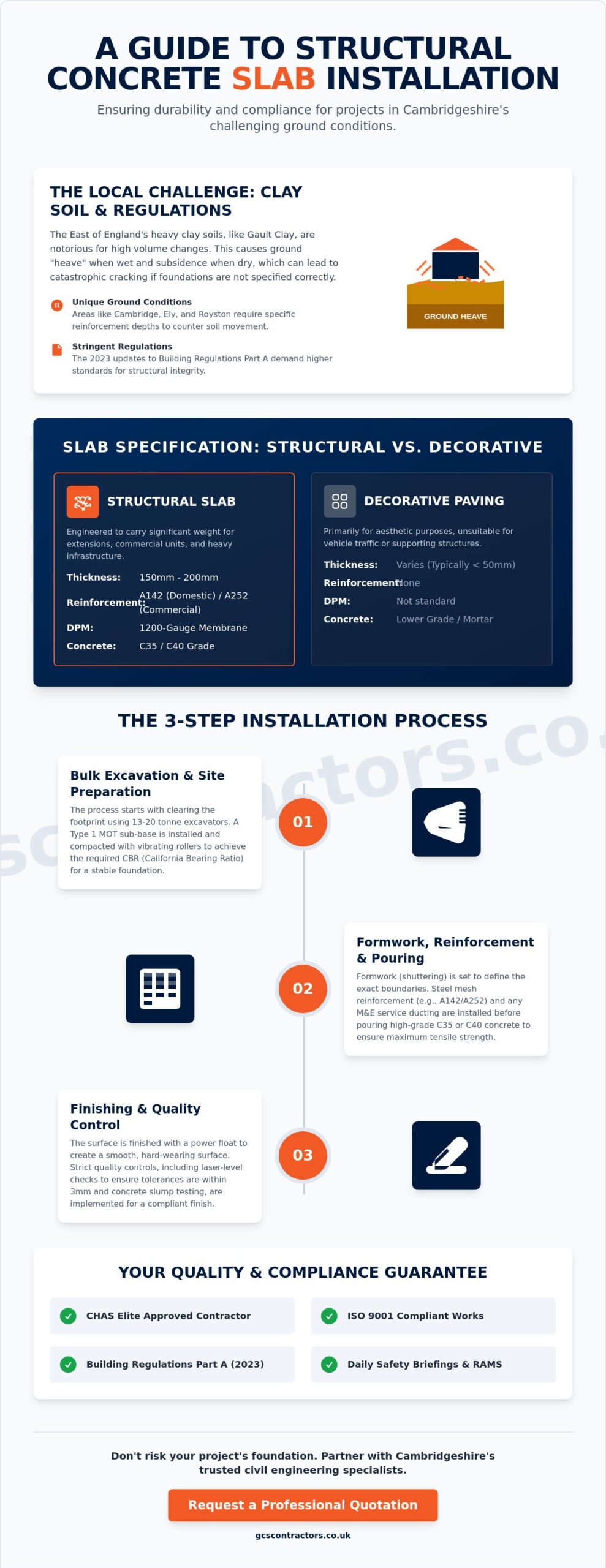
Choosing the correct specification depends entirely on the intended load. Structural Concrete Slabs require steel reinforcement mesh, typically A142 for domestic extensions or A252 for heavy-duty commercial environments. These slabs are usually 150mm to 200mm thick and include a 1200-gauge damp-proof membrane (DPM). We don’t recommend standard paving for outbuildings or driveways that carry vehicle traffic; reinforced works are necessary to resist tension and prevent cracking under pressure.
The Impact of East of England Soil on Slab Specification
Cambridge and surrounding areas like Ely and Royston sit on challenging geology. Gault Clay is common here, a soil type known for high volume changes. This causes “heave” when the clay swells with moisture, potentially lifting a building. In Saffron Walden, chalky soils present different drainage requirements. We conduct thorough site clearance and soil analysis before any pour. This data determines the required depth of the sub-base and the specific grade of concrete, ensuring the slab remains stable despite seasonal ground movement. Developers who treat ground erosion as a simple landscaping issue rather than a structural engineering risk often discover too late that surface-level fixes mask far deeper instability in these clay-heavy soils. For projects requiring deeper sub-structure works, understanding the complexities of basement excavation in Cambridge’s challenging clay soils is equally critical to long-term structural success.
How to Organise a Structural Concrete Slab Installation
Successful Concrete Slabs depend on rigorous planning and coordination. In Cambridge, where the high-water table of the Fens presents unique challenges, drainage integration isn’t optional; it’s a structural necessity. You’ll need to align your schedule with specialist concrete contractors early to ensure site readiness. This prevents delays and ensures all building regulations are met from day one. Our approach focuses on a “safe pair of hands” methodology, prioritising site safety and technical precision.
Step 1: Bulk Excavation and Site Preparation
The process starts by clearing the footprint and digging to the engineered depth. Professional Bulk Excavation is vital here. We use 13-tonne or 20-tonne excavators to remove spoil efficiently while maintaining site integrity. Once the ground is clear, we install a Type 1 MOT sub-base. This layer must be compacted using vibrating rollers to achieve a CBR (California Bearing Ratio) that meets the structural design. This prevents the slab from sinking or cracking over time, especially in softer Cambridgeshire soils.
Step 2: Formwork, Reinforcement, and Pouring
Accuracy is everything during shuttering. We set the formwork to define the exact boundaries and finished floor levels. Before the pour, we install steel mesh reinforcement and M&E service ducting. Following industry-standard construction practices ensures the steel is positioned at the correct depth to provide maximum tensile strength. During the pour, we manage concrete grades, typically C35 or C40, to ensure long-term durability. We often finish with a power float to create a smooth, hard-wearing surface ready for final use.
To maintain a building-regulations-compliant finish, we implement strict quality controls:
- Daily safety briefings and RAMS compliance for all site personnel.
- Laser-level checks to ensure slab tolerances are within 3mm.
- Slump testing on-site to verify concrete consistency before the pour begins.
Our team handles everything from foundations to finishing, ensuring your project stays on track and within budget. If you’re planning a new build or commercial extension, contact our Cambridge office for a professional site assessment.
Selecting the Right Concrete Slab Contractor in Cambridgeshire
Choosing a partner for Concrete Slabs requires more than a basic price comparison. Structural concrete projects carry high stakes, and the quality of the installation dictates the longevity of the entire building. Professional accreditation isn’t optional. At GCS Contractors Ltd, we maintain CHAS Elite and ISO 9001 status. These certifications prove our site safety and quality management systems meet rigorous national standards. They provide peace of mind that your project is handled by a regulated, competent team.
A local specialist understands the specific challenges of the Cambridge, Peterborough, and Stevenage construction landscapes. We know the local soil conditions and regional planning expectations. Hiring a contractor capable of delivering end-to-end groundworks and civil engineering solutions reduces the risk of miscommunication between different trades. It ensures a seamless transition from site clearance to the final pour. Where projects also involve subterranean expansion, our expertise in basement excavation and specialist sub-structure works ensures every below-ground element is engineered to the same exacting standard.
Commercial vs Residential Slab Specialists
Industrial warehouse floors and domestic extensions require vastly different engineering approaches. Large-scale commercial slabs must withstand heavy plant machinery and high-traffic loads, demanding precise reinforcement and specific concrete grades. We bring a practical “can-do” attitude to every site. This is vital for complex projects in town centres like Ely or St Ives, where limited access and tight footprints make logistics difficult. Our team manages these constraints without compromising on structural integrity.
The GCS Advantage: Quality and Compliance
We operate with a “from foundations to finishing” philosophy. By integrating our concrete services with broader site infrastructure, such as drainage and roadworks, we provide a unified solution for residential and commercial clients. This integrated approach eliminates the friction often found when using multiple subcontractors. We focus on precision in every reinforced project, ensuring your Concrete Slabs are compliant, durable, and fit for purpose. Whether you’re building a single-storey extension or a large industrial unit, our disciplined team delivers professional results that stand the test of time.
Secure the Foundation of Your Next Project
Building a successful development in the East of England requires more than just raw materials; it demands precision and technical expertise from the ground up. High-quality Concrete Slabs form the essential structural base for any Cambridge construction project, whether you’re managing a residential extension or a large-scale commercial site. You’ve now seen how to organise a professional installation, from initial site preparation to the final pour, and why choosing a contractor with verified credentials is non-negotiable for long-term safety.
GCS Contractors Ltd brings a disciplined, no-nonsense approach to every site. As a CHAS Elite Approved Contractor with ISO 9001 Certified Quality Management, we ensure your groundworks meet the highest industry standards. We’re specialists in Cambridge and East of England groundworks, providing a safe pair of hands for your civil engineering needs. Our team handles the technical complexities so your build stays on schedule and complies with all relevant regulations.
We look forward to helping you get your site ready for the next phase of construction.
Frequently Asked Questions
How thick should a structural concrete slab be for a home extension?
A structural concrete slab for a domestic extension typically requires a depth of 100mm to 150mm. This thickness provides the load-bearing capacity needed for residential loads while complying with Building Regulations Part A. We install this over a 150mm compacted hardcore base and a 1200-gauge damp proof membrane. Every project involves specific site calculations to ensure the slab remains stable against local ground conditions.
Do I need steel reinforcement (rebar) for my concrete slab in Cambridge?
Most structural concrete slabs in Cambridge require steel reinforcement to counter the high shrink-swell potential of the region’s Gault Clay. We specify A142 or A193 steel fabric mesh to provide essential tensile strength and prevent structural cracking during seasonal shifts. This approach ensures a reliable foundation that meets NHBC standards. Our CHAS Elite approved teams ensure all steel is positioned correctly with 50mm cover before the pour begins.
Can a concrete slab be poured in wet weather in the East of England?
You can pour concrete during light drizzle, but heavy rain in the East of England will damage the surface finish and weaken the structural mix. If rainfall increases the water-to-cement ratio, the slab’s compressive strength can drop by as much as 30%. Our site managers monitor local weather data and use heavy-duty polythene covers to protect the work. We don’t proceed if there’s standing water in the footings or if temperatures are under 5 degrees Celsius.
How long does a new concrete slab take to cure before building can start?
It takes 7 days for a new concrete slab to gain enough strength for light foot traffic and the commencement of wall construction. While the concrete is hard enough to walk on after 48 hours, it requires 28 days to reach its full design strength. We follow these strict curing timelines to ensure every project meets ISO 9001 quality standards. Rushing the build process can lead to structural settlement or surface failures later on.