New Build Foundation Cost Calculator UK 2026: Cambridge & East of England Guide
Your 2026 project budget is won or lost before the first brick is laid. Groundworks represent the highest financial risk in any development. This is especially true when you factor in the volatile material price forecasts predicted for the next 24 months. You likely recognise that a single miscalculation in the East of England’s challenging soil can lead to a 15% increase in total build costs. It’s a common frustration for developers who face the unpredictability of Cambridgeshire clay and chalk without a rigid financial plan. Using a reliable new build foundation cost calculator UK 2026 is the only way to safeguard your margins against these local variables.
This guide provides a professional framework to help you lock in accuracy. We offer expert insight into local building control standards and specific ground engineering requirements for the Cambridge region. You’ll learn how to account for every cubic metre of concrete and hour of plant hire required for a compliant site. We ensure your project starts on a stable, cost-effective footing. GCS Contractors Ltd delivers the technical expertise needed to move from foundations to finishing with total confidence and zero hidden overruns.
Key Takeaways
- Access an expert-led framework using a new build foundation cost calculator UK 2026 to accurately forecast expenses for projects across Cambridgeshire and the East of England.
- Identify how local geological factors, specifically Gault Clay and Chalk, impact footing depths and material volumes compared to national averages.
- Break down 2026 labour rates and material costs for site clearance, bulk excavation, and reinforcement steel amongst regional groundworks specialists.
- Optimise your groundworks budget by integrating drainage systems and utility trenching early to ensure a seamless “foundations to finishing” approach.
- Learn how to mitigate financial risk by partnering with a CHAS Elite approved contractor for end-to-end substructure delivery in the Cambridge and London corridors.
Understanding Foundation Costs in Cambridge: Why Local Ground Conditions Matter
A new build foundation cost calculator UK 2026 serves as a technical framework that integrates current labour rates, material price indices, and modern structural requirements. In Cambridge, these calculations rely heavily on specific ground conditions. Foundation engineering principles dictate that the soil’s load-bearing capacity determines the substructure’s complexity and final price point. We utilise a no-nonsense approach to site assessment to identify risks like high water tables or unstable strata before the first pour. This precision prevents the 15% to 20% budget overruns often seen in poorly planned groundworks projects.
To better understand the financial variables of a construction project, watch this helpful video:
The Impact of Cambridgeshire Soil on Trench Depth
Standard UK footings often sit at a depth of 1 metre. However, in areas like Ely and Huntingdon, the presence of high-plasticity Gault Clay frequently forces depths of 1.5 metres or more. This soil type shrinks and swells significantly with moisture changes, necessitating deeper excavations to reach stable ground. Proximity to protected trees in Cambridge city centre adds further engineering challenges. Root protection zones and desiccated clay often require specific raft or piled foundations to ensure the structure remains safe for decades.
Regulatory Compliance and Building Control in 2026
Compliance is a critical factor in any new build foundation cost calculator UK 2026. Building control officers in St Neots and Bury St Edmunds now enforce strict 2026 environmental standards focused on carbon reduction in concrete and sustainable drainage (SuDS). As a CHAS Elite approved contractor, we ensure every project meets ISO 9001 quality benchmarks. We manage the entire process from foundations to finishing, ensuring that all substructure work passes local authority inspections without costly delays or remedial works.
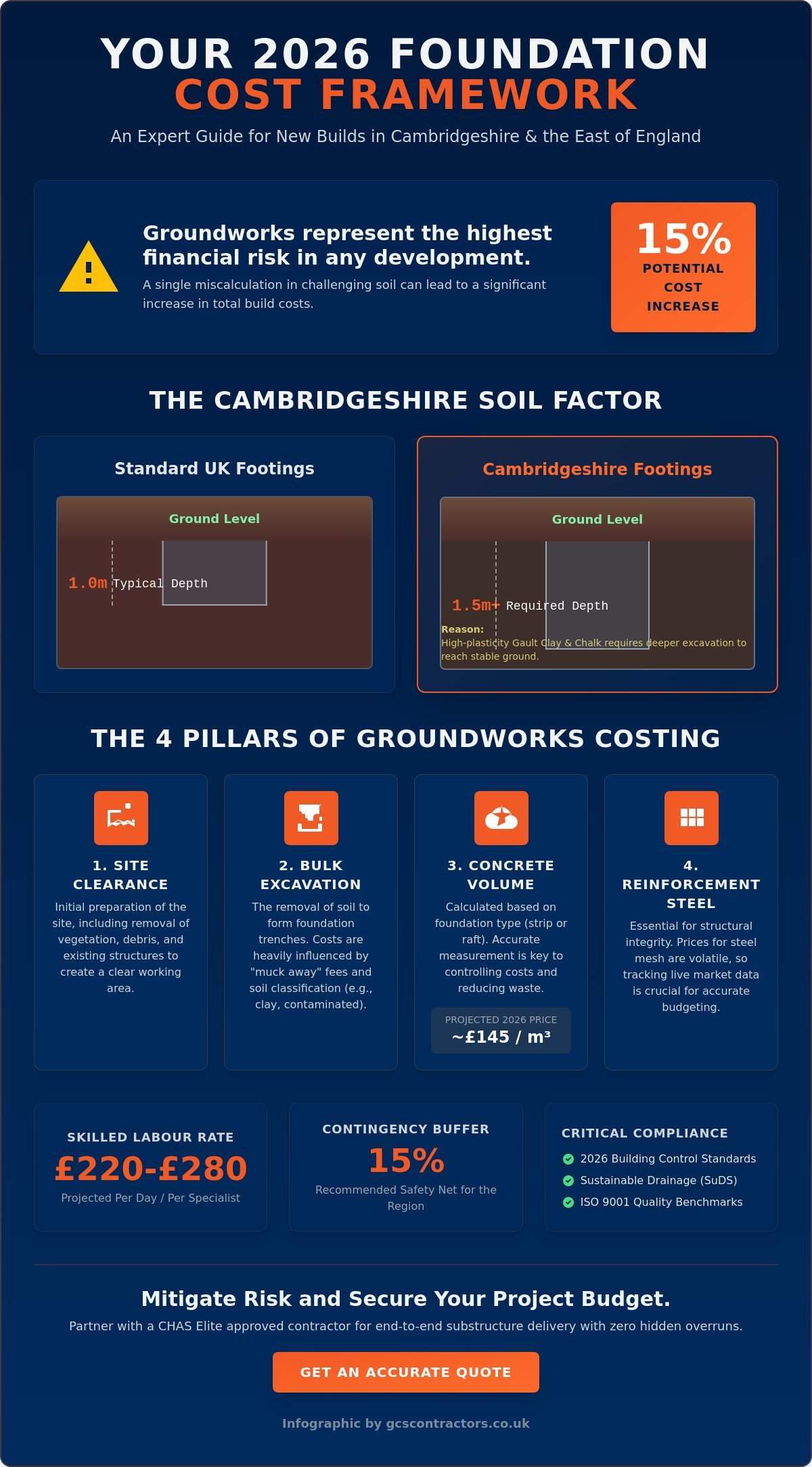
The 2026 New Build Foundation Cost Framework: A Step-by-Step Manual Calculator
Accurate budgeting for groundworks requires a granular look at site-specific variables. Using a manual new build foundation cost calculator UK 2026 involves tallying four primary pillars: site clearance, bulk excavation, concrete volume, and reinforcement steel. In the Cambridge and Peterborough corridors, labour rates for 2026 are projected to settle between £220 and £280 per day for skilled groundworks specialists. These figures reflect the high demand for infrastructure expertise across the East of England and the rising costs of living in the commuter belt.
Waste management is a critical budget line that many developers overlook. The “muck away” factor depends on local waste regulations and the specific classification of your soil. If you’re dealing with heavy clay or contaminated land, disposal fees rise sharply due to landfill tax and transport requirements. We recommend a 15% contingency safety net for all projects in this region. This buffer handles unforeseen obstructions like buried utilities, archaeological finds, or shifting water tables common in the Fens. Following UK Building Regulations for foundations ensures your depth and soil assessments meet legal safety standards from the outset.
Calculating Concrete and Material Volumes
Volume calculations depend on your specific design. For strip foundations, you’ll measure linear metres multiplied by trench width and depth. Raft foundations require a square metre calculation for the total footprint. By 2026, ready-mix concrete in the Cambridge area is expected to average £145 per cubic metre. Reinforced steel mesh prices remain volatile, so tracking live market data is essential for your new build foundation cost calculator UK 2026 inputs. Precise measurements prevent expensive over-ordering and reduce environmental impact.
Excavation and Site Preparation Costs
Plant hire for bulk excavation in Royston, Haverhill, and Saffron Walden varies based on machine tonnage and fuel costs. Standard trench fill is the most cost-effective route for stable ground. However, if your site has poor load-bearing capacity, you’ll need to budget for complex piling. This can significantly increase your initial groundworks estimate. Our specialists often provide site clearance and preparation to ensure the ground is ready for the first pour without delay.
Managing Your Groundworks Budget in the East of England: From Footings to Finish
GCS Contractors Ltd operates as a specialist partner for end-to-end substructure works across Cambridge, London, and the Home Counties. Whilst a new build foundation cost calculator UK 2026 provides a helpful starting point, professional oversight ensures your budget accounts for the technical realities of the site. We provide a safe pair of hands for complex reinforced concrete works and deep basement excavations that require precision and strict safety compliance.
Integrating drainage systems and utility trenching during the initial foundation stage significantly reduces overall project costs. By avoiding multiple mobilisations of heavy plant, we keep your 2026 build schedule on track. Once utilities are in place, ensuring gas safety and heating compliance is the next vital step; to understand these requirements, visit Gas2Heat.com Ltd. For developments in Stevenage and Hitchin, we manage essential S278 works to ensure compliant road access and highway connections from day one. This proactive approach prevents the delays often associated with local authority approvals and infrastructure tie-ins.
Integrated Civil Engineering Solutions
Our team reviews local ground conditions to design integrated systems that handle surface water effectively. Coordinating drainage installation with foundation pours is vital to prevent future structural issues and costly rework. Using a single contractor for site clearance, demolition, and foundations simplifies communication. It ensures every phase of the groundworks is handled by a CHAS Elite approved team, maintaining high standards from the first dig.
Ready to Start Your Project in Cambridge?
It’s time to move beyond a generic new build foundation cost calculator UK 2026 and secure a site-specific professional quote. We bring a “foundations to finishing” approach to every project, backed by ISO 9001 certification and a reputation for reliability. Whether you’re planning a residential extension or a large-scale commercial development, GCS Contractors Ltd delivers the technical expertise needed to get out of the ground safely and efficiently. Contact our Cambridge office today to discuss your requirements and book a site visit.
Secure Your 2026 Cambridge Groundworks Schedule
Success on a construction site starts below the surface. Understanding the specific soil profiles across Cambridge and the East of England is essential for accurate budgeting. Our guide highlights how site-specific factors like heavy clay or high water tables impact your bottom line. Using a new build foundation cost calculator UK 2026 provides a baseline, but professional oversight ensures you account for technical variables such as drainage, attenuation, and S278 highway works.
GCS Contractors Ltd delivers reliability from foundations to finishing. We’re a CHAS Elite Approved Contractor and hold ISO 9001 and 14001 certifications, ensuring every project meets the highest industry standards. As specialists in Cambridge and East of England groundworks, we provide the technical expertise needed to manage complex site clearances and footings. We’re your disciplined, compliant partner for any scale of development, providing a safe pair of hands for your infrastructure needs.
For developers looking to source professional boundary materials, Romford Fencing Ltd offers an extensive online catalogue that supports the transition from initial groundworks to final site completion.
Get a Professional Foundation Quote for Your Cambridge Project
Let’s get your project started on the right ground.
Frequently Asked Questions
What is the average cost per m2 for new build foundations in the UK in 2026?
Standard trench fill foundations in 2026 are projected to cost between £130 and £195 per square metre according to industry price indices. This figure covers basic excavation, concrete pouring, and essential reinforcement for stable ground conditions. You should use a new build foundation cost calculator UK 2026 to account for the 4.2% annual inflation rate currently forecasted for heavy construction materials.
How does the soil type in Cambridgeshire affect my foundation budget?
Cambridgeshire contains significant deposits of heavy Gault Clay, which often requires foundation depths of 2.5 metres or more to satisfy NHBC requirements. These deeper trenches can increase your concrete consumption by up to 45% compared to standard 1-metre excavations. We always advise clients in Cambridge to conduct a professional soil analysis early to prevent unexpected budget spikes during the groundworks phase.
Is a raft foundation cheaper than trench fill for a 2026 new build?
Raft foundations are often 12% to 18% cheaper than trench fill when you’re building on poor or unstable ground that would otherwise require expensive piling. However, for standard load-bearing soil, trench fill remains the more economical choice because it requires less steel reinforcement and specialist formwork. Your final cost will depend on the structural engineer’s assessment of your specific site conditions in the 2026 season.
Do I need to factor in S278 works when calculating my foundation costs?
S278 works are separate from your internal foundation costs, but they’re vital for site infrastructure and legal compliance. These works involve any modifications to the public highway, including new site entrances or drainage connections. As a CHAS Elite approved contractor, we manage these civil engineering requirements alongside your foundations to ensure a seamless transition from the road to the building footprint.