The Comprehensive Guide to Tarmac Roads: Engineering, Benefits, and Comparisons
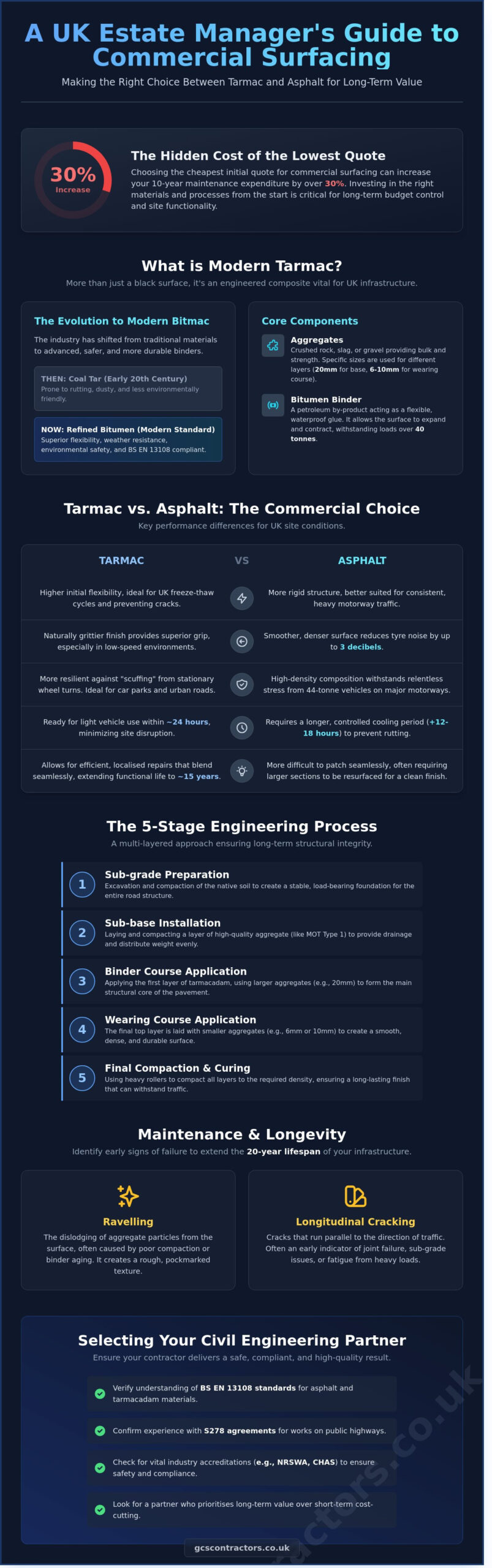
Choosing the lowest initial quote for your commercial site could inadvertently increase your 10-year maintenance expenditure by more than 30%. We understand that for most UK estate managers, the technical distinction between surfacing options often feels unnecessarily complex. You likely recognise that a high-quality tarmac road is the backbone of seamless site logistics, yet the industry jargon surrounding binders and aggregates often obscures the path to a durable, compliant result.
We’ve developed this guide to eliminate that uncertainty, providing the technical specifications and commercial advantages required to ensure your project meets BS EN 13108 standards. Our team delivers a direct comparison between tarmac and asphalt. We outline the engineering behind our 5-stage construction process and explain how specific material choices impact your long-term budget. You’ll gain a thorough understanding of modern bitumen chemistry and the precise methodologies we use to guarantee a finish that withstands heavy-duty traffic for decades.
Key Takeaways
- Understand the technical evolution of modern bitumen-based binders and how they provide superior durability compared to traditional coal-tar mixtures.
- Compare the cost-efficiency and flexibility of a tarmac road against asphalt to identify the most suitable surfacing solution for your specific commercial environment.
- Discover the essential multi-layered engineering process, from sub-grade preparation to the final wearing course, that ensures long-term structural integrity.
- Learn to identify early signs of surface failure, such as ravelling and longitudinal cracking, to effectively manage and extend the 20-year lifespan of your infrastructure.
- Navigate the complexities of S278 agreements and the vital accreditations required to ensure your civil engineering partner delivers a safe, compliant, and high-quality result.
What is a Tarmac Road? Defining Modern Tarmacadam
A tarmac road is a durable, weather-resistant surface created by combining mineral aggregates with a sticky, viscous binding agent. While the term is often applied to almost any black-top surface in the UK, it specifically refers to the patented process developed by Edgar Purnell Hooley in 1902. Understanding What is Tarmacadam helps clarify why it remains a staple of British infrastructure. Today, the industry has transitioned away from the original coal-tar binders used in the early 20th century. We now utilise refined bitumen, a byproduct of the petroleum industry, which offers superior flexibility and environmental safety. This modern iteration is vital for UK commercial property development, where approximately 95% of the local road network relies on some form of bituminous surfacing.
Our team sees tarmac as more than just a surface; it’s a critical component of national infrastructure. It provides the reliable, high-grip finish necessary for everything from retail car parks to heavy-duty industrial access roads. Because it’s quick to install and cost-effective, it remains the primary choice for developers who require a professional finish that stands up to the British climate.
The Evolution from McAdam to Modern Bitmac
John McAdam’s 1820s “water-bound” process revolutionised travel by using layers of small, angular stones for natural drainage. However, these roads suffered from heavy dust and rutting as motor vehicles became popular at the turn of the century. By 1902, the addition of tar provided the necessary adhesion to lock stones in place and eliminate dust. Bitmac stands as the modern industry standard used since the mid-20th century, replacing tar with bitumen for enhanced durability. Our engineers apply these principles to ensure every tarmac road we construct meets current British Standards for load-bearing capacity and longevity.
Core Components: Aggregates and Binders
The structural integrity of a road depends on the synergy between its components. We select specific stone sizes based on the intended use. For example, a 20mm base course offers essential stability, while a 6mm or 10mm wearing course provides a smooth, dense finish for the top layer. Bitumen acts as a flexible, waterproof glue, coating each piece of aggregate to prevent water ingress. This chemical bond allows the surface to expand and contract with temperature changes without cracking. These properties enable the material to withstand vehicular loads exceeding 40 tonnes on commercial sites, making it a dependable choice for high-traffic environments.
- Aggregates: Crushed rock, slag, or gravel that provides the bulk and strength.
- Bitumen Binder: A petroleum-based substance that ensures the stones remain bound together.
- Flexibility: The ability to deform slightly under pressure without fracturing.
Tarmac vs. Asphalt: Key Comparisons for UK Roadworks
Choosing between materials depends on the projected traffic load and the specific geometry of your site. While both involve mineral aggregates and bitumen, their performance profiles differ significantly. A tarmac road offers higher initial flexibility, making it less prone to cracking during the freeze-thaw cycles common in the UK. Asphalt provides a smoother, denser surface that reduces tyre noise by up to 3 decibels compared to traditional concrete or coarse macadam.
Site accessibility is a primary concern for our commercial clients. Tarmac typically reaches sufficient hardness for light vehicle use within 24 hours of laying. Asphalt requires a more controlled cooling period. This often extends project timelines by 12 to 18 hours to prevent “rutting” or permanent indentations from early traffic. We prioritise these timelines during the planning phase to ensure your operations resume with minimal disruption.
- Surface Texture: Tarmac provides a naturally grittier finish, offering superior grip for low-speed urban environments.
- Flexibility: Tarmac adapts better to slight ground movements in older urban areas.
- Maintenance: Asphalt is harder to patch seamlessly, whereas tarmac allows for efficient, localised repairs.
Durability and Lifespan Under Heavy Traffic
Asphalt’s high-density composition is designed for the relentless stress of UK motorways like the M1 or M6. It maintains structural integrity under the weight of 44-tonne haulage vehicles. Conversely, a tarmac road is more resilient against “scuffing.” This occurs when stationary vehicles turn their wheels on a fresh surface, a common issue in retail car parks. For urban roads, tarmac’s easier repair profile allows for maintenance that extends the surface’s functional life to approximately 15 years.
Cost-Effectiveness for Commercial Projects
For projects under 500 square metres, tarmac is frequently the most economical choice. Current UK market rates for tarmac installation range between £45 and £70 per square metre. Hot rolled asphalt often carries a 15% to 20% premium due to the specialised equipment and higher temperatures required for laying. Our team provides bespoke infrastructure assessments to ensure the chosen material aligns with your long-term maintenance budget. While asphalt has a higher initial cost, its 20-year lifespan in high-traffic zones offers a strong return on investment for large-scale industrial estates.
The Engineering Process: How a Tarmac Road is Constructed
Constructing a durable tarmac road requires a meticulous engineering approach that extends far beyond the visible surface. At GCS Contractors, we treat every project as a structural undertaking where longevity is built from the bottom up. Professional groundworks are a non-negotiable requirement because approximately 85% of surface failures, such as potholes or subsidence, originate from deficiencies in the underlying layers. Our team delivers a structured, multi-layered solution that ensures the finished pavement can withstand heavy axle loads and harsh British weather cycles.
Temperature control remains a critical factor during the “hot lay” process. We ensure the material arrives on-site and is compacted while maintaining a temperature between 120°C and 180°C. If the mixture cools too rapidly, it loses its workability, which prevents the bitumen from binding effectively with the aggregate. This leads to a porous surface that is susceptible to water ingress and frost heave. Our contractors use precision timing and insulated transport to guarantee the material is laid at its optimal thermal state.
Sub-Base Preparation and Groundworks
The sub-base is the most critical layer for preventing future cracks and structural deformation. We typically utilise MOT Type 1 crushed aggregate for standard applications or Type 3 for projects requiring SuDS (Sustainable Drainage Systems) compliance. Our engineers conduct plate bearing tests to verify the California Bearing Ratio (CBR), ensuring the ground achieves a minimum 5% strength rating for adoptable roads. This rigorous compaction testing confirms the foundation can support the intended load without shifting over time.
Layering: Binder Course and Wearing Course
Once the foundation is secure, we apply the binder course to distribute weight evenly across the sub-base. This layer uses larger aggregates to provide the necessary skeletal strength for the tarmac road. Following this, we select the wearing course based on the specific requirements for skid resistance and aesthetics. The wearing course is the final 30mm to 40mm layer that interacts with tyres. We use laser-guided levelling equipment to ensure a precise 1:40 gradient fall, which facilitates efficient water runoff and prevents hazardous pooling. This disciplined process results in a seamless, high-performance finish that meets all UK building standards.
Maintenance, Longevity, and Common Road Issues
A well-constructed UK tarmac road typically delivers a reliable service life of 15 to 20 years before it requires significant intervention. This durability depends heavily on the resilience of the bitumen binder. Over time, UV oxidation strips the bitumen of its essential oils; this process reduces flexibility and makes the surface brittle. When the binder loses its elasticity, the road becomes vulnerable to several common issues:
- Potholing: Small fractures allow water to enter the sub-base, which expands and contracts during freeze-thaw cycles.
- Ravelling: The aggregate particles begin to detach from the surface, leading to a “loose gravel” effect and thinning of the top layer.
- Longitudinal Cracking: Cracks that run parallel to the road’s centre line, often caused by heavy load stress or temperature fluctuations.
Proactive maintenance programmes can effectively double the service life of the pavement, often extending its utility to 30 or 40 years. By identifying early signs of wear, our team implements targeted interventions that prevent minor surface flaws from evolving into expensive structural failures.
The Critical Role of Drainage Systems
Standing water is the primary catalyst for tarmac degradation. Up to 90% of premature road failures in the UK are linked to moisture penetrating the surface and saturating the sub-base. Once the foundation is compromised, the weight of passing vehicles causes the tarmac road to sag and crack. We integrate precision-engineered kerbing and gully systems during the initial construction phase to ensure efficient water runoff. Investing in commercial drainage solutions acts as a vital preventative measure, protecting your infrastructure from the bottom up.
Repair Techniques: Patching vs. Resurfacing
Pothole patching serves as a viable fix for isolated damage; it’s a cost-effective way to maintain safety on an otherwise healthy road. However, if more than 15% of the surface area shows signs of cracking or ravelling, patching becomes a temporary sticking plaster. In these instances, we recommend resurfacing. This process involves “planing” the surface, where a specific depth of the old material is mechanically removed to create a level profile. This creates a clean bond for a fresh top layer. If you notice deep structural cracks, it typically indicates deep-seated groundworks issues that require a full-depth reconstruction rather than a simple surface refresh.
Ensure your infrastructure remains safe and compliant for years to come. Contact GCS Contractors for a professional site assessment and maintenance plan tailored to your specific requirements.
Selecting a Contractor for Commercial Roadworks and S278
Choosing a civil engineering partner for a tarmac road project requires a rigorous evaluation of technical competence and legal compliance. You should prioritise firms holding UK-recognised accreditations such as CHAS, Constructionline Gold, and ISO 9001. These certifications aren’t just badges; they prove a contractor’s ability to manage the high-stakes environment of a live site safely. A turnkey provider manages the entire lifecycle from initial demolition and groundworks to the final wearing course. This holistic approach eliminates the friction of managing multiple subcontractors, which significantly reduces project risk and prevents costly delays on site.
Effective site compliance is the foundation of any successful infrastructure project. We take full responsibility for health and safety, ensuring that every operative on site adheres to the latest CDM 2015 regulations. By managing the logistical burden of plant machinery, material procurement, and waste disposal, we allow your internal team to focus on broader development goals. Our role is to be a safe pair of hands, providing the technical credibility needed for complex commercial roadworks.
Navigating S278 Highways Works
S278 works refer to Section 278 of the Highways Act 1980, which governs permanent alterations to existing public roads made by private developers. These projects require formal local authority approval and a financial bond, often covering 100% of the estimated construction costs to protect public funds. We manage the transition between your private development and the public highway with precision. Our team handles the technical approvals and ensures every layer of the tarmac road meets the local council’s specific adoption standards, preventing future maintenance liabilities for the developer.
The GCS Approach: Quality and Reliability
GCS Contractors brings over 10 years of specialised experience to groundworks and commercial infrastructure projects across the UK. We provide fixed-price tenders to give you financial certainty, avoiding the budget creep that often plagues complex roadworks. Our disciplined project management ensures site compliance and health and safety are never compromised. We act as a dedicated partner, delivering physical results that withstand heavy use and time. To discuss your next infrastructure project, contact our expert team today.
Building Durable Infrastructure for the Future
Selecting the correct specification for a tarmac road requires a precise balance between initial investment and decades of durability. We’ve explored how modern engineering ensures these surfaces withstand heavy traffic loads while meeting strict UK safety standards. Whether you’re navigating the complexities of S278 highways works or managing a large-scale commercial development, the quality of your infrastructure depends on technical precision and rigorous compliance. Mistakes in the groundworks phase can lead to costly repairs; getting the engineering right from day one is vital.
GCS Contractors brings over 10 years of industry expertise in civil engineering to every project we undertake. We’re fully accredited for S278 highways works nationwide, ensuring your project meets all local authority requirements without the stress of regulatory delays. Our team are specialists in end-to-end groundworks and drainage solutions, providing a turnkey approach that keeps your project on schedule. We’ve built a reputation as a safe pair of hands by delivering tangible results that stand the test of time. The right partnership turns a complex construction challenge into a seamless delivery.
Partner with GCS Contractors for your next roadworks project to ensure your infrastructure is built to the highest professional standards. We look forward to supporting your vision.
Frequently Asked Questions
How long does it take for a tarmac road to set and be ready for traffic?
A tarmac road typically takes 48 to 72 hours to set sufficiently for heavy vehicle traffic. While the surface is usually cool enough to walk on within 5 to 8 hours, commercial vehicles should wait three days to prevent surface scuffing or indentation. Our team monitors surface temperatures to ensure the binder has hardened according to BS EN 13108 standards. This patience ensures the long-term structural integrity of your infrastructure.
Is tarmac cheaper than concrete for a large commercial road?
Tarmac is generally 25% to 40% cheaper than concrete for large-scale commercial projects. Current UK market rates for a professional tarmac road installation range from £45 to £70 per square metre, whereas reinforced concrete often exceeds £110 per square metre. We provide bespoke quotes that reflect these cost efficiencies. This allows clients to allocate budgets toward other essential site refurbishments or facility upgrades.
Can a tarmac road be recycled or is it environmentally damaging?
Tarmac is 100% recyclable and remains the most recycled construction material in the UK, with over 20 million tonnes repurposed annually. We use Reclaimed Asphalt Pavement (RAP) in our mixes to reduce the need for virgin aggregates and bitumen. This circular approach minimises landfill waste and lowers the carbon footprint of your project. Our commitment to sustainability ensures your road meets modern environmental compliance standards without compromising on quality.
What causes tarmac roads to melt during extreme UK summer heatwaves?
Tarmac begins to soften when road surface temperatures reach 50°C, a figure often surpassed when ambient UK temperatures hit 32°C. Dark surfaces absorb 90% of solar radiation, causing the bitumen binder to transition from a solid to a semi-liquid state. We mitigate this by using high-penetration grade binders designed to withstand these specific thermal fluctuations. This technical precision keeps your transport links stable during extreme weather events.
Do I need planning permission to build a new tarmac road on private land?
You don’t need planning permission if the new surface is under 5 square metres or uses permeable materials according to 2008 SUDS regulations. However, if you’re creating a new access point onto a public highway, you’ll need a Section 184 licence from your local council. Our team delivers end-to-end support to ensure all infrastructure work complies with current UK building standards. We handle the technical details so you don’t have to worry about legal compliance.
What is the difference between open-graded and dense-graded tarmacadam?
Open-graded tarmacadam contains 15% to 25% air voids to allow for rapid water drainage and reduced tyre spray. Dense-graded mixtures have less than 5% air voids, providing a high-strength, impermeable surface designed for heavy industrial loads. We select the specific grade based on your site’s drainage requirements and expected traffic volume. This meticulous approach ensures a seamless and durable finish for every client.
How often should a commercial tarmac road be resealed or treated?
A commercial tarmac road should be resealed or surface-dressed every 5 to 10 years to prevent oxidation and water ingress. Regular maintenance can extend the surface life by 15 years, preventing the need for a full depth refurbishment. Our dedicated maintenance programmes identify cracks early, usually when they exceed 3mm in width. This proactive strategy protects your investment and maintains a high-quality appearance for your facility.
Can you lay new tarmac directly over an old concrete surface?
You can lay new tarmac directly over an old concrete surface provided the base is structurally sound and free from significant movement. We apply a bitumen tack coat and often a glass-fibre reinforcement mesh to prevent reflective cracking from the concrete joints. This method provides a high-quality finish while saving up to 30% on excavation and disposal costs. Our engineers ensure the bond is seamless and meets all safety specifications.