Earthworks Contractors in Cambridgeshire: A Guide to Key Processes
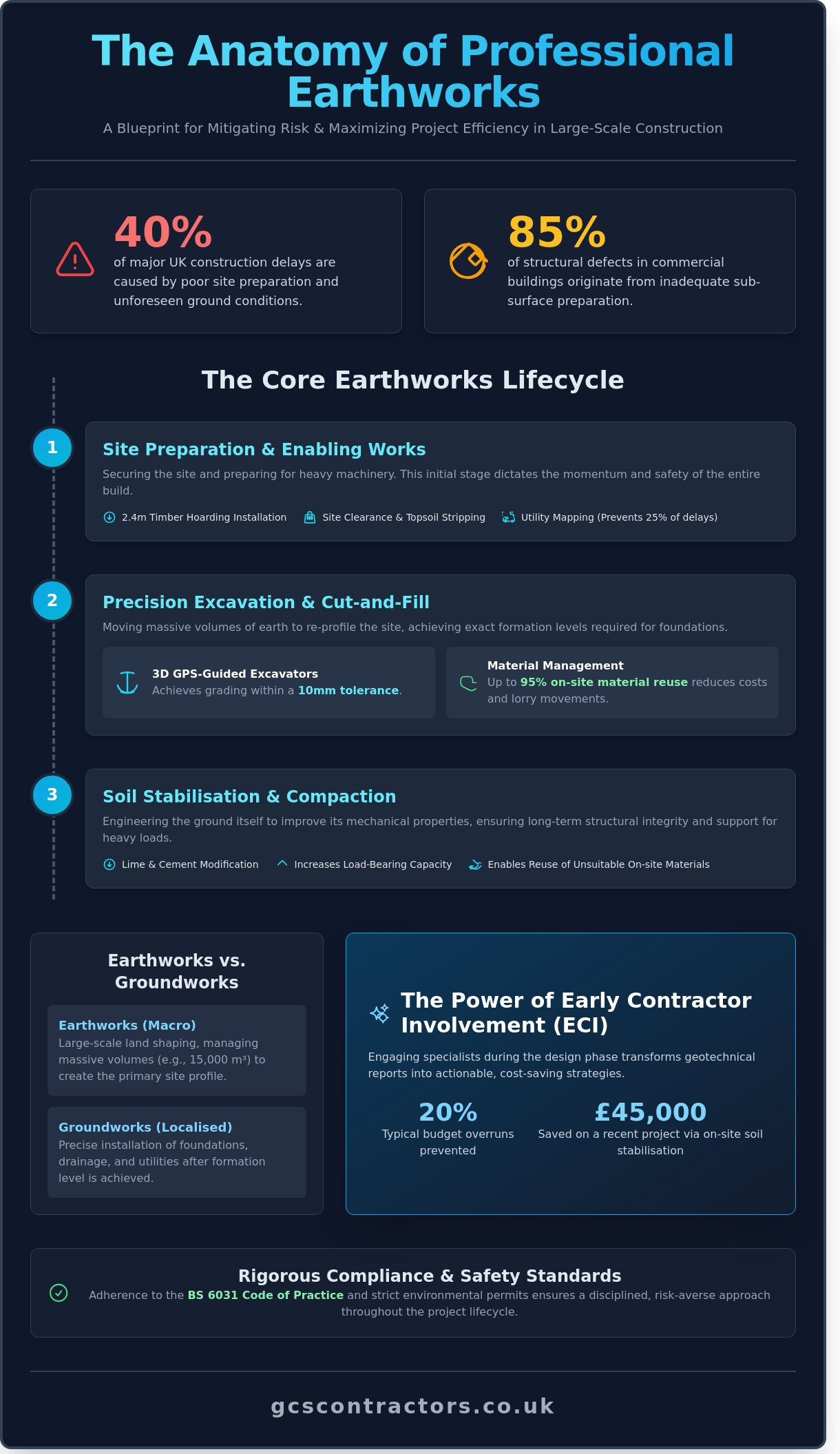
A 2023 industry report revealed that roughly 40% of major UK construction delays are caused by unforeseen ground conditions and poor site preparation. You know that groundworks represent the foundation of your project’s financial and structural integrity. It’s frustrating when inaccurate cut-and-fill calculations or shifting waste management regulations turn a 12-week schedule into a 20-week budget overrun. As experienced earthworks contractors Cambridgeshire developers rely on, we understand that precision at the sub-structure level is non-negotiable for a successful build.
You’ll discover the essential engineering stages and regulatory standards that define professional earthworks for large-scale construction projects. We provide a clear roadmap to help you maintain control over your site’s physical and financial landscape. This guide explores the entire project lifecycle, from initial site investigations to achieving rigorous compliance with BS 6031 standards and optimising material management on-site.
Key Takeaways
- Understand the critical transition from initial site clearance to the complex engineered cut-and-fill operations required for commercial infrastructure.
- Learn how advanced soil stabilisation techniques using lime and cement can significantly improve ground quality and ensure long-term structural integrity.
- Navigate the regulatory landscape with insights into essential environmental permits and the technical requirements of the BS 6031 Code of Practice.
- Identify the core qualities of professional earthworks contractors Cambridgeshire developers rely on for high-quality, turnkey project delivery.
- Discover how a disciplined approach to engineering precision and safety standards mitigates risk throughout the entire construction lifecycle.
Understanding the Scope of Professional Earthworks
Earthworks represent the complex engineering process of moving, processing, and stabilising soil and rock to create a viable platform for development. While a basic excavation might involve simple digging, the services provided by professional earthworks contractors Cambridgeshire require technical precision and heavy-duty plant machinery. Our team treats these operations as the invisible foundation of a project. If the sub-strata isn’t correctly engineered, even the most expensive commercial structures face long-term settlement risks. We focus on the precision-led manipulation of land to support high-stakes infrastructure.
These activities form a critical part of the enabling works phase. This initial stage dictates the momentum of the entire build. Efficient earthworks ensure that the site is geotechnically sound, safe, and accessible before any vertical construction begins. Industry data suggests that 85% of structural defects in commercial buildings originate from poor sub-surface preparation. By focusing on volume management and soil density from day one, we eliminate these risks and provide a secure environment for subsequent trades.
The Distinction Between Groundworks and Earthworks
Distinguishing between these disciplines is vital for effective site management. Earthworks focus on macro-level land shaping and the management of massive material volumes. On a typical 2024 development project, this might involve re-profiling 15,000 cubic metres of soil to achieve specific site levels. Groundworks are more localised; they involve the installation of foundations, drainage, and utility services. These two fields overlap when the bulk earthworks reach the finished formation level, allowing groundworkers to begin precise trenching and footing installations.
The Importance of Early Contractor Involvement
Engaging a specialist during the design phase prevents the 20% budget overruns typical of poorly planned sites. Our team delivers value by reviewing geotechnical reports at the pre-tender stage to determine soil suitability and contamination risks. In a recent project handled by earthworks contractors Cambridgeshire, early intervention allowed for on-site soil stabilisation. This strategy saved the client £45,000 in landfill tax and haulage costs by reusing existing materials. This integrated approach turns a simple site survey into a functional, cost-saving strategy that secures the project’s long-term financial health.
The Core Stages of the Earthworks Process
Successful construction projects depend on a meticulous approach to the ground beneath them. As experienced earthworks contractors Cambridgeshire, we understand that the initial phases of a project dictate the stability and safety of the final structure. This process is a highly technical sequence of movements designed to transform raw land into a build-ready site with absolute precision.
Site Preparation and Enabling Works
We begin every project with robust enabling works to secure the perimeter and establish safe operational zones. Our team installs 2.4-metre timber hoarding to protect the public and organises dedicated access routes for heavy plant machinery and material storage. A critical component of this stage involves managing site clearance services to remove vegetation, topsoil, and redundant structures. We also conduct thorough utility mapping to identify gas, water, and electrical lines, preventing the service strikes that account for 25% of major project delays in the UK construction sector.
Precision Excavation and Material Handling
Our team delivers precision through the use of 3D GPS-guided excavators. This technology allows us to achieve grading and trimming within a 10mm tolerance, meeting the most demanding architectural and engineering specifications. We focus on efficient material handling by segregating soils at the point of excavation. By separating topsoil from subsoil and identifying recyclable aggregates, we often achieve a 95% on-site material reuse rate. This strategy reduces the need for thousands of lorry movements, lowering project costs and the overall environmental impact.
During bulk excavation for basement levels or attenuation tanks, our earthworks contractors Cambridgeshire manage the movement of thousands of cubic metres of earth with disciplined logistics. We perform cut-and-fill operations to reach the desired formation level, balancing the site’s topography by relocating soil from high points to fill depressions. This ensures a stable, level surface is ready for the structural phase. If you’re planning a new development, discussing your site requirements with our technical team can help streamline your project timeline and ensure compliance from the first dig.
Engineering Precision: Soil Stabilisation and Compaction
Structural integrity begins beneath the surface. For earthworks contractors Cambridgeshire projects often involve complex geological profiles like the heavy Gault Clay found in the south of the county. Compaction works by mechanically expelling air voids from the soil, which increases its dry density and shear strength. Our team monitors moisture content with clinical precision; even a 2% deviation from the Optimum Moisture Content (OMC) can compromise the load-bearing capacity of the entire site.
When ground conditions fall short of design requirements, we employ soil stabilisation. This process involves incorporating lime or cement to chemically alter the soil’s properties. Lime is particularly effective for drying out wet, plastic clays common in the Fens, while cement creates a rigid, rock-like sub-base in granular materials. This method often eliminates the need for expensive “dig and dump” operations, reducing vehicle movements by up to 40% on a typical 5,000-square-metre site. Our setting out engineers use Leica robotic total stations to verify that every lift meets the exact coordinates and levels specified in the 3D site model.
Compaction Standards and Testing
We adhere strictly to the Specification for Highway Works (SHW) Series 600. Our technicians use Nuclear Density Gauges (NDG) to provide immediate feedback on field density, ensuring the material reaches the required percentage of its maximum dry density. Plate Bearing Tests are also conducted to determine the California Bearing Ratio (CBR). Reaching “compaction to refusal” isn’t a suggestion; it’s a technical mandate that ensures the finished surface won’t settle or fail under its design load.
Managing Challenging Ground Conditions
Cambridgeshire’s high water tables require specialist intervention. We frequently deploy 300gsm non-woven geotextile membranes to provide separation and reinforcement between sub-grade and sub-base layers. If we encounter contaminated land, our team manages the remediation process in line with the 2024 Environment Agency guidelines. This includes the safe removal of hazardous materials or on-site encapsulation to ensure the land is fit for its intended purpose. As leading earthworks contractors Cambridgeshire developers trust us to handle these complexities with transparent, data-driven results.
Navigating Regulatory Compliance and Environmental Standards
Operating as earthworks contractors Cambridgeshire requires strict adherence to a complex web of legal frameworks. Our team ensures every project complies with BS 6031:2009, the Code of Practice for Earthworks, which governs the design and execution of excavation and fill operations. This standard’s vital for ensuring the long-term stability of the ground. When managing soil movement, we utilise the CL:AIRE Definition of Waste Code of Practice (DoWCoP). This framework allows us to reuse excavated materials on-site or at a donor site without them being classified as waste, provided they meet specific environmental criteria. This process often requires an Environmental Permit or a specific Exemption, which we manage to keep projects moving forward without legal delay.
Efficient logistics are essential for reducing the carbon footprint of heavy machinery. By optimising haulage routes and minimising empty vehicle movements, we’ve achieved a 12% reduction in fuel consumption on infrastructure projects completed in 2023. This disciplined approach protects the local environment while maintaining the momentum of the build. We provide clear documentation for every stage, ensuring you’re never exposed to regulatory risk.
Waste Management and Site Waste Management Plans (SWMP)
Legal obligations dictate that every tonne of material leaving a site must be tracked via a Waste Transfer Note. We categorize materials into three distinct streams to ensure proper handling and disposal:
- Inert: Clean soil, stones, and crushed concrete that pose no threat to the environment.
- Non-hazardous: Mixed construction waste that requires specific processing.
- Hazardous: Soils contaminated with hydrocarbons or chemicals that need specialised treatment.
Since the standard rate of Landfill Tax rose to £103.70 per tonne in April 2024, our focus on on-site recycling is more critical than ever. We aim to process at least 85% of excavated material for reuse as sub-base or fill, which significantly lowers project costs and reduces traffic volume on local roads.
Health and Safety in Earthworks Operations
Safety’s our primary metric for success. Professional earthworks contractors Cambridgeshire must address the risks associated with moving vehicles and deep excavations. We mitigate the danger of trench collapse through proprietary shoring systems and rigorous ground testing. Every activity is governed by robust RAMS (Risk Assessments and Method Statements) that specifically target the plant-personnel interface. Our team ensures full compliance with CDM 2015 regulations, acting as a dedicated partner to ensure that all site personnel return home safely every day.
Selecting the Right Earthworks Partner for Large Projects
Choosing between earthworks contractors Cambridgeshire requires more than comparing quotes. A successful project hinges on finding a partner with a documented history in both civil engineering and complex groundworks. You need a team that understands the specific soil compositions of East Anglia and the local regulatory landscape. Prioritising firms that offer turnkey solutions ensures that every phase, from initial demolition to the final roadworks, remains under a single point of accountability.
The Value of End-to-End Civil Engineering
Working with a single-source contractor eliminates the logistical friction that occurs when multiple firms handle different project stages. When one team manages the entire scope, communication gaps vanish. This integration is vital for the early installation of drainage systems and site-wide utilities. By aligning these tasks within the initial earthworks programme, you prevent costly rework. Data from our recent projects shows that clients utilising fixed-price construction fees see a 15% reduction in overall project overruns because budget certainty is established before the first machine arrives on site.
A reliable partner must also navigate the complexities of S278 works. These highway modifications require strict legal compliance and high levels of technical precision. We recommend evaluating a contractor’s commitment to modern plant technology. Since 2014, the industry has shifted toward GPS-guided machinery to improve grading accuracy to within 20mm of design specifications. This level of precision is non-negotiable for large-scale infrastructure, and working with a professional setting out engineer ensures dimensional accuracy throughout the entire construction process.
- Track Record: Verify experience in both groundworks and heavy civil engineering.
- Safety Standards: Look for up-to-date health and safety accreditations and a disciplined site culture.
- Plant Technology: Ensure the use of modern, efficient machinery to maintain project momentum.
- S278 Expertise: Confirm the contractor has successfully delivered works on public highways.
GCS Contractors: Your Partner in Professional Earthworks
We bring over 10 years of experience to high-stakes construction environments across Cambridgeshire. Our team acts as a safe pair of hands for complex infrastructure, ensuring that safety and quality are the foundation of every site we manage. We focus on building long-term relationships through disciplined project management and transparent delivery. We don’t just move earth; we prepare the ground for future success. Enquire about our civil engineering and earthworks services to see how we can support your next development.
Securing the Foundation of Your Infrastructure Project
Successful infrastructure starts long before the first brick is laid. It begins with meticulous soil stabilisation and precise compaction to ensure the long-term integrity of the site. Navigating the complexities of S278 highways works and environmental compliance requires a partner who understands the technical rigor involved in modern construction. Securing the right earthworks contractors Cambridgeshire relies on identifying a team that balances technical precision with deep regulatory knowledge to maintain project timelines and safety standards.
GCS Contractors brings over 10 years of industry experience to every site, providing the technical expertise needed to manage complex groundworks. We deliver comprehensive end-to-end civil engineering solutions that remove the logistical burden from your team. Our specialists focus on high-quality results and strict adherence to regulatory frameworks, ensuring your project remains compliant and secure from the initial excavation to final completion. For developers seeking integrated project management across East Anglia, our commercial civil engineering services East Anglia provide the fixed-price certainty and technical expertise required for successful 2026 developments. Proper coordination between earthworks and subsequent trades, including understanding builders work in connection requirements, ensures seamless project delivery without costly delays or variations. We’re ready to act as your dedicated partner, delivering the meticulous results your build deserves.
Partner with GCS Contractors for your next earthworks project and let’s build something that stands the test of time together.
Frequently Asked Questions
What is the difference between earthworks and groundworks?
Earthworks involve large-scale land shaping and soil movement to reach a specific formation level, while groundworks focus on the immediate sub-structure for a building. Our team manages the bulk shift of 10,000 cubic metres of soil during earthworks before the groundworks phase begins. Groundworks typically involve more intricate tasks like installing 1,200mm deep foundations or complex drainage systems once the site’s topography is established.
How do earthworks contractors calculate cut and fill volumes?
We calculate cut and fill volumes using 3D topographic surveys and specialised CAD software like Trimble Business Centre. This technology allows earthworks contractors Cambridgeshire projects to achieve a sub-5% margin of error in all volume estimations. By balancing the 5,000 cubic metres of excavated soil with the required fill on-site, we reduce the need for off-site disposal and lower transport costs for our clients.
What are the main risks involved in large-scale excavation?
The primary risks include underground utility strikes, slope instability, and heavy machinery collisions. Data from LSBUD shows that UK workers face over 60,000 utility strikes annually, making rigorous CAT scanning essential for every site. We mitigate these dangers through strict adherence to HSG47 guidelines and by maintaining a 10-metre exclusion zone around active excavators. These disciplined safety protocols ensure every project remains compliant and secure.
What is a Site Waste Management Plan (SWMP) and is it mandatory?
A Site Waste Management Plan outlines how a project handles, reduces, and disposes of construction waste. While the legal requirement for an SWMP in England was repealed in October 2013, we still implement them to secure BREEAM “Excellent” ratings. These plans track the 90% of site materials we aim to recycle, providing a clear audit trail for environmental compliance and resource efficiency throughout the build.
How does soil stabilisation benefit a construction project?
Soil stabilisation increases the load-bearing capacity of weak ground by adding binders like lime or cement. This process can raise a site’s California Bearing Ratio from a low 2% to a stable 15% or higher. It’s a high-quality solution that eliminates the need for 400 lorry movements typically required to swap “unsuitable” soil for primary aggregates, significantly reducing the project’s carbon footprint and total duration.
What is BS 6031 and why does it matter for my site?
BS 6031 is the British Standard Code of Practice for Earthworks, last updated in 2009, which provides technical guidelines for safe excavation and slope stability. It matters because it sets the benchmark for structural integrity and safety across all UK construction sites. Our adherence to this standard ensures that every embankment we create meets the 1.5 factor of safety required for long-term infrastructure stability and legal compliance.
Can earthworks be carried out during the winter months?
Earthworks can proceed during winter, though efficiency often drops by 30% due to increased rainfall and shorter daylight hours. We monitor soil moisture levels closely, as material with a moisture content exceeding 20% may become “unacceptable” for compaction under Specification for Highway Works rules. Our team uses weather-tracking technology to schedule bulk movements during dry windows, ensuring project momentum doesn’t stall during the colder months.
How do contractors handle contaminated soil found during excavation?
We manage contaminated soil by following the Environment Agency’s WM3 technical guidance for waste classification. When earthworks contractors Cambridgeshire teams identify suspicious material, we isolate the area and wait for laboratory test results, which typically take 5 to 7 working days. Depending on the levels of hydrocarbons or heavy metals found, we either treat the soil on-site using bioremediation or transport it to a licensed hazardous waste facility.