Construction Site Hoarding: A Professional Guide to Safety and Compliance
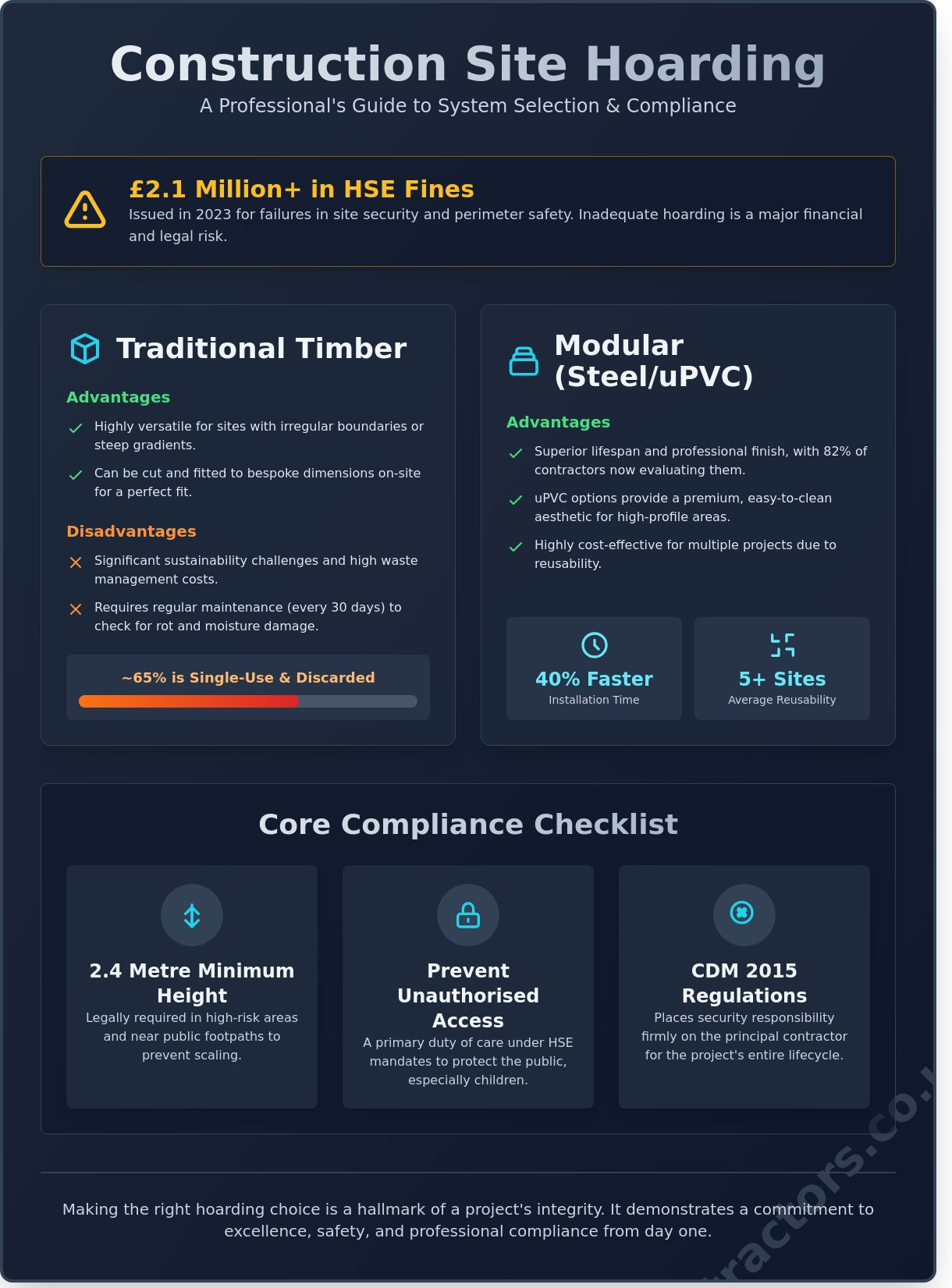
Did you know that the Health and Safety Executive (HSE) issued fines exceeding £2.1 million in 2023 specifically for failures related to site security and perimeter safety? For any professional project manager, an inadequate construction site hoarding isn’t just a boundary; it’s a significant legal and financial vulnerability. You already know that keeping the public away from hazards is the foundation of a disciplined project. However, balancing those security needs with the structural demands of wind loading or local aesthetic requirements often creates unnecessary uncertainty during the initial setup phase.
We believe that professional compliance shouldn’t be a source of anxiety but a hallmark of your project’s integrity. This guide delivers a clear roadmap to mastering legal requirements, material selection, and professional installation standards to ensure your perimeter remains both secure and compliant. We’ll explore the technical specifics of BS 5975 structural design and the practical benefits of various hoarding systems to help you establish a site that reflects a true commitment to excellence and safety.
Key Takeaways
- Understand the essential legal obligations for public protection and site security to ensure your project remains fully compliant with UK safety standards.
- Compare the structural and aesthetic benefits of timber versus modern modular systems to select the most effective construction site hoarding for your project.
- Discover the technical requirements for secure installation, including the vital role of GPR surveys in preventing strikes on underground utilities.
- Learn how to implement rigorous inspection programmes and integrated access controls to maintain a secure and professional site perimeter.
- Explore the benefits of a turnkey enabling works package that ensures a seamless, high-quality transition from demolition to a secure site setup.
Understanding Construction Site Hoarding and Legal Obligations
Construction site hoarding serves as a robust, temporary solid perimeter fence designed to isolate a building project from the public. Unlike standard mesh fencing, hoarding provides a continuous barrier that secures the site, mitigates noise pollution, and conceals high-value equipment from opportunistic theft. For any project in a busy urban environment or densely populated area, Understanding Temporary Fencing and solid hoarding is the first step in establishing a safe, compliant work environment. GCS Contractors Ltd delivers these solutions to ensure your project meets the 100% boundary integrity required by the Health and Safety Executive (HSE).
The HSE mandates that contractors take all reasonable steps to prevent unauthorised access. This duty of care isn’t just a recommendation; it’s a legal necessity to protect vulnerable groups, particularly children, from hazards like deep excavations or heavy machinery. We provide meticulous planning to ensure every construction site hoarding installation acts as a definitive line of defence against site-related accidents. By establishing a clear physical boundary, we help you maintain a disciplined and professional site presence.
The CDM 2015 Regulations and Your Responsibilities
The Construction (Design and Management) Regulations 2015 place the burden of site security firmly on the principal contractor. You’re responsible for planning, managing, and monitoring the entire construction phase to ensure the site’s perimeter remains secure throughout the project’s lifecycle. We act as your dedicated partner to manage these logistical burdens efficiently. In high-risk areas or sites adjacent to public footpaths, the legal requirement for hoarding height is a minimum of 2.4 metres to prevent scaling and ensure total visual screening.
Public Safety and the Duty of Care
Maintaining public safety is paramount when operating near schools, historic buildings, or narrow urban thoroughfares nationwide. Hoarding protects pedestrians from falling debris and the unpredictable movement of construction plant. A breach in site perimeter security can lead to significant legal consequences, including fines under the Health and Safety at Work etc. Act 1974. GCS Contractors Ltd ensures your site maintains its technical credibility by installing high-quality construction site hoarding that stands the test of time and weather, keeping your programme on track and your liability low.
Evaluating Types of Construction Hoarding Systems
Selecting the right construction site hoarding system requires a balance between project duration, budget, and local site conditions. Cambridge’s historic city centre often demands high aesthetic standards to minimise disruption to the local community. While traditional timber remains common, 82% of contractors are now evaluating modular alternatives for their superior lifespan and professional finish. For multi-year developments, materials must withstand the British climate without warping or losing structural integrity. Internal refurbishments often require specialised internal hoarding that contains dust and noise, allowing business operations to continue in adjacent spaces during a fit-out.
Safety remains the primary driver behind any perimeter choice. Adhering to rigorous OSHA Construction Safety Standards provides a global benchmark for risk mitigation, ensuring that every panel and support serves its purpose in protecting both the public and the workforce. Choosing a system that exceeds these basic safety requirements demonstrates a commitment to site discipline and excellence.
Traditional Timber Hoarding: Pros and Cons
Timber is a versatile choice for sites with irregular boundaries or steep gradients. Our teams can cut and fit plywood panels to bespoke dimensions on-site, ensuring a flush finish regardless of the terrain. However, timber presents significant sustainability challenges. Approximately 65% of single-use timber hoarding is discarded at the end of a project, increasing waste management costs. To prevent structural failure, timber requires regular maintenance checks every 30 days to identify rot or loose fixings caused by moisture ingress.
Reusable Steel and UPVC Modular Systems
Modular steel panels offer rapid installation, often reducing setup time by 40% compared to traditional methods. These systems are highly cost-effective over multiple projects because they’re designed for repeated use across five or more sites. UPVC hoarding provides a premium aesthetic that’s easy to clean, making it ideal for high-footfall areas like the Cambridge Science Park. Such systems often come with pre-finished surfaces, removing the need for on-site painting and reducing VOC emissions. If you’re planning a complex urban development, our site setup specialists can help you select the most efficient system for your specific site constraints.
Structural Integrity: In-Ground vs. On-Ground Installation
Selecting the correct foundation for construction site hoarding determines the safety of the public and the security of the project. A GPR survey is the first non-negotiable step before any soil is disturbed. Data from 2023 shows that 15% of site delays stem from utility strikes during perimeter setup. Our teams use GPR to identify buried cables or pipes, ensuring the installation doesn’t compromise local infrastructure. The choice between digging in or using ballast depends entirely on the existing ground conditions and the project’s duration.
In-Ground Hoarding and Post Foundation
We set timber or steel posts directly into concrete footings for projects requiring maximum longevity. This method offers the highest level of stability for 24-month or longer developments. It involves “builders work in connection” (BWIC) where our team prepares the foundations to specific depths, usually between 600mm and 900mm. This ensures the construction site hoarding remains immovable during heavy rain or ground shifts. It’s the most robust solution for high-traffic areas where space is at a premium.
On-Ground Kentledge and Ballast Systems
Kentledge systems use heavy concrete blocks or water-filled tanks to provide stability without breaking the surface. They’re the standard choice for Cambridge car parks or paved areas where digging is prohibited by the local authority. A typical concrete ballast block weighs 500kg or more, requiring Hiab lorries and specialist plant for delivery and positioning. These systems are highly flexible but require a larger footprint on-site to accommodate the weights. They’re ideal for short-term projects where the ground must be returned to its original state.
Wind Loading and Structural Calculations
Wind loading is responsible for 80% of hoarding failures in the UK. We provide site-specific structural calculations for every project over 2.4 metres high. These calculations account for local wind speeds and the “sail effect” of solid panels. To mitigate pressure, we often integrate mesh panels or “wind windows” into the design. Adhering to OSHA construction safety standards and BS 5975 ensures that even in gusts exceeding 60mph, your site perimeter remains secure and compliant. Our engineers verify every calculation to guarantee that the ballast or post depth is sufficient for the specific location’s exposure level.
Best Practices for Site Perimeter Management
Managing a site perimeter requires more than just a physical barrier; it’s a continuous commitment to safety and compliance. We establish daily inspection programmes to identify structural damage or unauthorised tampering before they become liabilities. According to the Health and Safety Executive (HSE), approximately 20% of construction site accidents involve vehicle movements, which makes maintaining perimeter integrity vital for public safety.
Effective security relies on a layered approach. Our teams integrate 2,000-lumen LED floodlights and motion-activated CCTV to deter intruders after hours. These systems provide a clear audit trail for insurance purposes and ensure the site remains a safe environment for the local Cambridge community. Using high-quality equipment reduces the risk of theft and vandalism, protecting your project’s timeline and budget.
Integrating Gates and Access Control
Safety starts with the separation of traffic. We install dedicated pedestrian and vehicle entrance points to eliminate the risk of collisions. Our teams use heavy-duty, full-clad gates that match the height and strength of the construction site hoarding. For safe vehicle egress, we incorporate vision panels at eye level. These allow drivers to spot pedestrians on narrow city pavements before they exit the site, preventing accidents in high-traffic areas.
Signage, Branding, and Community Engagement
Professional signage is a legal requirement under the Health and Safety (Safety Signs and Signals) Regulations 1996. Every perimeter must display clear instructions to ensure anyone approaching the site understands the risks. Mandatory signage includes:
- Danger: Construction Work in Progress
- PPE Requirements (Hard hats and high-vis vests)
- Emergency Contact Information for the site manager
- No Unauthorised Entry warnings
High-quality “marketing hoarding” also serves a dual purpose. By wrapping the site in professional graphics, we promote the future development while improving the local streetscape. Data from industry surveys indicates that well-presented sites receive 30% fewer complaints from local residents. This proactive approach builds trust and demonstrates a commitment to professional standards and environmental responsibility.
Ensure your project meets all safety and branding requirements by choosing a dedicated construction site hoarding partner for your Cambridge development.
Professional Site Setup: The GCS Contractors Ltd Approach
At GCS Contractors Ltd, we view construction site hoarding as the critical first step in a successful project delivery. It isn’t merely a boundary; it’s the starting point of our comprehensive enabling works package. We handle the transition from initial demolition to full site setup, ensuring your project remains secure and compliant from day one. Our team manages every detail of the perimeter installation, allowing you to focus on the broader construction programme. We deliver tangible results through disciplined planning and execution.
Our approach integrates site security with logistical efficiency. By positioning hoarding as the primary phase of site infrastructure, we create a controlled environment that protects both the public and your assets. We take pride in being a safe pair of hands, navigating the complexities of Cambridge site requirements with quiet confidence and technical precision.
From Enabling Works to Groundworks
Managing site clearance alongside construction site hoarding installation creates a streamlined workflow. When a single contractor oversees the full site setup, you eliminate the communication gaps that often occur between separate trades. This unified approach provides a stable platform for professional groundworks, which are essential for the structural integrity and long-term success of any development. We ensure that the transition from a cleared site to a secured perimeter is seamless, reducing delays and maintaining momentum.
A turnkey solution offers significant advantages for project managers. We provide:
- Integrated site clearance and waste removal services.
- Professional hoarding installation that meets all local authority standards.
- Strategic placement of access points to optimise site logistics.
- Preparation for subsequent groundworks and foundation phases.
By centralising these tasks, we ensure that every element of the site infrastructure works in harmony.
Why Choose a Dedicated Partner for Site Infrastructure?
Our team brings over 10 years of experience in civil engineering and site logistics to every project we undertake. We understand that a site’s infrastructure is its backbone. Working with an accredited, safety-conscious partner gives you the reassurance that all HSE requirements are met without compromise. We deliver bespoke solutions that fit your specific site requirements, maintaining high-quality standards across all perimeters and access points. Our commitment to industry-leading standards means your site remains safe, tidy, and professional throughout the build process.
Enquire about our site setup and enabling works services to see how we can secure your next project.
Securing Your Project with Professional Site Perimeter Solutions
Effective construction site hoarding acts as the primary shield for your workforce and the general public. It isn’t just a physical barrier; it’s a critical compliance measure that meets rigorous CDM 2015 regulations and HSE standards. Selecting the right system, whether that’s an in-ground timber installation or a reusable on-ground steel solution, requires a deep understanding of structural wind loads and specific site topography. A failure in perimeter management can lead to significant legal liabilities and project delays.
GCS Contractors brings over 10 years of industry experience to every project we undertake. We provide comprehensive turnkey groundworks and civil engineering services that ensure your site remains secure from day one. Our team delivers full compliance with all current safety protocols, giving you the peace of mind that your perimeter is in a safe pair of hands. We focus on meticulous planning and disciplined execution to keep your timeline on track and your site fully protected.
Discuss your next project with our site setup experts to ensure your site meets every professional standard. We’re ready to help you build a solid foundation for your next development.
Frequently Asked Questions
Is construction site hoarding a legal requirement in the UK?
Yes, installing construction site hoarding is a legal requirement under the Construction (Design and Management) Regulations 2015. These regulations mandate that contractors take all reasonable steps to prevent unauthorised access to the work area. Our team ensures every barrier meets Health and Safety Executive standards to protect both the public and your site workers. We provide these physical boundaries to manage risk and maintain a secure perimeter throughout the project duration.
How high should construction site hoarding be?
Standard hoarding should be at least 2.4 metres high to provide adequate security and privacy for most urban projects. While some low-risk sites might use 2.0-metre barriers, developments in Cambridge often require the full 2.4-metre height to deter trespassers effectively. We deliver bespoke solutions that adjust for specific site topographies or increased security risks. Higher barriers are often necessary if the site sits adjacent to schools or high-traffic public areas.
Do I need a licence for hoarding on a public highway?
You must obtain a hoarding licence from Cambridgeshire County Council if your perimeter occupies any part of a public pavement or road. Applications typically require a fee, which starts at approximately £150 for the first month in many UK jurisdictions. Our experts manage this compliance process to ensure your project meets all local Highways Act 1980 requirements. We ensure the licence remains valid and that the structure doesn’t obstruct essential pedestrian sightlines or traffic signals.
What is the difference between site hoarding and temporary fencing?
Site hoarding consists of solid, opaque panels that block the view of the works, whereas temporary fencing uses open wire mesh. Hoarding provides superior security and noise reduction, which is vital for long-term urban developments. Temporary fencing, such as Heras panels, is often used for short-term projects or internal site zoning. We recommend solid hoarding for sites where public safety, privacy, and dust containment are primary concerns.
Can I use timber hoarding for a long-term project?
Timber hoarding is highly effective for long-term projects lasting 12 to 24 months when constructed with treated plywood and sturdy C16 or C24 timber posts. We provide high-quality timber installations that withstand British weather conditions and high wind loads. For projects exceeding two years, we often suggest steel hoarding systems for their enhanced durability and resistance to wear. Our team regularly inspects timber structures to prevent rot or structural degradation over time.
Who is responsible for maintaining the site hoarding?
The Principal Contractor holds the legal responsibility for the ongoing maintenance and safety of the hoarding under CDM 2015 regulations. They must conduct weekly inspections to ensure the structure remains stable and secure against wind and tampering. Our dedicated maintenance teams provide regular checks to identify and repair any damage immediately. Keeping the perimeter in top condition prevents legal liabilities and maintains a professional image for your project during its lifecycle.
What are the main risks associated with poorly installed hoarding?
Wind-induced collapse is the most significant risk of poorly installed hoarding, potentially causing serious injury or property damage. Statistics from the HSE indicate that structural failure of temporary works remains a leading cause of site-related accidents. Inadequate fixings can also allow unauthorised access, leading to theft or vandalism. We use calculated wind loading data to ensure every post and panel remains fixed even during peak gusts recorded in the local area.
How much does construction site hoarding cost per metre?
Professional construction site hoarding typically costs between £50 and £150 per linear metre depending on the materials and ground conditions. Basic timber hoarding starts at the lower end of this scale, while bespoke steel systems or those requiring specialist in-ground digging cost more. Factors like the inclusion of pedestrian gates or vehicle access points also influence the final price. Before any hoarding installation, many projects require professional strip-out and demolition services to ensure the site is properly prepared and compliant with CDM 2015 regulations. We provide detailed, transparent quotes to help you budget accurately for your site security needs.