S278 Contractors Cambridgeshire: Navigating Highways Works and Council Agreements
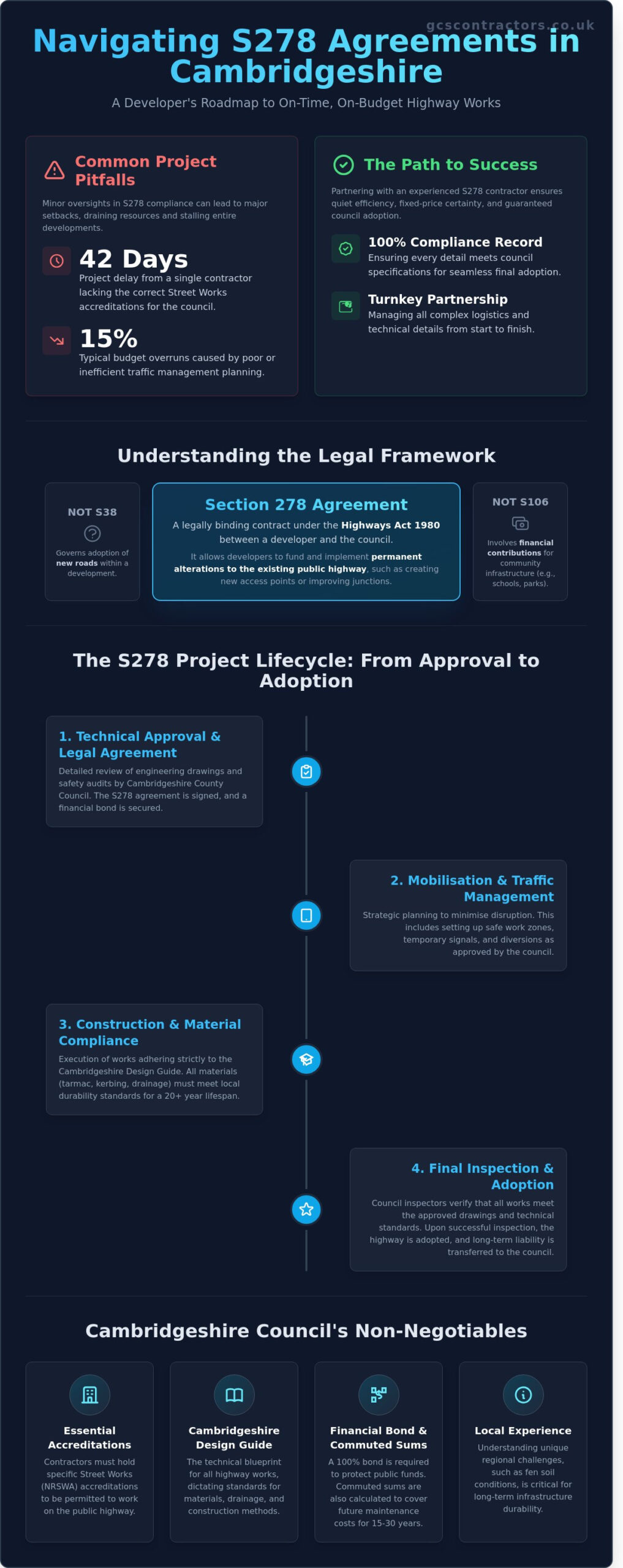
A developer in Ely recently watched their project timeline extend by 42 days because their groundworks team lacked the specific Street Works accreditations demanded by Cambridgeshire County Council. It’s a frustratingly common scenario where minor technical oversights lead to expensive delays in council approval. When you’re managing a high-stakes development, you need S278 contractors Cambridgeshire who understand that a single error in a Section 278 agreement can stall an entire site. We’ve seen how these administrative hurdles can drain resources and impact your reputation with local stakeholders.
You likely agree that the most successful projects are those where the highway works are completed with quiet efficiency and zero surprises. This guide provides a detailed roadmap for selecting a partner who delivers fixed-price certainty and maintains the 100% compliance record required for local authority adoption. We’ll explore how to avoid the 15% budget overruns typically caused by poor traffic management planning and how to ensure your infrastructure is delivered on time, every time.
Key Takeaways
- Understand the legal framework of the Highways Act 1980 to ensure your project aligns with Cambridgeshire County Council’s specific planning requirements.
- Identify the essential accreditations and local experience required when vetting S278 contractors Cambridgeshire to guarantee high-quality infrastructure delivery.
- Learn how to adhere to the Cambridgeshire Design Guide to ensure all kerbing, drainage, and surfacing materials meet local durability standards.
- Gain insights into the full construction lifecycle, from securing technical approval and managing traffic to the final adoption of the works.
- Discover the benefits of a turnkey partnership that manages complex logistics and technical compliance to keep your project on time and within budget.
Understanding S278 Agreements in Cambridgeshire
An S278 agreement is a legally binding contract between a developer and Cambridgeshire County Council. This framework is established under the Highways Act 1980. It provides the mechanism for private developers to fund and implement permanent changes to the existing public highway. These works are mandatory when a planning consent requires infrastructure modifications to accommodate increased traffic or new access points. Finding experienced S278 contractors Cambridgeshire ensures that these high-stakes projects meet the council’s rigorous technical specifications. Our team delivers these projects with a focus on precision; we understand that the highway must eventually be adopted back by the local authority.
The role of the contractor extends beyond simple construction. We act as a technical partner, ensuring every kerb height and drainage gradient aligns with the approved drawings. If the work doesn’t meet the required standard, the council won’t adopt it, leaving the developer with ongoing liability. We provide the skilled labour and management needed to avoid these costly pitfalls. Our approach is grounded in reliability, ensuring that every project we undertake is a safe pair of hands for the developer and the community.
Common triggers for these works across the county include the construction of new site entrances for residential estates, the installation of roundabouts, or junction improvements to mitigate traffic impact. In 2023, Cambridgeshire County Council oversaw numerous infrastructure upgrades where compliance with the Design Manual for Roads and Bridges (DMRB) was non-negotiable. Typical projects include:
- New priority junctions and bellmouth entrances.
- Signalised crossings and pedestrian refuges.
- Traffic calming measures and speed reduction schemes.
- Widening existing carriageways to include cycle lanes.
The Legal Framework of the Highways Act 1980
The S278 agreement focuses strictly on alterations to existing roads. This differs from a Section 38 agreement, which covers the adoption of entirely new roads within a development, or Section 106, which involves financial contributions for community infrastructure like schools or parks. To protect the public purse, the council requires a financial bond, often 100% of the estimated work value, to ensure completion if a developer defaults. The S278 agreement serves as the essential bridge between private development and public infrastructure.
Cambridgeshire County Council Specific Requirements
Before any ground is broken, developers must navigate the Technical Approval (TA) process. This involves a detailed review of engineering drawings and safety audits. Cambridgeshire County Council also applies “Commuted Sums” for future maintenance. These payments, often calculated over a 15-year or 30-year period, cover the ongoing costs of maintaining specialised assets like traffic lights or non-standard paving. It’s vital to use a contractor with the right credentials. We provide the technical expertise and safety accreditations required to satisfy the council’s inspectors. Selecting verified S278 contractors Cambridgeshire reduces the risk of project delays and ensures a seamless transition from construction to adoption. Our team maintains a disciplined focus on these local standards, delivering results that stand the test of time and heavy traffic usage.
Technical Standards for Cambridgeshire Highways Works
Delivering successful highway infrastructure in East Anglia requires a disciplined approach to local regulations. Every project must strictly adhere to the Cambridgeshire Design Guide for Housing and Estate Roads. This document serves as the technical blueprint for any developer or local authority project. Experienced S278 contractors Cambridgeshire developers trust understand that these specifications aren’t merely suggestions. They’re mandatory requirements that ensure the long-term durability of the county’s transport network. We focus on selecting materials that withstand the unique soil conditions of the region, particularly in the fens where ground stability is a constant variable.
Material selection is a critical component of our quality assurance process. We ensure that tarmac, kerbing, and sub-base layers meet the 2023 updated local durability standards. For instance, using AC 20 dense binder course and specific surface treatments ensures the road surface can handle the projected traffic load for 20 years or more. Our team delivers precision in kerb laying, ensuring that transition kerbs and drainage channels align perfectly with the existing topography. This level of detail prevents premature wear and reduces future maintenance costs for the local authority.
Modern roadworks in this region now include a 100% requirement for Sustainable Drainage Systems (SuDS). Integrating these systems into a Section 278 project is a complex task that demands a meticulous partner. We manage the installation of permeable surfaces and attenuation systems that manage runoff at the source. For developers, managing “builders work in connection” (BWIC) is equally vital. This often involves the coordination of utility diversions, which can account for up to 15% of a project’s timeline if not handled with professional rigour. Our team manages the interface between the highway and utility providers to prevent delays. For a detailed breakdown of these requirements, developers should consult the Cambridgeshire highways development guidance, which outlines the technical expectations for all adoptable roads.
Drainage and Infrastructure Requirements
Surface water management is a cornerstone of Cambridgeshire infrastructure. We install high-capacity attenuation tanks and oversized pipework to ensure the highway remains clear during heavy rainfall events. Our engineers work closely with Anglian Water to ensure all foul and surface water connections comply with S104 and S106 agreements. We verify that every manhole and inspection chamber meets adoptable standards before any backfilling occurs. This transparency ensures a seamless handover to the local authority once the maintenance period concludes.
Lighting, Signage, and Traffic Calming
Safety and visibility are non-negotiable elements of our delivery model. We standardise street lighting to match the existing LED infrastructure used across the county, ensuring consistency for maintenance teams. Our team installs traffic calming measures, such as speed cushions or chicanes, with millimetre precision to meet Department for Transport regulations. Permanent signage and road markings are applied using high-friction materials that provide 100% compliance with BS EN 1436 standards. This meticulous approach ensures that S278 contractors Cambridgeshire firms provide a safe environment for all road users. If you require a partner to navigate these technical complexities, our team offers comprehensive highway solutions tailored to your specific site requirements.
Key Criteria for Selecting S278 Contractors in Cambridgeshire
Selecting the right partner for highway works involves more than comparing quotes. It’s about mitigating risk on the public stage. In a region where infrastructure projects like the A14 Cambridge to Huntingdon scheme have set high benchmarks for quality, your chosen S278 contractors Cambridgeshire must demonstrate technical precision and financial resilience. We focus on delivering infrastructure that meets the rigorous standards of the local authority while protecting your commercial interests through every phase of the build.
The stakes are high because S278 works take place on live highways. Any failure in compliance or safety doesn’t just result in fines; it can halt your entire development. You need a team that acts as a disciplined extension of your own business, ensuring that every kerb, drainage run, and surfacing layer meets the exact specifications required for adoption by the council.
Accreditations and Professional Rigour
Operatives working on your project must hold New Roads and Street Works Act (NRSWA) qualifications. This isn’t a mere preference; it’s a legal requirement for anyone excavating or placing equipment in the public highway. We ensure our site supervisors hold either SSSTS or SMSTS certifications to maintain strict discipline on-site. To ensure centimetre-perfect compliance with the approved technical drawings, a dedicated Setting Out Engineer using the latest robotic total stations is essential. A safe pair of hands in civil engineering starts with a robust health and safety record, specifically one that shows zero reportable incidents over the last 36 months of highway operations.
Our commitment to professional rigour is evidenced by our adherence to ISO 9001 and ISO 45001 standards. These frameworks ensure that our quality management and safety protocols aren’t just words on a page but active processes that govern our daily site activities. We provide clients with full traceability on all materials used, from the 1st of January through to the end of the calendar year, ensuring that every batch of asphalt or concrete meets British Standards.
Local Knowledge and Liaison Capability
Local expertise is a significant asset when dealing with the Cambridgeshire road network. A contractor who understands the specific nuances of the Cambridgeshire County Council (CCC) Design Guide can reduce logistical friction by up to 20% during the approval process. We proactively organise site inspections with council officers at critical milestones. This ensures that each stage of the work, from the initial sub-base compaction to the final wearing course, receives immediate sign-off. Evaluating a contractor based on their portfolio of adopted highways in the East of England provides the best evidence of their ability to deliver results that stand the test of time.
Financial stability is the final, non-negotiable pillar of selection. S278 agreements require a bond, often representing 100% of the estimated works value, which can range from £50,000 to over £750,000 for complex junctions. You must verify that your S278 contractors Cambridgeshire have the financial standing to support these bonds and carry £10 million in Public Liability insurance. We also manage complex Traffic Management Plans (TMPs) internally. By controlling the deployment of temporary signals or lane closures ourselves, we eliminate the 15% mark-up often charged by third-party providers and reduce the risk of delays that can cost a developer upwards of £2,500 per day in liquidated damages.
- Verified NRSWA Operatives: Essential for legal compliance on all street works.
- Internal TMP Management: Reduces reliance on third parties and improves site safety.
- Financial Resilience: Ability to provide the necessary insurance and bond support for large-scale projects.
- Proven Track Record: A history of successful road adoptions with local authorities in the East of England.
The S278 Construction Process: From Mobilisation to Adoption
The journey from a signed legal agreement to a fully adopted highway requires a disciplined approach. Professional S278 contractors Cambridgeshire developers rely on must bridge the gap between complex engineering drawings and the strict standards of the local authority. The process begins with a formal pre-start meeting. This session involves the developer, the contractor, and a representative from Cambridgeshire County Council to verify technical approval. We ensure every detail, from material specifications to the construction programme, meets the approved Section 278 design before any plant arrives on site.
The implementation phase follows a structured five-step sequence to ensure compliance and safety:
- Phase 1: Pre-start and Approval. Finalising the technical design and securing the “Letter of Approval” from the council.
- Phase 2: Enabling Works. Setting up site compounds and installing the agreed traffic management systems.
- Phase 3: Core Construction. Executing civil engineering tasks, including deep drainage, kerbing, and high-specification road surfacing.
- Phase 4: Maintenance Period. A mandatory 12-month duration where the contractor remains liable for any defects.
- Phase 5: Final Adoption. The formal handover where the council takes over future maintenance responsibility.
Reliable S278 contractors Cambridgeshire teams focus heavily on Phase 3. This stage often involves complex utility diversions and the installation of sustainable drainage systems (SuDS). We coordinate these works to ensure they align with the 2023 Cambridgeshire Design Guide, preventing costly remedial work during the final inspection.
Managing Traffic and Public Safety
Work on an active highway presents significant risks. We manage these by organising comprehensive traffic management plans, including temporary traffic lights or diversions approved via the Street Works team. Minimising disruption is a priority. In 2023, roadwork delays cost the UK economy billions; we mitigate this locally through precise scheduling. Our team maintains clear communication with residents and businesses through regular updates and professional signage. This proactive stance reduces complaints and ensures the project maintains a positive reputation within the local community.
The Journey to Adoption
The “Maintenance Period,” often called the Defects Liability Period, typically lasts for 12 months following the issuance of the Part 1 Certificate. This certificate confirms that the works are substantially complete and safe for public use. During this year, the infrastructure must withstand weather cycles and traffic loads. We conduct regular inspections to identify any settlement or surfacing issues. It’s a critical time for the developer’s capital, as a significant portion of the financial bond remains held by the council until the final handover.
Securing the Part 2 Certificate requires a flawless final inspection. To achieve this, we provide a comprehensive handover package. This includes:
- Accurate “As-Built” drawings that reflect the exact position of all new assets.
- Health and Safety Files detailing all materials used during construction.
- Verification that all remedial works identified in the penultimate inspection are resolved.
Once the council is satisfied, they issue the Final Certificate. This triggers the release of the remaining bond money back to the developer and marks the official adoption of the road. We take pride in delivering a seamless transition that protects your investment and satisfies the local authority’s rigorous standards.
If you need a partner who understands the intricacies of local highway authority requirements, our team is ready to assist. Contact GCS Contractors today to discuss your upcoming S278 project in Cambridgeshire.
GCS Contractors: Your Dedicated Partner for Cambridgeshire Infrastructure
GCS Contractors Ltd operates as a specialist in the groundworks and civil engineering sector, bringing over 10 years of operational experience to every site. We’ve spent a decade refining our processes across the UK, specifically focusing on the complex requirements of Section 278 agreements. As established S278 contractors Cambridgeshire, our team understands that these projects involve more than just laying tarmac. They require a meticulous balance of technical precision and local authority liaison. We provide a comprehensive turnkey service that covers every stage of the infrastructure lifecycle. Our engineers manage the initial technical assessments, handle the logistical hurdles of traffic management, and execute the physical construction with disciplined accuracy.
Our approach centres on financial certainty. We provide fixed-price tenders that eliminate the budget creep often associated with highway works. By delivering transparent project management, we ensure that 100% of our clients receive a detailed breakdown of costs before a single spade hits the ground. This transparency is vital for developers managing tight margins on large-scale residential or commercial schemes. Being based in the heart of the region allows our site managers to reach Cambridgeshire developments within 60 minutes. This proximity ensures a responsive service that national firms often struggle to match, particularly when urgent site adjustments are required.
We take the logistical burden off your shoulders by coordinating directly with Cambridgeshire County Council. Our team handles the technical approvals and ensures every aspect of the work meets the strict adoption standards required for the local road network. This end-to-end management style means you have a single point of contact from the initial site strip to the final surface course. It’s a method designed to provide peace of mind and maintain the momentum of your broader construction programme.
Why Developers Trust GCS Contractors Ltd for S278 Works
Developers return to GCS Contractors Ltd because we prioritise collaborative problem-solving. We don’t just identify issues; we resolve them through a disciplined team that values building standards and site safety above all else. Our history includes successful groundworks and roadworks for major residential hubs near Cambridge and Ely, where we maintained a zero-incident safety record across 24 months of continuous site activity. We treat every project as an opportunity to build a long-term relationship. This commitment to quality ensures that the finished infrastructure is durable, compliant, and ready for official adoption without unnecessary delays or remedial costs.
Getting Started with Your S278 Project
Efficiency starts at the planning stage. We encourage developers to engage our team early to identify potential topographical or utility-based risks that could impact the project timeline. You can request a detailed bill of quantities or a fixed-price tender to secure your project’s financial framework. Our team is ready to provide the technical credibility and physical labour your development requires. By choosing experienced S278 contractors Cambridgeshire, you ensure your project meets all legal obligations while staying on schedule. Contact GCS Contractors Ltd for a professional consultation on your Cambridgeshire S278 works and let us manage the complexities of your highway infrastructure.
Secure Your Cambridgeshire Infrastructure Success
Navigating the complexities of Section 278 agreements requires more than just technical skill; it demands a deep understanding of Cambridgeshire County Council’s specific highways standards. Successful delivery hinges on meticulous planning from initial mobilisation through to final adoption. When you choose GCS Contractors, you’re opting for a partner with over 10 years of industry experience in the local market. Our team delivers comprehensive turnkey civil engineering solutions that ensure every aspect of your project meets strict compliance markers. As leading S278 contractors Cambridgeshire developers trust, we remove the logistical burden from your shoulders. We focus on safety, quality, and proven expertise to get the job done right the first time. Our approach is grounded in professional rigour and a commitment to long-term maintenance standards. We’re ready to bring our disciplined methodology to your site to ensure your infrastructure stands the test of time. You can rely on our team to manage technical hurdles while you focus on the broader goals of your development.
Partner with a dedicated S278 contractor for your next Cambridgeshire project
We look forward to delivering the high-quality results your project deserves.
Frequently Asked Questions
How much do S278 works typically cost in Cambridgeshire?
S278 works in Cambridgeshire typically range from £35,000 for minor bellmouth access points to over £400,000 for complex junction improvements. These figures include the council inspection fees, which usually sit between 7% and 10% of the total bond value. We provide a detailed cost breakdown during the early stages to ensure your project remains financially viable and transparent from start to finish.
How long does it take to get technical approval for an S278 agreement?
Technical approval for an S278 agreement in Cambridgeshire generally takes between 12 and 24 weeks. This duration depends on the complexity of the design and the current caseload at the local highways authority. Our team manages the submission process meticulously to ensure all designs meet the Cambridgeshire Design Guide on the first attempt. This disciplined approach reduces the risk of lengthy revision cycles and delays. For developers seeking comprehensive guidance on navigating these timelines and requirements, our detailed S278 agreement process guide provides essential insights into managing technical submissions and bond requirements effectively.
Can I use any civil engineering contractor for S278 works?
No, you must appoint S278 contractors Cambridgeshire developers trust who hold specific industry accreditations like NRSWA and high-level public liability insurance. Cambridgeshire County Council requires contractors to demonstrate a proven track record of compliance with the Specification for Highway Works. We maintain a £10 million insurance policy and all necessary certifications to ensure your project meets every legal and safety benchmark required by the authority.
What is the difference between S278 and S38 agreements?
The primary difference lies in the ownership of the land being developed. S278 agreements cover modifications to existing public highways, such as adding a new turning lane or upgrading a footpath. S38 agreements involve the adoption of entirely new roads built within a development. Both processes require the contractor to meet 2024 council standards to ensure the infrastructure is fit for long-term public maintenance and safety.
Who is responsible for traffic management during highways works?
The appointed contractor is responsible for the design, implementation, and 24-hour maintenance of all traffic management measures. We coordinate directly with the local authority to secure necessary permits under the New Roads and Street Works Act 1991. Our team deploys Chapter 8 compliant signage and temporary signals to protect both road users and our site staff. This ensures a seamless flow of traffic throughout the construction phase.
What happens if the contractor fails to meet the council standards?
If a contractor fails to meet the required standards, the council will issue a defect notice requiring immediate remedial works at the developer’s expense. In extreme cases, the local authority can draw down the S278 bond to hire an alternative firm to rectify the errors. We mitigate this risk by conducting rigorous quality checks and material testing at every stage, ensuring every layer of construction passes inspection the first time.
How is the S278 bond calculated and when is it released?
The S278 bond is usually calculated as 100% of the estimated construction costs plus a 10% contingency fee. The council releases the first 80% of this bond once the works reach substantial completion and a Provisional Certificate is issued. The final 20% is held for a 12-month maintenance period. It’s only released after a successful final inspection confirms that no defects have appeared during the first year of use.