Local Engineering Companies in Cambridge: A Guide to Choosing the Right Partner
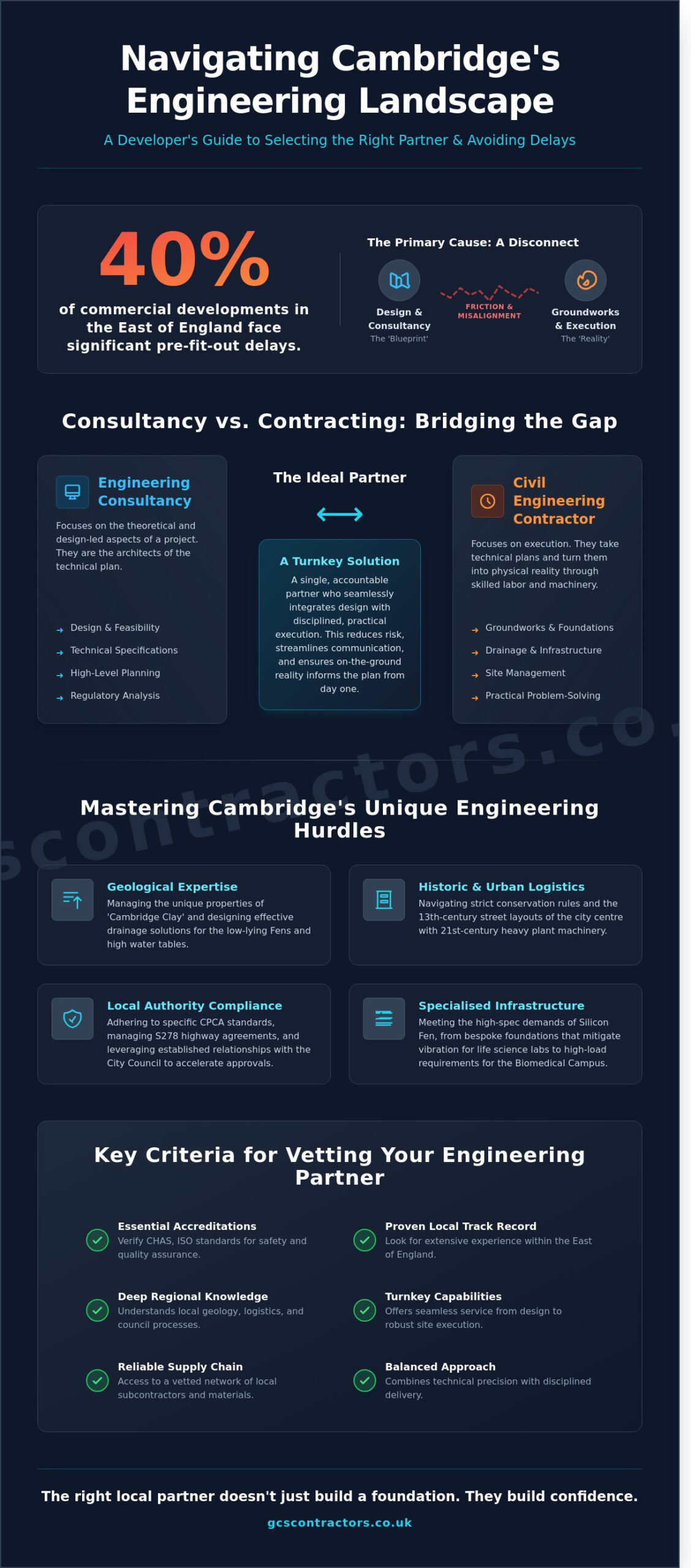
Why do nearly 40% of commercial developments in the East of England face significant delays before they even reach the fit-out stage? When you are evaluating the local engineering companies Cambridge offers, it becomes apparent that a gap often exists between high-level consultancy and practical site execution. You likely believe that a project is only as strong as its foundation, yet the friction between design teams and groundworks contractors remains a primary source of frustration for developers across the county.
This guide will show you how to navigate the Cambridge engineering landscape to find a partner who balances technical precision with disciplined delivery. We’ll explore the complexities of the “Cambridge Clay” soil conditions and the nuances of managing S278 highway agreements with local authorities. By the end of this article, you’ll know how to select a contractor that provides a turnkey solution, reducing your project risk and ensuring full compliance with the latest building standards.
Key Takeaways
- Distinguish between design-led consultancies and execution-focused contractors to ensure your project has the right balance of planning and practical delivery.
- Learn how to navigate Cambridge-specific infrastructure challenges, such as managing the unique properties of ‘Cambridge Clay’ and drainage in the low-lying Fens.
- Identify the essential industry accreditations, such as CHAS and ISO standards, needed to properly vet local engineering companies Cambridge for safety and compliance.
- Discover why a proven track record in the East of England is vital for delivering reliable, high-quality groundworks and civil engineering infrastructure.
- Understand the value of a turnkey partner who provides a seamless transition from initial design to robust, long-term site execution.
The Evolving Landscape of Local Engineering Companies in Cambridge
Cambridge is a global epicentre for technical excellence. While the city is famous for its academic heritage, the physical environment is undergoing its most significant transformation since the 1970s. The UK’s engineering sector provides a vital framework for this growth, contributing over £400 billion to the national economy. In Cambridge, this manifests as a unique tension between preserving a medieval city centre and building the high-spec infrastructure required for Silicon Fen. Our team understands that delivering a project here isn’t just about structural integrity; it’s about managing the logistical constraints of a city that was never designed for 21st-century heavy plant machinery.
The 2023 Greater Cambridge Local Plan identifies a requirement for 48,800 new homes and 58,500 new jobs by 2041. This growth strategy has fundamentally altered the demand for local engineering companies Cambridge. Developers no longer look for generalists. They require partners who can bridge the gap between sophisticated laboratory requirements and the rugged realities of Cambridgeshire’s Fenland geology. We provide the technical rigour needed to ensure these ambitious developments are both safe and sustainable, focusing on turnkey solutions that address the specific environmental challenges of the region.
From Silicon Fen to Civil Infrastructure
The local market is divided into three distinct pillars: Mechatronics, MEP (Mechanical, Electrical, and Plumbing), and Civil Engineering. While Mechatronics drives the robotics and sensors found in the Cambridge Science Park, Civil Engineering provides the essential groundwork and structural frames that make these innovations possible. These sectors don’t operate in isolation. A new life sciences lab requires precise MEP coordination to manage air filtration, yet it also needs a civil engineer to design bespoke foundations that mitigate vibration from the nearby A14. Our team delivers this integrated perspective, ensuring that the ‘engineering’ on your project isn’t a broad label but a specific, disciplined application of construction science.
Why ‘Local’ Matters in Cambridgeshire
The Cambridgeshire and Peterborough Combined Authority (CPCA), established in 2017, has introduced specific local standards for transport and infrastructure that external firms often overlook. Working within the historic core, such as projects near King’s Parade, involves navigating strict conservation rules and narrow access routes that can halt a project if not managed with local insight. Conversely, the expansion of the Biomedical Campus requires an understanding of the high-load requirements for medical imaging equipment. Local engineering companies Cambridge maintain established relationships with the City Council and local utility providers, which accelerates the approval process. We use these connections to remove the logistical burden from our clients, providing a seamless transition from the drawing board to the construction site. Our presence in the local market for over a decade means we don’t just know the regulations; we know the people who enforce them.
- Strategic Planning: Alignment with the CPCA’s 2017 devolution deal standards.
- Geological Expertise: Managing the high water tables and clay-heavy soils typical of the Cambridgeshire basin.
- Logistical Precision: Navigating the 13th-century street layouts of the city centre with modern construction equipment.
- Supply Chain Reliability: Access to a vetted network of local subcontractors who meet our high safety and quality benchmarks.
Consultancy vs. Contracting: Identifying the Right Engineering Partner
Distinguishing between an engineering consultancy and a civil engineering contractor is the first step toward a successful build. While both are essential to the lifecycle of a project, they serve different purposes. Consultancies focus on the theoretical and design-led aspects of a development. They’re the architects of the technical plan. In contrast, contractors are execution-led. We take those technical plans and turn them into physical reality through groundworks, drainage, and structural assembly. Finding the right local engineering companies Cambridge offers ensures you don’t overspend on high-level advice when you actually need boots on the ground.
Selecting from the local engineering companies Cambridge provides requires a clear view of your project’s current stage. If you’re in the earliest phases, such as conducting feasibility studies for a new site near the M11 or seeking planning permissions, a consultant is your primary contact. However, once the project moves toward the delivery phase, the focus shifts. A contractor-led approach often provides better budget certainty. By involving a contractor early, you can identify practical site constraints that a desk-based design might miss. This proactive collaboration can save between 10% and 15% on total project costs by avoiding mid-construction revisions and expensive design amendments.
The Role of the Engineering Consultant
Consultants manage the pre-construction phase. They’re responsible for the intricate calculations required for structural integrity and high-level planning applications. In a city defined by its scientific output, consultants often provide specialised services like fire engineering or acoustic design for the 115 research labs currently operating in the region. They play a vital role in addressing Cambridge’s infrastructure challenges, ensuring new builds comply with strict 2024 building regulations. A common issue, though, is the gap between a theoretical drawing and the site’s reality. A design that looks perfect on a screen can sometimes be impossible to build safely or cost-effectively without direct contractor input.
The Role of the Civil Engineering Contractor
The civil engineering contractor is the partner who manages the physical delivery. Our work begins where the blueprints end. We translate those designs into essential infrastructure, including complex groundworks and sustainable drainage systems (SuDS). This phase carries the highest level of risk, particularly regarding unforeseen ground conditions. A 2023 industry survey indicated that 60% of project delays stem from unexpected soil issues or utility clashes. A skilled contractor mitigates these risks through proactive site management and technical expertise.
GCS Contractors focuses specifically on the execution phase because that’s where projects are won or lost. We don’t just look at a drawing; we assess how that drawing interacts with the local geology and existing utilities. Our team delivers physical results that stand the test of time, ensuring every slab poured and pipe laid meets rigorous building standards. If you’re ready to move from the drawing board to the digger, you can view our civil engineering services to see how we handle complex site deliveries. We provide the reliability needed to keep your programme on track and within its original budget.
Navigating Cambridge-Specific Engineering and Infrastructure Challenges
Cambridge’s terrain demands more than standard civil engineering; it requires a forensic understanding of the local environment. Our team approaches every project by first addressing the geological and regulatory realities that define this region. It’s why Cambridge engineering and infrastructure challenges remain a central focus for both academic researchers and site practitioners alike. Successfully delivering a project here means balancing modern technical requirements with the city’s unique physical constraints.
The ‘Cambridge Clay’ Factor
The Gault Clay prevalent across Cambridgeshire is notoriously high-shrinkage. During the 2022 heatwave, ground movement risks in East Anglia rose by 20%, highlighting the volatility of these soils. When moisture levels drop, the clay contracts, causing significant settlement. Conversely, heavy rainfall leads to rapid expansion. We mitigate these risks by designing foundations that reach depths of 2.5 metres or by using reinforced concrete rafts to distribute loads evenly. Heave describes the upward ground pressure exerted when dehydrated clay soils expand upon rewetting, which can displace foundations if not properly managed through the use of compressible void-formers.
Highways and S278 Works in Cambridgeshire
Modifying public highways involves strict legal frameworks under the Highways Act 1980. Developers must secure an S278 agreement before altering any road managed by Cambridgeshire County Council. This process isn’t just about technical drawings; it’s about rigorous safety audits and traffic management plans that don’t paralyse the city’s narrow arterial routes. Our engineers act as the primary liaison with the Council to ensure all designs meet the 2023 Design Guide standards. This level of coordination is why local engineering companies Cambridge are essential for infrastructure projects, as they possess the established relationships and procedural knowledge to avoid the 4-month delays often seen in bureaucratic bottlenecks.
Managing water is equally complex in a county where 10% of the land, including parts of the Fens, sits up to 2.7 metres below sea level. We implement Sustainable Drainage Systems (SuDS) that incorporate attenuation ponds and permeable paving to manage surface water runoff. These systems are designed to handle 1-in-100-year storm events, plus a 40% allowance for climate change. By integrating these solutions early, we prevent the flood risks that have historically impacted the Great Ouse catchment area.
Preserving the city’s heritage is the final piece of the puzzle. With over 1,500 listed buildings in the city centre, we often work within metres of 12th-century masonry. We use non-intrusive vibration monitoring and precision piling techniques to protect these structures during groundworks. This meticulous approach ensures that modern developments can coexist with historic architecture without compromising structural integrity. Our commitment to these standards is what makes us a dedicated partner for developers who need their projects delivered safely and on schedule.
When selecting from local engineering companies Cambridge, developers should prioritise firms that demonstrate:
- Proven experience with Gault Clay and heave protection measures.
- A track record of successful S278 technical approvals with the County Council.
- Expertise in SuDS design for low-lying fenland topographies.
- Specialist knowledge in vibration monitoring for historic site protection.
Key Criteria for Vetting Engineering Firms in Cambridgeshire
Selecting the right partner from the pool of local engineering companies Cambridge offers requires more than a cursory glance at a digital portfolio. You’re looking for a firm that operates as a disciplined extension of your own team. Civil engineering involves high-risk activities; groundworks, structural alterations, and drainage installations carry significant liability. A firm’s commitment to safety isn’t just a badge; it’s a legal and operational necessity that protects your investment and reputation.
Accreditations and Compliance
A safe pair of hands begins with verified credentials. We recommend prioritising firms with CHAS (Contractors Health and Safety Assessment Scheme) and Constructionline Gold memberships. These aren’t just acronyms. They represent a rigorous annual audit of safety protocols and financial stability. For instance, ISO 9001 and ISO 14001 certifications prove a contractor’s dedication to quality management and environmental responsibility, which is vital for projects near sensitive Cambridgeshire sites like the River Cam or the historic city centre.
Expertise in builders work in connection (BWIC) is another critical differentiator. This ensures that civil works are perfectly aligned with mechanical and electrical (M&E) requirements, preventing 15% to 20% of common onsite clashes. Always verify that your chosen contractor holds a minimum of £10 million in Public Liability and Professional Indemnity insurance. This level of coverage is standard for reputable local engineering companies Cambridge handling large-scale commercial infrastructure since 2020.
Project Management and Communication
Effective delivery hinges on the presence of a dedicated project manager. This individual acts as your single point of contact, ensuring that technical complexities don’t translate into delays. Statistics from 2023 industry reports suggest that projects with a dedicated lead are 30% more likely to meet their initial completion date. Transparency in tendering is equally vital. Reliable firms provide detailed, fixed-price tenders rather than vague estimates that lead to scope creep and unexpected costs. This meticulous approach to budgeting ensures financial discipline throughout the project lifecycle.
Local references provide the most honest reflection of a firm’s capability. A contractor who has successfully navigated the specific clay-heavy soil conditions of the East of England since 2010 understands the local geological challenges better than a national firm with no regional roots. Turnkey solutions are the gold standard here. By choosing a partner who manages everything from initial site clearance to the final fit-out, you eliminate the logistical burden of managing multiple subcontractors. Our team delivers this end-to-end service to ensure seamless transitions between project phases.
When evaluating health and safety, ask for a firm’s specific protocols regarding high-risk tasks like deep excavations or working at height. A disciplined contractor will provide:
- Site-specific Risk Assessments and Method Statements (RAMS)
- Evidence of recent CSCS and CPCS plant operator training
- A proven track record of zero reportable RIDDOR incidents over the last 24 months
This level of professional rigour signals to the client that the business operates within a strict framework of excellence, ensuring that physical results stand the test of time.
GCS Contractors: Delivering Practical Engineering Excellence in Cambridge
GCS Contractors Ltd operates as a grounded, reliable partner for developers across the East of England. Since our inception in 2014, we’ve delivered high-quality groundworks and roadworks across the UK; establishing a 10-year legacy of technical precision. Unlike some local engineering companies Cambridge offers, we focus on the practical realities of the site. We understand that your project’s success rests on the integrity of the initial foundations and infrastructure. Our team acts as a safe pair of hands, providing the quiet confidence required to manage high-stakes commercial developments.
Developers frequently face bottlenecks with S278 agreements and complex drainage requirements. GCS Contractors Ltd specialises in these critical areas. We’ve managed over 45 S278 highway schemes in the last five years, ensuring that every connection to the public highway meets local authority standards without unnecessary delays. Our turnkey approach removes the logistical burden from your shoulders. We manage the interface between different trades, ensuring that the transition from enabling works to main construction is seamless. This end-to-end service model reduces the risk of miscommunication and keeps the project timeline on track.
Our Core Engineering Services
Our expertise covers the full spectrum of civil engineering. We provide comprehensive groundworks, including bulk earthworks and reinforced concrete foundations. Drainage is a core competency; we design and install SuDS (Sustainable Drainage Systems) that comply with the latest environmental regulations. For Cambridge developers, we handle complex site setups and enabling works, often on constrained urban sites where space is at a premium. Safety isn’t just a checkbox for us. We maintain a 100% safety record on projects through rigorous site management and a dedicated commitment to quality standards.
- Bulk Earthworks: Precise site levelling and soil stabilisation for large-scale commercial footprints.
- S278 Works: Expert management of highway alterations and junction improvements.
- Commercial Drainage: Installation of deep drainage, attenuation tanks, and pumping stations.
- Paving and Roadworks: High-specification finishes for car parks and private access roads.
Start Your Cambridge Project with GCS Contractors Ltd
Collaboration is the cornerstone of our business model. We work alongside architects and consultants from the early design stages to identify potential site risks before they become costly issues. Our fixed-price approach for commercial construction provides financial certainty in an unpredictable market. This transparency means you won’t face hidden costs halfway through the project. We’ve delivered over £20 million in infrastructure value since 2018, proving our capacity to handle projects of significant scale and complexity. We act as a meticulous and disciplined partner, ensuring your infrastructure is built to stand the test of time.
Our team understands the specific geological and regulatory challenges of the Cambridgeshire area. We don’t just provide a service; we deliver a partnership rooted in duty and precision. By choosing a firm that values long-term stability over flashy marketing, you ensure your project is built on a foundation of professional rigour. For developers seeking comprehensive commercial civil engineering services East Anglia can rely on, our team provides the fixed-price certainty and technical expertise required for successful project delivery. Contact GCS Contractors Ltd for a professional engineering consultation to discuss how we can support your next development with our proven expertise.
Build Confidence in Your Cambridge Engineering Project
Selecting a partner from the diverse range of local engineering companies Cambridge provides is a decision that dictates the long-term success of your infrastructure. It’s essential to distinguish between theoretical consultancy and the practical delivery of groundworks. We’ve discussed the importance of vetting firms based on their ability to handle Cambridge-specific constraints, especially regarding S278 highway works and complex subterranean challenges. A disciplined partner doesn’t just provide a service; they ensure every aspect of your project adheres to strict safety and quality benchmarks.
GCS Contractors delivers over 10 years of industry experience to every site we manage. We hold both CHAS and Constructionline Gold accreditations, providing the technical credibility needed for high-stakes developments. Our team specialises in delivering tangible results through a meticulous, end-to-end approach that simplifies complex logistics. We’re committed to maintaining the highest building standards while fostering transparent, long-term relationships with our clients. You can rely on our proven expertise to navigate the intricacies of the local built environment with calm efficiency.
Take the next step toward a seamless project delivery. Request a fixed-price tender for your Cambridge engineering project. We’re ready to deliver the precision and reliability your development deserves.
Frequently Asked Questions
What is the difference between a structural engineer and a civil engineer in Cambridge?
A structural engineer focuses on the specific framework and load-bearing elements of a building, while a civil engineer manages the broader infrastructure like roads, drainage, and earthworks. In Cambridge, our civil engineering team handles the essential ground-level works that support the structure. We ensure the site environment complies with local planning and environmental standards before any vertical construction begins.
Do I need a local Cambridge engineering company for an S278 agreement?
You aren’t legally required to hire a local firm, but partnering with local engineering companies Cambridge based provides a distinct advantage when negotiating with Cambridgeshire County Council. These agreements involve modifications to the public highway and require strict adherence to local technical standards. Our team manages the entire process, leveraging established relationships to ensure technical approvals are secured within the typical 12 to 16-week window.
How much does a site investigation or ground survey cost in Cambridgeshire?
A standard site investigation in Cambridgeshire typically costs between £1,800 and £4,500 depending on the site’s previous usage and total acreage. This investment covers geotechnical testing and chemical analysis to identify soil stability or potential contaminants. We provide detailed reports that mitigate risk, ensuring your foundations are designed correctly from the outset. Accurate data at this stage prevents unforeseen costs that often exceed £20,000 during the construction phase.
What are ‘enabling works’ and why are they critical for Cambridge sites?
Enabling works are the preparatory activities, such as site clearance and utility diversions, that make a site ready for the main construction phase. In Cambridge, these works are critical because 40 percent of city centre sites require archaeological monitoring or complex service relocations before foundations are laid. We deliver these services as part of a turnkey package, ensuring the ground is stable and fully serviced to prevent delays to your primary build schedule. Precision in these early stages is where a professional setting out engineer ensures accurate site dimensions and prevents costly spatial errors that can derail the entire project.
Can GCS Contractors handle both demolition and new infrastructure engineering?
GCS Contractors provides a comprehensive service that covers both controlled demolition and the installation of new infrastructure. We manage the transition from clearing redundant structures to laying the foundations for new developments, acting as a single point of contact. This integrated approach reduces logistical friction and ensures that 100 percent of the site preparation aligns with the final engineering specifications. Our team maintains high safety standards throughout every phase of the project.
How do I know if my project requires a specialised drainage engineer?
Your project requires a specialised drainage engineer if the site is over 0.5 hectares or located within a high-risk flood zone according to Environment Agency maps. Modern Cambridge developments must comply with Sustainable Drainage Systems (SuDS) regulations to manage surface water runoff effectively. We design bespoke systems that include attenuation tanks or permeable paving, ensuring your site meets the 1-in-100-year storm event criteria required for planning approval.
What engineering challenges are unique to the Cambridge city centre?
The primary engineering challenges in Cambridge city centre involve navigating the high-plasticity Gault Clay and working within the constraints of 800-year-old historic street layouts. This soil type requires specific foundation depths, often exceeding 2.5 metres, to account for seasonal volume changes. The 15 percent increase in traffic congestion within the core also necessitates precise logistics planning. We use compact equipment and rigorous scheduling to maintain project momentum in these restricted environments.
How long does the engineering design process typically take for a commercial project?
The engineering design process for a standard commercial project typically takes between 10 and 22 weeks from the initial survey to the final technical submission. This timeframe includes 4 weeks for site data collection and a further 6 to 8 weeks for detailed structural and civil calculations. Local engineering companies Cambridge based can often expedite this by anticipating the specific requirements of the local planning department. We provide a structured timeline at the start to ensure all stakeholders stay aligned. Critical to this process is ensuring that every measurement and boundary line is precisely established by a qualified setting out engineer to prevent boundary disputes and maintain legal compliance throughout the build.