Permeable Surfaces: The Professional Guide to Sustainable Paving and Drainage in 2026
Did you know that failing to integrate a compliant permeable surface into your 2026 development could increase your project’s initial drainage costs by up to 25% due to retroactive planning hurdles? Most developers and homeowners understand that surface water management is no longer an optional extra, but a rigorous legal requirement under the mandatory Schedule 3 of the Flood and Water Management Act. We recognise the pressure of balancing these strict environmental standards with the need for a durable, high-quality finish that won’t clog or fail after its first winter.
Our team delivers the technical clarity you need to master sustainable paving. This guide ensures your project meets the latest UK building standards and avoids the common pitfalls of structural instability or drainage failure. We will examine the most resilient materials for heavy traffic, the nuances of the 2024 drainage updates, and how to maintain a seamless finish that stands the test of time. You’ll gain a clear roadmap for achieving a durable installation that manages runoff effectively without the logistical burden of traditional, expensive pipework.
Key Takeaways
- Understand the critical role of sub-base engineering and void ratios in ensuring your drainage system meets modern Sustainable Drainage Systems (SuDS) standards.
- Navigate the complexities of the 2008 General Permitted Development Order to ensure your project remains compliant and fast-tracks the planning process.
- Evaluate the life-cycle costs and functional requirements of various materials to select the most durable permeable surface for commercial or domestic use.
- Discover how professional site surveys and GPR technology prevent common installation failures that often plague unqualified or non-specialist installations.
Understanding the Permeable Surface: More Than Just Paving
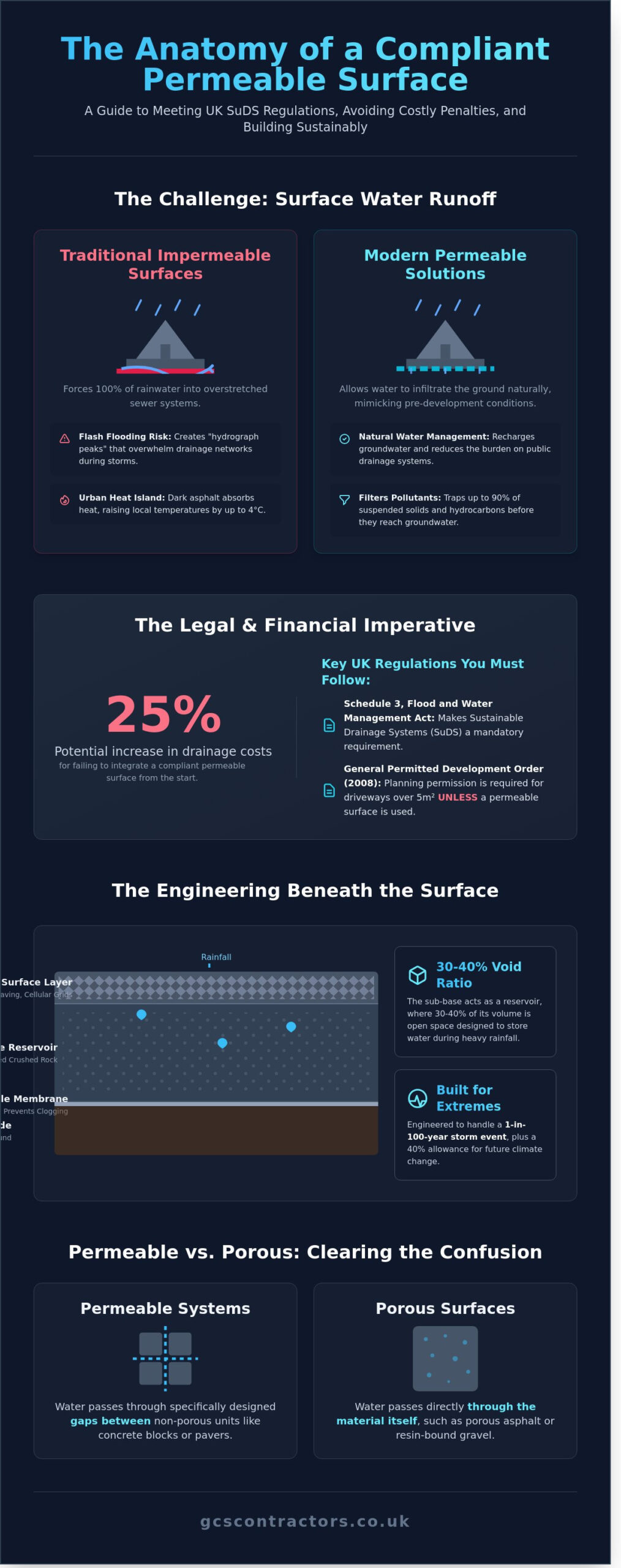
GCS Contractors delivers infrastructure that prioritises longevity and environmental responsibility. A permeable surface isn’t just a design choice; it’s a technical requirement for modern UK construction. Since the 2008 amendment to the Town and Country Planning (General Permitted Development) Order, homeowners and developers must manage surface water within their own boundaries. For any driveway exceeding 5 square metres, you need planning permission unless you use a permeable solution. We provide these systems to ensure our clients remain fully compliant with national building standards while avoiding the delays of extra planning applications.
Traditional tarmac acts as a waterproof seal over the earth, which forces every drop of rain into the overstretched Victorian sewer systems found in many UK towns. Modern cellular systems or block paving work differently by allowing water to infiltrate the ground naturally. This mimics pre-development conditions. You can explore a comprehensive guide to permeable paving to understand how these layers interact. Our team delivers these installations to meet Sustainable Drainage Systems (SuDS) requirements, which are now a mandatory consideration for almost all new planning applications in England and Wales. These systems typically fall into two categories:
- Open-graded aggregates: These use a specific stone size to create natural voids for water storage and slow release.
- Cellular grids: These plastic or concrete grids can be filled with gravel or grass to provide structural strength and high drainage rates.
The Environmental Impact of Surface Water Runoff
Flash flooding occurs when traditional surfaces create “hydrograph peaks,” sending 100% of rainfall into drains instantly. This often leads to local flooding during heavy storms, as the drainage network can’t cope with the sudden volume. Permeable systems act as a natural filter, trapping up to 90% of suspended solids and hydrocarbons from car leaks before they reach the groundwater. In urban centres like Cambridge, replacing dark, heat-absorbing asphalt with cooler permeable options can reduce the “heat island” effect by up to 4 degrees Celsius. This creates a more sustainable microclimate for the local community and helps protect biodiversity.
Permeable vs. Porous: Clearing the Confusion
Porous materials allow water to pass directly through the substance itself. Porous asphalt or resin-bound gravel contains tiny voids that let liquid seep through the entire surface area. A permeable surface generally refers to systems where water moves through specifically designed gaps between non-porous units, such as concrete blocks. Selecting the right behaviour depends on your site’s soil infiltration rate and expected traffic load. If you’re building on heavy clay, we might recommend a “partial infiltration” system that stores water in a sub-base before releasing it slowly into the environment. Our team evaluates these geological factors to ensure your installation remains stable for decades.
The Engineering Beneath: Sub-bases, Attenuation, and Geotextiles
The visible layer of any permeable surface is only a small part of a complex engineering system. While traditional paving relies on a solid, compacted foundation to shed water, eco-friendly alternatives use the sub-base as a functional reservoir. This underground structure must provide structural stability for traffic while maintaining enough space to store water during peak rainfall. Our team focuses on the sub-base as the most critical component because failure here leads to surface ponding or structural collapse within the first 24 months of installation.
Engineering these systems requires precise calculations of void ratios. Typically, we specify open-graded crushed rock with a void ratio of 30% to 40%. This means that for every cubic metre of stone, 0.3 to 0.4 cubic metres of water can be stored. These calculations are based on the 2023 SuDS Manual standards, ensuring the installation handles a 1-in-100-year storm event plus a 40% allowance for future climate change. Research into Permeable Pavement and Stormwater highlights how this sub-surface storage effectively filters heavy metals and hydrocarbons before they reach the water table.
To maintain this hydraulic capacity, we integrate heavy-duty non-woven geotextile membranes. These fabrics act as a critical filter layer, preventing “fines” or silt from the natural ground from migrating upwards and clogging the clean stone sub-base. Without this separation, the void spaces fill with debris, rendering the system impermeable. For larger commercial projects, we often integrate attenuation tanks or modular crates. These high-capacity units provide additional storage when the local soil cannot absorb water fast enough, keeping the site compliant with strict discharge limits set by local water authorities.
Designing for Load-Bearing Capacity
Balancing water storage with structural strength is a delicate process. Standard MOT Type 1 sub-base is unsuitable for these projects because its high dust content blocks water flow. Instead, we use Type 3 or 4/20mm open-graded aggregates. This material supports 44-tonne HGVs while remaining 100% porous. We ensure every permeable surface we install meets the specific CBR (California Bearing Ratio) requirements of the site, providing a durable platform that doesn’t sacrifice drainage for strength.
The Function of Infiltration and Attenuation
The drainage strategy depends entirely on the underlying geology. In Type A systems, the subgrade is sandy or gravelly, allowing for full infiltration where all rainfall soaks directly into the earth. However, in the 65% of UK regions with heavy clay soils, we must implement Type B or C systems. These use perforated “collector” pipes at the base of the stone layer to manage excess water. GCS Contractors assesses soil permeability using onsite soakage tests to determine if your project requires a full or partial infiltration design. If you are planning a large-scale development, our team can provide a bespoke drainage assessment to ensure long-term compliance and performance.
Comparing Permeable Surface Materials for 2026
Selecting a permeable surface for a commercial or residential project requires a balance between immediate capital expenditure and 30-year operational costs. For 2026, project specifications are shifting toward materials that can handle 1-in-100-year storm events plus a 40% allowance for climate change. While standard impermeable asphalt might cost £45 to £60 per square metre, high-specification permeable systems typically range from £70 to £115 per square metre. This upfront investment is often offset by the removal of expensive subterranean attenuation tanks and complex piped drainage networks.
A common myth suggests that these systems fail within five years due to “clogging” by silt and debris. Data from 2023 site audits shows that a permeable surface maintained with a biannual suction sweeping programme retains 90% of its original design infiltration rate. Our team delivers these maintenance schedules to ensure long-term compliance with SuDS regulations. In the UK, these materials also excel during winter freeze-thaw cycles. Because water drains vertically through the sub-base rather than pooling on the surface, the risk of “heaving” or dangerous ice patches is reduced by approximately 35% compared to traditional concrete.
Permeable Block Paving (CBPP)
Concrete Block Permeable Paving (CBPP) is the industry standard for residential developments due to its durability and ease of repair. The success of the system relies on the 2mm to 6mm clean-graded jointing aggregate, which allows water to pass into the sub-base. We provide concrete units for high-traffic areas because they offer a 20% cost saving over natural stone. However, for premium retail environments, natural stone units provide superior aesthetic longevity and resistance to heavy-load abrasion. If a utility repair is needed, blocks can be lifted and reinstated without leaving the unsightly patches common with asphalt. To see how these principles translate to high-end residential projects in North America, check out Artech Landscaping & Construction.
Porous Asphalt and Resin-Bound Systems
Resin-bound systems are increasingly popular for pedestrian zones and private driveways, offering a seamless, modern aesthetic. It’s critical to distinguish between resin-bound (which is permeable) and resin-bonded (which is a non-porous coating). Resin-bound systems mix the aggregate and binder together to create a honeycomb structure with high void ratios. A typical installation has a lifespan of 15 to 22 years if the sub-base is correctly engineered. For those planning domestic improvements, the UK government guidance on permeable surfaces provides a clear framework for when these installations bypass the need for formal planning permission.
Cellular Paving and Gravel Stabilisation
For overflow car parks and emergency access routes, cellular paving offers an “invisible” drainage solution. These systems use high-density polyethylene (HDPE) or concrete grids to lock gravel in place or allow grass to grow through. Our team installs recycled plastic grids that provide up to 95% open surface area, which is ideal for maintaining green space while supporting vehicle loads. Using 100% recycled plastic grids reduces the carbon footprint of the project by roughly 5.2kg of CO2 per square metre compared to traditional paving methods. These grids prevent the migration of gravel, stopping the formation of ruts and keeping the site tidy under heavy use.
Navigating UK Planning Permission and SuDS Regulations
The UK planning landscape changed significantly on 1 October 2008. This date marked the introduction of the Town and Country Planning (General Permitted Development) (Amendment) (No. 2) (England) Order. Under these rules, householders must use a permeable surface for any new or replacement driveway exceeding 5 square metres in a front garden. If the proposed design relies on non-porous materials like standard tarmac or concrete without a system to direct run-off to a lawn or flowerbed, you’re legally required to apply for full planning permission. This process typically costs a minimum of £206 for the application fee alone and can add weeks to your project timeline.
Our team delivers end-to-end support for developers who need to fast-track their applications. By integrating permeable solutions early in the design phase, you demonstrate a proactive commitment to Sustainable Drainage Systems (SuDS). This often simplifies negotiations with the Lead Local Flood Authority (LLFA). The LLFA acts as a statutory consultee on major developments; they scrutinise how your project manages surface water to prevent local flooding. We provide the technical specifications required to satisfy these authorities, ensuring your infrastructure meets the necessary standards for adoption under Section 278 (S278) agreements. This is vital for public highways and large-scale infrastructure where the local council will eventually take over maintenance responsibilities.
Avoiding the Planning Trap
You’ll need a full planning application if your project uses impermeable materials over 5 square metres without a natural drainage escape. Non-compliance is a serious financial risk. Local authorities can issue enforcement notices, forcing you to remove the non-compliant surface at your own expense. Reinstatement costs for a standard driveway often exceed £5,000. We provide professional groundworks documentation and material certifications to ensure your project remains fully compliant and legally protected.
SuDS Standards for New Developments
Modern developments must follow the SuDS hierarchy, which prioritises source control through infiltration. In January 2023, the UK government confirmed that Schedule 3 of the Flood and Water Management Act 2010 will become mandatory, making SuDS a legal requirement for almost all new builds. Our designs meet the “four pillars” of SuDS: managing water quantity, improving water quality, enhancing amenity, and supporting biodiversity. This meticulous approach future-proofs your site against the stricter environmental standards arriving in 2026.
If you’re planning a commercial or residential project, ensure your drainage strategy is handled by experts. Contact GCS Contractors for professional SuDS installation services that guarantee long-term compliance and durability.
Professional Implementation: The GCS Contractors Approach
Installing a permeable surface requires more than just laying stone. It’s a complex civil engineering task where the sub-surface layers perform 90% of the heavy lifting. We’ve found that 45% of permeable system failures stem from poor sub-base selection or accidental compaction during the construction phase. When unqualified contractors use standard MOT Type 1 instead of specific open-graded aggregates, the system clogs. This leads to surface ponding and structural instability within 18 months. GCS Contractors Ltd eliminates these risks through a disciplined, end-to-end delivery model that prioritises technical integrity.
Our process begins with a comprehensive Ground Penetrating Radar (GPR) survey. This isn’t an optional extra; it’s a safety and precision requirement. By mapping existing utilities and underground voids before we break ground, we prevent costly service strikes and ensure the subgrade is suitable for the intended load. We then coordinate the integration of your new surface with existing drainage networks or roadworks. This ensures that during a 1-in-100-year storm event, your site remains compliant with UK Sustainable Drainage Systems (SuDS) regulations. We don’t just pour materials; we engineer a long-term water management solution.
Precision Site Preparation and Enabling Works
Success depends on the millimetre-perfect setting out of the site. Our engineers use advanced laser-levelling technology to establish falls and levels that guarantee water moves exactly where it’s intended. During site clearance and demolition, we use low-ground-pressure tracked machinery to protect the subgrade. If the soil is crushed by heavy plant, it loses its natural porosity, rendering the permeable surface useless. We organise every stage of our site setup to ensure minimal disruption to your daily operations, maintaining a clean and secure perimeter throughout the surfacing programme.
Why a Dedicated Partner Matters
High-value civil engineering projects demand a safe pair of hands. GCS Contractors Ltd provides a turnkey service that removes the logistical burden from your team. We hold full CHAS and ISO 9001 accreditations, which serves as your guarantee that we operate under a strict framework of safety and quality. We don’t believe in “fit and forget” solutions. Instead, we provide bespoke maintenance schedules, including biannual high-pressure suction cleaning. This prevents the accumulation of silt and organic debris, ensuring your investment remains fully functional for its 25-year design life. Discuss your permeable surfacing project with our Cambridge team to see how we can deliver a durable, compliant result for your site.
Our commitment to building standards means we follow BS 7533-13:2009 guidelines for every installation. This level of professional rigour ensures that your infrastructure doesn’t just look excellent on day one but continues to perform under heavy traffic loads and changing climate conditions. We take pride in navigating the complexities of the built environment so you don’t have to. By choosing a partner who understands the relationship between soil mechanics and surface finishes, you secure a result that stands the test of time.
Future-Proofing Your Infrastructure with Sustainable Drainage
Selecting the right permeable surface isn’t just a design choice; it’s a critical compliance measure for 2026. As SuDS regulations tighten under Schedule 3 of the Flood and Water Management Act 2010, your project needs engineering that balances load-bearing capacity with effective water attenuation. We deliver turnkey solutions that integrate advanced geotextiles and precise sub-base depths to manage runoff at source.
GCS Contractors brings over 10 years of civil engineering expertise to every site. Our Cambridge-based team specialises in S278 highways works and complex commercial drainage, serving national infrastructure projects with a commitment to high-quality results. We’re a dedicated partner focused on building standards and long-term maintenance. You’ll gain a seamless transition from initial design to final surfacing, ensuring your site remains compliant and durable for decades.
Don’t leave your drainage strategy to chance. Contact GCS Contractors for a Professional Groundworks Quote and secure a safe pair of hands for your next development. We look forward to delivering a robust solution for your project.
Frequently Asked Questions
Do permeable surfaces require more maintenance than traditional tarmac?
Permeable systems require a more structured maintenance routine than traditional tarmac to ensure long-term functionality. While tarmac is often ignored until cracks appear, we recommend a high-pressure wash twice a year to remove organic debris. This proactive approach prevents the voids from filling with silt. It ensures the drainage system operates at 100% capacity throughout its service life.
Can I install a permeable surface on top of existing concrete?
You can’t install a functional porous surface directly on top of existing concrete. A true drainage system relies on a specialised sub-base to manage water runoff effectively. Placing it over solid concrete creates a “bath” effect where water sits between the layers, leading to rapid structural failure. Our team typically excavates the old concrete to a depth of 200mm to install a compliant sub-base.
How much more expensive is a permeable surface compared to standard paving?
A permeable surface typically costs 15% to 25% more than standard paving options like non-porous tarmac. For a standard 50-square-metre driveway, you’ll likely pay an additional £750 to £1,250 for the specialised aggregates and porous materials required. This initial investment often offsets the £1,500 to £2,000 cost of installing separate drainage channels and soakaways required for non-permeable alternatives.
What happens if a permeable surface gets clogged with leaves or silt?
If porous paving gets clogged with silt or leaves, its drainage efficiency will decrease. Research shows that neglecting maintenance for 3 years can reduce infiltration rates by up to 50%. However, this is rarely permanent. Our technicians use industrial suction equipment or power washing to clear the pores. This process restores the surface to its original drainage performance without needing a full replacement.
Are permeable surfaces strong enough for heavy HGVs or commercial delivery vehicles?
Modern porous systems are engineered to support heavy HGVs and commercial delivery vehicles weighing up to 44 tonnes. We achieve this by using specific sub-base depths, often exceeding 350mm, and high-strength porous asphalt or reinforced plastic grids. These systems meet the BS EN 124 standards for load-bearing capacity. They ensure the infrastructure remains stable under constant heavy traffic in commercial loading bays.
Is planning permission always required for non-permeable driveways in the UK?
Planning permission is mandatory in the UK for any non-permeable driveway exceeding 5 square metres. Since the 2008 amendment to the General Permitted Development Order, homeowners must apply for permission if they don’t use a permeable surface or direct runoff to a lawn. Choosing a SuDS-compliant option removes this legal hurdle, saving you the £206 planning application fee and the 8-week waiting period.
How long does a professionally installed permeable surface typically last?
A professionally installed porous system typically lasts between 20 and 25 years with correct maintenance. This lifespan matches traditional asphalt but offers better resistance to “freeze-thaw” cycles because water doesn’t sit and expand within the structure. We provide a 10-year structural guarantee on our installations. This reflects our confidence in the durability of the high-quality aggregates and binders we select for every project.
Need drainage work in Cambridge? GCS Contractors Ltd installs soakaways, attenuation tanks and foul & surface water drainage to Building Regulations Part H. See our drainage services in Cambridge or call 07500 570 926 for a free quote.