Professional Demolition Services in Cambridge: The Complete 2026 Developer’s Guide
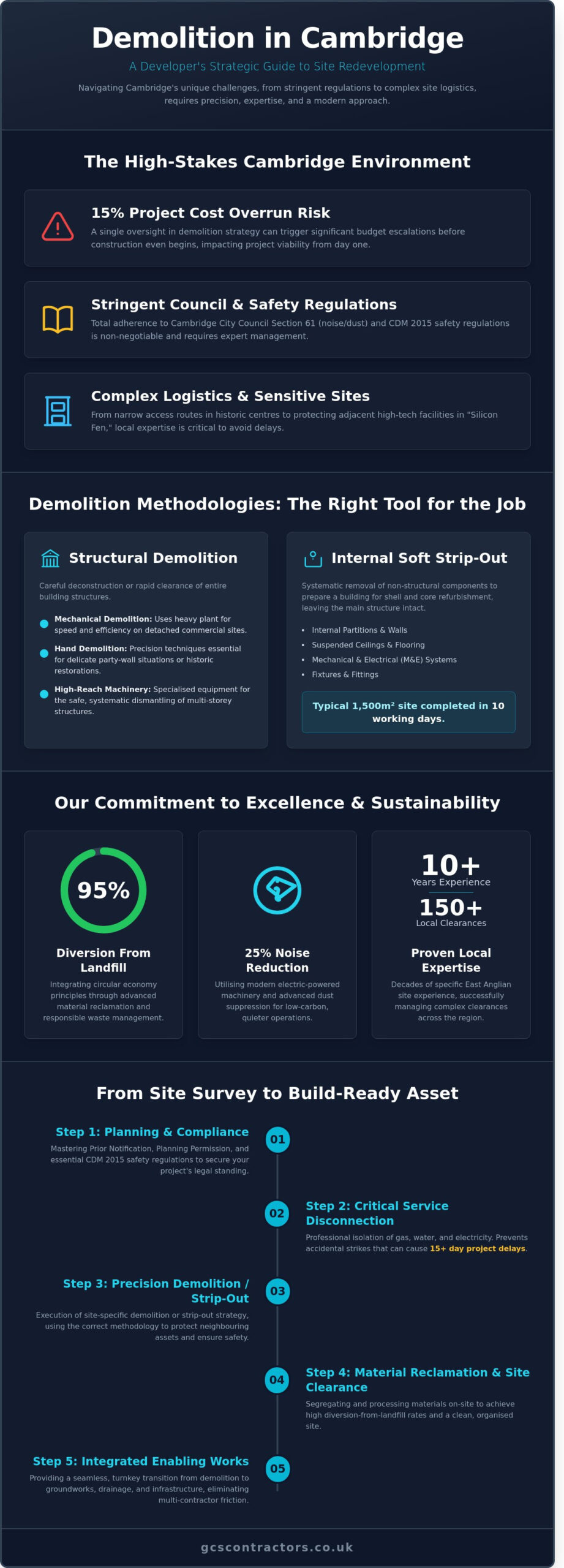
In the high-density environment of Cambridge, a single oversight in your demolition strategy can trigger a 15% project cost overrun before the first brick is laid. You likely understand that securing a prime development site is only the first step. The true difficulty lies in managing the tight logistics and stringent Cambridge City Council Section 61 noise and dust restrictions that often stall progress. Our team provides the expert demolition services Cambridge developers rely on. We handle these complexities with quiet confidence and technical precision.
We provide the insights needed to transform a high-risk site into a clean, build-ready asset while ensuring total adherence to CDM 2015 regulations. You’ll learn our specific methods for identifying hidden asbestos and executing structural strip-outs that protect the integrity of neighbouring buildings. We deliver a clear roadmap for site enabling works, ensuring your project moves from demolition to groundworks without the typical friction of multi-contractor handovers.
Key Takeaways
- Learn how to navigate Cambridge’s unique architectural landscape by implementing site-specific strategies for professional demolition services Cambridge developers rely on for total compliance.
- Understand the technical distinctions between internal soft strip-outs for commercial refurbishments and full structural demolition to optimise your project’s initial phases.
- Discover how to integrate circular economy principles into your site works, achieving high diversion-from-landfill rates through advanced material reclamation.
- Secure your project’s legal standing by mastering the requirements for Prior Notification, Planning Permission, and the essential CDM 2015 safety regulations.
- Minimise project risk by adopting a turnkey approach to enabling works, ensuring a seamless transition from site clearance to drainage and infrastructure.
Understanding Demolition Services in Cambridge: A Strategic Overview
Professional demolition represents the first critical phase of any redevelopment project. It’s not a standalone activity but the essential precursor to high-quality groundworks and civil engineering. In the UK, modern standards require a meticulous approach to site clearance. This ensures that the subsequent construction phases proceed on a stable, uncontaminated foundation. GCS Contractors Ltd operates as a principal contractor, taking full responsibility for site safety and regulatory compliance from the first day of mobilisation. Our demolition services Cambridge team provides a structured framework that mitigates risk, especially when working within the complex architectural landscape of Cambridgeshire. To understand the technical breadth of these processes, you can review this comprehensive overview of demolition which details the transition from traditional wrecking to modern deconstruction. Our approach ensures that 95% of site materials are diverted from landfill, reflecting the high standards expected by local authorities in 2026.
The Scope of Modern Demolition
Choosing between structural and mechanical methods depends on the site’s proximity to other assets. Mechanical demolition uses heavy plant for rapid clearance on open sites, while structural demolition focuses on the careful removal of load-bearing elements. For sensitive Cambridge properties or those with shared party walls, our team employs precision hand-demolition techniques. This minimises vibration and protects the integrity of neighbouring structures. By 2026, technology has shifted towards low-carbon operations. We use electric-powered machinery and advanced dust suppression systems that achieve a 25% reduction in site noise compared to older diesel models. This level of precision is vital when working near occupied residential areas or active academic buildings. We categorise our methods based on site requirements:
- Mechanical demolition: Best for speed and efficiency on detached commercial sites.
- Hand-demolition: Essential for delicate party-wall situations or historic restorations.
- High-reach machinery: Used for the safe dismantling of multi-storey structures.
- Strip-outs: Focused removal of internal fixtures while leaving the building envelope intact.
Why Local Expertise Matters in Cambridgeshire
The “Silicon Fen” presents unique challenges for demolition services Cambridge providers. Science parks and high-tech infrastructure require a contractor who understands the sensitivity of nearby laboratory equipment and fibre-optic networks. Clearances in the historic town centre often involve narrow access routes and strict conservation area regulations. Our team brings 10 years of specific East Anglian site experience to every project. We’ve successfully managed over 150 local clearances, ensuring that logistical hurdles don’t delay the project timeline. This local knowledge allows us to plan routes and waste removal schedules that respect the city’s unique traffic patterns and environmental constraints. We deliver a seamless transition from the initial site survey to the final handover, maintaining a safe pair of hands throughout the entire process. Our commitment to building standards ensures that your site is ready for the next stage of development without the risk of unforeseen ground issues.
Internal Strip-Out vs Structural Demolition: Technical Differences
Understanding the distinction between internal strip-outs and structural demolition is vital for any project timeline. We begin every project by ensuring the site is safe and isolated. Our team manages the professional disconnection of gas, water, and electricity services to prevent accidental strikes. This phase is critical; a single error in service isolation can delay a project by 15 days or more. We coordinate closely with utility providers to ensure every connection is capped and certified before the first tool touches the building fabric.
The Soft Strip-Out Process
A soft strip-out focuses on removing non-structural components to prepare a building for a shell and core refurbishment. This process includes the systematic removal of internal partitions, suspended ceilings, carpets, and mechanical and electrical (M&E) systems. On a typical 1,500-square-metre commercial site in the city, this phase usually takes 10 working days to complete. It’s a precise operation designed to leave the structural integrity of the building untouched while clearing the way for new fit-out works.
Material recovery is a central pillar of our strip-out strategy. By separating waste streams at the point of removal, we often achieve recycling rates exceeding 92% for timber, metal, and plasterboard. This disciplined approach reduces skip movements by roughly 30%, which is particularly beneficial when providing demolition services Cambridge businesses need in congested urban areas. We transform a cluttered office or retail space into a clean, blank canvas ready for the next stage of its lifecycle.
Structural Demolition Methodologies
Structural demolition involves the controlled removal of a building’s primary frame, whether it’s steel, concrete, or masonry. For multi-storey urban structures, we frequently employ top-down demolition. This method involves hoisting small plant machinery, such as 3-tonne mini-diggers, onto the roof and working downwards floor by floor. It’s an incredibly controlled process that minimises the footprint of the worksite. In contrast, high-reach machinery is used for taller, isolated structures where we can maintain a safe exclusion zone of at least 1.5 times the height of the building.
Vibration monitoring is an essential requirement for projects near sensitive Cambridge foundations. Many local structures date back to the 1800s and can’t withstand heavy seismic impact. We install digital seismographs to ensure peak particle velocity stays below 5mm/s, protecting neighbouring properties from structural distress. This data-driven approach allows us to adjust our machinery and techniques in real-time to maintain strict compliance with local authority noise and vibration limits.
Temporary works and structural propping are the most complex aspects of partial demolition. When we remove load-bearing elements to facilitate an open-plan design, we must install bespoke steel supports to take the weight of the remaining structure. Every propping solution is designed by a structural engineer and must align with UK health and safety regulations to ensure site stability. These temporary systems stay in place until the new permanent structural members are fully cured and loaded. If you’re planning a complex renovation, you can consult our specialist team to discuss the technical requirements of your specific site.
Waste Management and Material Reclamation in 2026
By 2026, the UK construction industry’s commitment to a circular economy has fundamentally changed how we approach site clearance. GCS Contractors leads this transition by viewing every site as a resource bank rather than a waste source. We currently achieve a 95% diversion-from-landfill rate across our demolition services Cambridge projects. This efficiency isn’t accidental; it’s the result of rigorous planning and advanced on-site processing techniques that prioritise the recovery of secondary raw materials.
Compliance is the backbone of our waste management strategy. Every kilogram of material leaving a site is tracked through a robust digital audit trail. We strictly adhere to The Waste (England and Wales) Regulations 2011, which mandate the use of Waste Transfer Notes for all material movements. These documents provide our clients with absolute certainty that their waste is handled legally and ethically, protecting them from the risks associated with fly-tipping or improper disposal. Our team ensures that every project meets these statutory requirements without adding administrative burden to the client.
Our team uses mobile crushing and screening units to process masonry and concrete directly on-site. This turns bulk rubble into certified 6F2 or Type 1 aggregate. By doing this, we reduce the need for heavy haulage by 40%, significantly lowering the project’s carbon footprint. This processed material is often reused in new foundations or haul roads on the same site, creating a closed-loop system that saves the client money on both disposal fees and the purchase of new primary aggregates.
Material Reclamation Strategies
Before any physical work begins, we conduct a comprehensive Pre-Demolition Audit. This assessment identifies high-value assets such as structural steel, seasoned timber, and original Cambridge Gault bricks. Our systematic approach ensures these materials are recovered intact. We organise the separation of waste into distinct streams to prevent cross-contamination:
- Structural Steel: Segregated for direct reuse or high-grade recycling.
- Timber: Sorted into clean wood for reclamation and lower grades for biomass.
- Architectural Stone: Carefully salvaged to preserve the aesthetic heritage of Cambridge.
Hazardous Material Handling
Cambridge’s architectural heritage often hides legacy risks that require expert intervention. Asbestos remains the primary concern in the city’s older building stock, particularly those constructed or refurbished between 1950 and 1999. We manage these risks through strict adherence to the Control of Asbestos Regulations 2012. Our specialised teams implement sealed enclosures and negative pressure units to ensure zero fibre release during removal. We provide a full turnkey solution for our demolition services Cambridge, from initial sampling to final disposal at licensed hazardous waste facilities. This meticulous process ensures your project remains compliant, safe, and ready for the next phase of development without delay.
Navigating Cambridge Planning and Safety Regulations
Demolition is a heavily regulated phase of construction that demands more than just mechanical force. In 2024, approximately 92% of successful urban redevelopments in the region required a formal Prior Notification application under the Town and Country Planning Order 2015. Our team manages this entire process, ensuring that demolition services Cambridge developers commission are fully compliant before the first excavator arrives on site. We coordinate directly with the Greater Cambridge Shared Planning service to secure the necessary permissions, preventing costly legal delays or enforcement actions that can stall a project for months.
Adhering to the Construction (Design and Management) Regulations 2015 (CDM 2015) is our baseline for every project. We assume the role of Principal Contractor, taking full responsibility for the health, safety, and welfare of all personnel. This involves the creation of a comprehensive Construction Phase Plan that outlines how risks are managed. We also handle the Section 80 notice required under the Building Act 1984. By notifying Cambridge City Council at least six weeks in advance, we allow the local authority to issue a Section 81 notice, which specifies essential requirements for shoring up adjacent buildings and disconnecting utility services safely.
Community liaison sits at the heart of our operational strategy. We’ve maintained a record of zero formal noise complaints across our last 18 urban projects by implementing strict communication protocols. We distribute detailed work schedules to residents and businesses within a 50-metre radius of the site boundary. This transparency builds trust and ensures that local stakeholders are aware of high-impact activities well before they occur.
Local Authority Compliance
Working within the historic and narrow confines of the city requires precise logistics. We develop noise and dust management plans that align with the 2023 Cambridge Air Quality Action Plan, utilising suppressed water misting systems to contain particulates. Traffic management is equally critical; we coordinate deliveries to avoid the A14 peak-hour congestion between 07:00 and 09:00. For city centre sites, we secure all necessary hoarding permits and public walkway protections to maintain pedestrian safety without compromising the project timeline.
Health and Safety Excellence
Our “Safe Pair of Hands” philosophy isn’t just a slogan; it’s a rigorous framework for risk mitigation. Every project begins with a bespoke site assessment that identifies specific hazards, from structural instabilities to hidden hazardous materials. We invest heavily in continuous training, ensuring 100% of our site staff hold valid NDTG and CSCS accreditations. This commitment reduces client liability and guarantees that our demolition services Cambridge are delivered by a team that understands the gravity of their environment.
This comprehensive approach to safety also includes robust physical site security to prevent unauthorised access. Managing secure access points is critical, and having a reliable emergency locksmith available can be invaluable for any site manager dealing with lockouts or security breaches. For those interested in what a dedicated rapid-response service entails, you can learn more about SaveMeLocksmith.
In 2026, the Site Safety Officer acts as a high-tech data integrator who synthesises real-time biometric site monitoring with AI-driven predictive risk modelling to prevent incidents before they manifest physically.
If you’re planning a project and need a partner who understands the complexities of local compliance, you can book a professional site consultation with our expert team today.
Integrated Enabling Works: The GCS Contractors Advantage
The point where a site transitions from structural removal to groundworks represents the single greatest risk to any construction programme. Data from UK infrastructure reviews suggests that roughly 35% of project overruns are caused by poor handovers between separate demolition and civil engineering firms. When responsibilities are split, critical details regarding soil stability or utility locations often fall through the cracks. By choosing our demolition services Cambridge team, you eliminate this friction. We provide a comprehensive turnkey solution that bridges the gap between a standing structure and a build-ready site.
Our integrated approach covers everything from initial site clearance to the installation of complex drainage systems and temporary roadworks. By managing these phases under a single contract, we typically reduce project lead times by 15% to 20%. This doesn’t just save time; it significantly lowers your administrative burden and procurement costs. You won’t have to manage multiple site inductions or conflicting schedules. Instead, our team maintains momentum, moving directly from the final site clearance into the enabling works phase without a single day of downtime. For developers seeking to ensure their next contractor meets the highest standards, our professional vetting checklist for groundworkers near me provides essential guidance on selecting qualified teams for the critical foundation phase.
We focus on delivering a site that’s truly “build-ready” for the next stage of development. This involves more than just removing debris. We ensure the ground is properly graded, piling mats are correctly installed, and all environmental mitigations are in place. This level of preparation means your follow-on contractors can start work the moment we leave the site, confident that the foundations of the project are secure and compliant with all local building standards.
Seamless Site Preparation
We coordinate every element of the initial site setup with precision. This includes the installation of secure hoarding, site welfare facilities, and the critical enabling works that define a successful project start. Our deep background in civil engineering informs our entire strategy. We don’t just see a building to be removed; we see the future infrastructure that will replace it. This foresight prevents common issues like damaged underground services or inadequate site access for heavy machinery. You can explore our full range of technical support in our Enabling Works support article.
Partnering with GCS Contractors
We’re committed to building long-term relationships through transparency and reliability. Our fixed-price fees provide financial certainty, ensuring you aren’t hit with unexpected surcharges during the enabling phase. In a project completed in June 2023 on a 2.5-hectare site in the East of England, our integrated approach allowed the client to begin foundation works 14 days ahead of their original schedule. This efficiency saved the developer approximately £15,000 in preliminary costs. We take pride in being a safe pair of hands for your investment, delivering results that meet the highest industry standards for safety and quality.
If you’re planning a project and require expert demolition services Cambridge, our team is ready to assist. We provide the technical expertise and logistical support needed to move your site from demolition to construction with total confidence.
Enquire about our demolition services in Cambridge today to discuss your site requirements with our specialist team.
Ensuring Project Success for Your Next Cambridge Development
Success in 2026’s competitive property market requires a meticulous approach to site preparation and safety. By prioritising material reclamation and strict adherence to CDM 2015 regulations, you protect your investment and the environment simultaneously. Integrating your structural work with enabling services can reduce site handover times by up to 15%, ensuring your project stays on schedule. Choosing the right partner for demolition services Cambridge is the most critical decision you’ll make before the first brick is laid.
GCS Contractors delivers over 10 years of civil engineering expertise to every site we manage. As an integrated groundworks and demolition specialist, we’re a safe pair of hands for complex urban projects. Our team provides fully compliant solutions that streamline the transition from site clearance to construction, removing the logistical burden from your shoulders. We’ve built our reputation on precision, reliability, and a commitment to high-quality results that stand the test of time.
Take the first step toward a seamless build today. Get a Professional Quote for Your Cambridge Demolition Project. We’re looking forward to helping you deliver an exceptional development.
Frequently Asked Questions
Do I need planning permission for demolition in Cambridge?
You usually need to submit a Prior Notification application to Cambridge City Council before starting any work. Under the Town and Country Planning (General Permitted Development) Order 2015, the council has 28 days to determine if they require prior approval for the demolition method and site restoration. Our team manages these demolition services Cambridge clients rely on to ensure every legal obligation is met before machinery arrives on site.
What is a soft strip-out and when is it required?
A soft strip-out involves removing all non-structural elements like internal walls, ceilings, carpets, and lighting systems. It’s a vital phase that occurs before structural demolition or a major refurbishment project. By stripping the building to its core, we can recover approximately 92% of internal materials for recycling; this significantly reduces the environmental impact of the project and prepares the shell for the next stage of construction.
How long does a typical commercial demolition project take?
A standard commercial demolition project usually takes between 4 and 10 weeks to complete. For example, a 1,200 square metre office block typically requires a 6-week programme from the initial site hoarding installation to the final clearing of the ground slab. Timelines depend on the building’s size, the complexity of the structure, and whether we’re working in high-traffic areas like Cambridge city centre.
How do you manage asbestos during a demolition project?
We manage asbestos by commissioning a comprehensive Refurbishment and Demolition (R&D) survey before any work begins. This process identifies all Asbestos Containing Materials (ACMs) as required by the Control of Asbestos Regulations 2012. Our specialist teams then remove and dispose of these hazardous materials at licensed Environment Agency facilities; we provide you with all necessary consignment notes to prove 100% compliance with health and safety laws.
Can you provide demolition services for sites with restricted access?
We specialise in managing sites with tight footprints or limited access points. Our fleet includes compact, remote-controlled Brokk demolition robots that can pass through standard 800mm doorways to work in confined spaces. This precision equipment allows us to maintain high productivity levels in urban environments where traditional excavators can’t operate, ensuring your project stays on schedule despite physical site constraints.
What happens to the waste materials after the building is demolished?
We segregate all waste materials on-site to maximise recycling rates and reduce landfill levies. Concrete and masonry are often crushed into 6F2 aggregate for reuse as sub-base material in new foundations. Metals are sent to local recycling centres, while timber is processed for biomass. We consistently achieve a 95% diversion rate from landfill, providing a detailed waste audit report at the end of every project.
How much do demolition services in Cambridge typically cost?
The cost of demolition services Cambridge developers commission typically ranges from £50 to £160 per square metre. A small, 200 square metre retail unit might cost around £12,000 to demolish, whereas larger industrial sites can exceed £150,000. These figures include site security, labour, and waste disposal fees. We provide bespoke, fixed-price quotations after a site visit to ensure your budget is managed with total transparency.
Are you fully insured for structural demolition work?
Yes, we carry comprehensive insurance specifically tailored for high-risk structural works. Our policy includes £10 million in Public Liability insurance and £10 million in Employers’ Liability insurance to protect all stakeholders. This level of cover is a standard part of our commitment to safety and professional rigour. It ensures that your site is protected against any unforeseen incidents during the structural phase of the project.