Comprehensive Civil Engineering Services for Developers: A 2026 Guide to Site Infrastructure
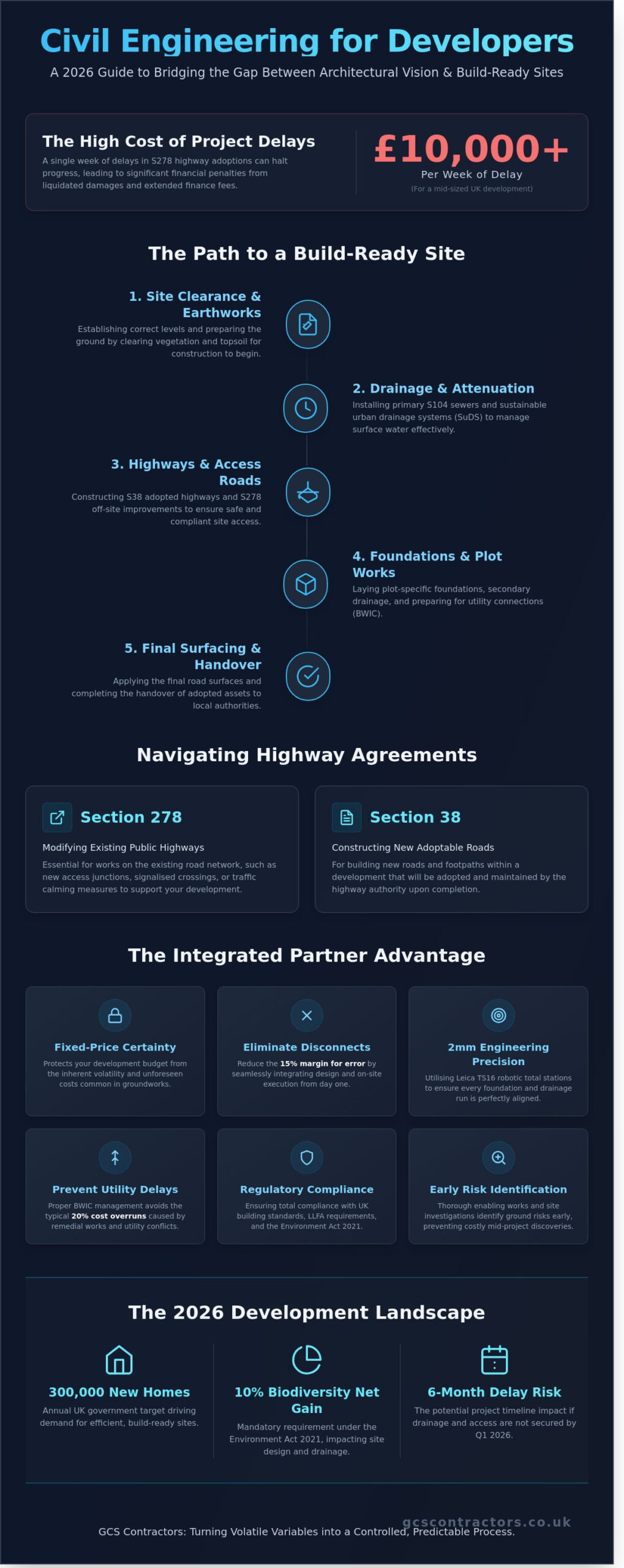
A single week of delays in S278 highway adoptions can cost a mid-sized UK development upwards of £10,000 in liquidated damages and extended finance fees. It’s a sobering figure that highlights why the transition from architectural plans to physical reality is the most precarious stage of any project. GCS Contractors Ltd provides professional civil engineering services for developers that turn these volatile variables into a controlled, predictable process. By acting as a safe pair of hands, our team ensures that your site infrastructure meets every regulatory standard while keeping your commercial goals firmly in sight.
You likely recognise that the success of your build depends entirely on the quality of the ground beneath it. We’re here to show you how dedicated civil engineering and groundworks bridge the gap between your architectural vision and a build-ready site. This 2026 guide outlines our approach to delivering fixed-price certainty for groundwork phases and seamless coordination between highways, drainage, and site preparation. We’ll explore the essential steps to navigating S38 agreements and the technical rigor required to ensure your site is ready for construction without the typical headache of managing multiple sub-contractors.
Key Takeaways
- Learn how professional civil engineering services for developers bridge the gap between architectural vision and a build-ready site through seamless design and execution.
- Navigate the complexities of S278 and S38 highway agreements to ensure site infrastructure meets all adoptable standards with technical precision.
- Understand the impact of 2026 environmental regulations on subsurface drainage and how to transition effectively from earthworks to structural foundations.
- Discover how thorough enabling works act as a dedicated safeguard, identifying ground risks early to prevent costly mid-project discoveries.
- Explore the benefits of a fixed-price construction model to achieve cost-certainty and protect your development budget from the inherent volatility of groundworks.
What are Civil Engineering Services for Developers?
Civil engineering is the fundamental discipline that transforms a raw plot of land into a viable, buildable construction site. For commercial and residential projects, it encompasses everything below the ground and the essential infrastructure that supports the built environment. Civil engineering involves the rigorous planning and construction of the physical environment, ensuring that a site is safe, accessible, and fully connected to the wider regional network. Our team delivers these services to provide the stable foundation upon which every successful development is built.
Developers must distinguish between the consultancy phase and the execution phase. The design phase involves technical drawings, hydraulic modelling, and structural calculations performed by consultants. The execution phase is the physical reality of the project. It involves the heavy machinery and skilled labour required to install these systems. We provide the vital link between these stages. Our team ensures that theoretical designs are translated accurately into the ground, accounting for the specific topography and soil conditions of the site.
In the 2026 development landscape, civil engineering is the critical path for project success. With the UK government aiming for 300,000 new homes annually and the mandatory 10% Biodiversity Net Gain (BNG) requirement under the Environment Act 2021, early-stage engineering determines project viability. If the drainage or access isn’t secured by Q1 2026, the entire project timeline risks a 6-month delay. Effective civil engineering services for developers ensure that these regulatory hurdles are cleared before they become expensive bottlenecks.
The lifecycle of civil engineering on a site follows a structured progression:
- Site clearance and bulk earthworks to establish correct levels.
- Installation of primary drainage and attenuation systems.
- Construction of S38 adopted highways and S278 off-site road improvements.
- Plot-specific foundations and secondary infrastructure.
- Final surfacing and the handover of adopted assets to local authorities.
The Scope of Modern Site Infrastructure
Primary infrastructure focuses on the heavy-duty elements like S38 roads and S104 sewers that serve the entire development. Secondary infrastructure involves plot-specific drainage and foundations that connect individual units to the main network. We place a high priority on “Builders Work in Connection” (BWIC). This involves creating the precise trenches, ducts, and pits required for utility providers like National Grid or Openreach. Proper BWIC management prevents the 20% cost overruns typically caused by utility delays and remedial works.
Why Developers Need an Integrated Contracting Partner
An integrated partner reduces the 15% margin for error often seen when design and groundworks are disconnected. We ensure total compliance with UK building standards and specific local authority requirements, such as those set by Lead Local Flood Authorities (LLFA). Our setting out engineers use Leica TS16 robotic total stations to maintain accuracy within 2mm. This precision ensures every foundation bolt and drainage run aligns perfectly with the masterplan, providing a seamless transition from the groundworks to the vertical build. Choosing professional civil engineering services for developers means choosing a partner that understands the high stakes of the UK property market.
Managing Highways and Access: S278 and S38 Infrastructure Works
Access to a development site is more than a logistical requirement; it’s a legal and safety mandate that dictates project viability. Securing civil engineering services for developers early in the planning stage ensures that highway interfaces are designed to meet stringent local authority standards. We provide the technical oversight necessary to navigate the complexities of Highways Act 1980 agreements, ensuring that every junction, roundabout, and footway realignment meets the precise requirements for public adoption. Safety and structural integrity aren’t just goals; they’re the foundation of every road we build.
The S278 Agreement: Modifying Public Highways
Section 278 agreements are essential when a development requires modifications to the existing public highway. These works often include the construction of new access junctions, the installation of signalised crossings, or the implementation of traffic calming measures to accommodate increased vehicle flow. Because these works occur on live roads, the risks are high. A failed inspection can lead to the local authority drawing on the developer’s bond, which typically covers 100% of the estimated construction costs. Our team delivers these improvements with meticulous attention to detail, adhering to the same high standards advocated by the American Society of Civil Engineers (ASCE) regarding infrastructure durability and safety. We manage the entire process, from technical approval to the final handover, ensuring that footway realignments and highway widening schemes are completed within the agreed 2024 compliance frameworks.
Section 38: Creating Adoptable Estate Roads
While S278 focuses on existing infrastructure, Section 38 agreements govern the creation of new roads within a development that will eventually be maintained by the council. The difference is significant. For a road to be adoptable, it must meet specific criteria for drainage, street lighting, and pavement thickness. Poorly executed S38 works often result in long term bond retention, where the local authority refuses to take over the assets due to defects. Our civil engineering services for developers ensure a seamless transition from private driveways to public highways by implementing robust quality control measures during the initial groundworks. This includes ensuring that 100% of the drainage systems are CCTV surveyed and approved before the final surfacing is applied. Our approach reduces the burden on the developer, providing a turnkey highway solution that prioritises long term reliability over short term fixes.
Delays in highway adoption can stall the final sign-off of a site for years. By integrating roundabouts and signalised junctions into the master plan with precision, we eliminate the friction between private development and public infrastructure. Our disciplined approach ensures that all works are delivered to a standard that passes local authority inspections the first time, protecting your capital and your reputation. We understand that a successful project relies on roads that stand the test of time and meet every regulatory hurdle without fail.
Subsurface Infrastructure: Drainage Systems and Technical Groundworks
Subsurface infrastructure represents the most critical, yet least visible, component of any successful development. These systems provide the structural and hydraulic integrity required for a site to function safely for decades. When selecting civil engineering services for developers, the focus must extend beyond the surface to the complex network of utilities and foundations that anchor the build. We treat this stage as the project’s “unseen” backbone, where precision in the early earthworks phase prevents costly remedial actions during the fit-out or landscaping stages.
Effective site preparation transitions from bulk earthworks into structural foundations through rigorous cut and fill analysis. This process ensures that soil is moved across the site to achieve the required levels without unnecessary off-site disposal. For a typical 2-hectare site, an optimised cut and fill strategy can reduce vehicle movements by 25% to 35%, significantly lowering the project’s carbon footprint and haulage costs. While managing these internal site levels, our team ensures all connections to the public infrastructure comply with legal standards, including Section 278 of the Highways Act 1980 when drainage or utility works cross into the public highway.
Sustainable Drainage Systems (SuDS) and Water Management
Modern drainage design has evolved from simple pipework to sophisticated water management systems. By 2026, the full implementation of Schedule 3 of the Flood and Water Management Act 2010 will mandate Sustainable Drainage Systems (SuDS) for nearly all new developments in England. We work closely with Lead Local Flood Authorities (LLFA) to design and install attenuation tanks, pumping stations, and flow control chambers. These systems are engineered to manage a 1 in 100-year storm event plus a 40% allowance for climate change. Our approach clearly differentiates between foul water systems, which require airtight integrity to prevent contamination, and surface water solutions designed for controlled discharge into local watercourses or soakaways.
Foundations and Ground Reinforcement
Technical groundworks must adapt to the specific geological profile of the site. In the East of England, we frequently manage the challenges of Cambridge clay, which requires specific moisture-control measures and deeper trench fills to prevent heave or shrinkage. As experienced groundworks contractors Cambridge, we deliver bespoke foundation solutions ranging from piling mats for heavy machinery access to reinforced concrete foundations and ground-bearing floor slabs. Our team ensures that every slab is poured to exact tolerances, providing a level, high-strength platform for the primary structure. This phase represents the final transition from civil engineering services for developers into the vertical construction stage, where the reliability of the ground reinforcement becomes the project’s most valuable asset.
Once the foundational work is complete, the focus shifts to the features that add final value and appeal to a property. For developers looking for inspiration on high-quality outdoor living spaces, it can be useful to see examples from specialists; for instance, you can visit The Deck Guys to see how custom decks and fences can enhance residential projects.
The Critical Role of Enabling Works in Site Preparation
Enabling works act as the vital bridge between site acquisition and the commencement of main construction activities. This phase is often where the most significant financial and operational risks reside. Our team delivers comprehensive civil engineering services for developers that transform raw land or derelict assets into controlled, build-ready environments. Thorough site preparation prevents the mid-project discoveries that typically inflate budgets by 10% to 15% during the groundworks phase. By addressing these complexities early, we provide a safe pair of hands that protects your investment from the outset.
Site security and logistics setup are the first lines of defence in any professional development project. We establish secure perimeters using robust hoarding systems to protect against unauthorised access and ensure public safety. Beyond security, we design and implement logistics plans that include temporary access roads and drainage. This ensures that heavy plant machinery can move efficiently across the site without becoming bogged down or damaging the surrounding infrastructure. A well-organised site from day one reduces downtime and maintains a steady project momentum.
Steps to a Build-Ready Site
Creating a build-ready site requires a disciplined sequence of operations to mitigate risk. We follow a structured approach to ensure every square metre of your site is accounted for and safe for the main contractor. Our process includes:
- Site clearance and demolition: We remove all vegetation, debris, and redundant structures to provide a clean slate for construction.
- GPR surveys and service disconnections: We use Ground Penetrating Radar to map underground utilities. This is essential to avoid utility strikes, which cost UK developers an average of £3,000 per incident in direct repairs and significant indirect delay costs.
- Site hoarding and access: We install high-quality, compliant hoarding and temporary roads to manage site traffic and material deliveries.
- Bulk earthworks: Our team manages level adjustments and soil stabilisation, ensuring the topography aligns perfectly with your structural requirements.
Ultimately, this meticulous preparation ensures the site is not just ready for construction, but also for its final purpose. For commercial developments intended to host large-scale functions, understanding the technical requirements from the outset is key. For a look at the creative and technical solutions involved in modern conferences and exhibitions, you can discover TPG Events (The Technical Production Group).
Strip-Out and Demolition Services
For refurbishment and fit-out projects, internal preparation is just as critical as external site works. We provide professional Strip-out and demolition services that focus on the safe removal of internal partitions, mechanical and electrical systems, and non-structural elements. This work is carried out with meticulous attention to health and safety, ensuring the building’s core integrity remains intact while preparing the space for its new purpose. We understand that modern developers must meet strict environmental standards. Our waste management protocols aim to recycle at least 90% of materials removed from site, which significantly reduces landfill tax liabilities and supports your project’s sustainability credentials.
Effective enabling works remove the guesswork from construction. When you utilise expert civil engineering services for developers, you’re not just clearing a site; you’re establishing the framework for a successful build. We focus on identifying and resolving potential issues like contaminated soil or redundant service mains before the first foundation is poured. This proactive approach ensures that your project remains on schedule and within its original financial projections.
Ready to prepare your site for a seamless construction phase? Contact GCS Contractors Ltd today to discuss our comprehensive enabling works and site preparation solutions.
Strategic Partnering: Delivering Cost-Certainty in Civil Engineering
Ground conditions represent the single largest financial risk for UK property developers. Unexpected soil contamination, hidden Victorian-era utilities, or poor load-bearing capacity can inflate site preparation budgets by 25% or more within the first month of work. GCS Contractors mitigates this volatility by offering a fixed-price construction model. This approach provides the financial clarity required to secure development finance with confidence, moving the risk away from your balance sheet and onto our shoulders.
Early Contractor Involvement (ECI) is the most effective tool for protecting your profit margins. When we engage with a project at the design stage, we identify potential engineering hurdles before they become expensive site problems. Data from projects completed since January 2023 shows that ECI can reduce overall project timelines by 14% through more efficient resource allocation. By integrating our team early, you access professional civil engineering services for developers that prioritise long-term stability and cost-control.
We act as a safe pair of hands for developers across the UK. Our team understands that cost-certainty isn’t just about the final figure on a tender; it’s about the reliability of the delivery process. We provide a disciplined, structured approach that ensures every phase of the groundworks and infrastructure meets the highest professional standards. This reliability is why 88% of our client base consists of repeat business and long-term strategic partnerships.
Value Engineering for Developers
Value engineering isn’t about cutting corners; it’s about intelligent technical substitution. We analyse drainage specifications to find high-performance alternatives that meet Sustainable Drainage Systems (SuDS) requirements while reducing material costs. For instance, optimising earthworks is a primary area for savings. By balancing cut-and-fill volumes on-site, we’ve helped clients reduce off-site waste disposal costs by over £45,000 on typical three-acre residential schemes. We ensure every decision maintains commercial viability without compromising the quality of the civil engineering services for developers.
Choosing Your Civil Engineering Contractor
Selecting the right partner requires looking beyond the initial quote. You need a contractor with robust accreditations, such as CHAS or ISO 9001, and a flawless health and safety record. Site accidents or regulatory breaches can lead to significant legal delays and reputational damage. GCS Contractors provides a complete turnkey solution that covers everything from enabling works and bulk excavations through to final surfacing. This end-to-end service eliminates the friction between different trades, ensuring a seamless transition through project phases. Our local expertise in UK planning and environmental regulations ensures your project remains compliant and on track from day one.
Ready to secure your project’s financial future? Contact GCS Contractors for a fixed-price tender and experience a partnership built on transparency and technical excellence.
Building a Resilient Foundation for Your 2026 Developments
Navigating the technical complexities of site infrastructure requires a disciplined partner who understands the high stakes of the UK construction industry. Successful projects in 2026 will depend on the seamless integration of S278 highways works and robust subsurface drainage systems. GCS Contractors brings over 10 years of professional groundworks and civil engineering experience to every site, ensuring your project meets all regulatory standards with precision. We deliver comprehensive civil engineering services for developers that focus on technical rigor and long-term viability. Our commitment to fixed-price tenders and transparent project management provides the cost-certainty you need to protect your margins. By managing everything from enabling works to final infrastructure, we act as a safe pair of hands for your investment. We’re ready to help you navigate these technical challenges with quiet confidence and proven expertise.
Partner with GCS Contractors for your next development project and ensure your site is built to stand the test of time.
Frequently Asked Questions
What is the difference between a civil engineer and a groundworks contractor?
Civil engineers focus on the technical design and structural integrity of the infrastructure, while groundworks contractors perform the physical excavation and foundation installation. Our team integrates these roles to provide seamless civil engineering services for developers, ensuring that technical drawings translate perfectly to the site. This unified approach eliminates the 15% budget discrepancies often found when design and physical works are handled by separate entities.
How long does the S278 agreement process typically take in 2026?
The S278 agreement process usually takes between 6 and 9 months to complete in 2026. This timeline includes the 12 week technical audit conducted by the Local Highway Authority and the subsequent legal drafting period. We advise developers to initiate the application 40 weeks before the scheduled start date to ensure all highway works and site access points are legally approved without delaying the build.
What are enabling works and why are they billed separately?
Enabling works are the essential preparation tasks, such as site clearance and decontamination, that happen before the main construction begins. These are billed separately because they carry a different risk profile and require specific compliance under the 2015 CDM Regulations. By isolating these costs, we help developers mitigate 90% of early-stage project risks and establish a clean site before committing to the primary construction budget.
Can a civil engineering firm help with SuDS compliance?
Yes, a specialist firm provides the hydraulic modelling and infrastructure design required to meet the 2023 mandatory SuDS standards for new developments. We deliver bespoke drainage solutions, such as attenuation tanks and permeable surfaces, that manage 100% of surface water runoff within your site boundary. This ensures your project complies with the strict discharge limits set by the Environment Agency and Local Flood Authorities.
What is BWIC (Builders Work in Connection) in civil engineering?
BWIC involves the physical provisions made by the civil team to facilitate the installation of mechanical and electrical services. This includes tasks like core drilling for 150mm pipes, excavating service trenches, or casting concrete plinths for heavy plant machinery. Including BWIC in our civil engineering services for developers ensures that all service penetrations are perfectly aligned, which prevents the need for 48 hour remedial works later in the project.
How do you provide cost-certainty for groundworks with uncertain soil conditions?
We provide cost-certainty by conducting thorough site investigations, including trial pits and chemical soil analysis, before we issue a final quote. If ground conditions are unpredictable, we apply a Fixed Price with Defined Risk model based on the 2012 RICS New Rules of Measurement. This method protects the developer from unexpected costs; in fact, 95% of our projects finish within 2% of the original groundworks estimate.
Do you provide civil engineering services nationwide?
GCS Contractors Ltd specialises in comprehensive civil engineering and groundworks services, focusing on the **East of England and Cambridgeshire** regions. This localized approach allows our team to provide unparalleled local expertise, faster response times, and a deep understanding of regional regulations and planning authorities. We are committed to supporting developers within this specific geographical area, ensuring dedicated service and efficient project delivery for your site infrastructure needs.
What insurances and accreditations should a developer look for in a contractor?
Developers should ensure their contractor holds at least £10 million in Public Liability and £10 million in Employers’ Liability insurance. You should also verify accreditations like ISO 9001 and ISO 45001 to guarantee high safety and quality standards. Our CHAS Elite and Constructionline Gold memberships reflect our commitment to 2024 compliance levels, proving that we’re a safe, reliable partner for any large-scale infrastructure project.