Type 1 sub base: what it is and how much to order
Type 1 sub base (MOT Type 1) is a crushed, graded 0–40mm aggregate produced to Clause 803 of the Specification for Highway Works, designed to compact into a dense, load-bearing layer beneath driveways, roads, and hardstandings. UK suppliers sell it loose by the tonne, in 800–850kg bulk bags, or occasionally in smaller trade bags for patch repairs.
A rough working figure helps before you order anything: Type 1 typically has a common bulk density figure used for estimation once compacted.
- Supplied loose by the tonne for large jobs delivered by tipper
- Bulk bags (800–850kg) suit driveways and smaller domestic projects
- Trade bags available for repairs and small patching work
Key Takeaways
Type 1 sub base performs reliably when its grading is verified, its depth matches the load above it, and compaction happens in thin, checked layers rather than one thick dump.
| Point | Details |
|---|---|
| Confirm the standard | Check the supplier’s grading certificate against SHW Clause 803 before ordering. |
| Calculate with 2.1 t/m³ | Use this working density and add 5–10% contingency for wastage and compaction. |
| Match depth to use | Allow 75–100mm for patios, 100–150mm for driveways, 150–250mm for car parks. |
| Compact in layers | Lay in 75–100mm lifts and compact each pass before adding the next. |
| Rethink permeable surfaces | Choose a free-draining aggregate instead of Type 1 under artificial grass. |
Table of Contents
- What is Type 1 sub base and the UK technical standard?
- Where is Type 1 sub base used on a project?
- Should you choose primary or recycled aggregate?
- How much Type 1 sub base do you actually need?
- What does correct installation involve?
- Is Type 1 sub base suitable under artificial grass?
- How do you buy Type 1 sub base and what should you check first?
- What do contractors actually check on site?
- Get your groundworks specified and installed correctly
- Editorial take: what the spec sheets don’t tell you
- Sources
What is Type 1 sub base and the UK technical standard?
Clause 803 of the Specification for Highway Works sets the formal definition. It requires a crushed, angular aggregate graded within a specific envelope, typically referenced as 31.5/0 or described commercially as 0–40mm. That grading matters more than most buyers realise: the mix of particle sizes, from dust up to 40mm stones, is what allows the material to lock together under compaction rather than shifting underfoot.
Rounded, uncrushed gravel fails this test, which is why genuine Type 1 always comes from crushing quarried rock or approved recycled sources. Suppliers such as Holcim publish technical data sheets confirming grading and intended use, and it’s worth checking one before committing to an order. Poor fines content or the wrong source material increases frost susceptibility and undermines long-term stability, especially under driveways that see repeated freeze-thaw cycles.
Where is Type 1 sub base used on a project?
Type 1 sits beneath most surfaces that carry vehicle or pedestrian loads across the UK, from garden patios to full-scale car parks. The right compacted depth depends entirely on what sits above it and what will drive or walk over it.
- Patios and light pedestrian areas: 75–100mm compacted depth is usually sufficient.
- Domestic driveways: 100–150mm, depending on subgrade strength and vehicle weight.
- Car parks and light commercial areas: 150–250mm compacted, built up in layers.
- Heavily loaded or soft-ground sites: seek an engineer’s specification rather than relying on standard depth tables.
If the subgrade is peaty, waterlogged, or shows signs of significant clay movement, standard Type 1 depths won’t compensate for a weak foundation.
Should you choose primary or recycled aggregate?
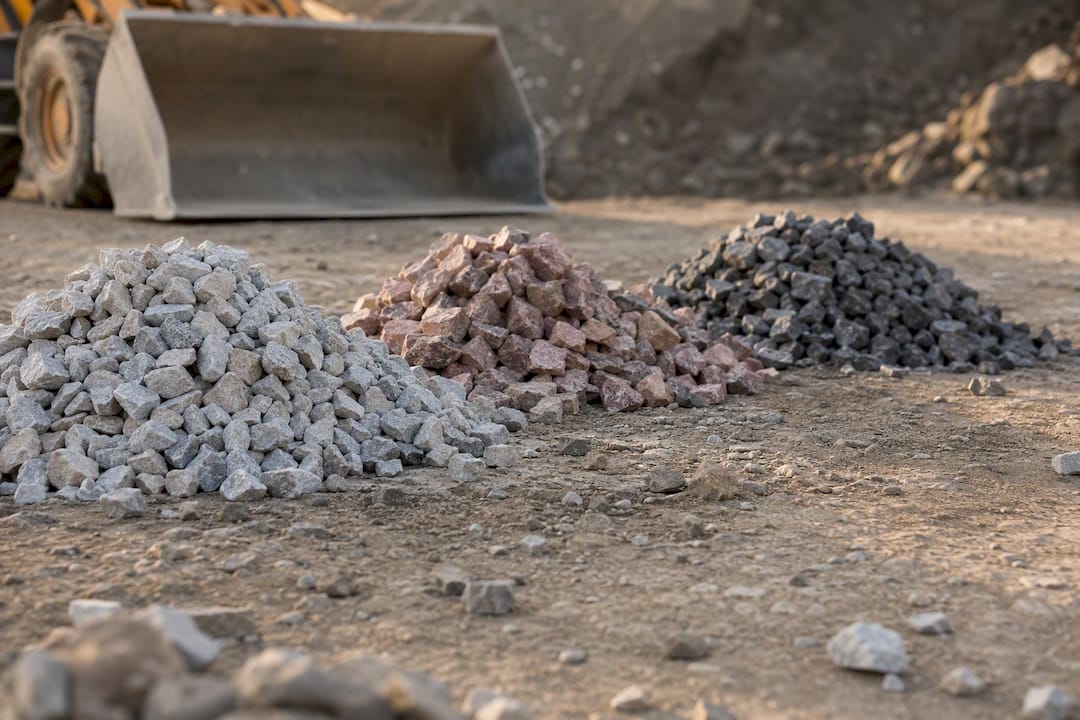
Limestone, granite, and gritstone dominate the primary Type 1 market, and each behaves slightly differently underfoot. Limestone compacts well and is widely available across much of England, though it can be softer and more prone to breakdown under sustained heavy traffic than granite or gritstone, which offer harder, more angular particles and better long-term durability.
Recycled aggregate, crushed from demolition concrete and masonry, offers a genuine cost and sustainability advantage. The catch is quality control: reputable producers cap recycled asphalt content, often below 5%, to avoid softening and rutting over time, a point PavingExpert makes clear when discussing blended sources. Ask any supplier offering recycled Type 1 for confirmation of source material and asphalt content before you order, particularly for driveways expected to last decades.
How much Type 1 sub base do you actually need?
Working out quantities comes down to one figure: bulk density. Most suppliers and PavingExpert use 2.1 tonnes per cubic metre as the standard working estimate, though moisture content and compaction can shift that slightly toward 2.0 or 2.2.
Pro Tip: Order slightly more than your calculation suggests. A 5–10% contingency covers compaction losses, uneven excavation, and the inevitable spoil left over from levelling.
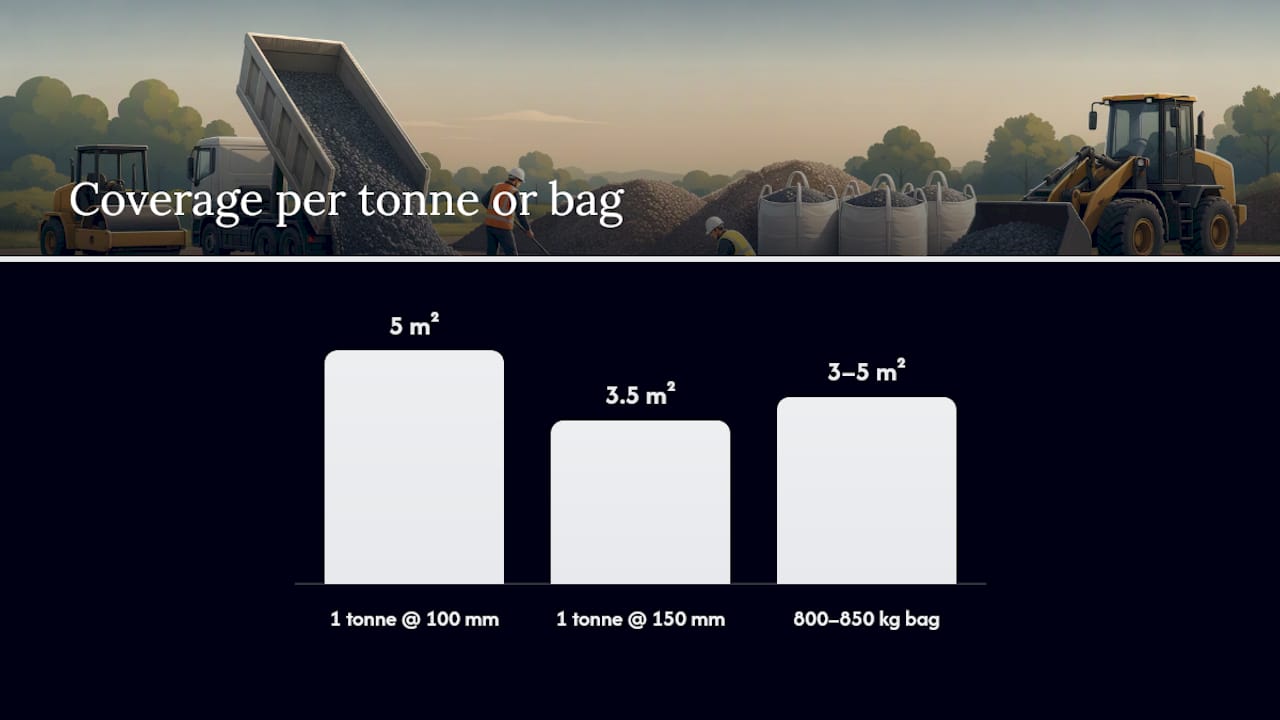
Coverage works out as follows, based on PavingExpert’s figures:
- One tonne covers roughly 5 m² at 100mm compacted depth.
- One tonne covers roughly 3.5 m² at 150mm compacted depth.
- An 800–850kg bulk bag typically covers 3–5 m², depending on depth.
Take a 40m² domestic driveway at 120mm compacted depth as a worked example. That’s roughly 4.8 tonnes of loose Type 1, or around six bulk bags once you allow for wastage and uneven ground.
What does correct installation involve?
Good material poorly laid still fails. Start by excavating to remove topsoil, organic matter, and any soft or contaminated ground, testing the exposed subgrade before you place a single barrow-load of aggregate. A subgrade that flexes visibly underfoot needs either additional depth or a geotextile layer before Type 1 goes down.
- Lay Type 1 in lifts of 75–100mm rather than dumping the full depth at once.
- Compact each layer thoroughly using a vibrating plate compactor for smaller areas or a roller for larger surfaces.
- Check levels and falls after each pass, not just at the end.
- Fit a geotextile membrane where separation from the subgrade is needed, or a woven type where reinforcement of a weak subgrade is the priority.
The choice between woven and nonwoven geotextile isn’t cosmetic. Woven geotextiles provide reinforcement and low elongation, useful over soft or variable ground, while nonwoven types suit filtration and drainage where separating soil from aggregate is the main concern.
Pro Tip: Always ask your supplier for the technical data sheet before delivery, not after. Verifying grading and source material on paper is far easier than arguing about a load that’s already on site.
Is Type 1 sub base suitable under artificial grass?
Not ideally, and this catches a lot of buyers out. Type 1 compacts to a dense, low-permeability layer by design, which is exactly what you want under a driveway but works against you under artificial turf, where surface water needs to drain away rather than pool.
For permeable surfacing or artificial grass, a free-draining sub-base is the better choice, sometimes paired with a designed soakaway or drainage channel at the perimeter. Where Type 1 has already been laid, adding a geotextile with dedicated drainage runs can mitigate the problem, though switching to a free-draining aggregate from the outset is the cleaner fix, as both PavingExpert and Armstrongs note.
How do you buy Type 1 sub base and what should you check first?
Bulk bags at 800–850kg suit driveways and smaller domestic jobs where a tipper delivery isn’t practical. Loose tonnage makes more sense for larger sites, car parks, or anywhere a grab lorry can offload directly where it’s needed.
Before placing an order, run through a short checklist with the supplier:
- Ask for the current grading certificate or technical data sheet.
- Confirm whether the material is primary quarried aggregate or contains recycled content, and at what percentage.
- Check minimum order quantities and whether part-loads carry a surcharge.
- Confirm delivery method: tipper access, grab offload, or bag drop, and whether your site can accommodate it.
Prices vary by region and source material, so treat any online figure as a starting point rather than a quote. For detailed advice on preparing the site before material arrives, our groundworks guide for Cambridge covers site setup in more depth. If you’re weighing material choice against a full resurfacing project, our driveway resurfacing guide sets out layer depths and surface options side by side.
What do contractors actually check on site?
Experienced groundworks teams don’t just order material and lay it. They confirm subgrade strength before committing to a spec, checking for soft spots that a standard depth table won’t cover. They request supplier documentation, including grading certificates and TDS, and keep it on file for building control or client sign-off.
When a site shows unusual loading, poor drainage, or unstable ground, that’s the point to call a structural or civil engineer rather than push ahead with textbook depths. Getting foundations right underneath any sub-base matters just as much as the aggregate itself, a principle covered in our foundations best practice guide.
For readers weighing up specification detail against contract compliance, it’s also worth understanding how specification sections are structured on larger projects, since Type 1 requirements often sit within a wider Section 01 document.
Get your groundworks specified and installed correctly
Getting the sub-base right is only half the job. Site clearance, subgrade preparation, drainage, and compaction all need to happen in the right order and to the right standard, which is where a contractor with direct groundworks experience earns their fee. GCS Contractors delivers groundworks and foundation work across Cambridge and East Anglia, from initial site setup through to compacted sub-base and surfacing.
If you’re planning a driveway, hardstanding, or commercial groundworks package and want the specification checked before material arrives on site, our groundworks and foundation services page sets out what’s involved and how to get a project scoped properly.
Editorial take: what the spec sheets don’t tell you
Most Type 1 guidance online repeats the same density figure and coverage table without addressing why so many driveways fail early. It’s rarely the aggregate. It’s the subgrade underneath it, skipped compaction passes, or a bulk bag ordered on guesswork rather than a proper calculation.
The conventional advice treats Type 1 as a commodity: order by weight, tip it, compact it, done. That’s backwards. The grading certificate and source material matter more than the price per tonne, because a poorly graded or asphalt-heavy recycled load will underperform no matter how well you compact it. I’d prioritise the supplier conversation over the online calculator every time: ask for the TDS, confirm the source, and only then work out tonnage.
The permeability issue under artificial grass is the clearest example of good material used wrongly. Type 1 does exactly what Clause 803 asks of it. The mistake is assuming one aggregate suits every surface above it.
— George
Sources
- Sub-base Aggregates | PavingExpert
- Holcim technical data sheet: Type 1 sub-base (TDS)
- MOT Type 1 sub-base: What it is, uses & how much you need | Armstrongs Group
- Travis Perkins MOT Type 1 Sub Base Bulk Bag product page
Recommended
- Underpinning Cost per Metre UK 2026: The Complete Buying Guide – GCS Contractors Ltd
- Reinforced Concrete Base for Garden Office Stevenage: Professional Guide 2026 – GCS Contractors Ltd
- How Ground Conditions Affect Foundation Costs in the UK: A 2026 Guide – GCS Contractors Ltd
- Trench Fill Foundation Specialists Peterborough: Expert Substructure Solutions – GCS Contractors Ltd