Site welfare facilities explained: a practical guide
Site welfare facilities are the legally required toilets, washing facilities, drinking water, changing areas and rest spaces that CDM Schedule 2 obliges every construction project to provide, whatever its size. The client must ensure suitable arrangements are made, the contractor must provide them for their own workforce, and on multi-contractor jobs the principal contractor coordinates provision across the whole site. These facilities must be ready before a single worker sets foot on site and kept running until the last person leaves.
Get this wrong and you’re not looking at a minor paperwork slip. Inadequate welfare is one of the most common triggers for an Improvement Notice from HSE, and it stops work, damages your reputation with clients, and puts your workforce at genuine risk.
Before diving into the detail, here’s what needs doing immediately if you’re mobilising a site this week:
- Confirm toilets, washing facilities, and drinking water are installed and functioning before day one.
- Check ratios against your expected peak headcount, not your opening-week numbers.
- Record welfare arrangements in the Construction Phase Plan and cover them at site induction.
- Arrange a servicing contract (cleaning, chemical toilet emptying, restocking) before you need it.
Pro Tip: Plan welfare provision around your busiest week, not your quietest. A site that swells from six to thirty workers during the groundworks phase needs facilities sized for thirty from day one, not a scramble to add cubicles once the extra trades turn up.
Key Takeaways
Site welfare facilities under CDM Schedule 2 must be functioning before any worker arrives on site and maintained without interruption until the project ends.
| Point | Details |
|---|---|
| Five core facilities required | Toilets, washing facilities, drinking water, changing/lockers, and rest/eating areas must all be provided under Schedule 2. |
| Responsibility shifts by role | Clients plan arrangements early; contractors provide for their own workforce; principal contractors coordinate on multi-contractor sites. |
| Size provision to peak headcount | Use HSE ratio guidance against your busiest week, not your opening-week numbers. |
| Hazardous work needs more | Cement, lead, or silica exposure typically requires showers or dedicated decontamination areas, not just basins. |
| Gcscontractors builds welfare into mobilisation | Site setup and groundworks teams in Cambridge and East Anglia install welfare-ready compounds as part of getting a project started. |
Table of Contents
- Understanding welfare facilities: what Schedule 2 actually requires
- Who is responsible for site welfare, and when
- Minimum standards: what counts as adequate welfare
- Placement and delivery: getting welfare to the right spot
- Extra provisions for hazardous or heavily soiling work
- Maintenance, supplies, and daily welfare management
- Enforcement and what inspectors actually look for
- A practical site manager checklist for welfare provision
- Why getting welfare right pays off beyond compliance
- How Gcscontractors helps you get welfare right from day one
- Sources
Understanding welfare facilities: what Schedule 2 actually requires
CDM Schedule 2 names five categories of provision, and each one has specific practical requirements attached rather than being left to guesswork. This is the legal backbone of every welfare conversation on a UK construction site, and Schedule 2 itself sets out exactly what’s required.
- Sanitary conveniences — toilets that are clean, ventilated, and lit, with separate provision or lockable doors for privacy.
- Washing facilities — basins with hot and cold running water, soap, and a hygienic means of drying hands, positioned adjacent to the toilets.
- Drinking water — a supply that’s readily accessible, marked if there’s any risk of confusion with non-potable water, and paired with cups where a tap or fountain isn’t practical.
- Changing and locker facilities — secure space to store clothing and personal protective equipment, particularly where workers need to change out of site clothing.
- Rest and eating areas — sheltered space with seating that has backs, and a means of heating food or boiling water.
The distinction that trips people up most often is between handwashing and general washing. A basin for handwashing after using the toilet is a baseline requirement everywhere. But where work is heavily soiling, HSE’s own operations guidance expects larger troughs or additional washing points near the work area itself, not just at the welfare block. Drinking vessels catch people out too: a water bowser with no cups attached technically fails the requirement, because workers need a practical means of actually drinking the water provided.
According to HSE, welfare facilities must be maintained in a clean, well-lit, and ventilated state throughout the job, not just on the day they’re installed.
Who is responsible for site welfare, and when
Responsibility for welfare doesn’t sit with one person. It shifts depending on project structure, and getting this matrix wrong is how facilities end up missing on day one.
| Dutyholder | Core responsibility | Timing |
|---|---|---|
| Client | Ensures suitable welfare arrangements are planned and funded before construction begins | Pre-construction phase, as part of project planning |
| Contractor | Provides and maintains welfare for their own workforce on single-contractor jobs | Before their workers arrive, throughout their period on site |
| Principal contractor | Coordinates welfare provision across all contractors on multi-contractor sites | Before mobilisation, maintained until practical completion |
HSE guidance is unambiguous on timing: everyone working on a construction site must have access to these facilities, and clients need to ensure arrangements are made early in project planning, not retrofitted once work is under way. There’s no grace period for getting welfare sorted after people arrive.
On small domestic jobs, the test applied is “so far as is reasonably practicable.” That can mean a single contractor working alone in an occupied house relies on an agreement to use household facilities, provided access is genuinely available throughout working hours. It doesn’t mean welfare is optional. It means the standard scales to the size and nature of the job, and you still need a documented arrangement, not an assumption.
Minimum standards: what counts as adequate welfare
“Adequate” isn’t a vague aspiration in CDM. HSE guidance sets out concrete expectations, and the ratio tables in leaflets like INDG293 give site managers something they can actually check against a headcount.
- Cleanliness and servicing — facilities need daily cleaning as a baseline, with more frequent attention on sites where trades produce heavy soiling.
- Lighting and ventilation — every welfare unit needs functioning artificial lighting and ventilation, not reliance on daylight or an open door.
- Hot and cold running water — a genuine requirement, not an either/or; cold-only supply doesn’t meet the standard.
- Soap and hand-drying — both must be present together; a basin with no soap or no towels/dryer fails the requirement regardless of water supply.
- Privacy and accessibility — lockable cubicle doors as standard, with separate or accessible provision considered for workers with disabilities.
The toilet-to-worker ratio guidance most site managers reach for looks roughly like this:
| Number of workers | Number of toilets | Number of washbasins |
|---|---|---|
| 1 to 5 | 1 | 1 |
| 6 to 20 | 2 | 2 |
| 21 to 40 | 3 | 3 |
| 41 to 60 | 4 | 4 |
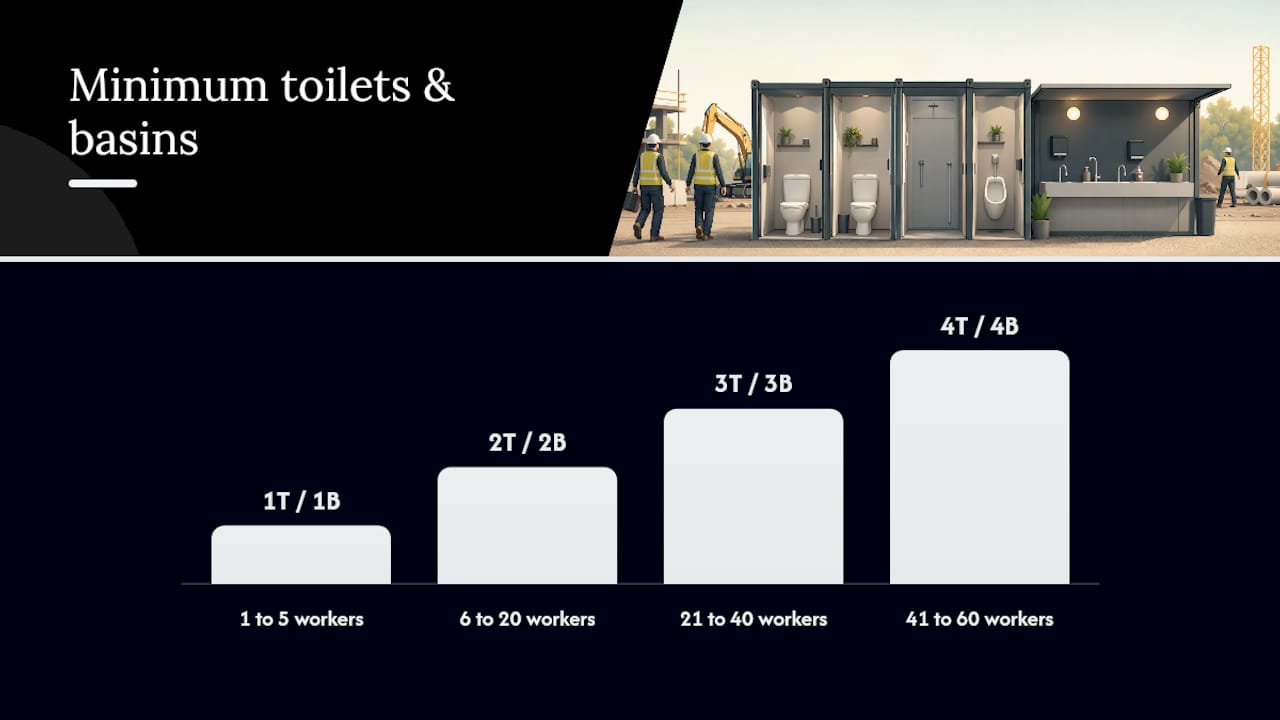
These figures come from HSE’s practical guidance in INDG293, and they’re a starting point, not a ceiling. If your peak headcount doubles for a four-week concrete pour, you scale provision to that peak, not to your average.
On the “reasonably practicable” test specifically: HSE’s own interpretive guidance confirms that washing facilities are qualified by practicability while sanitary conveniences are treated as an absolute duty. That’s why chemical toilets are widely accepted on remote or short-duration sites where mains drainage genuinely isn’t feasible, but a contractor can’t argue their way out of providing toilets at all.
Placement and delivery: getting welfare to the right spot
Where you put welfare matters almost as much as what you provide. A compound sited too far from the working face doesn’t get used properly, and that undermines the entire point of having it.
- Accessibility from the furthest work point — HSE guidance treats walking distance and time as a genuine factor; facilities that take fifteen minutes to reach in wet-weather PPE won’t get used when it matters.
- Separation from hazardous zones — welfare compounds should sit outside plant movement routes, storage areas for hazardous substances, and any zone with elevated noise or dust.
- Mobile and satellite units — larger linear sites (roadworks, groundworks spanning several hundred metres) often need satellite welfare points rather than one central block.
- Potable water bowsers and bottled supply — acceptable where mains connection isn’t yet available, provided delivery frequency keeps pace with headcount.
- Local facility agreements — usable on smaller or short-duration jobs, but only with a written agreement confirming access throughout working hours, not an informal nod from a neighbouring business.
Experienced site managers plan what amounts to a welfare lifecycle: initial provision sized for early mobilisation, satellite units added as the working footprint moves, and relocations scheduled ahead of peak workforce phases rather than reacted to after complaints start.
Pro Tip: Build welfare moves into your programme the same way you’d schedule a crane move. If your groundworks package finishes in week six and the frame package starts in week five, plan the welfare relocation for week four, not the Monday morning the steel arrives.
If your groundworks or fencing works are pushing the compound layout to change, our guide to groundworks safety on site covers how to keep welfare zones clear of plant movement and excavation risk.
Extra provisions for hazardous or heavily soiling work
Standard welfare provision assumes relatively clean trades. Once work involves substances that genuinely contaminate skin, clothing, or the working environment, the bar rises considerably.
- Showers become necessary where workers are exposed to substances that cannot be adequately removed at a basin, such as extended contact with cement, lead-bearing materials, or silica dust.
- Decontamination areas should be segregated from general welfare, preventing contaminated PPE or clothing from crossing into rest and eating spaces.
- Enhanced washing troughs replace standard basins where multiple workers need to clean up simultaneously after a heavily soiling shift.
- Secure storage for contaminated clothing stops site clothing being carried home or mixed with clean garments in shared locker space.
Where work involves hazardous substances like cement, lead, or silica, inspectors expect more than basic washing facilities. They look for larger basins or troughs, showers, or dedicated decontamination areas specifically to prevent cross-contamination between the working zone and rest areas.
The same logic applies to any project handling bulk chemicals or fuel storage on site. Guidance on chemical tank bunding is worth reviewing alongside your welfare plan if your site stores or transfers hazardous liquids, since the same segregation principle that protects welfare areas from contamination also protects your bunded storage zones from cross-contact with general site traffic.
Maintenance, supplies, and daily welfare management
Installing welfare facilities correctly is only half the job. Keeping them adequate day after day is where most compliance failures actually happen, usually because servicing gets deprioritised once the initial mobilisation push is over.
- Toilet paper, soap, and paper towels need daily stock checks, not weekly ones.
- Hot water systems should be checked at the start of each week, since a failed immersion heater on a Monday can leave a site without hot water until Friday if nobody notices.
- Chemical toilets need a servicing frequency matched to headcount, generally more often than the supplier’s default schedule on larger crews.
- Waste disposal from welfare units should be logged against the servicing contract, so gaps in collection are visible before they become a hygiene issue.
A simple cleaning log removes most of the ambiguity around who checked what and when:
| Date | Time | Cleaner/checker | Issues found | Remedial action |
|---|---|---|---|---|
| Example entry | Example entry | Example entry | Example entry | Example entry |

On larger sites, ownership of the daily check should sit with a named welfare or facilities coordinator, reporting into the site manager. On smaller jobs, the site manager typically does the check themselves as part of the morning walk. Either way, the log needs to exist somewhere a visiting inspector can see it, because an unrecorded check is functionally indistinguishable from no check at all.
Enforcement and what inspectors actually look for
HSE’s Enforcement Management Model treats missing or inadequate welfare as a compliance failure with a clear default response. According to the EMM, the typical initial enforcement outcome for welfare shortfalls is an Improvement Notice rather than immediate prosecution, though repeat or severe failings escalate quickly.
The failings that come up again and again during inspections are rarely exotic:
- Facilities not ready when the first workers arrive on site.
- Insufficient toilet or basin numbers against actual peak headcount rather than planned headcount.
- Poor or inconsistent servicing, leaving facilities visibly unclean.
- No provision made for female workers on sites where the workforce composition has changed.
- Compounds sited too far from the working face to be used practically.
The consequences scale with severity. An Improvement Notice requires a fix within a set timeframe and stays on HSE’s public record. A Prohibition Notice halts specific work immediately if the risk is judged serious enough. Beyond the direct penalty, a published notice against your company name is visible to every client tendering for their next project, which makes welfare failures a commercial risk as much as a legal one.
A practical site manager checklist for welfare provision
Before the first worker arrives, work through this order of operations rather than treating welfare as a task to slot in once groundworks are under way:
- Confirm expected peak headcount for every phase of the programme, not just the opening week.
- Calculate toilet and basin numbers against that peak figure using HSE’s ratio guidance.
- Site the welfare compound with realistic walking distances from the furthest working point.
- Arrange servicing contracts for cleaning, chemical toilet emptying, and hot water checks before mobilisation, not after a complaint.
- Confirm drinking water supply and drinking vessels are installed and accessible.
- Assess whether any planned work requires showers or decontamination facilities.
- Record all arrangements in the Construction Phase Plan and brief them at site induction.
A short quick-audit template makes ongoing checks repeatable rather than ad hoc:
- Headcount check: does current provision still match actual numbers on site today?
- Toilet and basin ratios: still adequate against current headcount?
- Water supply: hot and cold both running, drinking water accessible?
- Cleaning schedule: last service date visible and within agreed frequency?
- Disabled access: lockable doors, accessible route, any specific provision required?
- Hazardous-work controls: showers or decontamination areas needed for current work packages?
Both the mobilisation order and the audit fields belong in your Construction Phase Plan, and every point should be repeated at site induction so new starters know exactly what’s available and where.
Why getting welfare right pays off beyond compliance
Welfare gets treated as a box-ticking exercise on too many programmes, and that’s a mistake born from looking at it purely as a cost line rather than a control measure. HSE itself frames welfare as a primary control, sitting alongside PPE and safe systems of work rather than beneath them, and that framing matters because it changes how you budget and schedule it.
The commercial argument is straightforward once you’ve watched it play out on a live site. Workers who have to walk twenty minutes to a decent toilet, or who face a cold, dirty rest area at lunch, lose productive time and morale faster than almost any other single factor on a programme. Industry commentary increasingly links welfare quality directly to retention and lower fatigue-related incident rates, which tracks with what most experienced project managers have seen firsthand: a warm, clean welfare block during a wet UK winter keeps a crew on site and working rather than finding reasons to leave early. Gcscontractors builds this thinking into every site mobilisation, treating welfare-ready compounds as part of getting a project started properly rather than an afterthought bolted on once groundworks begin.
How Gcscontractors helps you get welfare right from day one
Getting welfare provision right under time pressure, alongside groundworks, drainage, and the dozen other things competing for attention during mobilisation, is exactly where sites go wrong. Gcscontractors builds welfare-ready compounds into site setup from the outset, so toilets, washing facilities, and rest areas are functioning before your first worker steps through the gate, not scrambled together in week two.

Our site setup and groundworks teams across Cambridge and East Anglia handle the practical side of mobilisation so you’re not managing servicing contracts and compound layout on top of everything else:
- Site mobilisation planning, including welfare compound siting and peak-headcount sizing.
- Groundworks and drainage installation to get welfare units connected and functioning.
- Temporary welfare unit installation coordinated with your wider site setup programme.
- Compliance-focused site setup that keeps your Construction Phase Plan documentation straightforward.
If you’re planning mobilisation for an upcoming project, our site setup and enabling works page is the place to start, and you can get in touch to discuss your specific compound layout and timeline before groundworks begin.
Sources
- The Construction (Design and Management) Regulations 2015: Schedule 2
- Enforcement management model – HSE
Use the legislation itself when you need exact statutory wording for a dispute or inspection response, and turn to HSE’s interpretive guidance when you need to know how a specific standard applies in practice on your site.
This article is general information, not a substitute for advice from a qualified lawyer. Consult a qualified legal professional about your own circumstances before acting on anything here.