Civil engineering in Cambridge: the professional guide
Civil engineering in Cambridge is defined as the design, construction, and management of infrastructure within the Cambridge region, covering projects from city centre regeneration and drainage networks to sustainable residential development. The University of Cambridge Engineering Department and the Institution of Civil Engineers (ICE) set the academic and professional standards that shape local practice. Cambridge’s position as both a research hub and a fast-growing city creates a distinctive environment where groundworks and civil engineering projects must meet rigorous technical, regulatory, and sustainability demands simultaneously.
What civil engineering education and accreditation look like in Cambridge
The University of Cambridge offers one of the most respected engineering programmes in the world. Students follow a generalist curriculum for the first two years, covering mechanics, materials, and structures across multiple disciplines before specialising in civil, structural, and environmental engineering from year three. That broad foundation is a deliberate design choice. It produces engineers who can reason across disciplines rather than defaulting to a single technical lens.
The Construction Engineering MSt programme at Cambridge extends this further. It bridges engineering and leadership, preparing graduates for the cross-disciplinary challenges that modern construction projects demand. Professionals who complete this route are equipped to manage not just technical delivery but procurement, risk, and stakeholder engagement.
Professional accreditation in Cambridge centres on three bodies:
- ICE (Institution of Civil Engineers): The primary route to Chartered Civil Engineer status, recognised across all infrastructure sectors.
- CIWEM (Chartered Institution of Water and Environmental Management): Particularly relevant for water management, drainage, and flood resilience roles.
- IHE (Institute of Highway Engineers): Valued for professionals working on roadworks and transport infrastructure.
Pro Tip: If you are a student at Cambridge, pursue ICE’s Graduate Training Framework alongside your degree. Logging structured experience from year one means you reach Chartered status faster than peers who start the process after graduation.
Cambridge’s multidisciplinary approach sets it apart from institutions that channel students into narrow specialisms early. That breadth is a genuine advantage when working on complex urban regeneration schemes where structural, environmental, and drainage considerations all intersect on the same site.
Which major infrastructure projects define Cambridge’s development?
Cambridge infrastructure projects are dominated by urban regeneration, large-scale residential development, and water management schemes. The city’s rapid population growth has driven demand for schemes exceeding 1,000 residential units, each requiring full civil engineering packages covering foundations, drainage, roadworks, and utilities. These are not straightforward greenfield builds. Most involve working within or adjacent to existing urban fabric, which raises the complexity of every stage.
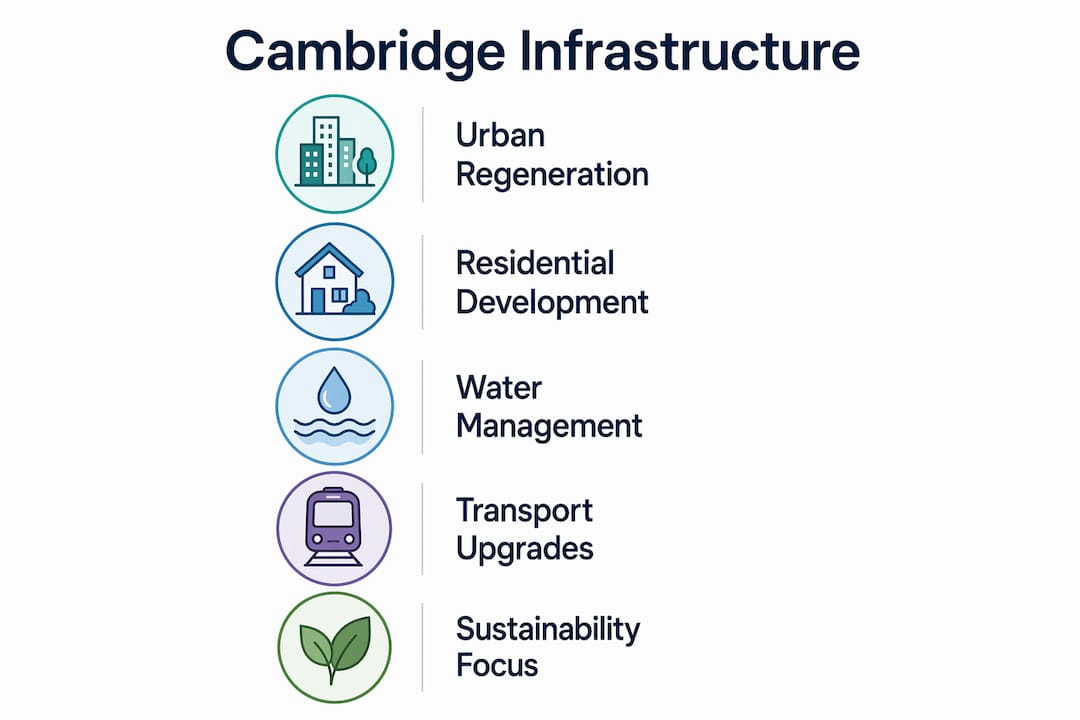
Water infrastructure is a particular focus. Cambridge sits in a low-lying region with a high water table, making surface water drainage and flood risk management central to almost every significant development. Sustainable Drainage Systems (SuDS) are now standard on new schemes, replacing traditional piped drainage with attenuation ponds, permeable paving, and swales that manage runoff at source.
Key characteristics of current Cambridge civil engineering projects include:
- Large residential schemes requiring integrated drainage, roadworks, and utilities packages
- City centre regeneration involving demolition, strip-out, and phased construction within live environments
- Water management infrastructure addressing flood risk across low-lying development zones
- Public-private collaboration between local authorities, developers, and specialist contractors
| Project type | Primary civil engineering scope | Key challenge |
|---|---|---|
| Large residential development | Foundations, drainage, roadworks | Phasing within live environments |
| City centre regeneration | Strip-out, demolition, site preparation | Minimising disruption to adjacent occupiers |
| Water management schemes | SuDS, attenuation, drainage networks | High water table and flood risk compliance |
| Transport infrastructure | Roadworks, kerbing, surfacing | Coordination with utility diversions |
Regeneration and infrastructure projects dominate local civil engineering activity. That concentration means professionals in Cambridge need strong project leadership skills, not just technical competence.
What advanced techniques are shaping Cambridge civil engineering practice?
Cambridge civil engineering practice is increasingly shaped by research emerging directly from the University’s laboratories and specialist centres. Professor Stuart Haigh’s work highlights that novel materials science techniques are central to this shift, with bio-cementation and self-sensing concrete among the most significant developments reaching practical application.

Bio-cementation uses microbial processes to bind soil particles, reducing the risk of pothole formation and improving ground stability without the carbon footprint of traditional cement-based stabilisation. Self-sensing concrete embeds sensing capability within the material itself, allowing engineers to detect structural damage without intrusive inspection. Both techniques address longstanding maintenance problems in a way that conventional materials cannot.
The University’s centrifuge laboratory supports advanced soil-structure interaction modelling. This facility allows researchers and practitioners to test foundation behaviour under realistic stress conditions before committing to a design on site. The practical benefit is a reduction in costly design revisions during construction.
Professionals looking to apply these advances should follow a structured approach:
- Engage with University research outputs. Cambridge publishes applied research through its engineering department and the Construction Engineering MSt programme. Practitioners who read this material stay ahead of specification changes.
- Pilot new materials on lower-risk elements first. Bio-cementation and self-sensing concrete are best trialled on secondary infrastructure before specifying them on critical load-bearing elements.
- Use centrifuge modelling data to inform foundation design. Where ground conditions are uncertain, commissioning specialist modelling reduces risk more cost-effectively than over-engineering the foundation.
- Document performance data from new materials. Building an evidence base on site strengthens future specifications and supports ICE Chartered status applications.
Pro Tip: Sustainability-focused material choices are increasingly weighted in planning applications and procurement scoring. Specifying bio-cementation or permeable SuDS components early in the design process strengthens both the environmental case and the commercial bid.
How do regulations and sustainability shape project delivery in Cambridge?
Sustainability as a primary design driver is now an expectation in Cambridge, not an optional extra. Local employers and planning authorities require engineers to integrate environmental performance from project conception, not as a retrofit at the end of the design process. This shift changes how projects are scoped, tendered, and delivered.
ICE standards provide the technical baseline for structural and infrastructure design. Flood risk assessments are mandatory for any development in Cambridge’s flood-sensitive zones, and these assessments directly influence site layout, finished floor levels, and drainage strategy. SuDS requirements under Schedule 3 of the Flood and Water Management Act 2010 apply to most new developments, requiring approval from the Lead Local Flood Authority before construction begins.
Regulatory compliance in Cambridge civil engineering involves several concurrent obligations:
- Flood risk assessment (FRA): Required for development in Flood Zones 2 and 3, and for sites above one hectare in Flood Zone 1.
- SuDS approval: Drainage designs must demonstrate compliance with national SuDS standards and receive sign-off from Cambridgeshire County Council as the Lead Local Flood Authority.
- Environmental Impact Assessment (EIA): Required for larger schemes, covering ecology, noise, air quality, and ground conditions.
- CDM Regulations 2015: Health and safety obligations apply from the earliest design stages, with Principal Designer and Principal Contractor roles clearly defined.
Stakeholder engagement is not a soft skill in this context. Balancing technical tasks with community engagement is a core competency that Cambridge employers actively assess at interview. Projects that fail to manage community and planning authority relationships face delays that dwarf any technical risk on the programme.
Key takeaways
Civil engineering in Cambridge requires a combination of technical depth, regulatory fluency, and sustainability expertise to deliver projects successfully in one of the UK’s most demanding built environments.
| Point | Details |
|---|---|
| Education pathway | Cambridge students specialise in civil engineering from year three, following a broad multidisciplinary foundation. |
| Accreditation value | Chartered status with ICE or CIWEM is a strong differentiator in Cambridge’s competitive job market. |
| Project landscape | Large residential schemes, regeneration, and water management dominate Cambridge civil engineering activity. |
| Advanced techniques | Bio-cementation and self-sensing concrete are moving from research into practical specification in Cambridge. |
| Regulatory compliance | SuDS approval, flood risk assessment, and CDM 2015 obligations apply concurrently on most Cambridge projects. |
George’s view on careers in Cambridge civil engineering
The Cambridge civil engineering market rewards specialists who can think like generalists. I have seen this play out repeatedly: the engineers who progress fastest are not the ones with the deepest knowledge of a single technique. They are the ones who can read a drainage constraint, a structural challenge, and a planning condition at the same time and find a solution that satisfies all three.
Civil engineering jobs in Cambridge at principal level command £60,000–£70,000 annually. That salary reflects genuine complexity. These roles require project leadership, not just technical delivery, and the gap between a competent engineer and a Chartered one is visible in every procurement scoring matrix I have reviewed.
My honest advice to professionals building a career here: pursue Chartered status with ICE or CIWEM earlier than feels necessary. The Cambridge market values it heavily, particularly for water management and flood resilience work. Pair that with genuine engagement with the University’s research outputs. The academic-industry connection in Cambridge is tighter than in most UK cities, and practitioners who tap into it gain a real specification advantage.
For students, the multidisciplinary foundation at Cambridge is an asset you should protect. Resist the temptation to narrow your focus too early. The most interesting and well-paid projects in this city sit at the intersection of structural, environmental, and drainage engineering. Breadth is not a weakness here. It is the qualification.
— George
How Gcscontractors supports civil engineering projects in Cambridge
Gcscontractors delivers groundworks, drainage, and civil engineering services across Cambridge and the wider East of England. The team works across foundations, site setup, drainage networks, and roadworks, with direct experience on live-environment projects where programme certainty and minimal disruption are non-negotiable.
For developers and contractors managing complex regeneration or residential schemes, Gcscontractors provides strip-out and site preparation services that clear and prepare sites to programme, reducing risk at the earliest project stage. The team’s compliance focus covers CDM 2015, health and safety obligations, and local building regulations throughout every phase. For a full picture of available services, the civil engineering and drainage page covers the complete scope. Contact Gcscontractors directly to discuss your project requirements.
FAQ
What is civil engineering in Cambridge?
Civil engineering in Cambridge is the design, construction, and management of infrastructure within the Cambridge region, including drainage, foundations, roadworks, and urban regeneration schemes. Projects must comply with ICE standards, SuDS requirements, and local flood risk regulations.
What civil engineering courses does Cambridge University offer?
The University of Cambridge offers an Engineering BA (Hons) and MEng, with students specialising in civil, structural, and environmental engineering from year three. The Construction Engineering MSt programme provides postgraduate training combining technical and leadership skills.
What do civil engineering jobs in Cambridge pay?
Principal civil engineer roles in Cambridge offer salaries in the range of £60,000–£70,000 annually, reflecting the complexity of regeneration, residential, and water infrastructure projects active in the region.
Why is Chartered status important for civil engineers in Cambridge?
Chartered status with ICE or CIWEM is highly valued by Cambridge employers, particularly for roles involving sustainable infrastructure, water management, and flood alleviation projects. It is a standard requirement at senior and principal level.
What regulations apply to civil engineering projects in Cambridge?
Cambridge civil engineering projects must comply with CDM Regulations 2015, flood risk assessment requirements, SuDS approval under the Flood and Water Management Act 2010, and Environmental Impact Assessment obligations for larger schemes.
Recommended
- Local Engineering Companies in Cambridge: A Guide to Choosing the Right Partner – GCS Contractors Ltd
- Groundworks Contractors in Cambridge: The Professional Guide to Civil Engineering & Infrastructure (2026) – GCS Contractors Ltd
- Civil Engineers Near Me: Expert Contracting in Cambridge & East England – GCS Contractors Ltd
- Construction Foundations in Cambridge: A Professional How-To Guide (2026) – GCS Contractors Ltd