12 Critical Questions to Ask a Demolition Contractor in the UK (2026)
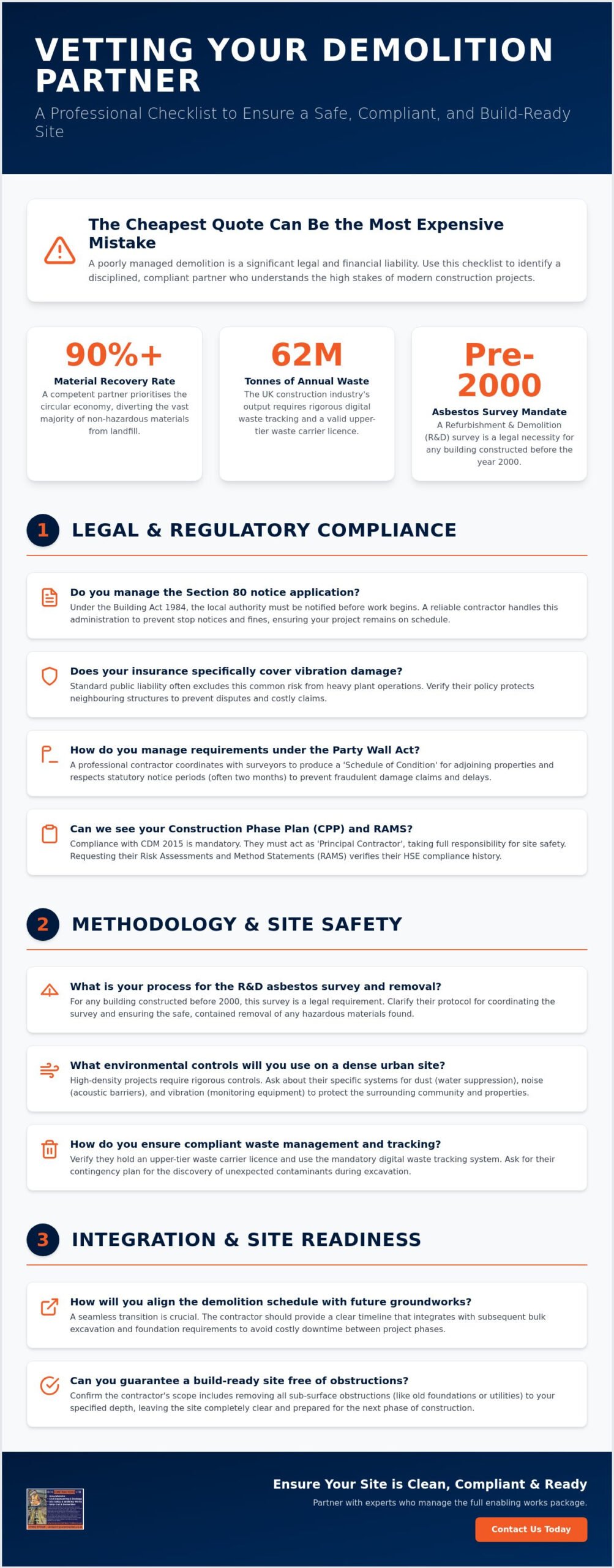
What if the cheapest demolition quote you receive is actually the most expensive mistake your project will ever make? In 2026, a poorly managed site clearance isn’t just a mess; it’s a legal liability that can halt your build before the foundations are even poured. Identifying the right questions to ask a demolition contractor is the only way to avoid accidental damage to neighbouring properties or the sudden discovery of asbestos. These risks require a disciplined, compliant partner who understands the high stakes of infrastructure and engineering.
We agree that the complexity of Section 80 notices and the shift toward mandatory digital waste tracking can feel overwhelming. This guide ensures you vet your demolition partner with confidence using a professional checklist focused on safety and seamless site preparation. Our goal is to help you find a contractor who manages the full enabling works package whilst ensuring zero legal delays.
We’ll preview the twelve critical areas you must cover, from CDM 2015 competency to landfill tax mitigation strategies. This structured approach ensures your site is left clean, compliant, and ready for the next phase of construction.
Key Takeaways
- Identify the legal requirements, including CDM 2015 and the Party Wall Act, that protect your project from avoidable delays and liability.
- Learn how to scrutinise a contractor’s methodology for R&D asbestos surveys and their environmental impact mitigation strategies.
- Use our professional checklist of questions to ask a demolition contractor to ensure they provide a comprehensive enabling works package.
- Ensure a seamless transition by aligning your demolition schedule with future bulk excavation and foundation requirements.
- Confirm your contractor can deliver a build-ready site by removing all sub-surface obstructions to your specified depth.
Questions Regarding Legal Compliance and UK Regulations
Legal compliance isn’t optional. It’s the foundation of a safe site. One of the first questions to ask a demolition contractor is whether they handle the Section 80 notice. Under the Building Act 1984, you must notify the local authority before work begins. Failure to do so can result in immediate stop notices and heavy fines. A reliable partner manages this administrative burden to ensure your project remains on schedule.
Insurance is equally critical. Verify that their policy specifically covers vibration damage to neighbouring structures. Standard public liability often excludes this, yet it’s a common risk during heavy plant operations. Understanding varied Demolition methods and techniques is essential to selecting a contractor who can mitigate these structural risks whilst maintaining project momentum.
To better understand the red flags to watch for when vetting contractors, watch this helpful video:
Understanding the Party Wall Act in Demolition
Boundary work requires precision. Ask how the contractor manages the ‘Schedule of Condition’ for adjoining properties. This document records the pre-existing state of shared walls to prevent fraudulent damage claims. They must also respect the statutory notice periods, which are often two months for structural works amongst shared boundaries. A disciplined contractor will coordinate with your Party Wall surveyor to ensure all awards are in place before demolition starts.
CDM 2015 and Health & Safety Executive (HSE) Requirements
Compliance with the Construction (Design and Management) Regulations 2015 is mandatory for all projects. You need to see a detailed Construction Phase Plan (CPP) before any machinery arrives. A competent demolition service will act as the ‘Principal Contractor’, taking full responsibility for site safety. Request examples of their site-specific Risk Assessments and Method Statements (RAMS) to verify their history of HSE compliance. A professional firm will provide these documents readily to prove their commitment to disciplined, compliant site management.
Methodology, Asbestos, and Site Safety Procedures
Effective demolition is a surgical process. When considering questions to ask a demolition contractor, you must prioritise their approach to hazardous materials. A Refurbishment and Demolition (R&D) survey is a legal requirement for any building constructed before 2000. Ask how they coordinate this survey and their protocol for safe removal. Adherence to UK demolition safety regulations ensures that asbestos fibres are contained and managed without risking site workers or the public.
Urban projects in high-density residential areas require rigorous environmental controls. We utilise water suppression systems to manage dust and acoustic barriers to mitigate noise pollution. Vibration monitoring is equally vital to protect neighbouring structures. You should inquire about the specific machinery intended for your site. High-reach excavators offer precision, whilst remote-controlled demolition robots are ideal for confined internal spaces where traditional plant is too heavy or loud.
Managing Hazardous Materials and Waste
The UK construction industry generates approximately 62 million tonnes of waste annually. In 2026, compliance means using the mandatory digital waste tracking system to provide real-time data to regulators. Verify that your contractor holds a valid upper-tier waste carrier licence. You need a partner who prioritises the circular economy; look for a recovery rate of over 90% for non-hazardous materials. Ask for a contingency plan regarding the discovery of unexpected contaminants during bulk excavation to avoid costly project halts.
Structural Integrity and Propping
Precision is paramount during a strip out project. We focus on temporary works and propping to maintain structural integrity whilst removing internal non-structural elements. This protects the building’s skeleton for future use. Ensure your contractor has a clear plan to protect existing drainage systems and utility ducting. Heavy plant operations can easily crush sub-surface infrastructure if not properly shielded. If you require a partner who manages these technical details with precision, our team can provide a comprehensive site clearance plan tailored to your project.
Integration with Groundworks and Project Timelines
Demolition is the start of the build, not just a process of destruction. One of the essential questions to ask a demolition contractor is how their schedule aligns with the bulk excavation phase. If these two stages aren’t synchronised, you risk idle machinery and mounting costs. A build-ready site means more than just a clear surface. It requires all existing foundations and footings to be removed to your specified depth. This ensures no sub-surface obstructions hinder your new foundations.
Clear communication between the site manager and the client is the only way to manage enabling works effectively. We maintain a disciplined reporting structure to ensure the transition from site clearance to driveway preparation or hard landscaping is seamless. This prevents the “dead time” where sites sit dormant and vulnerable to weather or security risks. A professional partner views the site as a live construction project from day one.
Transitioning to Sub-Structure Works
Efficiency increases when you reduce the number of subcontractors. Ask if your provider can offer a comprehensive enabling works package. Combining demolition with piling and reinforced concrete works eliminates the friction often found between different trades. This approach ensures the ground is stabilised and ready for drainage installation immediately after the structures are gone. It’s about maintaining momentum from the first hammer blow to the final slab pour.
Final Site Handover and Documentation
Documentation is as important as the physical work. Upon completion, you must receive a full Health and Safety File. This file should contain:
- Waste transfer notes and digital tracking logs.
- Asbestos clearance certificates.
- Certified records of all utility disconnections.
- A final site survey confirming foundation removal depths.
Confirming these deliverables before hiring prevents legal delays during the next construction phase. A reliable contractor ensures every utility is safely terminated and recorded so your groundworks team can begin without risk.
Secure a Build-Ready Site for Your Next Project
Professional demolition is the first critical phase of a high-standard build. It requires more than just machinery; it demands full compliance with CDM 2015 and the Party Wall Act to protect your investment and neighbouring structures. By using this checklist of questions to ask a demolition contractor, you ensure that hazardous materials like asbestos are managed correctly and that your site transitions seamlessly into the bulk excavation phase. This disciplined approach prevents legal delays and keeps your project on a strict operational timeline.
We are specialist sub-structure and site preparation experts serving Cambridge, Essex, and London. Our team provides fully compliant enabling works that meet the most rigorous safety standards. We handle the technical complexities of site clearance and groundworks so you can focus on the construction ahead. Request a Professional Demolition and Groundworks Quote to begin your project with a reliable, certified partner who gets the job done correctly.
Start your build on solid ground with a team that understands the high stakes of modern infrastructure and engineering.
Frequently Asked Questions
Do I need a Party Wall Agreement if I am only demolishing a detached structure?
You may still need a Party Wall Agreement even for a detached structure if your work falls within the statutory distances defined by the 1996 Act. If you excavate for new foundations within 3 or 6 metres of a neighbour’s building and go deeper than their footings, you must serve notice. It’s one of the vital questions to ask a demolition contractor during your initial site walkover to ensure legal compliance from day one.
What is the difference between a soft strip and a full structural demolition?
A soft strip focuses on removing non-structural components to prepare a building for refurbishment or final demolition. This process includes taking out internal partitions, suspended ceilings, floor finishes, and MEP services. Full structural demolition is the complete mechanical removal of the building’s primary frame, masonry, and foundations to leave a clear, build-ready site for the next phase of construction; including the removal of all sub-surface obstructions.
How long does a typical residential demolition project take in the UK?
A typical residential demolition in the UK usually takes between 5 and 10 working days to complete. Complex sites with significant asbestos or restricted access in urban centres like London or Cambridge may require additional time for site setup and waste removal. This estimate covers the full sequence from the initial soft strip and structural down-taking to the final site clearance and foundation removal to your specified depth.
What happens if a demolition contractor discovers asbestos that wasn’t in the initial survey?
Work stops immediately in the affected area if suspected asbestos is discovered during the project. The contractor must secure the zone to prevent fibre release and consult the original R&D survey records. An HSE-licensed specialist is then brought in to test the material and organise its safe disposal under the Control of Asbestos Regulations 2012; ensuring the site remains safe for all workers and neighbours before work resumes.