Preventing Cracks in Your New Concrete Driveway: A Professional Guide for 2026
A crack-free driveway is won or lost in the groundworks, not the concrete mixer. Whilst the surface finish gets the most attention, the structural integrity of your installation depends entirely on meeting specific driveway sub-base requirements UK standards. Many homeowners invest thousands in premium concrete only to see it fail within months because the foundation wasn’t prepared to withstand the British weather or heavy vehicle loads. It’s a costly mistake that’s easily avoided with the right technical approach.
We understand the anxiety of watching a significant investment crumble due to technical oversights or poor site preparation. You deserve a surface that remains smooth and structurally sound for decades, providing both aesthetic value and peace of mind. This professional guide provides the technical knowledge you need to vet contractors and ensure your project meets the highest engineering standards. We’ll examine the critical role of sub-base depth, the official MOT Type 1 specifications defined in the SHW, and the drainage regulations required to keep your property compliant and your concrete stable through 2026 and beyond.
Key Takeaways
- Learn why professional site preparation and adhering to driveway sub-base requirements UK standards are the only way to prevent structural shifts.
- Understand why adding water to a concrete mix for workability leads to shrinkage cracks and how to manage the pour correctly.
- Discover how professional reinforced concrete works ensure your driveway slab can withstand tension and heavy vehicle weight without crumbling.
- Master the 28-day curing rule and modern hydration methods to ensure your new surface reaches its full structural design strength.
The Foundation: Why Groundworks and Sub-Base Preparation Are Critical
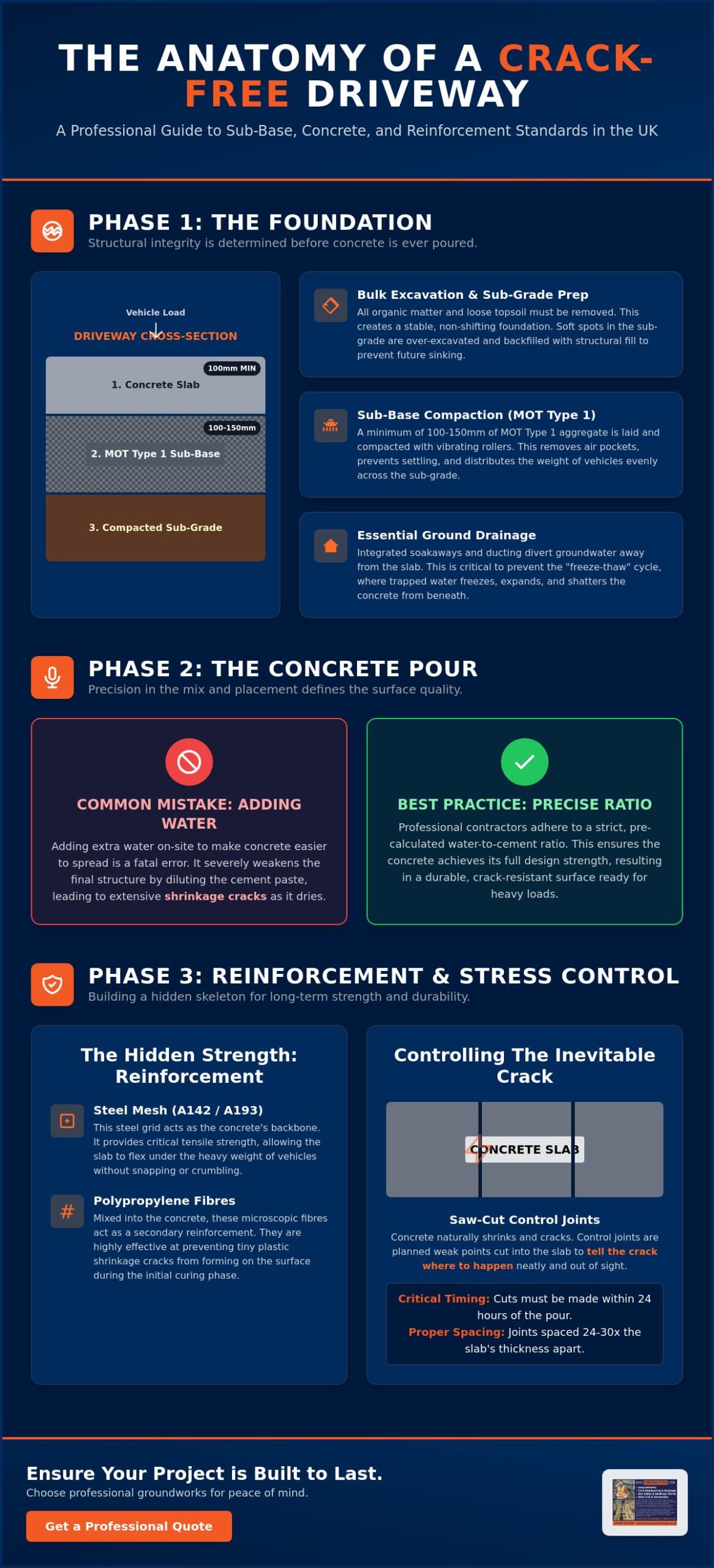
A durable driveway isn’t defined by the final pour; it’s defined by the quality of the void it fills. Most structural failures occur because the initial bulk excavation was shallow or poorly executed. Professional site preparation ensures that organic matter and loose topsoil are completely removed. This creates a stable environment for a ground-bearing concrete slab. Without this, the sub-grade remains susceptible to movement. This leads to “hollow” spots that cause concrete to snap under the weight of a standard family car.
To better understand this concept, watch this helpful video:
The primary role of the sub-base is weight distribution. It spreads the vertical load of vehicles across a wider area, preventing localised sinking and edge crumbling. Before any stone is laid, we identify and treat soft spots in the sub-grade. This often involves over-excavating these areas and backfilling with compacted structural fill. Ignoring these weak points is the fastest way to ensure your new surface cracks within its first winter.
Soil Compaction and the MOT Type 1 Standard
Achieving the correct driveway sub-base requirements UK standards requires heavy-duty mechanical compaction. We use vibrating rollers or plate compactors to remove air pockets that would otherwise lead to settling. For domestic projects, GCS Contractors Ltd recommends a minimum of 100-150mm of compacted MOT Type 1. In regions like East England or the Midlands, where clay-heavy soils are common, we adjust our depths to mitigate the risks of soil heave and seasonal expansion.
Managing Ground Drainage to Protect the Slab
Drainage isn’t a finishing touch; it’s a foundational necessity. Poorly managed groundwater leads to the freeze-thaw cycle. This occurs when water trapped beneath the slab expands as it turns to ice, shattering the concrete from below whilst it’s vulnerable. We integrate drainage systems during the groundworks phase. By installing soakaways and service ducting early, we ensure water is diverted away from the driveway edges. This proactive approach protects the structural integrity of the installation from day one.
The Pour: Managing Concrete Mix and Stress Points
Concrete strength is determined by chemistry, not just volume. A common but fatal error on-site is adding extra water to the mix to improve workability. Whilst it makes the pour easier to spread, it dilutes the cement paste and leads to massive shrinkage cracks as the moisture evaporates. Professional reinforced concrete works rely on a precise water-to-cement ratio to ensure the final slab meets its intended kilonewton rating.
For standard domestic vehicles, a 100mm slab thickness is the non-negotiable industry baseline. This depth works in tandem with the driveway sub-base requirements UK standards to ensure the surface doesn’t buckle under load. If the slab is too thin, even the best foundation can’t prevent structural failure. Choosing a partner experienced in professional groundworks ensures these technical specifications are met before the first mixer arrives on-site.
Control Joints and Expansion Gaps
Concrete will crack; the goal is to control where those cracks occur. We use saw-cut control joints to create “weak” lines that tell the concrete where to break. The 24-hour rule is vital here. Cuts must be made within a day of the pour to be effective without causing surface spalling. We strategically space these joints no more than 24 to 30 times the slab thickness apart to keep the surface looking seamless and professional.
Reinforcement: Mesh vs. Synthetic Fibres
Steel reinforcement is the backbone of a durable driveway. In residential settings, we typically use A142 or A193 steel mesh to provide maximum structural integrity under tension. This is often supplemented with polypropylene fibres. These fibres help reduce plastic shrinkage cracks during the initial set, acting as a secondary insurance policy for the surface finish. Following UK Government guidance on surface types is also essential to ensure your project remains compliant with local drainage and flooding regulations.
Curing and Maintenance: Protecting the Surface in 2026
The final stage of a successful installation is often the most neglected. Concrete doesn’t dry; it cures through a chemical reaction called hydration. The 28-day rule is a non-negotiable standard in the industry. Whilst the surface may look hard within hours, the slab only reaches its full design strength after a month of controlled moisture retention. Rushing to use the driveway before this process is complete can lead to structural failure, regardless of how well you followed the driveway sub-base requirements UK guidelines earlier in the project.
In 2026, professional contractors favour liquid curing membranes over traditional plastic sheeting. These membranes are sprayed onto the fresh surface to seal in moisture, ensuring a uniform set. If you are managing the project yourself, refer to this Driveway Installation Guide for specific hydration benchmarks. Seasonal precautions are also vital. Fresh concrete must be shielded from drying spring winds, which cause surface tension, and winter frosts, which can expand internal moisture and lead to scaling.
Heavy vehicle loads are the primary threat during the first week. You must wait at least 7 days before parking a standard car on a new pour. Even then, avoid turning the wheels whilst stationary, as this can scuff the tender surface. For heavier vans or SUVs, extending this wait to 14 days is a safer professional practice.
Post-Pour Maintenance Checklist
- Daily hydration: During a UK summer, lightly hose the slab twice daily for the first seven days to prevent rapid moisture loss.
- Sealing the surface: Wait approximately 60 to 90 days before applying a high-quality breathable sealer. This prevents oil penetration and protects against salt damage during winter months.
When to Call the Professionals
You need to distinguish between cosmetic and structural issues. Hairline crazing often looks like a spider web and is typically a result of surface drying too quickly; it rarely affects integrity. However, if you notice significant sinking or cracks wider than a pound coin, it suggests a sub-grade failure. This usually indicates that the initial groundworks were insufficient or that soft spots weren’t treated. Professional intervention is required to assess whether the foundation can be stabilised or if the section requires replacement.
Securing Your Investment for the Long Term
A successful driveway installation is an engineering project that demands precision at every stage. From the initial bulk excavation to the final 28-day curing phase, cutting corners leads to structural failure. You now understand that meeting driveway sub-base requirements UK standards is the only way to prevent sinking and cracking. By prioritising reinforced concrete works and managing stress points through control joints, you ensure a surface that withstands both heavy vehicle loads and the British weather.
GCS Contractors Ltd are specialists in reinforced concrete and site preparation. We operate across Cambridge, Essex, and London, delivering expertise in both residential driveways and large-scale commercial infrastructure. Whether you’re planning a new build or replacing a failing surface, our team ensures the groundworks are compliant and built to last.
Get a professional groundworks quote for your new driveway from GCS Contractors Ltd and build your property on a foundation of reliability. Your new driveway is a significant investment; make sure it’s done correctly the first time.
Frequently Asked Questions
Is it normal for a brand-new concrete driveway to have small cracks?
Hairline cracks on the surface are common and usually cosmetic, often resulting from rapid surface drying. However, significant structural cracks are not normal and typically indicate a failure in the groundworks or a poor water-to-cement ratio. Professional installers use strategically placed control joints to ensure that any necessary cracking occurs in a controlled, invisible manner beneath the surface line.
How long should I wait before driving my car on a new concrete driveway?
You should wait at least seven days before driving a standard passenger vehicle onto a new concrete pour. Whilst the surface feels hard to the touch within 24 hours, the slab requires 28 days to reach its full engineering design strength. For heavier SUVs or delivery vans, we recommend extending this waiting period to 14 or 21 days to prevent internal structural damage.
Do I really need steel mesh reinforcement for a domestic driveway?
Steel mesh is essential for providing tensile strength to the concrete slab. Concrete is naturally strong under compression but weak under tension; the mesh acts as a backbone that prevents the slab from pulling apart under the weight of moving vehicles. We typically utilise A142 or A193 steel mesh to ensure the driveway remains structurally sound for decades rather than years.
Can I pour a new concrete driveway over my old tarmac one?
We do not recommend pouring concrete directly over an existing tarmac surface. Tarmac is a flexible material that moves differently to rigid concrete, which inevitably leads to reflective cracking in the new slab. To properly meet driveway sub-base requirements UK standards, the old tarmac should be excavated to allow for a fresh, mechanically compacted MOT Type 1 foundation.
What is the best time of year to pour a concrete driveway in the UK?
Late spring and early autumn provide the most stable conditions for pouring concrete in the UK. Extreme summer heat causes the mix to dry too rapidly, leading to shrinkage cracks, whilst winter frosts can disrupt the chemical curing process entirely. If a pour must happen during a hot spell, consistent daily hydration is required to manage the temperature of the slab.
How deep should the foundations be for a heavy-duty concrete driveway?
Heavy-duty foundations require a minimum of 150mm of compacted MOT Type 1 sub-base topped with a 150mm reinforced concrete slab. This combined depth is necessary to support the increased weight of larger vehicles or frequent commercial traffic. Ensuring these driveway sub-base requirements UK specifications are met during the excavation phase prevents localised sinking and long-term structural collapse under heavy loads.