Pre-demolition survey guide for project managers
A pre-demolition survey is a mandatory, systematic evaluation of a building’s structural condition, hazardous materials, and site risks before any dismantling work begins. Known formally as a pre-demolition engineering survey under OSHA 29 CFR 1926.850(a)(1) and referenced within the UK’s Construction (Design and Management) Regulations 2015 (CDM 2015), this assessment is not optional. It is the legal and operational foundation upon which every demolition project must be built. Without it, project managers expose workers, neighbouring properties, and their organisations to serious legal and safety consequences.
What does a compliant pre-demolition survey cover?
A compliant survey covers five core areas: structural integrity, hazardous materials, adjacent structures, utility status, and demolition method determination. Each area carries distinct compliance obligations and informs decisions that cannot be made safely without documented evidence.
Structural integrity covers load-bearing walls, floors, columns, and temporary supports. Surveyors must identify weakened or previously altered structural elements that could cause premature collapse during demolition operations.

Hazardous materials identification is often the most time-intensive component. Asbestos-containing materials (ACMs), lead paint, polychlorinated biphenyls (PCBs), and other regulated substances must be located, quantified, and documented before any physical work starts. Critically, composite sampling is prohibited. Each layer of a multi-layer building system must be individually sampled and analysed. If any single layer tests positive for asbestos, the entire system must be treated as ACM and removed accordingly.
Utility status requires confirmation that gas, electricity, water, and telecommunications services have been isolated or are scheduled for disconnection. Assumptions about utility status are not acceptable.
Adjacent structure assessment documents the condition of neighbouring buildings, boundary walls, and infrastructure that could be affected by vibration, ground movement, or falling debris.
Demolition method determination must follow from the survey findings, not precede them. The survey data drives the choice between mechanical demolition, deconstruction, or controlled implosion.
| Survey component | Key requirement |
|---|---|
| Structural integrity | Document load-bearing elements and any prior alterations |
| Hazardous materials | Individual layer sampling; treat ACM-positive systems as whole |
| Utility status | Confirmed isolation or scheduled disconnection before work starts |
| Adjacent structures | Condition record of all neighbouring properties and infrastructure |
| Demolition method | Selected after survey completion, not before |
The survey is also a living document. As hidden voids are opened or unexpected materials are discovered during strip-out, the report must be updated to reflect new conditions. Treating the survey as a one-time submission rather than an evolving record is one of the most common compliance failures on active sites.
Pro Tip: Assign a named competent person to own the survey document throughout the project lifecycle. That individual should have the authority to halt work if site conditions diverge from the survey findings.
How to conduct a thorough pre-demolition survey
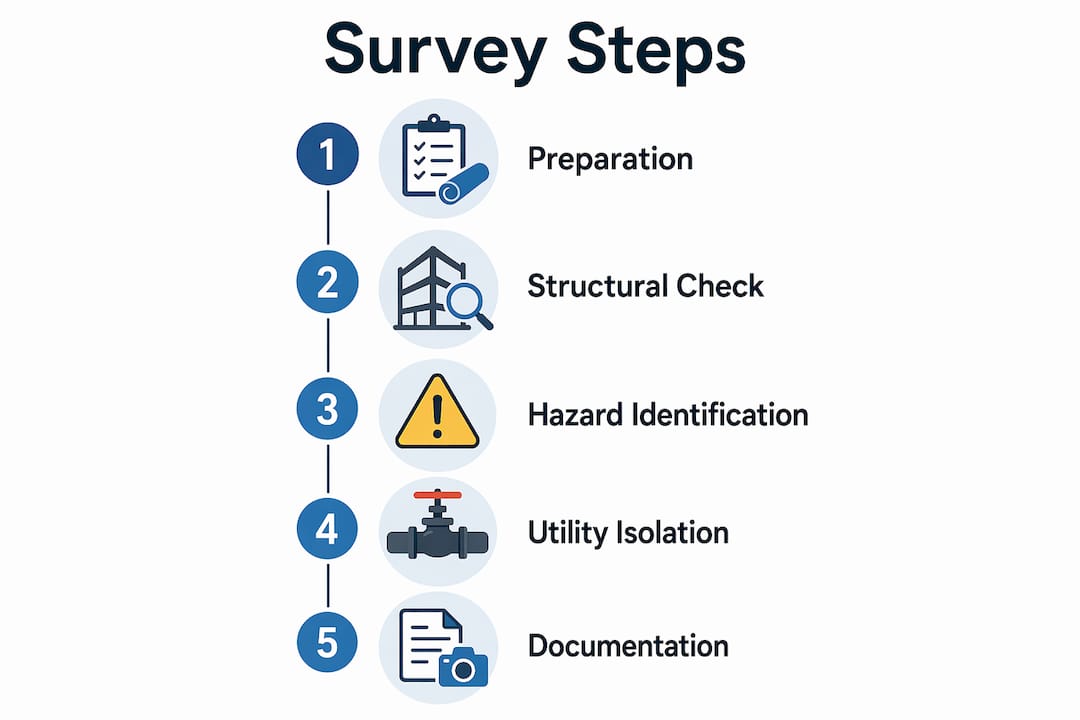
Executing a defensible survey requires a structured sequence of activities, not a single site visit. The following steps reflect current best practice for construction professionals and project managers.
-
Desk-based research. Gather existing building records, planning drawings, previous survey reports, and any known hazard registers. Historic buildings in particular may contain materials no longer in common use, such as asbestos insulating board in ceiling voids or lead-based paint on structural steelwork.
-
Preliminary site walkthrough. Conduct an initial visual assessment to identify access constraints, obvious structural concerns, and areas requiring closer investigation. Note locations where surfaces cannot be inspected without destructive sampling.
-
Material inventory and photographic documentation. Record every material type, location, and approximate quantity. Photo records and digital logging are baseline expectations for defensible survey reports. Use a digital inventory system to capture images alongside material descriptions, grid references, and condition notes. Tools such as site diary platforms, including those offered by LifeSafety.ai, allow surveyors to log findings in real time and share updates with the wider project team.
-
Sampling and laboratory analysis. Where hazardous materials are suspected, collect samples for laboratory testing. Before any destructive sampling, assess what lies behind surfaces to avoid inadvertently disturbing ACMs. Multiple site visits are necessary to cover areas that were inaccessible during earlier inspections.
-
Utility verification. Contact all relevant utility providers and obtain written confirmation of service status. Do not rely on verbal assurances or outdated drawings.
-
Stakeholder collaboration. Share draft findings with the client, demolition contractor, structural engineer, and environmental consultant before finalising the report. Each party may identify gaps or flag concerns based on their specialist knowledge.
-
Report finalisation and distribution. Produce a written report that includes all findings, photographic evidence, laboratory results, and recommended abatement sequences. Distribute to all relevant duty holders before demolition commences.
Pro Tip: Use a digital inventory platform to log materials with GPS coordinates and timestamps. This creates an audit trail that satisfies regulatory scrutiny and supports accurate bid specifications for specialist subcontractors.
How surveys integrate environmental, health, and safety controls
The survey is the diagnostic input. The demolition plan is the prescription. Both documents are legally required and serve distinct purposes. Conflating them is a compliance error that regularly causes audit failures and, more seriously, worker injuries.
Hazardous material abatement must be sequenced correctly. Asbestos removal, for example, must be completed by a licensed contractor before mechanical demolition begins. The survey report defines the abatement scope, which then feeds directly into the demolition programme and procurement schedule.
Utility isolation follows a strict protocol. Power sources must be shut off and locked out prior to any demolition activity. Lockout/tagout (LOTO) procedures require physical verification by a competent person, not assumption based on supplier confirmation alone.
“Identifying environmental hazards during the pre-demolition survey reduces costly mid-project changes and supports accurate bid specifications.” — US EPA guidance on large-scale demolition
Protecting adjacent properties requires the survey to document baseline conditions with photographic evidence. If a neighbouring building sustains damage during demolition, that baseline record is the primary defence against liability claims. Environmental controls, including dust suppression, noise monitoring, and groundwater protection, are also scoped directly from survey findings.
The competent person’s authority is non-negotiable. That individual must have sufficient knowledge, independence, and authority to halt work if conditions on site diverge from what the survey recorded. This is not a procedural formality. It is the mechanism by which survey findings translate into real-time safety decisions.
Common mistakes in pre-demolition surveys and how to avoid them
Several recurring errors undermine survey quality and create compliance exposure. Recognising them before they occur is far more cost-effective than addressing them mid-project.
-
Choosing the demolition method before completing the survey. Method must follow from survey findings. Selecting a method first and then commissioning a survey to validate it produces a document that is neither objective nor defensible.
-
Treating the survey as a one-time submission. The survey must be updated whenever new hazards are discovered or site conditions change. Failing to maintain it as a living record leaves the project team operating on outdated information.
-
Underestimating sampling requirements. Inadequate sampling leads to emergency abatement during demolition, which is significantly more expensive and disruptive than planned removal. Inspectors must assess materials behind surfaces before committing to destructive sampling to avoid accidental disturbance of ACMs.
-
Confusing the survey with the demolition plan. The survey identifies hazards; the demolition plan prescribes controls. Submitting a single document that attempts to serve both purposes will not satisfy regulatory requirements under CDM 2015 or OSHA standards.
-
Failing to produce a written report. Failing to produce a written engineering survey before demolition is the most common OSHA violation of demolition standards. Verbal briefings and informal notes do not constitute compliance.
Pro Tip: Schedule a formal survey review meeting with all duty holders before the demolition programme is locked. This single step catches the majority of documentation gaps before they become regulatory violations.
Key takeaways
A pre-demolition survey is the legally required, written assessment that identifies structural, hazardous, utility, and environmental risks before demolition begins, and it must be treated as a living document throughout the project.
| Point | Details |
|---|---|
| Survey is legally mandatory | Failure to produce a written survey is the most cited OSHA demolition violation. |
| Five core components | Structural, hazardous materials, utilities, adjacent structures, and method determination must all be covered. |
| Living document requirement | Update the survey whenever hidden hazards or changed conditions are discovered during the project. |
| Method follows survey | Never select a demolition method before completing the survey; doing so undermines safety and compliance. |
| Documentation standards | Photo records, digital logging, and individual layer sampling are baseline requirements for a defensible report. |
Why I think most teams underestimate the survey stage
Having worked across strip-out and demolition projects in live environments, the pattern I see most often is this: the survey gets treated as a box-ticking exercise rather than the operational backbone of the project. Teams rush it to meet programme deadlines, and then spend far more time and money dealing with the consequences.
The detail that makes the difference is the material inventory. A thorough, photographically documented inventory does three things simultaneously. It satisfies the regulator, it gives the demolition contractor an accurate scope, and it protects the client from change-order disputes. When that inventory is incomplete, every one of those three benefits disappears.
The living document principle is equally undervalued. On a recent project involving a 1970s commercial building, a void inspection during strip-out revealed asbestos pipe lagging that had not been identified in the original survey. Because the survey had been set up as an updatable record from the outset, the team was able to commission targeted remediation without halting the entire programme. That responsiveness saved weeks of delay. If the survey had been filed and forgotten after the initial submission, the outcome would have been very different.
My advice to any project manager reading this: invest the time upfront. A survey that costs more in hours but produces a complete, defensible, and regularly updated record will always be cheaper than the alternative.
— George
How Gcscontractors supports pre-demolition survey compliance

Gcscontractors brings direct experience in strip-out, demolition, groundworks, and civil engineering to every project, including the survey and planning stages that precede physical work. The team at Gcscontractors understands the regulatory requirements under CDM 2015 and works alongside project managers to produce thorough, compliant pre-demolition assessments. From hazardous material identification to utility verification and structural evaluation, Gcscontractors supports the full scope of pre-demolition planning. The team is experienced in working within live environments, which means surveys are conducted with minimal disruption to ongoing operations. If your project requires expert support at the survey stage or through to full demolition, contact Gcscontractors to discuss your requirements.
FAQ
What is a pre-demolition survey?
A pre-demolition survey is a written engineering assessment of a building’s structural condition, hazardous materials, utility status, and adjacent risks, conducted before demolition begins. It is a legal requirement under OSHA 29 CFR 1926.850(a)(1) and the UK’s CDM 2015 regulations.
What must a pre-demolition survey include?
A compliant survey must cover structural integrity, hazardous material identification (including asbestos and lead), utility status, adjacent structure conditions, and the basis for demolition method selection. Each area must be documented in a written report with photographic evidence.
How often should a pre-demolition survey be updated?
The survey must be updated whenever new hazards are discovered or site conditions change during the project. Treating it as a living document is a regulatory expectation, not optional best practice.
What is the difference between a survey and a demolition plan?
The survey identifies hazards and site conditions. The demolition plan prescribes the controls and methods to address those hazards. Both are legally required and cannot be substituted for one another.
Who is responsible for conducting the survey?
A competent person with sufficient knowledge, training, and authority must conduct or oversee the survey. That individual must also have the authority to halt work if site conditions diverge from the survey findings during demolition.