Underpinning Cost per Metre UK 2026: The Complete Buying Guide
Is a single structural crack a minor repair or the start of a five-figure investment? For many property owners, the discovery of subsidence triggers immediate concerns about hidden structural costs and complex engineering requirements. You likely want a clear answer on the underpinning cost per metre UK 2026 to avoid financial surprises whilst ensuring your building remains safe and compliant. It’s a common worry, particularly when dealing with the challenging clay soils of East England or historic foundations that require modern intervention. We understand that structural integrity is not a place for guesswork or cutting corners.
This guide provides the clarity you need to move forward with your groundworks project with absolute confidence. You will discover the latest 2026 pricing benchmarks and the technical differences between methods like traditional mass concrete, beam and base, and piling. We explain how your specific soil type dictates the engineering approach and provide a straightforward path to hiring a specialist contractor. From site preparation and bulk excavation to final reinforced concrete works, you’ll gain the technical knowledge required to secure your structure effectively and permanently. We focus on site safety, structural stability, and specialist standards to help you protect your most valuable asset.
Key Takeaways
- Identify how stabilised material prices for reinforced concrete influence the 2026 outlook whilst specialist labour remains a primary cost driver.
- Recognise the impact of regional soil conditions, particularly how heavy clay amongst Cambridgeshire and Essex developments necessitates deeper piling solutions.
- Evaluate the technical variables affecting the underpinning cost per metre UK 2026, including the increased labour hours required for restricted urban sites.
- Follow a structured project path by prioritising structural engineer reports and borehole soil analysis before commencing any physical groundworks.
- Compare traditional mass concrete methods with advanced mini-piling to determine the most reliable solution for your specific structural load requirements.
Understanding Underpinning Costs: Methods and 2026 Price Drivers
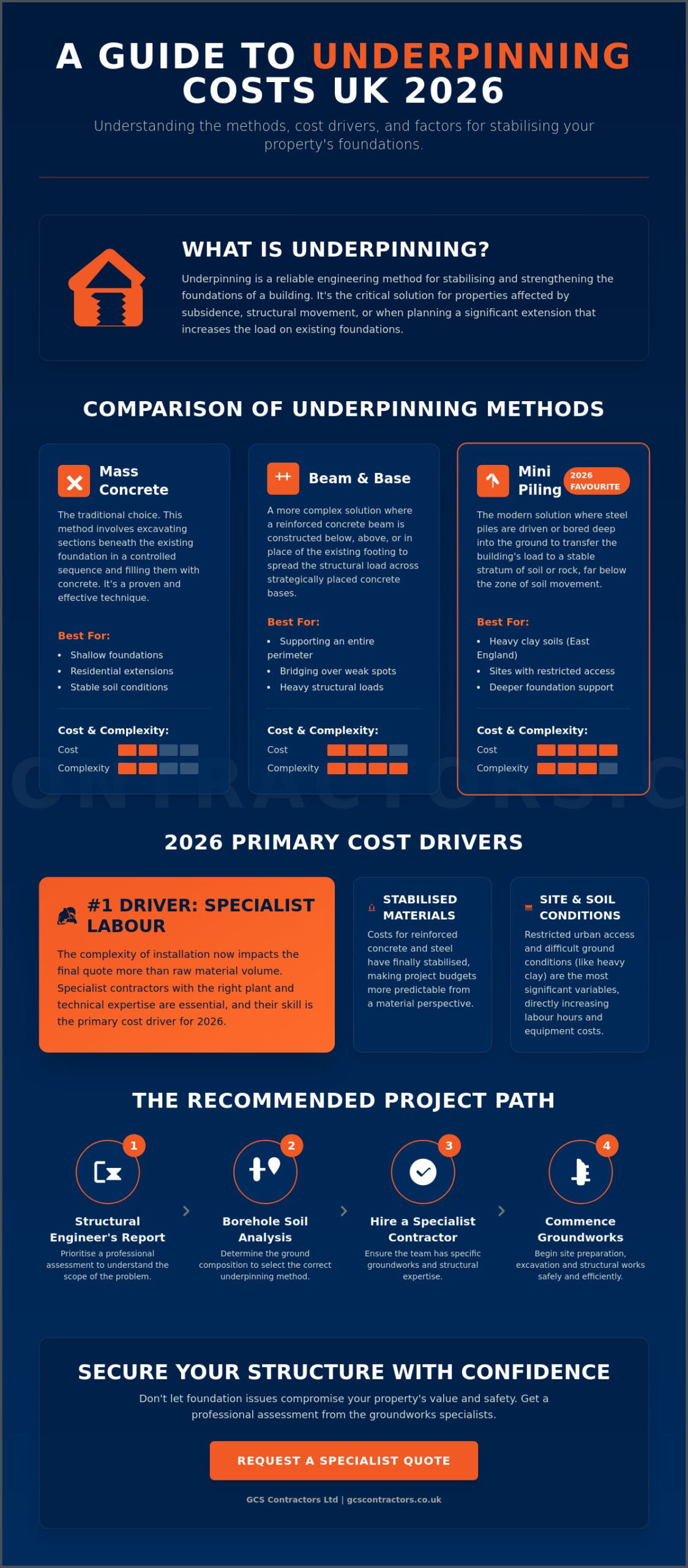
Underpinning remains the most reliable engineering method for stabilising foundations affected by subsidence or increased structural loads. Understanding what is underpinning? is the first step for any property owner facing structural movement or planning a significant extension. In 2026, the underpinning cost per metre UK 2026 serves as a vital benchmark for budgeting, though it requires adjustment for site-specific depth and the total number of “pins” required. Safety remains the priority. Mass concrete, beam and base, and piling are the three primary methods defined as the industry standards for 2026.
To better understand the financial variables involved in foundation stabilisation, watch this helpful video:
Market data for 2026 indicates that whilst material costs for reinforced concrete and steel have finally stabilised, specialised labour remains a primary cost driver. This shift means that the complexity of the installation often impacts the final quote more than the raw material volume. Site access and soil conditions are now the most significant variables in any professional quote.
Comparison of Underpinning Methods
Choosing the right technical approach is essential for managing the underpinning cost per metre UK 2026 effectively. Mass concrete underpinning is the traditional choice for shallow foundations and residential extensions. Beam and base is a more complex structural solution often used when the entire perimeter requires support. Mini-piling has become the 2026 favourite for sites with restricted access or difficult soil conditions, such as the heavy clay found amongst many East England developments.
The 2026 Labour and Material Outlook
Fuel prices and new carbon-neutral machinery requirements are currently influencing groundworks quotes across the industry. Hiring a specialist groundworks contractor is generally more cost-effective than using general builders for structural works. Specialists possess the specific plant and technical expertise required for reinforced concrete works, reducing the risk of costly errors or project delays. Professional firms also ensure that all site preparation and site clearance activities meet the latest 2026 safety regulations.
Factors Influencing the Underpinning Cost per Metre in the UK
Soil composition remains the primary variable in any structural quote. The heavy clay found amongst Cambridgeshire and Essex developments often necessitates deeper, more expensive piling to reach a stable stratum. Access restrictions also play a critical role in the final bill. In tight urban centres like London or Cambridge, hand-digging mass concrete pins increases labour hours significantly. These physical constraints directly impact the underpinning cost per metre UK 2026 and must be assessed during the initial site investigation.
The building’s intended purpose dictates the engineering tolerances. Commercial projects requiring reinforced concrete works often face stricter safety and load-bearing requirements than domestic builds. Compliance is essential. You must also factor in legal fees and surveyor costs for Party Wall Agreements whilst planning your budget. Following official government guidance ensures your project adheres to the necessary building regulations and safety standards.
Regional Variations: East England and London
Local geology in areas such as Peterborough and Stevenage dictates whether mass concrete or piling is the most efficient choice, which significantly influences the underpinning cost per metre UK 2026 for local developers. Whilst shallow foundations might suffice in some regions, the shrink-swell behaviour of East England clay typically requires a more robust foundation solution. Working on historic or listed buildings in town centres adds further complexity. These projects require delicate site preparation to protect the existing structure whilst foundations are reinforced.
Associated Site Costs
Total project budgets must include necessary enabling works. The role of bulk excavation is essential in preparing a site for deep underpinning. Additionally, drainage re-routing and utility trenching often add to the per-metre total. Managing these elements concurrently with the foundation work prevents redundant costs and ensures structural integrity. If you need a professional assessment of your site conditions, contacting an experienced groundworks partner like GCS Contractors Ltd can clarify the necessary scope of work.
Budgeting for Success: Managing Your Underpinning Project
Managing a structural project requires a disciplined approach to procurement and planning. To secure an accurate underpinning cost per metre UK 2026, you must first establish the technical requirements through professional assessment. It’s the only way to prevent the “hidden” costs often associated with reactive foundation repairs. Following a structured roadmap ensures that your groundworks remain on schedule and within your financial projections.
- Step 1: Commission a structural engineer’s report. This identifies the root cause of movement or the specific load requirements for your extension.
- Step 2: Obtain a soil analysis. Borehole tests determine if mini-piling is the more cost-effective long-term solution compared to traditional mass concrete.
- Step 3: Secure Party Wall agreements. You must provide neighbours with written notice at least two months before the planned start date to avoid legal delays.
- Step 4: Request a detailed quote. Contact a specialist civil engineering firm for a breakdown that includes waste removal, site preparation, and site clearance.
Vetting Your Underpinning Contractor
Technical accreditations and safety records are more important than the lowest price per metre. A low initial quote often masks poor site standards or a lack of specialised plant. Prioritising integrated services is a practical strategy for cost control. Using one firm for demolition and underpinning saves on mobilisation costs and streamlines site management. It ensures that the transition from enabling works to structural reinforcement is seamless and compliant.
Insurance and Warranties in 2026
Distinguishing between insurance-backed subsidence repairs and proactive underpinning for extensions is vital for your financial planning. Insurance often covers remediation for unforeseen damage, whilst proactive works for new builds or extensions are typically self-funded. Always secure structural warranties for new foundation works to protect the property’s future resale value. This documentation provides proof of compliance with building regulations and professional standards. It’s a hallmark of a disciplined and reliable project delivery.
Securing Your Foundations for the Future
Structural integrity is the bedrock of any successful development. We have explored how specific site variables and engineering requirements dictate the technical approach for your project. You now understand that the underpinning cost per metre UK 2026 represents a vital investment in the long-term safety and value of your property. Cutting corners on sub-structure work leads to significant risks that far outweigh any initial savings. A disciplined approach to your foundations protects your asset and ensures full compliance with the latest building regulations.
GCS Contractors Ltd has been a trusted partner for complex sub-structure and reinforced concrete works since 2017. We serve Cambridge, Essex, and London with a focus on professional project delivery for both residential extensions and commercial infrastructure. Our team handles every stage from site preparation to final sub-structure installation with efficiency and technical precision. We speak the language of developers and engineers to ensure every project is completed correctly and safely.
Don’t leave your building’s stability to chance. Contact GCS Contractors Ltd for a technical underpinning quote and start your project with professional momentum. We look forward to securing your site for years to come.
Frequently Asked Questions
Is underpinning always necessary for subsidence in 2026?
Underpinning is not the only solution for every instance of subsidence. Engineers first identify the root cause, such as leaking drainage systems or invasive tree roots. If the movement is found to be non-progressive, ground stabilisation or simple repairs might suffice. However, if the structural integrity is compromised or the soil is inherently unstable, professional underpinning becomes the mandatory engineering standard to prevent further collapse.
How much does a structural engineer charge for an underpinning report?
Structural engineer fees for an initial assessment typically range between £50 and £100 per hour as of 2026. A comprehensive report for a standard residential property usually requires several hours of site investigation and calculation. This document is essential for determining the specific technical requirements that dictate your underpinning cost per metre UK 2026 and ensures the project meets local building control standards.
Can I live in my house whilst underpinning work is being carried out?
Most homeowners remain in their property whilst underpinning work is carried out. Since the majority of the excavation and reinforced concrete works occur externally and beneath the existing foundations, internal disruption is often kept to a minimum. You should expect noise from piling rigs or excavation machinery and restricted access to certain parts of your garden or driveway during the standard project timeline.
Does underpinning increase the value of a property?
Underpinning restores the structural integrity and marketability of a property rather than providing a direct profit increase. A house with active subsidence is often unmortgageable and significantly devalued. Completing professional underpinning with a structural warranty makes the property safe and insurable again. This process protects the asset’s value and provides potential buyers with the necessary confidence in the building’s long-term stability.