Builders Work in Connection (BWIC): A Comprehensive Guide for 2026
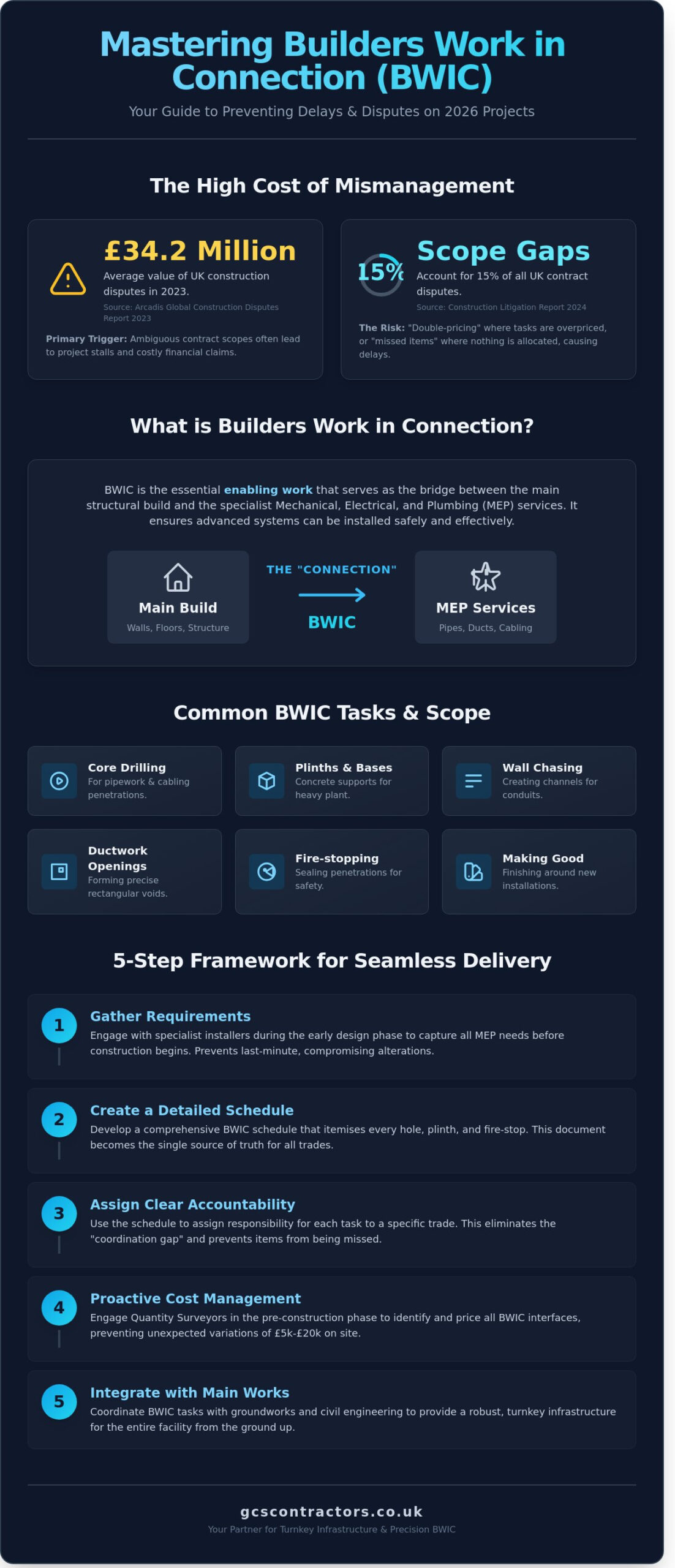
Did you know that according to the 2023 Arcadis Global Construction Disputes Report, the average value of UK construction disputes reached £34.2 million, with ambiguous contract scopes often acting as the primary trigger? It’s a common frustration for site managers and developers when a project stalls because a specific hole, plinth, or fire-stopping requirement wasn’t clearly assigned. You likely agree that these small oversights in builders work in connection are often what lead to the most significant delays and unexpected variations on a modern site.
Our team at GCS Contractors understands that technical precision is the foundation of a successful build. This guide is designed to help you master the complexities of BWIC for your 2026 projects, ensuring you can handle trade integration with quiet confidence. We’ll provide the clarity you need to reduce the risk of financial claims and keep your delivery schedule on track. We’ll explore everything from defining precise scopes to implementing better coordination strategies between your specialist installers and the main building team.
Key Takeaways
- Understand why the “connection” between general building and specialist services is the critical factor in preventing project friction and costly delays.
- Identify essential tasks such as core drilling, fire-stopping, and the construction of plant plinths that form the backbone of mechanical and electrical support.
- Learn how to eliminate the “coordination gap” by using a detailed builders work in connection schedule to assign clear accountability across all onsite trades.
- Discover a five-step framework for gathering specialist requirements during the design phase to ensure a seamless, turnkey delivery of complex infrastructure.
- Gain insights into integrating these supporting works with groundworks and civil engineering to provide a robust, long-term solution for your facility.
What is Builders Work in Connection (BWIC)?
Builders work in connection represents the essential structural and cosmetic tasks that enable specialist services to function within a building. We define it as the enabling phase for Mechanical, Electrical, and Plumbing (MEP) installations. The term “in connection” is the most vital part of this definition. It signifies that these works don’t exist in isolation; they serve a specific purpose for another trade. This might include cutting a hole for a ventilation duct or casting a concrete plinth for a heavy boiler. Without this coordination, the most advanced building systems cannot be installed safely or effectively.
Distinguishing between main contract works and specialist requirements is a core discipline for our team. While a main contractor builds the primary walls, the builders work in connection involves the specific penetrations, pattresses, and fixings required for technical equipment. Defining these requirements early in the project programme prevents legal friction and ensures structural integrity isn’t compromised by last-minute alterations. We’ve seen that failing to define this scope leads to significant delays during the 2026 commissioning phases because structural elements weren’t prepared for the necessary technical fit-outs.
- Core components include:
- Core drilling for pipework and cabling
- Constructing plinths and plant bases
- Chasing walls for electrical conduit
- Firestopping around service penetrations
- Making good finishes after specialist installations
The Origin of BWIC in Construction Contracts
Standard forms of contract like JCT and NEC4 handle these works through detailed “Attendance” schedules. BWIC serves as the bridge between structural integrity and service functionality. Within the UK industry, you’ll hear this referred to as General Attendance or Special Attendance, depending on the complexity of the equipment being installed. Our team delivers these works by following precise specifications to ensure every penetration and support maintains building compliance and safety standards.
Why Clear Definitions Save Money
Ambiguity in tender documents is a primary driver of project overruns. Data from the 2024 Construction Litigation Report indicates that scope gaps account for 15% of all contract disputes in the UK. When builders work in connection isn’t clearly defined, you risk “double-pricing,” where two contractors include the same task, or “missed items” where neither does. Our Quantity Surveyors focus on identifying these interfaces during the pre-construction phase. This proactive approach eliminates the £5,000 to £20,000 variations that often emerge when a specialist contractor arrives on-site to find no structural base ready for their equipment.
Common Examples and Scope of BWIC Tasks
Builders work in connection encompasses the physical alterations required to facilitate the installation of primary building services. Our team delivers these essential tasks to ensure that mechanical, electrical, and plumbing systems integrate seamlessly with the structural shell. A standard scope often begins with structural penetrations. This includes core drilling for pipework and forming precise rectangular openings for ductwork in masonry or reinforced concrete. Understanding What is Builder’s Work in Connection involves recognising that these tasks are vital for maintaining structural integrity while allowing for service passage. Without professional execution, these penetrations can compromise the safety of the entire building.
We provide robust containment and routing solutions such as chasing walls for electrical conduits and installing floor ducting or trenching. Once services are in place, our specialists focus on finishing works. This involves making good around pipes and the painting of services to match the surrounding environment. Crucially, we prioritise acoustic sealing and fire-stopping to meet the stringent requirements of the Building Safety Act 2022. We ensure every penetration is sealed to its original fire rating, preventing the spread of smoke and heat between compartments. This meticulous attention to detail is what defines a safe pair of hands in modern construction.
Mechanical and Electrical (M&E) Support
Heavy HVAC units and industrial boilers require substantial support structures to function safely. We construct reinforced concrete plinths and equipment stands tailored to specific load bearings. For ground-level installations, our team manages electrical earth pits and cable entry points during the early stages of a project. Accuracy is paramount in these high-stakes environments. We rely on the precision of setting out engineers to verify coordinates for every service penetration before any concrete is poured. This prevents the need for invasive remedial works later in the programme.
Plumbing, Drainage, and Hydraulic Connections
BWIC extends deep into the ground and through the structural core. We form pits for pumping stations and install large-scale attenuation tanks to manage surface water. These tasks must be carefully integrated with wider earthworks processes to manage site levels and drainage falls accurately. In reinforced concrete structures, we install pipe sleeves and puddle flanges. These components are essential for preventing water ingress in basement levels and high-pressure zones. Our approach ensures that every hydraulic connection is housed within a protected, accessible, and compliant environment.
If you are planning a complex installation, consulting with an experienced contractor early in the design phase can help you identify potential structural challenges before they impact your budget.
Managing the Coordination Gap Between Trades
Construction projects often stall in the “no-man’s land” between the mechanical sub-contractor and the main builder. If a pipe requires a 150mm penetration through a masonry wall, the MEP installer might assume the builder has already formed it. Meanwhile, the builder waits for a marked-up drawing that hasn’t been issued. This lack of clarity causes avoidable delays and budget overruns. We provide clear accountability through a formal BWIC Schedule. This document, recognised within industry standards for BWIC, acts as the definitive source of truth for every hole, chase, and plinth on site.
Site managers must facilitate weekly coordination meetings specifically focused on these interfaces. Our team delivers results by ensuring that MEP drawings are overlaid with structural plans at least 14 days before work begins. This proactive approach eliminates finger-pointing. It ensures that builders work in connection is executed precisely where and when it’s needed, keeping the project on track. Effective communication strategies include:
- Identifying unassigned tasks during the pre-start meeting to prevent “assumption gaps”.
- Utilising a shared digital platform for real-time schedule updates and sign-offs.
- Verifying all proposed penetrations against the structural engineer’s “no-drill” zones.
The Risk of Structural Compromise
Unauthorised core drilling represents a severe safety hazard. If a contractor cuts through a tensioned cable or a primary reinforcement bar, the structural integrity of the entire floor slab is compromised. We always consult structural engineers before any penetration exceeding 50mm is made. A 2023 industry report highlighted a London commercial project where missed reinforcement during a late-stage HVAC installation led to £45,000 in remedial structural strengthening. Safety isn’t optional; it’s the foundation of our delivery and protects the long-term viability of the building.
Sequencing for Success
Effective builders work in connection must be baked into the master project programme. Late-stage service changes often lead to “patchwork” fixes that compromise fire-safety compliance. We manage the “making good” phase with discipline, ensuring that fire stopping and acoustic seals are restored to 100% of the required rating. If a service layout changes after the walls are closed, the cost of rectification can increase by up to 300% compared to planned installation. We prioritise early-stage alignment to protect your budget and ensure a seamless finish.
5 Steps to Planning and Scheduling BWIC Effectively
Successful builders work in connection requires a disciplined approach that begins months before a single drill touches a wall. We provide a structured framework to ensure every opening and support is accounted for, preventing the costly delays that plague poorly managed sites. Our team delivers results by prioritising these five critical phases:
- Gather Specialist Requirements: We engage M&E sub-contractors during the RIBA Stage 3 design phase to capture precise dimensions for ductwork, pipework, and cable trays.
- Produce BWIC Schedules: Our engineers create a master “Holes on Drawings” (HoD) schedule that lists every penetration, its location, and the required fire-rating.
- Allocate Responsibility: We define exactly which party performs the cutting and which manages the subsequent firestopping to eliminate ambiguity between trades.
- Safety Review: Every proposed opening undergoes a structural assessment to ensure load-bearing integrity remains intact, particularly in older masonry buildings.
- Formal Sign-off: We implement a digital “Permit to Cut” and a final inspection process, ensuring works meet the approved design before following trades arrive.
Utilising BIM and Digital Twins
Modern construction relies on 3D modelling to identify service clashes before they reach the site. Digital twins allow us to visualise how builders work in connection interacts with complex HVAC systems in real-time. While many projects historically relied on local engineering expertise to solve problems on-site, 2026 standards demand digital precision. This transition ensures that every core hole or letterbox opening is positioned with millimetre accuracy, reducing material waste and structural risk.
Tendering and Cost Control
Precision in the Bill of Quantities (BoQ) is essential for maintaining budget discipline. We ensure every element of builders work in connection is explicitly priced, from temporary propping to final acoustic sealing. Proactive planning reduces contingency spend by up to 15% by eliminating the need for reactive structural repairs. When specialist equipment specifications change, our digital schedules allow for immediate variation costings, keeping the project on a firm financial footing. This level of transparency protects the client from hidden costs during the fit-out phase.
Our meticulous approach ensures your project remains compliant and on schedule. Contact GCS Contractors today to discuss your upcoming infrastructure or refurbishment requirements.
Turnkey Infrastructure: The GCS Contractors Approach to BWIC
GCS Contractors operates as a safe pair of hands for complex infrastructure projects across the United Kingdom. We recognise that builders work in connection is rarely a standalone task. It acts as the vital link between structural integrity and mechanical services. By integrating these works with our core groundworks and civil engineering capabilities, we eliminate the friction often found when managing multiple subcontractors. Our team delivers a seamless transition from initial site setup through to the specialist support required for the advanced building standards of 2026.
Using a single partner for the entire scope provides clear accountability. We manage the interface between trades, ensuring that every service penetration and equipment plinth is perfectly aligned with the mechanical and electrical requirements. This integrated approach ensures compliance with the latest safety regulations, including the stringent requirements of the Building Safety Act 2022. We take pride in our ability to navigate these complexities, providing clients with a sense of security that their project is legally and technically sound.
Beyond Basic Contracting
We provide bespoke solutions for unique site challenges, such as retrofitting heavy plant equipment into restricted urban basements or managing complex service diversions. Our focus extends beyond the immediate fit-out. We prioritise long-term durability to reduce lifecycle maintenance costs for the end-user. Every project undergoes meticulous planning and professional rigor. We use detailed coordination to prevent service clashes before any physical work begins. This disciplined methodology ensures that our infrastructure supports your building for decades, reflecting our commitment to quality results that stand the test of time.
Getting Started with Your Project
Engaging GCS Contractors for early-stage consultancy allows us to identify potential builders work in connection hurdles during the design phase. In high-stakes construction environments like data centres or hospitals, a dedicated partner is essential for managing risk. We act as a single point of contact, streamlining communication and accelerating project timelines. Our team is ready to guide you through a professional journey from initial inquiry to project completion with calm efficiency. Contact our expert team to discuss your BWIC requirements today to ensure your project is built on a foundation of technical excellence and reliability.
Mastering Infrastructure Delivery with Strategic Coordination
Effective project delivery hinges on the seamless integration of structural and mechanical elements. Managing builders work in connection ensures that service penetrations, openings, and trade interfaces don’t become bottlenecks that stall your timeline. By implementing a structured five-step planning process and addressing the coordination gap early, you protect your project from the risks of miscommunication and expensive site rework.
GCS Contractors provides the technical rigour required to navigate these complexities across the United Kingdom. With over 10 years of industry expertise, our team of accredited civil engineering professionals has established a proven track record in national infrastructure delivery. We offer a bespoke, turnkey approach that transforms high-stakes logistics into a streamlined process, acting as a dedicated partner rather than just another contractor on site. It’s our commitment to quality and safety that makes us a reliable pair of hands for your most demanding builds.
Partner with GCS Contractors for your next infrastructure project to secure a disciplined approach to construction. Let’s build a foundation that stands the test of time together.
Frequently Asked Questions
What is the difference between BWIC and general building works?
Builders work in connection refers to specific tasks that facilitate the installation of mechanical and electrical services, such as creating holes for pipes. General building works involve the primary construction of the property’s shell, including the foundation and main walls. While a main contractor builds the structure, the BWIC team manages the precise interfaces where services penetrate that structure to ensure a seamless fit-out.
Who is usually responsible for fire-stopping in BWIC?
The specialist contractor performing the builders work in connection typically handles fire-stopping to ensure the project complies with Building Regulations Part B. It’s a vital safety step because every penetration through a fire-rated wall must be sealed with tested materials. This process prevents the spread of smoke and flame, which causes 54% of fire-related fatalities according to recent Home Office data.
Is core drilling always considered part of builders work in connection?
Core drilling is a fundamental element of builders work in connection when services must pass through reinforced concrete or masonry. It uses diamond-tipped bits to create clean, circular openings without causing structural vibrations. We include this service to prevent the need for multiple subcontractors on site, which helps maintain the 2026 project timeline and ensures all penetrations are accurately placed.
How does BWIC affect the overall construction programme?
BWIC acts as a critical bridge between the structural build and the service installation phase. If these works aren’t sequenced correctly, it can delay the mechanical and electrical fit-out by 14 days or more. We mitigate this risk by integrating BWIC tasks into the master programme early. This structured approach ensures that every plinth and opening is ready before the service engineers arrive on site.
Can BWIC be added as a variation later in the project?
You can add these works as a variation, but doing so after the primary structure is complete often increases costs by 25% compared to pre-planned works. Late additions frequently require scanning for reinforcement bars or working around existing infrastructure. We recommend defining all requirements during the RIBA Stage 4 design phase to avoid expensive remedial work and unnecessary site disruption.
What happens if BWIC is not properly documented in the contract?
Poorly documented works lead to commercial disputes and “grey areas” regarding which trade is responsible for specific tasks. If the contract doesn’t explicitly state who provides the scaffolding or clears the waste, projects often face 10% budget overruns due to unforeseen day-work charges. We provide clear, itemised schedules to ensure every task is accounted for and that there’s total transparency for the client.
Does BWIC include the installation of the actual mechanical services?
BWIC doesn’t include the installation of mechanical hardware like boilers, heat pumps, or air handling units. Its purpose is to provide the enabling environment, such as building concrete plinths or cutting ductwork openings. The mechanical contractor remains responsible for the service installation itself, while our team ensures the building is physically prepared to receive those complex systems.
How do CDM Regulations apply to builders work in connection?
The CDM Regulations 2015 apply to all BWIC activities because they involve high-risk tasks like structural modification and diamond drilling. Every operative must have the correct training and equipment to manage dust, noise, and vibration levels on site. We maintain strict compliance with these safety standards to protect our workforce and ensure the principal contractor meets their legal health and safety obligations.