Strip-out and Demolition: A Professional Guide to Site Preparation
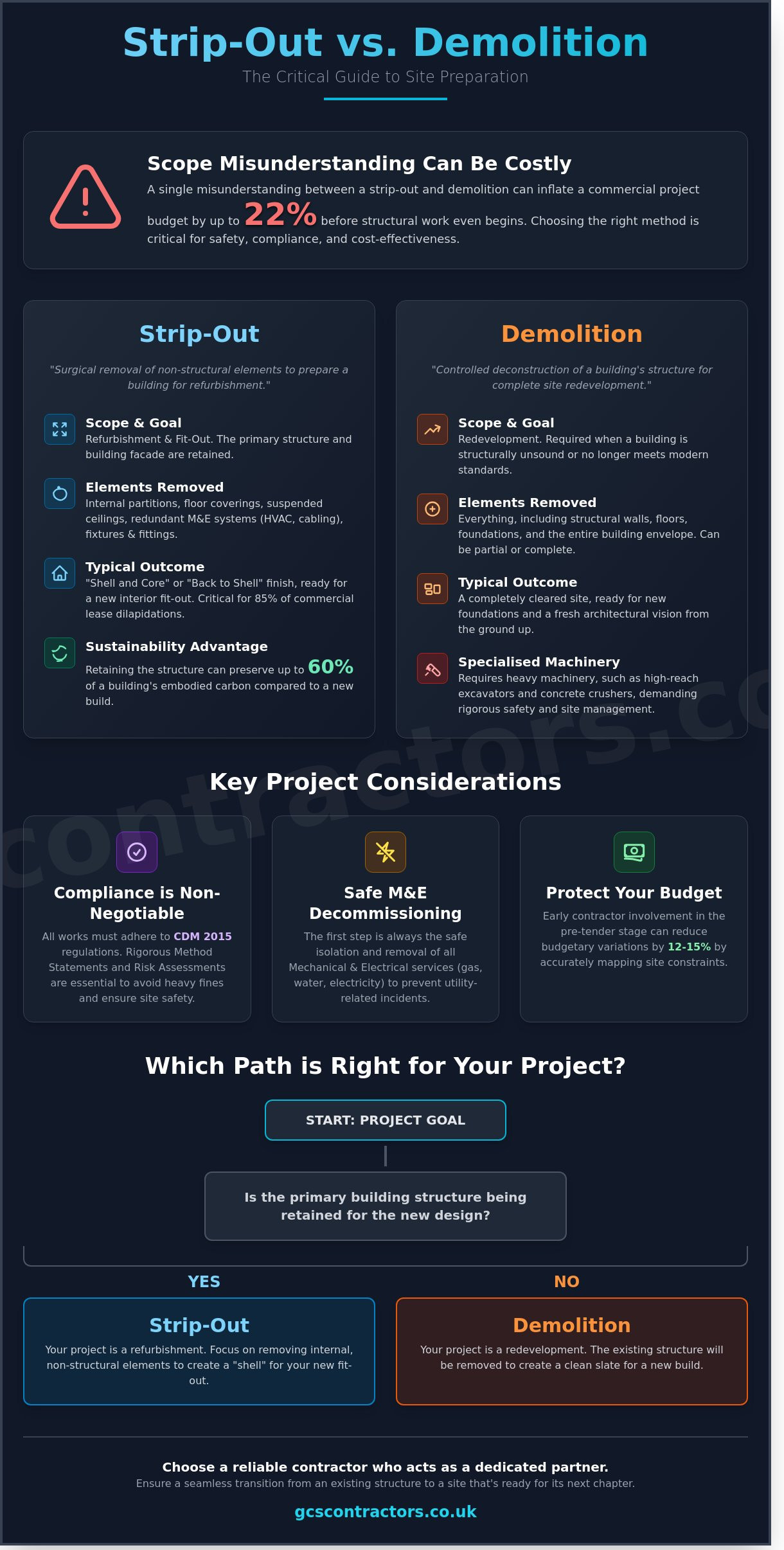
A single misunderstanding of the scope between a strip-out and demolition can inflate a commercial project budget by as much as 22% before the first structural beam is even touched. We understand that site preparation is often the most volatile phase of any refurbishment, where the fear of health and safety non-compliance or a poorly defined scope can lead to costly delays. You need to be certain that every piece of waste is tracked and every CDM 2015 obligation is met to avoid the heavy fines that have risen significantly across the UK construction sector since 2023.
This guide helps you master the critical differences between strip-out and demolition to ensure your next project is safe, compliant, and cost-effective. We provide a clear framework for deciding which service fits your specific site requirements, alongside a breakdown of the legal requirements you can’t afford to ignore. Our team delivers the technical knowledge you need to choose a reliable contractor who acts as a dedicated partner, ensuring a seamless transition from an existing structure to a site that’s ready for its next chapter.
Key Takeaways
- Distinguish between non-structural “soft strips” and full structural removal to determine the most efficient methodology for your refurbishment.
- Master the technical requirements of strip-out and demolition to ensure all mechanical and electrical services are decommissioned safely and professionally.
- Navigate the complexities of CDM 2015 regulations and learn why rigorous Method Statements are essential for maintaining site compliance.
- Compare project timelines and relative costs per square metre to establish a realistic and authoritative budget for your site preparation.
- Identify the specialised machinery and deconstruction methods required to maintain structural integrity and ensure a safe pair of hands on-site.
Understanding Strip-out and Demolition in Modern Construction
Successful site preparation begins with a clear distinction between two fundamental processes. A strip-out involves the systematic removal of non-structural elements such as internal partitions, floor coverings, suspended ceilings, and mechanical and electrical (M&E) systems. This process prepares a building for a new fit-out while keeping the primary structure intact. In contrast, demolition refers to the controlled destruction of a structure or a specific part of a building. For a detailed Demolition overview, it is evident that these methods vary from manual deconstruction to high-reach mechanical intervention depending on the site constraints.
These services represent the critical first phase of enabling works. They provide the clean slate required for subsequent trades to operate efficiently. At GCS Contractors, we act as a safe pair of hands during this high-stakes phase. Our team ensures that every strip-out and demolition project adheres to strict safety protocols, protecting the integrity of the site and the safety of all personnel. We focus on delivering a predictable environment where surprises are minimised and project momentum is maintained from day one.
The Strategic Role of Site Preparation
Professional site preparation acts as a safeguard against unforeseen risks that often delay groundworks. When contractors are involved during the pre-tender stage, clients often see a 12% to 15% reduction in budgetary variations. This early collaboration allows for accurate mapping of services and structural constraints before heavy machinery arrives. Often, these works follow comprehensive site clearance services. This sequence ensures the footprint is free of hazardous waste, debris, or vegetation before internal work begins.
Refurbishment vs Redevelopment: The Primary Drivers
The chosen method depends entirely on the project’s end goal. A strip-out typically results in a shell and core finish. This is ideal for commercial refurbishments where the building’s facade and structure remain. This approach is highly sustainable; retaining a building’s structure can preserve up to 60% of its embodied carbon compared to a new build. This makes it a greener alternative to total redevelopment. Conversely, demolition is the preferred route when the existing building no longer meets modern occupancy requirements or structural standards. It provides a completely cleared site, ready for new foundations and a fresh architectural vision.
Our approach is always tailored to the specific requirements of the UK building regulations and local planning constraints. Whether we are preparing a Victorian warehouse for modern office use or clearing a redundant industrial unit, we deliver results that stand the test of time. We provide the technical expertise needed to navigate complex urban environments, ensuring that your project starts on a firm, professional footing.
The Anatomy of a Professional Strip-out Process
A professional strip-out is a surgical process that requires precision and a deep understanding of building anatomy. It serves as the bridge between a building’s past use and its future potential. Our approach to strip-out and demolition focuses on the systematic removal of internal components while protecting the primary structure. This phase is critical for the 85% of commercial tenants who face strict dilapidation requirements when a lease ends, ensuring the property returns to its pre-let condition without dispute. We treat every project as a bespoke operation, recognising that the requirements for a 1960s warehouse differ vastly from a modern Grade A office space.
Work always begins with the isolation of services. We verify that all electricity, gas, and water supplies are safely decommissioned before any physical removal occurs. This prevents utility-related incidents and allows our teams to work with quiet confidence. Following isolation, we remove Mechanical and Electrical (M&E) services, including complex HVAC systems and redundant cabling. While we strictly adhere to UK HSE regulations, we also look to global benchmarks like OSHA demolition standards to inform our safety culture and risk assessment strategies. This ensures that even the most complex M&E removals are handled without compromising the safety of the site or the surrounding infrastructure.
Non-Structural Elements and Internal Clearance
Our teams specialise in achieving a “back to shell” state, which is now a standard requirement for 92% of high-end office refurbishments in London and the South East. This involves the meticulous removal of internal partitions, glazing systems, suspended ceilings, and raised access floors. We also clear redundant furniture and integrated fire suppression components. Our focus remains on maintaining the building’s structural integrity, ensuring that no load-bearing elements are compromised while we clear the space for its next phase. If you need a partner to manage your next project, our team provides bespoke site preparation services tailored to your specific requirements.
Waste Management and Material Recovery
We operate within a circular economy framework where material recovery is the priority. In a typical project, we aim to segregate and recycle at least 95% of all strip-out waste, including metals, timber, and plastics. Although the formal Site Waste Management Plan (SWMP) regulations were simplified in 2013, we maintain these plans as a standard for every project. This provides our clients with full traceability and ensures compliance with modern environmental audits. By categorising materials at the point of removal, we reduce landfill contributions and support the sustainable goals of the wider construction industry.
Structural Demolition: Methods, Safety, and Rigour
Demolition isn’t a blunt instrument; it’s a disciplined civil engineering task that requires meticulous planning and execution. Our teams treat structural works with the same level of precision as a new build project. We categorise these operations into three distinct methods: total demolition for full site clearance, partial demolition for structural remodelling, and deconstruction, which prioritises the careful recovery of materials for reuse. We deploy a sophisticated fleet of plant to match the project’s scale, ranging from 40-tonne high-reach excavators for vertical structures to robotic “Brokk” machines for delicate internal work. This phase acts as the critical bridge to the groundworks contractors phase, ensuring the site is stable and clear for the installation of new foundations and infrastructure.
Managing High-Risk Hazards and Compliance
Safety serves as our primary metric for project success. Before any strip-out and demolition begins, we ensure a comprehensive Refurbishment and Demolition (R&D) survey is complete to identify asbestos or other hazardous materials. We follow the demolition safety guidance issued by the Health and Safety Executive to maintain structural stability throughout the process. Our site managers implement real-time monitoring for noise, dust, and vibration to ensure we remain within the 75dB limits often mandated in urban environments. To maintain a secure perimeter and protect the public from site activities, we install professional construction site hoarding that complies with BS EN 1991 standards for wind loading and impact resistance.
Structural Alterations and Partial Demolition
Modifying an existing building demands a higher level of engineering rigour than total site clearance. We often perform partial demolition to facilitate modern extensions or internal reconfigurations while the primary structure remains intact. This process requires the installation of temporary works, including hydraulic propping and needle shoring, to safely transfer structural loads. In tight urban settings where buildings may be within 2 metres of neighbouring properties, we use precision techniques like diamond drilling and hydraulic crunching to eliminate percussive vibration. Our engineers calculate every stage of the sequence to ensure the building’s equilibrium is never compromised during the strip-out and demolition process. This controlled approach allows for complex architectural changes without risking the integrity of the original fabric.
Comparing Strip-out vs Demolition: Choosing the Right Path
Selecting the appropriate method for site preparation dictates your project’s financial trajectory and environmental legacy. While a strip-out focuses on removing internal non-structural components like partition walls and MEP systems, full demolition levels the entire structure to its foundations. Data from 2023 UK commercial projects shows that interior strip-outs typically cost between £25 and £65 per square metre. In contrast, full-scale demolition often starts at £110 per square metre when you factor in site clearance and waste management fees.
- Project Timelines: A standard 10,000 sq ft office strip-out usually takes 4 to 6 weeks. A full demolition of the same footprint requires 12 to 16 weeks, including structural surveys and safety hoarding installation.
- Environmental Impact: Retaining the building shell through a strip-out preserves up to 80% of the embodied carbon. Demolition generates significantly more waste, requiring 95% or higher recycling rates to meet modern BREEAM standards.
Key Decision Factors for Project Managers
Structural integrity and heritage status are the primary filters for your decision. If a building is Grade II listed, full demolition is rarely an option; meticulous internal clearing becomes the only compliant path. We utilise GPR surveys to map reinforcement and hidden utilities before work begins. This prevents strikes on post-tensioned cables or live services that don’t appear on original blueprints. You must also consider the Party Wall etc. Act 1996. Demolition often triggers complex negotiations with neighbours that can delay a programme by 4 to 7 months.
Impact on Budget and Programme
A hybrid approach often provides the best value for complex sites. Our team frequently performs a soft strip-out to segregate high-value materials like copper or aluminium before the heavy machinery arrives for demolition. This increases recycling rebates and lowers your overall costs. It’s vital to account for a 15% contingency fund for hazardous material discovery, such as asbestos hidden in floor voids. We recommend securing a fixed-price tender to ensure your strip-out and demolition budget remains predictable throughout the project lifecycle.
Use this checklist to evaluate your site needs:
- Is the current structural frame suitable for the new building use?
- Are there restrictive covenants or planning constraints on the facade?
- Does the site allow for heavy plant machinery and debris crushers?
- Have you completed a pre-demolition audit for recyclable materials?
- Are there sensitive neighbouring businesses that require vibration monitoring?
Our experts deliver precise site preparation that aligns with your commercial goals. Contact GCS Contractors today to discuss your specific project requirements.
Implementation: Managing Your Site Preparation Project
Executing a successful strip-out and demolition project requires more than just heavy machinery; it demands a disciplined adherence to the Construction (Design and Management) Regulations 2015. As the Principal Contractor, our team assumes full responsibility for the health and safety of everyone on-site. We produce a comprehensive Risk Assessment and Method Statement (RAMS) before any physical work begins. These documents aren’t mere formalities. They’re live blueprints that guide every operative, ensuring that hazardous materials are handled correctly and structural integrity is maintained. By centralising control, we eliminate the communication gaps that often lead to delays or safety breaches on complex sites.
Statutory Obligations and Health & Safety
Compliance begins with the Health and Safety Executive. Any project exceeding 30 working days or involving more than 500 person-days requires an F10 notification. We manage this filing process to ensure your project remains on the right side of the law. Logistics in congested urban environments require high-level precision; poor traffic management often accounts for 15% of early-stage project delays. We implement rigorous access strategies to keep your site moving without disrupting the local community. Our team maintains CHAS and SafeContractor accreditations, providing a verified standard of safety that protects your reputation and your investment. This professional rigour ensures that every risk is mitigated before it becomes a liability.
Selecting a Turnkey Partner for Enabling Works
The transition from strip-out and demolition to the initial site setup is where many developers experience friction. Using a single turnkey partner for enabling works, demolition, and groundworks removes the logistical burden of managing multiple sub-contractors. It ensures that the site is handed over in a condition that’s ready for immediate construction. GCS Contractors provides a seamless bridge between these critical phases. Our integrated approach can reduce project lead times by up to 10% by eliminating the gaps between different trades. We’re dedicated to delivering tangible results that stand the test of time, acting as a safe pair of hands for your most complex infrastructure needs.
Our commitment to quality and safety makes us the ideal partner for developers seeking a meticulous, disciplined approach to site preparation. We don’t just clear sites; we prepare the foundations for your future success. Contact our team today for a professional consultation and see how our expertise can streamline your next project.
Securing a Precise Foundation for Your Project
Successful site preparation requires more than just heavy machinery; it demands a meticulous balance of technical rigour and safety compliance. Whether your project calls for a precise internal strip-out or full structural demolition, the focus must remain on mitigating risk. Choosing the correct path ensures your timeline stays on track. It keeps your site safe for the next phase of construction.
GCS Contractors delivers this certainty through over 10 years of civil engineering expertise. As a CHAS accredited and safety-focussed partner, our team delivers turnkey solutions that span from initial enabling works to complex groundworks. We provide a dedicated partnership that removes the logistical burden from your shoulders while ensuring every stage of your project meets the highest professional standards. Our disciplined approach guarantees your site is ready for its next chapter without compromise.
Ready to move forward with a team you can trust? Contact GCS Contractors for a professional strip-out and demolition quote today. We look forward to helping you achieve a seamless transition to your next build phase.
Frequently Asked Questions
What is the main difference between soft strip and demolition?
The main difference is that a soft strip removes non-structural elements while demolition targets the building’s core structure. Our team removes floor coverings, internal partitions, and suspended ceilings during a soft strip to prepare for refurbishment. Demolition involves the systematic removal of load-bearing walls and concrete slabs. This distinction ensures the building remains structurally sound while we clear the interior for a new fit-out.
How much does a commercial strip-out cost per square foot in the UK?
Commercial strip-out costs in the UK typically range between £5 and £15 per square foot. For a standard 5,000 square foot office space, you should budget approximately £25,000 for a comprehensive clearing of internal finishes. These figures fluctuate based on the volume of mechanical and electrical systems that require decommissioning. We provide bespoke quotes that reflect the specific logistical challenges of your site.
Do I need planning permission for internal strip-out works?
You don’t usually need planning permission for internal strip-out works unless the property is a listed building. The Town and Country Planning Act 1990 generally exempts internal alterations from requiring consent. However, 100% of Grade I and Grade II listed structures require Listed Building Consent before any work begins. We always recommend checking with your Local Planning Authority to confirm your project’s specific requirements.
How long does it take to strip out a typical office building?
It takes approximately 2 to 4 weeks to strip out a typical 10,000 square foot office floor. A smaller 2,000 square foot suite can be cleared in 5 working days. These timelines depend on the ease of access and the complexity of the building’s infrastructure. Our team delivers a detailed project schedule to ensure your site preparation stays on track for the subsequent construction phase.
What happens to the waste generated during a demolition project?
We process waste by segregating materials on-site to achieve a 95% recycling rate. Timber, metals, and concrete are transported to licensed UK waste transfer stations for repurposing. Our team provides a full audit trail including Waste Transfer Notes for every kilogram of material removed. This meticulous approach ensures your strip-out and demolition project complies with the Environmental Protection Act 1990.
Is asbestos removal included in a standard strip-out and demolition quote?
Asbestos removal isn’t included in a standard quote because it requires a specialist Refurbishment and Demolition survey first. If the survey identifies hazardous materials, we provide a dedicated removal plan that follows the Control of Asbestos Regulations 2012. We treat this as a separate service to ensure the safety of our workforce. This integrated strip-out and demolition approach keeps your project compliant and secure.
Can you perform a strip-out while other parts of the building are occupied?
We can perform a strip-out while other parts of the building are occupied by using phased work schedules. Our team installs floor-to-ceiling acoustic hoarding and industrial dust extractors to protect neighbouring tenants. We often conduct the loudest tasks during out-of-hours shifts, typically between 18:00 and 06:00. This ensures your business operations continue without any significant interruption or safety risk.
What insurance coverage should a demolition contractor have?
A professional demolition contractor must hold a minimum of £10 million in Public Liability and £10 million in Employer’s Liability insurance. We also maintain Professional Indemnity insurance to cover our technical advice and project management. These high levels of coverage provide a vital safety net for our clients. We verify all insurance documents through our annual CHAS and Constructionline Gold accreditation processes.