Driveway Resurfacing: A Complete Guide to Materials, Costs, and Methods (2026)
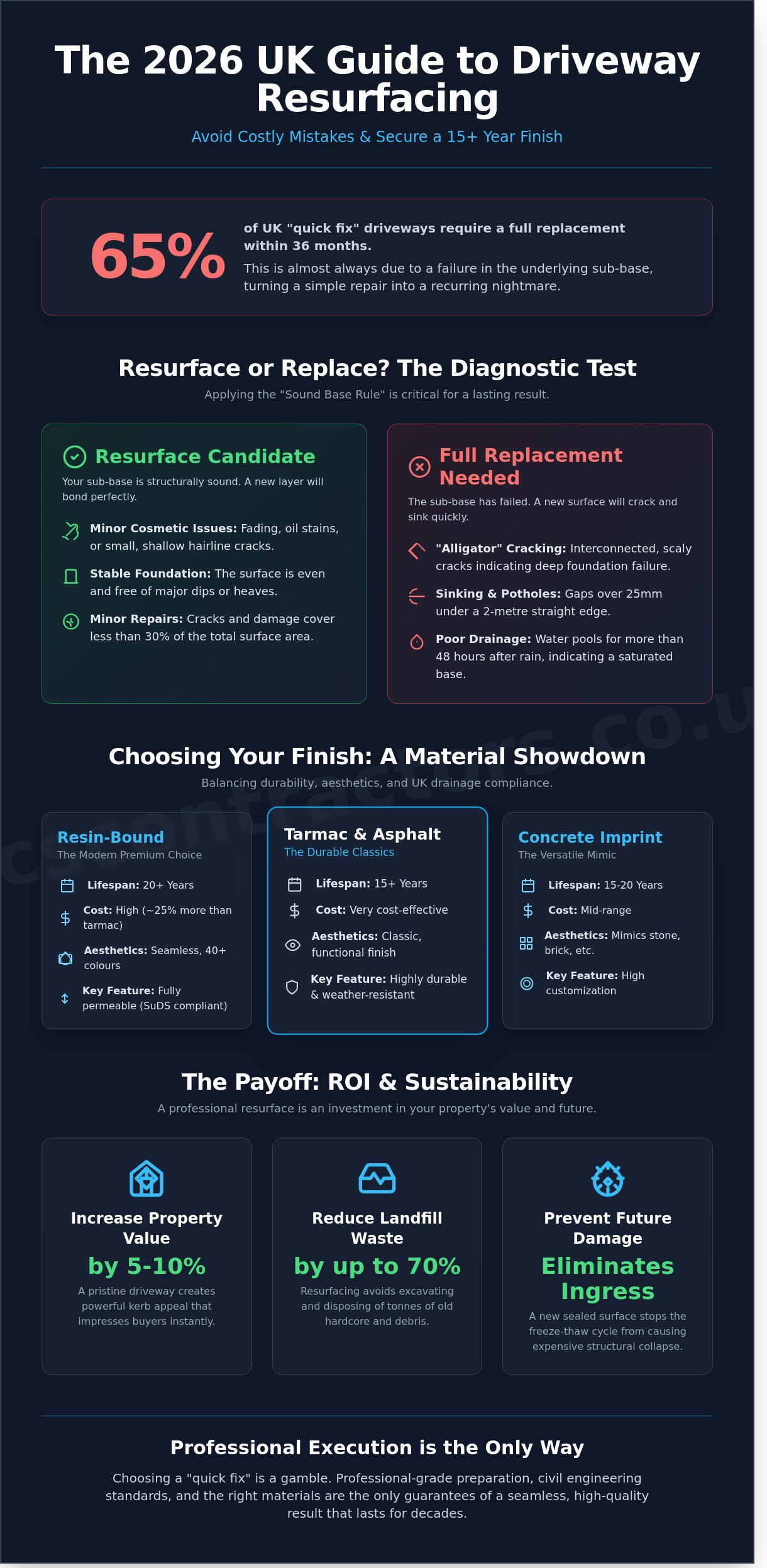
Nearly 65% of UK homeowners who opt for a “quick fix” for their property frontage end up paying for a full replacement within just 36 months because of underlying sub-base failures. You likely believe that a professional driveway resurfacing should be a one-time investment rather than a recurring headache. It is natural to feel anxious about wasting thousands of pounds on a surface that might crack after the first frost, or to feel confused by the £50 per square metre price differences between resin, tarmac, and asphalt.
Our team at GCS Contractors understands that you need a safe pair of hands to deliver a bespoke, high-quality result. We provide this comprehensive 2026 guide to ensure you achieve a finish that looks brand new and maintains its integrity for 15 years or more. You’ll discover the exact breakdown of modern material costs, the technical reality of UK drainage compliance, and the disciplined methods we use to avoid the “patch jobs” common in the industry. We’ll walk you through everything from structural refurbishment to the final seamless seal.
Key Takeaways
- Determine if your existing sub-base is structurally viable for professional driveway resurfacing by applying the essential “Sound Base Rule.”
- Evaluate the durability and aesthetic benefits of resin-bound, tarmacadam, and asphalt to select the most compatible material for your substrate.
- Access 2026 pricing benchmarks per square metre and understand how to navigate SUDS legislation to ensure your drainage remains fully compliant.
- Discover why professional-grade preparation and civil engineering standards are critical for achieving a seamless, high-quality result that lasts.
Understanding Driveway Resurfacing: Is Your Driveway a Candidate?
Driveway resurfacing involves applying a new, high-quality wear layer over an existing structural foundation. Our team delivers this solution as a sustainable alternative to full excavation, providing a seamless finish that restores the appearance and function of your property. We follow the “Sound Base Rule” strictly. This means we only recommend resurfacing if the underlying sub-base remains structurally intact and stable. If the foundation is compromised, a new surface layer will fail within 24 months. We use various driveway resurfacing materials, such as asphalt, resin, or concrete, to ensure the new layer bonds perfectly with the old.
Identifying the difference between surface wear and structural failure is vital for a long-term result. You’ll see fading or minor hairline cracks as your driveway ages. These are typical cosmetic issues. However, potholes, significant sinking, or “alligator” cracking indicate a failed sub-base. Alligator cracking looks like a series of interconnected, scaly splits. This signals that the ground beneath has shifted or lost its load-bearing capacity. In these cases, driveway resurfacing won’t fix the root cause. Choosing to resurface instead of replace reduces landfill waste by up to 70% because we don’t have to remove and transport tonnes of old hardcore and debris.
Resurfacing vs. Full Replacement: The Diagnostic Test
We use a simple level test to check for sub-base movement. Place a 2-metre straight edge across several points of the driveway. If you find gaps larger than 25mm, it suggests the foundation is settling or shifting. Deep-rooted drainage issues also prevent simple resurfacing. If water pools for more than 48 hours after rain, the sub-base is likely saturated and unstable. Our data shows that if repairs exceed 30% of the total surface area, a full replacement becomes more cost-effective over a 10-year period.
The Aesthetic and Financial ROI of a Fresh Surface
A professional resurface provides immediate financial benefits. UK estate agent data suggests a well-maintained driveway can increase property value by 5% to 10%. First impressions matter. Potential buyers often decide on a property within the first 30 seconds of arrival. A high-quality finish also eliminates the risk of water ingress. This prevents the freeze-thaw cycle from causing expensive structural collapse during winter months. We provide bespoke finishes that ensure your home’s kerb appeal remains a long-term asset rather than a maintenance burden.
The Best Driveway Resurfacing Materials: A Comparative Roundup
Selecting the right material for driveway resurfacing requires more than an eye for design. Our team ensures that the chosen finish integrates perfectly with your existing substrate to prevent premature failure or shifting. With UK annual rainfall increasing by approximately 7.3% over the last decade, we prioritise permeable solutions that manage surface water effectively while meeting modern building standards. Whether you’re looking for a quick refresh or a complete aesthetic overhaul, the material you choose must balance durability with the specific drainage requirements of your property.
Resin-Bound Surfacing: The Modern Premium Choice
Resin-bound systems create a fully permeable, SuDS-compliant surface by mixing aggregate with clear UV-stable resin before application. This differs significantly from resin-bonded systems, where stone is scattered over a non-permeable resin layer. It offers over 40 colour combinations and naturally resists weed growth. While the initial investment is often 25% higher than tarmac, the seamless, contemporary finish provides long-term value. It’s a technical installation that requires a stable, clean base to ensure the bond remains secure for its 20-year expected lifespan.
Tarmac and Asphalt Overlays: The Durable Classics
Bitmac remains the standard for UK homes because it’s flexible enough to accommodate slight ground movement without cracking. For high-traffic areas or heavier vehicles, we often recommend Stone Mastic Asphalt (SMA). This material contains added fibres to prevent deformation under weight. These options are highly cost-effective and typically ready for vehicle use within 24 hours of installation. They provide excellent weather resistance, making them a reliable choice for the unpredictable British climate.
Concrete Imprinting and Overlays
Patterned concrete allows homeowners to achieve the look of expensive natural stone or Flemish brick at a fraction of the cost. When planning concrete driveway resurfacing, we install precision-cut expansion joints every 3 to 4 metres. These joints are vital to prevent cracking during the freeze-thaw cycles common in Northern Europe. To maintain the protective barrier and prevent colour fading, you’ll need to reseal the surface every 3 to 5 years. This maintenance schedule ensures the infrastructure remains robust against de-icing salts and heavy rain.
For a truly high-end finish, thin-set block paving offers an “over-paving” alternative. This method allows us to lay premium blocks over an existing sound substrate, reducing the need for full excavation and lowering waste by up to 60%. If you’re unsure which material suits your property’s specific drainage needs, our experts can provide a bespoke site assessment to guide your project from initial inquiry to completion.
The Professional Resurfacing Process: A Step-by-Step Overview
Successful driveway resurfacing relies almost entirely on the work completed before the final layer is even visible. Our team operates on the principle that preparation accounts for 70% of a project’s lifespan. We begin by removing all organic matter, moss, and loose debris using industrial power brushes. Oil stains are treated with specialised chemical degreasers, as residual petroleum can prevent the new binder from adhering. We then apply a “tack coat,” which is a bitumen emulsion that acts as a high-strength bonding agent between the old substrate and the new material.
Step 1: Substrate Preparation and Repair
We don’t simply cover up existing problems. Our technicians fill structural cracks using polymer-modified bitumen fillers to stop water ingress. If we identify “soft spots” where the sub-base has failed, we excavate these sections and reinstate them with 150mm of compacted MOT Type 1 aggregate. We also ensure that all edge restraints, such as concrete kerbs or granite setts, are secure and level. This provides the necessary lateral support to prevent the new surface from spreading under vehicle loads. For detailed technical standards on these repairs, the Manual for Asphalt Pavement Repair provides a framework for professional-grade restoration that we follow to ensure longevity.
Step 2: Regulating and Levelling
A regulating course is a preparatory layer used to provide a uniform surface for the final wear course. This stage is vital for correcting dips or hollows that have formed over years of use. We use laser levels to ensure the driveway maintains a minimum 1:40 fall. This gradient is essential to prevent standing water and ensure efficient runoff into drainage channels or soakaways. Precision at this stage prevents the “puddling” that often leads to premature surface failure in poorly managed projects.
Step 3: The Final Wear Course Application
The final layer of your driveway resurfacing requires strict temperature management. Tarmac must be laid while it’s between 100°C and 150°C to ensure proper compaction and a seamless finish. Our team uses heavy rollers to achieve a specific density, which prevents “scuffing” when car tyres turn at a standstill. Once the rolling is complete, the surface needs time to set. While it feels solid quickly, we recommend waiting at least 24 to 48 hours before driving a vehicle onto the new surface. In peak summer temperatures, this curing period may extend to 72 hours to ensure the bitumen has fully hardened and won’t track into your home.
Project Planning: Costs, Regulations, and Drainage
Accurate budgeting ensures your project remains viable from inception to completion. For a driveway resurfacing project in 2026, expect tarmac costs to range between £45 and £70 per m2. High-performance resin-bound surfaces typically command a premium of £70 to £120 per m2. These figures fluctuate based on site-specific variables. Complex geometric shapes, the installation of integrated drainage, and the disposal of existing sub-base materials add to the final invoice. We often see homeowners choosing the lowest quote only to face delamination within 24 months. This occurs when the top layer fails to bond, leading to unsightly peeling. Quality materials and correct preparation prevent this failure.
Estimating Your Driveway Resurfacing Budget
Project costs aren’t just about the surface material. In 2026, waste disposal fees account for roughly 15% of a total budget due to increased landfill taxes. If your existing driveway has significant structural cracks, the cost increases because we must repair the sub-base before the new layer is applied. A cheap quote usually skips this step. Without a stable foundation, your new surface will mirror the old cracks within one winter season. We provide transparent, fixed-price estimates to ensure there aren’t any hidden surprises mid-project.
Drainage and Legal Compliance
UK law mandates strict management of surface water. Under Sustainable Urban Drainage Systems (SUDS) legislation, you must ensure water remains within your property boundaries. If you install a non-permeable surface exceeding 5sqm, you’ll likely require formal planning permission from your local authority. GCS Contractors mitigates these risks by integrating Aco drains and soakaways into our designs. These systems redirect runoff effectively; they prevent local flooding and protect your home’s foundations from hydrostatic pressure. Our team manages the technical compliance so your project adheres to the latest 2026 environmental standards.
Selecting a partner for driveway resurfacing requires due diligence. Use this checklist to verify competence:
- Insurance: Public liability insurance of at least £5 million.
- References: Verifiable case studies from projects completed in the last 18 months.
- Technical Knowledge: A clear explanation of how they’ll handle sub-base preparation and drainage.
- Accreditations: Membership in recognised trade bodies or manufacturer-approved installer status.
Why Professional Execution is the Only Way to Ensure Longevity
While off-the-shelf DIY kits offer a tempting price point, they frequently fail within 18 months of application. These retail products often lack the polymer-modified binders required for a permanent chemical bond between the original base and the new wearing course. Professional driveway resurfacing succeeds because it utilises industrial-grade tack coats and heavy-duty plant machinery. Without a 6-tonne vibrating roller, you simply can’t achieve the 95% compaction levels necessary to prevent water ingress and freeze-thaw cracking.
The finish of your driveway depends heavily on the temperature at which the material is laid. Professional crews use insulated vehicles to keep asphalt at precisely 140°C until the moment it’s laid. Manual DIY attempts often result in “cold spots,” where the material begins to set before it’s properly levelled, leading to a pitted, uneven surface that traps standing water.
The GCS Difference: Civil Engineering Precision
Our team applies the same civil engineering rigour to a private home as we do to a £500,000 commercial road surfacing contract. We follow the BS EN 13108 standard for all bituminous materials, sourcing exclusively from accredited UK suppliers such as Aggregate Industries. By using precision pavers rather than hand-raking, we ensure a consistent depth and a gradient that manages 100% of surface water runoff. This “Right First Time” delivery reduces project timelines by 25% compared to less structured contractors.
Maintenance Tips to Protect Your Investment
Protecting your new surface requires specific care to maintain its structural integrity. You should avoid using high-pressure jet washes exceeding 100 bar for the first 12 months, as the intense pressure can dislodge aggregate before the binder has fully cured. If you notice oil spills, apply a proprietary pH-neutral degreaser immediately. This prevents hydrocarbons from softening the bitumen. We don’t just finish a job and leave; we act as your long-term infrastructure partner, offering guidance to ensure your property’s value remains protected for decades.
A lasting finish starts with an accurate technical survey rather than a rough estimate. Contact GCS Contractors today for a professional assessment of your site’s sub-base integrity and a detailed quote for your driveway resurfacing project.
Future-Proof Your Property with Expert Engineering
Investing in high-quality driveway resurfacing isn’t just about property value; it’s a vital infrastructure upgrade that protects your home’s long-term integrity. Choosing the right materials, such as permeable resin or durable bitumen, ensures compliance with UK drainage regulations and prevents premature surface failure. The success of your project depends on meticulous sub-base preparation and precise engineering that stands up to heavy vehicle loads and shifting weather patterns.
GCS Contractors delivers this level of professional rigor through our 10 years of civil engineering expertise. We’re fully accredited S278 highways works contractors, meaning our team operates under the same strict standards required for major public road infrastructure. We eliminate financial uncertainty by providing fixed-price quotes with no hidden costs. This transparent approach ensures your project stays on budget while meeting the highest building standards. Our dedicated team manages every phase, providing a seamless turnkey solution that removes the logistical burden from your shoulders.
Don’t leave your property’s entrance to chance. Request a Professional Driveway Assessment from GCS Contractors to secure a durable, professional finish. We’re ready to help you build a surface that lasts for decades.
Frequently Asked Questions
How much does driveway resurfacing cost in the UK?
Driveway resurfacing costs in the UK typically range from £45 to £120 per square metre. For a standard 30-square-metre driveway, you should budget between £1,350 and £3,600. These figures include all labour and materials but exclude structural repairs to the sub-base. We provide detailed quotes that reflect current 2026 market rates for high-quality aggregates and binders.
Can you resurface a concrete driveway with tarmac or resin?
You can resurface a concrete driveway with tarmac or resin-bound materials if the existing slab is structurally sound. Our team ensures the concrete is free from major cracks and properly cleaned before application. We apply a specialist primer to 100% of the surface area to guarantee a seamless bond between the old concrete and the new decorative layer.
Do I need planning permission to resurface my driveway?
You don’t usually need planning permission if you use permeable materials like resin-bound gravel. Since the 2008 SuDS (Sustainable Drainage Systems) regulations, any non-porous surface over 5 square metres that drains into a public sewer requires formal approval. We design systems that comply with these UK building standards to avoid the £200 cost of a retrospective application.
How long does a resurfaced driveway last?
A professionally resurfaced driveway lasts between 15 and 25 years depending on the chosen material. Tarmac overlays typically offer a 20-year lifespan, while high-grade resin-bound systems often exceed 25 years with minimal maintenance. Our commitment to quality ensures the finish resists UV degradation and heavy vehicle loads without premature failing.
What is the difference between resin-bound and resin-bonded surfacing?
Resin-bound surfacing involves mixing the aggregate and resin together before installation, creating a 100% permeable and smooth finish. In contrast, resin-bonded systems involve spreading loose stones over a layer of resin, resulting in a non-porous, textured surface. We recommend resin-bound solutions for 90% of residential projects because they eliminate standing water and comply with environmental drainage laws.
Can I resurface my driveway in the winter?
We don’t recommend resurfacing your driveway during extreme winter conditions when temperatures drop below 5°C. Most resin and bitumen products require dry conditions and specific thermal windows to cure correctly. Our engineers monitor local weather data to schedule works when humidity is below 80%, ensuring the material reaches its full structural integrity.
How long after resurfacing can I drive on my driveway?
You can typically walk on the surface after 6 hours, but you must wait 48 hours before parking a vehicle on it. During the first 14 days, we advise against turning your steering wheel while the car is stationary to prevent scuffing. This initial curing period is vital for the long-term durability of your driveway resurfacing project.
Is resurfacing better than a full driveway replacement?
Resurfacing is better if your sub-base is intact, as it costs roughly 50% less than a full replacement. If the foundation shows signs of subsidence or deep structural failure, a full excavation is necessary to prevent the new surface from cracking within 24 months. Our surveyors conduct a thorough site assessment to determine which approach offers the best return on your investment.