Surface Water Drainage Solutions: A Comprehensive Guide for UK Developers (2026)
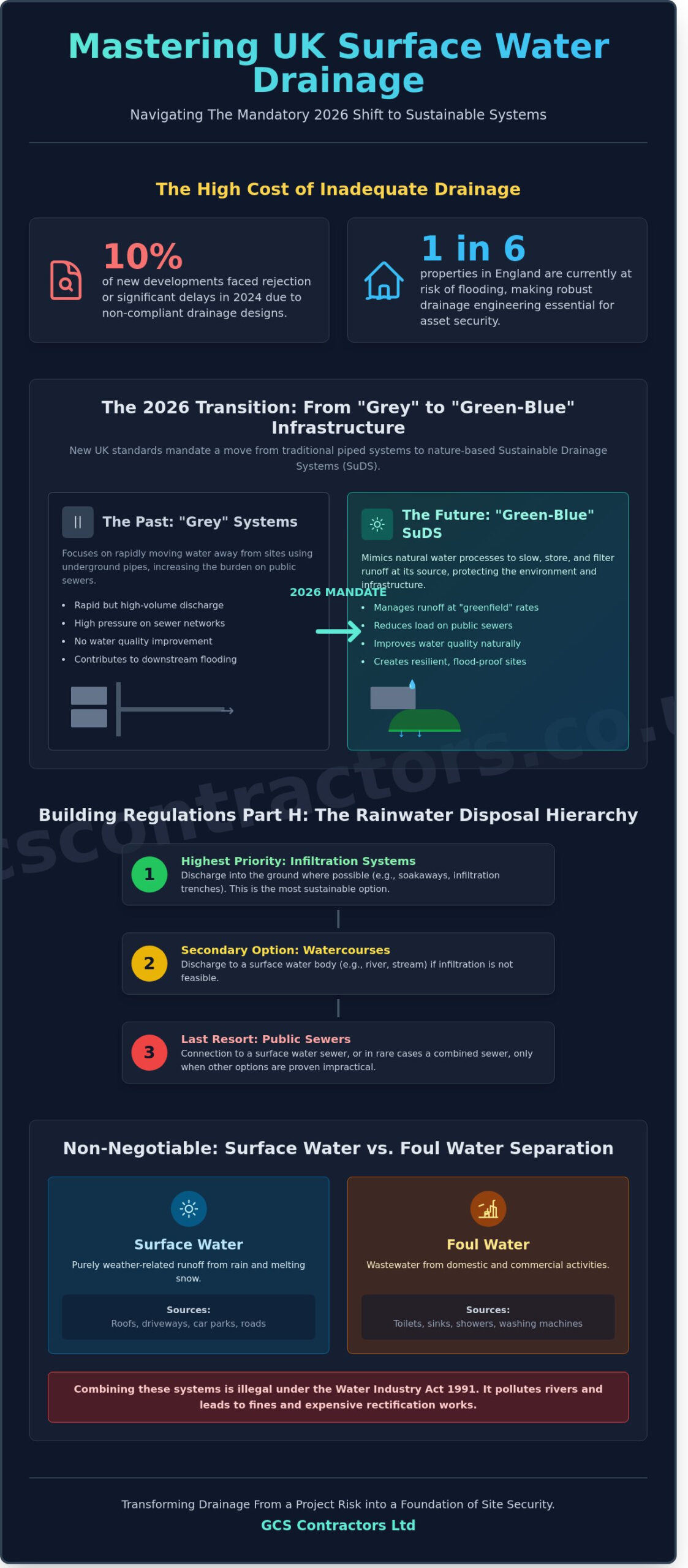
Recent data from the Environment Agency indicates that nearly 10% of new development applications in England faced significant delays or rejections in 2024 because of non-compliant drainage designs. You understand that managing run-off is no longer a simple matter of installing pipes; it’s a high-stakes balancing act between environmental responsibility and commercial viability. Implementing effective surface water drainage solutions requires a meticulous approach that satisfies both local planning authorities and the long-term integrity of the site. At GCS Contractors Ltd, we believe that drainage shouldn’t be a source of project risk, but a foundation of site security.
You’ve likely felt the frustration of unexpected groundworks costs or the pressure of meeting Building Regulations Part H under tight deadlines. We’ve designed this guide to provide the technical clarity you need to master modern water management, from SuDS compliance to advanced attenuation strategies. You’ll gain a clear roadmap for integrating robust systems that prevent site flooding and ensure a seamless connection to your wider S278 works. We will walk you through the essential components of a high-quality infrastructure plan that delivers tangible results and stands the test of time.
Key Takeaways
- Navigate the 2026 transition from traditional “grey” infrastructure to integrated “green-blue” systems to ensure your development meets the latest UK compliance standards.
- Learn how to select and deploy the most effective surface water drainage solutions, from high-traffic linear channel drains to specialised silt traps and catch pits.
- Compare the long-term maintenance costs and land-take requirements of Sustainable Drainage Systems (SuDS) against traditional piped networks for complex urban refurbishments.
- Understand the technical precision required during site preparation, including the necessity of GPR surveys and exact gradient falls for reliable gravity-fed systems.
- Master the complexities of connecting site drainage to public highways via S278 works while leveraging turnkey groundworks to reduce delivery risk and streamline infrastructure.
Understanding Surface Water Drainage in the Modern UK Landscape
Effective surface water drainage is the systematic removal of rainwater from impermeable surfaces including roofs, driveways, and highways. It’s a critical component of any construction project. Without a robust strategy, runoff quickly accumulates, which leads to soil erosion and compromised building foundations. We provide bespoke surface water drainage solutions that ensure water is diverted safely away from structural assets and into appropriate discharge points.
The UK is currently undergoing a significant shift in how we manage this runoff. By 2026, new standards will firmly prioritise “green-blue” infrastructure over traditional “grey” piped systems. This transition reflects a move away from simply hiding water underground. Instead, we now focus on natural attenuation methods like swales and rain gardens. The 2025 Planning Practice Guidance (PPG) update reinforces this, requiring developers to demonstrate how they’ll manage water at its source to reduce the burden on our national sewer network.
Our team delivers drainage strategies that align with Building Regulations Part H. This regulation sets out the hierarchy for rainwater disposal, favouring soakaways and natural watercourses over public sewers. Proper management isn’t just about compliance; it’s about resilience. With 1 in 6 properties in England currently at risk of flooding, the engineering behind your drainage can be the difference between a secure asset and a liability.
The Legal Framework: SuDS and Planning Permission
The implementation of Schedule 3 of the Flood and Water Management Act 2010 has transformed the planning landscape. It’s now a mandatory requirement for nearly all new developments to incorporate Sustainable Drainage Systems (SuDS). These systems are designed to mimic natural processes, reducing the speed and volume of runoff. We work closely with Lead Local Flood Authorities (LLFAs) to ensure every project meets local flood risk strategies.
- LLFA Oversight: Local authorities now act as statutory consultees on major planning applications, scrutinising drainage designs before any ground is broken.
- Environment Agency Standards: National standards dictate that discharge rates shouldn’t exceed “greenfield” runoff levels, even on previously developed brownfield sites.
- Commercial Compliance: For commercial groundworks, failing to provide adequate SuDS can result in the refusal of planning permission or expensive retrospective remedial works.
Surface Water vs. Foul Water: Why Separation is Non-Negotiable
Engineering separate systems for surface water and foul water is a technical necessity. Foul water consists of waste from toilets, sinks, and washing machines, while surface water is purely weather-related runoff. Combining these flows creates immense hydraulic pressure on the network. During heavy storms, combined systems often reach capacity, which triggers emergency overflows. This causes untreated sewage to enter local rivers, a practice that’s facing increased scrutiny and tighter regulation.
It’s also a matter of legal liability. Under the Water Industry Act 1991, misconnections are illegal. If you accidentally pipe your surface water into a foul sewer, you’re liable for the costs of rectification and potential fines. We ensure that your surface water drainage solutions are entirely distinct. This separation simplifies long-term maintenance and makes it much easier for water companies to adopt the infrastructure. It’s a cleaner, safer, and more professional approach to site management that protects both the client and the environment.
Core Surface Water Drainage Solutions for Commercial and Domestic Sites
Effective surface water drainage solutions require a site-specific approach that balances hydraulic capacity with environmental safety. We install linear channel drains, often rated to D400 or F900 loading for heavy goods vehicles, to capture runoff across large expanses like loading bays and warehouse perimeters. These systems provide a continuous line of interception, preventing the “ponding” often seen on uneven asphalt. For focused collection points, our team installs point drainage infrastructure. This includes trapped gullies and catch pits that use gravity to settle out solids. Silt traps are vital here; they prevent debris from entering the main pipework, which reduces long-term maintenance costs by approximately 25% for a standard commercial site.
Commercial car parks and industrial yards demand a higher level of water quality management. We integrate Class 1 oil separators and petrol interceptors to treat runoff before it leaves the site. These units are essential for any area over 800 square metres where vehicles are parked or serviced. By separating hydrocarbons from the water, we ensure your site remains compliant with Environment Agency guidelines and prevents the contamination of local watercourses. Our team delivers these systems as part of a turnkey package, ensuring every component from the grid to the outlet works seamlessly.
The choice between attenuation and infiltration depends entirely on local geology. In sandy soils with high permeability, infiltration is the preferred method. However, in regions dominated by heavy Cambridge clay, water cannot soak away quickly enough to be effective. Since the 2015 changes to planning legislation, developers must prove their drainage strategy handles a 1-in-100-year storm event, including a 40% allowance for climate change. If you’re unsure which system suits your land, our drainage specialists can provide a comprehensive site survey and percolation test to guide your design.
Attenuation Tanks and Stormwater Storage
We design attenuation systems to hold vast volumes of water during peak rainfall, releasing it at a controlled rate. Plastic modular crates offer a flexible, high-void solution for 90% of domestic and light commercial installs. For heavy-duty environments like distribution centres, we install reinforced concrete tanks that withstand significant surface pressure. To regulate discharge, we integrate flow control devices such as Hydro-Brakes. These mechanical valves ensure discharge rates align with the National technical standards for SuDS, effectively protecting downstream infrastructure from flooding during extreme weather. For complex commercial developments requiring precise hydraulic calculations and Section 104 adoption compliance, our professional attenuation tank installation services ensure your system meets all regulatory requirements while providing long-term reliability.
Permeable Surfaces and Infiltration Solutions
Permeable paving and reinforced grass systems are increasingly popular for meeting Sustainable Drainage Systems (SuDS) requirements. These surfaces allow water to pass through the top layer into a sub-base, mimicking natural water cycles. Soakaways and infiltration trenches work well in free-draining soil, but they face limitations in clay-heavy ground where the infiltration rate often drops below 10mm per hour. In these challenging conditions, we implement hybrid surface water drainage solutions. These combine permeable surfaces with a piped overflow to an attenuation tank, ensuring the site remains dry and stable even when the ground is saturated.
Comparing Traditional Piped Systems with Sustainable Drainage (SuDS)
Traditional drainage relies on rapid conveyance. These systems use vitrified clay or concrete pipes to move water away from a site as quickly as possible. While effective for decades, they don’t offer the ecological or water-quality benefits found in modern surface water drainage solutions. Installation costs for deep-run piped networks typically range from £150 to £450 per linear metre. This price varies based on soil conditions and the required pipe diameter. While the “land take” for these systems is minimal because they’re buried, they do little to mitigate the volume of water entering the wider network.
Sustainable Drainage Systems (SuDS) take a different approach by mimicking natural processes. Features like swales, detention basins, and rain gardens provide significant amenity value and boost local biodiversity. They create habitats for native UK flora and fauna while filtering pollutants from runoff. However, they require more surface space, often consuming 7% to 15% of a development’s footprint. This makes them difficult to implement in dense urban refurbishments where every square metre is needed for building footprints. A CIWEM report on SuDS highlights that these systems can reduce peak flow rates by up to 80% when compared to direct piping into a sewer.
When we look at the total cost of ownership over a 25-year infrastructure lifespan, the financial argument shifts. Traditional pipes have high upfront capital costs but require infrequent, high-intensity maintenance. SuDS often cost less to build but demand regular, low-intensity landscaping. Our team delivers bespoke surface water drainage solutions that balance these long-term costs against the immediate requirements of the site and local planning authorities.
The Engineering Case for Hybrid Systems
GCS Contractors frequently implements hybrid models to achieve maximum resilience. We combine hard engineering, such as geocellular attenuation tanks, with soft landscaping like swales. This ensures the site can handle extreme weather. We design these systems to manage a 1-in-100-year storm event plus a 40% allowance for climate change, as per current UK Environment Agency guidance. In space-constrained environments, we prioritise storage over conveyance. This prevents the site from overloading the public sewer during peak rainfall, protecting both the client’s asset and the local community.
Maintenance Realities: Traditional vs. SuDS
Maintenance needs differ vastly between the two systems. For traditional piped networks, our engineers perform high-pressure water jetting and CCTV surveys to clear debris and check for structural cracks. These tasks are essential but hidden. SuDS require visible landscape management, such as mowing swales and weeding rain gardens. Siltation is the primary threat to any complex attenuation system. If you don’t manage silt effectively, a system’s capacity can drop by 50% within just five years. We provide dedicated maintenance schedules to ensure your infrastructure remains compliant and fully operational throughout its life.
Site Preparation and Installation: The Groundworks Perspective
Successful groundworks begin long before the first excavator arrives on site. Our team initiates every project with a comprehensive Ground Penetrating Radar (GPR) survey to PAS 128 standards. This process is non-negotiable for risk mitigation; utility strikes cost the UK economy approximately £1.1 billion every year according to the Utility Strike Group. By mapping existing services with precision, we protect your timeline and ensure the safety of our operatives. We don’t rely on outdated statutory records which are often inaccurate by several metres.
Establishing the correct site setup is the next critical phase. We implement robust enabling works to protect future surface water drainage solutions from heavy plant machinery. It’s common for buried pipes to suffer structural failure before a build is even finished because of excessive surface loading. We use dedicated haul roads and temporary protection measures to maintain the integrity of the sub-base and pipework throughout the construction lifecycle.
Safety remains our primary driver during deep excavations. Any trench exceeding 1.2 metres in depth requires mandatory shoring or battering to prevent collapse, strictly adhering to the Construction (Design and Management) Regulations 2015. Our staff are trained in confined space entry and use calibrated gas detectors and escape sets whenever they work within manholes or deep chambers. This disciplined approach ensures that high-risk tasks are managed with quiet confidence and total legal compliance.
The Role of the Setting Out Engineer
Precision is the difference between a functional system and a failing one. Our setting out engineers use Leica robotic total stations and GPS rovers to achieve millimetre-perfect levels. For gravity-fed systems, gradients typically range between 1 in 40 and 1 in 100. Even a 10mm deviation over a long run can lead to siltation or hydraulic backflow. We ensure every trench is excavated to the exact invert levels specified in the approved drainage strategy, providing a seamless transition from design to physical infrastructure.
Adoption and Section 104 Agreements
Navigating Section 104 of the Water Industry Act 1991 is essential for developers who want water companies to adopt their assets. A common pitfall is failing to provide adequate “as-built” surveys or using non-approved materials, which can delay vesting for years. We focus on high-quality groundworks that meet the specific Sewers for Adoption standards. This meticulous attention to detail ensures a smooth handover to authorities like Thames Water or United Utilities, removing long-term maintenance liabilities from the developer.
If you need a reliable partner to manage your next infrastructure project, our team delivers expert civil engineering and drainage installation tailored to your site requirements.
Effective surface water drainage solutions also require careful management of falls across finished surfaces. We coordinate the installation of linear channels and gully pots to ensure that 100% of runoff is captured efficiently. By integrating these components during the primary groundworks phase, we avoid the need for costly remedial works. Our proactive communication rhythm keeps all stakeholders informed, ensuring that the drainage network is installed correctly the first time, every time.
Integrating Drainage with Wider Infrastructure and S278 Works
Effective surface water drainage solutions don’t exist in a vacuum. They form a critical component of the broader civil infrastructure, particularly where private sites meet public land. On most commercial or residential developments, this intersection is governed by Section 278 (S278) of the Highways Act 1980. These legal agreements allow developers to carry out permanent alterations to the public highway. Because any new road or junction alters the natural flow of water, the drainage design must be flawlessly integrated to prevent localized flooding or structural damage to the road network.
Managing drainage, roadworks, and site setup under a single turnkey contract significantly reduces project risk. When a single partner oversees the entire groundworks package, they eliminate the communication gaps that often occur between separate drainage and surfacing contractors. This unified approach ensures that the depth of attenuation tanks, the fall of the pipes, and the final tarmac levels are perfectly aligned from day one. It prevents the costly remedial works that arise when a utility connection is found to be at the wrong elevation during the final stages of a build.
Drainage design also dictates your surfacing choices and car park construction strategies. A 2,000 square metre car park generates a vast volume of runoff during heavy rainfall. If you choose traditional non-porous asphalt, you’ll need extensive underground storage and interceptors to manage oil and grit. Alternatively, we often recommend Sustainable Drainage Systems (SuDS) like permeable block paving. These systems allow water to soak directly into the sub-base, reducing the burden on the public sewer and often lowering your overall infrastructure costs by 15% or more.
S278 Drainage Requirements
Meeting local authority standards for highway drainage is a rigorous process. Most councils require that runoff rates from a new development don’t exceed the original “greenfield” rates. Our team manages the complex interface between your private site drainage and public sewers, ensuring every connection complies with the Water Industry Act 1991. We coordinate directly with utility providers like Anglian Water to secure the necessary permissions, ensuring that infrastructure connections are seamless and don’t delay your project timeline.
Why Choose GCS Contractors for Your Drainage Project?
We’ve spent over 10 years delivering high-quality civil engineering projects in Cambridge and across the UK. Our team brings deep expertise in BWIC (Builders Work in Connection), ensuring that every pipe, duct, and trench is placed with absolute precision. We don’t believe in “hidden extras” or shifting timelines. We provide fixed-price tenders and maintain a disciplined project management style that keeps your budget on track. By acting as your dedicated partner, we handle the technical compliance and health and safety requirements, allowing you to focus on the rest of your build. We’re a safe pair of hands for even the most complex surface water drainage solutions and infrastructure challenges.
Our commitment to standards and long-term reliability makes us the preferred choice for developers who value order and precision. Discuss your project requirements with our civil engineering team to see how we can streamline your next groundworks programme.
Future-Proofing Your Development with Reliable Infrastructure
Mastering modern surface water drainage solutions is essential for any UK project aiming for completion in 2026. Developers must now balance traditional piped infrastructure with mandatory Sustainable Drainage Systems (SuDS) to meet strict environmental regulations. Early integration of S278 and S38 works prevents the common pitfalls that stall major highways and civil projects. Success depends on precise site preparation and a disciplined approach to groundworks from the outset.
GCS Contractors brings over 10 years of civil engineering expertise to your site. Our team specialises in complex S278 and S38 highways works, ensuring every installation meets rigorous local authority standards. We maintain the highest accredited health and safety benchmarks, providing the technical rigour required for high-stakes commercial and domestic builds. We’re here to act as your dedicated partner, delivering turnkey results that stand the test of time.
Partner with GCS Contractors for your next drainage and groundworks project to ensure your infrastructure is built on a foundation of quality and compliance. We’ll help you navigate the complexities of 2026 regulations with confidence and ease.
Frequently Asked Questions
What is the most cost-effective surface water drainage solution for a commercial site?
Sustainable Drainage Systems (SuDS), such as dry swales or attenuation basins, represent the most cost-effective surface water drainage solutions because they reduce the need for extensive underground pipework. By managing runoff on the surface, you avoid high excavation costs and the connection fees charged by water authorities, which can exceed £1,000 per unit. Our team delivers these schemes to ensure your project remains within budget while meeting environmental standards.
How do SuDS regulations affect my planning application in 2026?
Mandatory implementation of Schedule 3 of the Flood and Water Management Act 2010 means all new developments in England will require SuDS Approval Body (SAB) consent from 2026. You’ll no longer have an automatic right to connect to public sewers without demonstrating that surface-level management is unfeasible. We provide the technical expertise to navigate these evolving compliance requirements, ensuring your planning application meets the 1 in 100-year storm event criteria plus a 40% climate change allowance.
What is the difference between an attenuation tank and a soakaway?
An attenuation tank stores storm water during peak rainfall and releases it slowly into a sewer, whereas a soakaway allows water to drain directly into the surrounding soil. Soakaways are only viable if a percolation test confirms an infiltration rate better than 10-6 metres per second. If your site has heavy clay soil, we’ll likely recommend a bespoke attenuation system to manage flow rates and prevent downstream flooding.
Do I need a GPR survey before installing new drainage?
Yes, you must conduct a Ground Penetrating Radar (GPR) survey to PAS 128 standards to identify existing buried infrastructure before any excavation begins. Striking an unmapped utility line can lead to repair costs exceeding £5,000 and significant project delays. Our disciplined approach to site preparation includes these surveys to protect your investment and ensure the safety of our workforce during the installation of surface water drainage solutions.
How often should commercial surface water drainage systems be maintained?
You should schedule professional maintenance for commercial drainage systems at least twice per year, ideally in autumn and spring. Silt traps and catch pits require clearing once they reach 50% capacity to ensure the system operates at peak efficiency. We provide comprehensive maintenance contracts that include CCTV inspections every 24 months to identify structural issues like root ingress or pipe displacement before they cause a total system failure.
What happens if my site drainage is not adopted by the water authority?
If your drainage system isn’t adopted under a Section 104 agreement, the legal and financial responsibility for all repairs falls entirely on the site owner. This lack of adoption can decrease a commercial property’s market value by up to 10% during a sale. Our engineers focus on building to the “Design and Construction Guidance” standards, which simplifies the adoption process and provides long-term security for your assets. For developers seeking reliable expertise in the Cambridge area, our comprehensive guide to commercial drainage Cambridge contractor selection provides essential criteria for evaluating technical competency and ensuring successful project delivery.
Can I use permeable paving for heavy-duty commercial vehicle areas?
Yes, modern permeable paving is engineered to support 44-tonne HGVs when installed with a reinforced sub-base. These systems typically feature a 450mm to 600mm deep layer of clean, crushed stone that provides both structural integrity and a high-capacity storage reservoir for rainwater. It’s a seamless way to combine hardstanding with effective drainage, reducing the footprint of your water management infrastructure.
What are the penalties for misconnecting surface water to a foul sewer?
Misconnecting surface water to a foul sewer is a breach of the Water Industry Act 1991 and can result in a fine of up to £50,000 or criminal prosecution. Local authorities have the power to issue a formal notice requiring you to rectify the plumbing within 21 days at your own expense. We ensure every connection is verified through dye testing or CCTV surveys to guarantee total compliance with UK environmental regulations.
Need drainage work in Cambridge? GCS Contractors Ltd installs soakaways, attenuation tanks and foul & surface water drainage to Building Regulations Part H. See our drainage services in Cambridge or call 07500 570 926 for a free quote.