Foundation Building: The Professional Guide to Groundworks and Civil Engineering
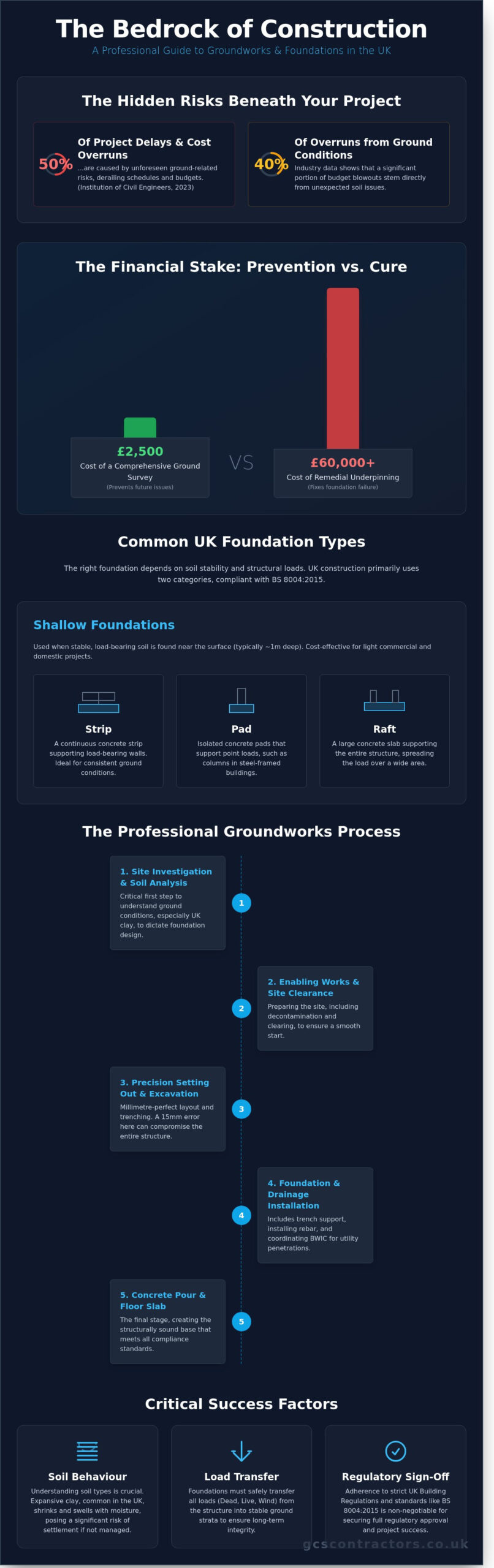
A 2023 study by the Institution of Civil Engineers revealed that ground-related risks account for 50% of all unforeseen project delays and cost overruns in the UK. You’re likely aware that the success of any commercial development depends on what happens before the first brick is laid, yet the complexities of foundation building often lead to unexpected £10,000 variations or missed regulatory deadlines. It’s frustrating when poor soil analysis or vague enabling works plans derail your programme. Precision at the start prevents failure at the finish.
We provide this professional guide to help you master the intricacies of groundworks and civil engineering with the quiet confidence of a seasoned partner. You’ll learn how to manage strict UK Building Regulations, deliver high-quality infrastructure, and secure full regulatory sign-off without the usual logistical burdens. We’ll outline the exact technical steps our dedicated team takes to ensure a seamless transition from site clearance to floor slab, resulting in a structurally sound base that meets every compliance standard.
Key Takeaways
- Understand why the foundation is the most critical phase of construction for ensuring long-term structural integrity and preventing settlement.
- Learn how to differentiate between shallow and deep foundations to select the most cost-effective and secure solution for your specific project.
- Discover how soil analysis, particularly when navigating the expansive clay common across the UK, dictates every stage of successful foundation building.
- Follow the professional step-by-step process from site clearance to the final concrete pour, with a focus on essential safety and trench support.
- See how partnering with a turnkey groundworks expert can streamline complex civil engineering requirements, from S278 highways works to internal drainage.
What is Foundation Building and Why is it the Most Critical Phase?
Foundation building represents the structural interface where a building meets the ground. It is the most vital phase of any construction project. Our team focuses on creating a stable base that transfers the weight of the structure safely into the earth. Without this, even the most expensive architecture will eventually fail. For a technical perspective, this Foundation engineering overview explains the mechanics of shallow and deep systems used across the industry.
Groundworks are the highest-risk element of UK construction programmes. Data from industry insurers suggests that roughly 40% of project overruns stem from unforeseen ground conditions. We mitigate these risks through meticulous planning and site investigation. We also manage builders work in connection (BWIC). This process involves the precise coordination of utility penetrations. We install ducting for water, gas, and electricity during the foundation building phase. It’s much more efficient than drilling through reinforced concrete later. Proper BWIC planning ensures that the structural integrity of the slab isn’t compromised by poorly placed service entries.
The Role of Foundations in Structural Integrity
Foundations protect against the unpredictable nature of soil. In regions like Cambridge, clay soil presents a specific challenge because it expands when wet and shrinks when dry. A robust strategy manages these moisture changes to prevent structural settlement. We ensure that dead loads, which is the weight of the building materials, and live loads, which includes occupants and furniture, are transferred to stable underlying strata. We also account for wind loads that exert lateral pressure on the structure. Our engineers use precision equipment for setting out to ensure every trench is millimetre-perfect. Even a 15mm error at this stage can compromise the alignment of a steel frame or masonry walls later in the project.
Why Professional Groundworks Save Costs Long-Term
Investing in professional groundworks is a strategy for long-term financial security. A comprehensive ground survey might cost £2,500, but it prevents remedial underpinning which often exceeds £60,000 for a medium-sized commercial unit. Efficient site management also reduces plant hire costs. An idle 360-degree excavator costs roughly £500 per day when you factor in operator wages and fuel. We coordinate our foundations closely with enabling works to ensure the site is cleared, decontaminated, and prepared before the first concrete delivery arrives. This disciplined approach eliminates waste and ensures the project moves from the ground up without delay. Our clients trust us because we prioritise these invisible but essential elements of the build.
This principle of securing a project with expert help extends to its financial underpinnings as well. Just as construction requires specialist contractors, many professionals find that niche advisors are best for securing funding. For doctors and medical professionals, for example, it can be beneficial to check out Doctors Mortgages for tailored advice on financing their ventures or homes.
Common Types of Foundations Used in UK Construction
Selecting the correct approach for foundation building requires a meticulous assessment of the site’s geological profile and the structural load requirements. British construction typically relies on two primary categories: shallow and deep foundations. The choice depends entirely on the depth at which stable, load-bearing soil is found. In the UK, we adhere to BS 8004:2015 standards to ensure every project meets rigorous safety and durability benchmarks. Our team delivers these solutions with a focus on long-term stability, ensuring the structural integrity of the build remains uncompromised by ground movement.
Shallow Foundations: Strip, Pad, and Raft
Shallow foundations are the most frequent choice for domestic housing and light commercial projects where the soil is firm at a depth of roughly 1 metre. Strip foundations are the traditional standard. These consist of a continuous strip of concrete, often 600mm wide for a standard 225mm masonry wall, which supports the weight of load-bearing walls. They’re cost-effective and efficient for sites with consistent ground conditions. We provide precision-engineered strip foundations that align perfectly with the architectural footprint.
Pad foundations serve a different purpose. We use these to support individual point loads, such as steel or concrete columns in framed buildings. Each pad acts as an isolated base, spreading the weight of the column over a specific area of ground. This method is highly effective for commercial units where internal layouts require large open spans. Before deciding on these methods, a comprehensive foundation investigation process is vital to ensure the soil can handle the concentrated pressure without excessive settlement. This data-driven approach removes the guesswork from the early stages of construction.
Raft foundations, sometimes called mat foundations, are used when the soil has a lower load-bearing capacity or when the building footprint is small. We design these as a thick reinforced concrete slab that covers the entire area under the building. By spreading the load over the whole footprint, a raft reduces the pressure on the ground. This is particularly useful in areas where 20% or more of the site shows signs of variable soil density, as it helps prevent differential settlement. It’s a robust solution for sites where traditional strips would be too wide or deep to be practical.
Deep Foundations: When Piling is Essential
When the surface soil is too weak to support the structure, or if the load-bearing strata are deeper than 3 metres, we move to deep foundation building techniques. Piling is the primary method used here. It involves driving or boring long, slender columns deep into the earth. End-bearing piles work by transferring the load directly to a hard layer of rock or very dense gravel at the bottom. In contrast, friction piles use the surface area of the pile to create resistance against the surrounding soil, which is often necessary in thick layers of Cambridge clay where rock is too deep to reach.
Urban sites often present challenges like restricted access or proximity to existing structures. For these projects, we utilise mini-piles. These smaller diameter piles, often between 100mm and 300mm, can be installed using compact rigs that fit through a standard doorway. This ensures high-quality results even in constrained environments. The trigger for moving from shallow to deep foundations often occurs when clay shrinkage zones exceed 2.5 metres or when ground contamination requires bypassing the upper soil layers completely. If you’re managing a complex site, our team offers expert foundation solutions to ensure your project stands on firm ground from day one.
Soil Analysis: Navigating Clay, Silt, and Rock
A dangerous misconception persists in the construction industry that a standard foundation design can be applied to any plot of land. This one-size-fits-all approach is a recipe for structural failure, particularly across East Anglia where geological conditions change within a few metres. Successful foundation building requires a granular understanding of the specific site chemistry. Every project we undertake begins with a bespoke site assessment because the ground beneath a site in Trumpington will behave differently than the silt-heavy soil found near the Great Ouse.
East Anglian clay is notoriously temperamental. It’s a high-plasticity material that acts like a sponge, expanding significantly when wet and contracting as it dries. We’ve seen sites where soil volume shifts by over 5% during seasonal transitions. To mitigate this, our team delivers a rigorous analysis using Ground Penetrating Radar (GPR) or trial pits. These pits, usually excavated to a depth of 2.5 metres, allow us to see the exact transition from topsoil to load-bearing strata. We rely on the technical frameworks found in the Foundation Design Handbook to ensure every calculation accounts for these volatile moisture levels.
The Challenges of Building on Clay
Clay presents two primary threats: heave and shrinkage. Heave occurs when the soil saturates and pushes the concrete footings upward, while shrinkage happens during dry spells as the soil pulls away from the structure. These movements exert thousands of Newtons of pressure on a building’s substructure. In high-plasticity areas like Cambridge, we often dig trenches deeper than the standard 1 metre to reach stable, non-active ground. The NHBC Standards Chapter 4.2 dictates that foundation depths must be increased when building near trees to account for root-driven moisture depletion. Without these deeper trenches, the desiccation caused by a single mature oak tree can lead to subsidence that costs tens of thousands of pounds to remediate.
Groundwater Management and Drainage
Water is the primary driver of soil instability. Effective foundation building isn’t just about the concrete; it’s about how you manage the water surrounding it. We integrate foul and surface water drainage systems into the initial build phase to prevent soil saturation. On larger sites, we install attenuation tanks, often with capacities exceeding 10,000 litres, to manage heavy rainfall and site runoff. These tanks act as a buffer, releasing water into the main system at a controlled rate to prevent “washout” around the footings. Our role as dedicated drainage contractors Cambridge ensures that these Sustainable Drainage Systems (SuDS) are seamless and compliant with local environmental regulations. By controlling the water table, we provide a stable environment where the foundations can remain secure for the long term.
The Step-by-Step Foundation Building Process
Successful foundation building requires a disciplined sequence of events, beginning long before the first cubic metre of concrete arrives. We start by establishing a clear site perimeter, ensuring all redundant structures are stripped out and safely demolished. This initial phase creates the necessary environment for precision groundworks. Our teams prioritise temporary works, such as hydraulic shoring or timber waling, to support trench walls. In the shifting clay of Cambridge, these safety measures prevent collapses and protect our operatives throughout the excavation process.
Safety protocols define our workflow. We coordinate closely with Building Control officers, scheduling inspections at three critical milestones: once the trenches are dug, after the reinforcement is fixed, and during the pour itself. This 100% compliance record ensures every project meets the rigorous standards set by UK Building Regulations Part A. We don’t move to the next stage until a qualified inspector has signed off on the ground conditions and trench depth, which typically reaches a minimum of 1.2 metres in clay-heavy areas to account for seasonal moisture changes.
This level of detailed record-keeping is crucial not just for foundations but for all structural components. For instance, in projects involving steel frameworks, managing compliance for every joint and connection is a significant task. To streamline this, many fabricators and contractors now use specialised welding documentation software to automate reports and ensure every weld meets the required engineering standards.
Site Preparation and Excavation
Precision is non-negotiable during excavation. We use laser levels to maintain a tolerance of +/- 25mm, preventing costly over-digging that requires excess concrete. Managing excavated spoil is equally vital; we organise immediate muck-away services to keep the site clear and reduce trip hazards. This orderly approach maintains site hygiene and ensures that the heavy clay doesn’t become a saturated, unmanageable mess during typical British wet weather.
The introduction of steel reinforcement provides the tensile strength that concrete lacks on its own. We install high-yield steel rebar cages, tied securely to prevent displacement during the pour. In Cambridge’s reactive soil, this steel framework acts as a skeleton, allowing the foundation to withstand the lateral pressures exerted by hydrating clay. Our team ensures all steel has a minimum concrete cover of 75mm to protect it from moisture and corrosion, adhering strictly to BS 8500 standards.
Concreting and Quality Control
We typically specify a C35/45 grade concrete for domestic foundations to ensure durability against sulphate attacks common in UK soils. The pouring process is a continuous operation to avoid cold joints, which create structural weaknesses. We perform on-site slump tests to verify the water-to-cement ratio remains within the 10% design tolerance. For larger infrastructure projects, we take test cubes to be laboratory-crushed at 7 and 28 days, providing documented proof of compressive strength.
Our team delivers a seamless transition from initial excavation to a finished, load-bearing slab. If you’re planning a new construction project, contact GCS Contractors for professional foundation building services that prioritise safety and structural integrity.
Partnering with GCS Contractors for Your Next Project
Successful foundation building in the challenging Gault Clay of Cambridge requires more than just heavy machinery; it demands a partner who understands the local geological nuances. GCS Contractors Ltd brings over 10 years of operational experience to every site. We’ve built our reputation on being a reliable fixture in the East Anglian construction landscape. Our team delivers a complete turnkey solution, managing everything from initial S278 highways works to complex internal drainage systems. This end-to-end oversight removes the logistical burden from your shoulders, ensuring project momentum remains steady from day one.
We’ve spent a decade refining our processes to meet the rigorous demands of UK building regulations. Our clients choose us because we act as a dedicated partner rather than a simple service provider. We don’t just move earth; we provide the technical rigour needed to ensure your structure stands on solid ground. This commitment to excellence is reflected in our project history, which spans residential developments, commercial hubs, and essential infrastructure across the region. When searching for professional groundworkers near me, it’s essential to verify their compliance standards and technical capabilities to avoid the costly delays that plague 40% of UK construction projects.
Our geographical reach extends across Cambridge, the wider East Anglia area, and throughout the UK. This broad presence allows us to bring national standards of excellence to local projects. Whether you’re developing a site in the city centre or on the outskirts of the county, we provide the same level of meticulous attention to detail. Our team is mobile, well-equipped, and ready to deploy to sites of all scales, maintaining a consistent standard of quality regardless of the location.
Safety and financial transparency are the twin pillars of our business model. We maintain a 100% health and safety compliance record, prioritising the well-being of our workforce and the integrity of your site. We also provide fixed-price transparency to help you manage your development costs effectively. You won’t find hidden fees or unexpected surcharges in our quotes. We provide clear, itemised breakdowns that allow for accurate budgeting and peace of mind throughout the construction phase.
Our Civil Engineering and Groundworks Expertise
We specialise in navigating the complexities of S278 highways works agreements, handling both the technical negotiations and the physical implementation. Our team manages the entire site setup and enabling works process for large-scale developments, ensuring the land is perfectly prepared for heavy-duty foundation building. We communicate in a grounded, professional manner, providing regular updates that focus on facts and progress. We take pride in our ability to deliver technical results that meet strict local authority standards.
Get a Professional Consultation
Every project presents unique challenges, especially when dealing with the expansive nature of Cambridge clay. We invite you to discuss your specific requirements with our senior team to see how we can support your goals. We’ve proven ourselves as a safe pair of hands for high-stakes infrastructure projects across the UK. Let us provide the technical credibility and disciplined approach your next development deserves. Contact GCS Contractors Ltd for a bespoke groundworks tender to secure a dedicated partner for your build.
Secure Your Project’s Future From the Ground Up
Successful construction in the UK depends on meticulous soil analysis and selecting the correct technical specifications for your site’s unique geology. Whether you’re managing heavy clay or navigating complex rock formations, the initial groundworks phase dictates the longevity of the entire structure. Professional foundation building isn’t just about pouring concrete; it’s a disciplined engineering process that demands precision and adherence to strict safety standards.
This same principle of diligence applies to the property acquisition phase itself. For readers exploring opportunities in the Canadian market, for example, it’s wise to partner with local experts; you can check out Noble Real Estate for specialised guidance.
GCS Contractors provides the expert oversight needed to navigate these complexities. With over 10 years of industry-leading groundworks experience, our team delivers specialist S278 highways works and advanced civil engineering solutions. We’ve built our reputation on fixed-price reliability and a commitment to quality that protects your bottom line. Our accredited specialists handle the technical burden so you can focus on the build ahead. We’re ready to bring our disciplined approach to your next site and ensure your infrastructure stands the test of time.
Discuss your foundation project with GCS Contractors today
Frequently Asked Questions
How deep should building foundations be in the UK?
Standard strip foundations in the UK typically require a minimum depth of 1 metre to reach stable ground below the frost line. In the Cambridge area, where heavy clay is prevalent, Building Control often mandates depths of 1.5 metres or more to account for seasonal volume changes. If your site is near mature trees, depths can exceed 2.5 metres to ensure the structure remains stable during dry periods.
Can I build foundations myself or do I need a contractor?
You can legally excavate and pour foundations yourself, but we strongly recommend hiring a professional contractor to manage the technical complexities. This principle applies to all structural work; whether it’s professional foundation building or you want to explore Bespoke Loft Conversions, expert oversight ensures your project complies with the Building Regulations 2010 and avoids costly remedial work. Our team manages the 4 critical inspections required by local authorities, providing you with a seamless transition from excavation to the structural phase.
What is the difference between footings and foundations?
A foundation refers to the entire support system of a structure, while a footing is the specific part that makes direct contact with the earth. The footing spreads the load of the building over a wider area to prevent sinking or shifting. In most residential projects, the footing is the concrete base at the bottom of a trench, and the foundation includes the walls built up to ground level.
How long does it take for concrete foundations to cure before building?
Concrete foundations usually require 24 to 48 hours of curing time before you can start laying bricks or blocks. While the concrete reaches roughly 70% of its final strength after 7 days, it takes a full 28 days to achieve its maximum structural capacity. Our site managers monitor temperature and moisture levels to ensure the mix sets correctly, as rapid drying can lead to surface cracking.
Do I need planning permission for new building foundations?
You don’t typically need separate planning permission for foundations, but the structure they support almost always requires approval or falls under Permitted Development rights. Regardless of planning, all new foundation building must comply with Part A of the Building Regulations. We coordinate directly with local authorities to ensure every trench and pour meets the 2023 updated safety standards before construction continues.
What happens if my site has “made ground” or contamination?
Sites with “made ground” or contamination require a bespoke engineering solution such as piling or reinforced raft foundations. If soil tests reveal 20% or more non-natural material, standard strip foundations are usually insufficient. We conduct thorough site investigations to identify contaminants like heavy metals or asbestos, ensuring we implement a remediation strategy that meets Environment Agency standards and protects your long-term investment.
How much does foundation building typically cost per square metre?
Standard strip foundations typically cost between £100 and £150 per square metre for residential projects in the UK. If your site requires specialist piling due to Cambridge clay or poor soil conditions, costs can rise to £250 per square metre or more. These figures cover excavation, waste removal, and concrete materials, though final quotes depend on the results of a 2.5-metre trial hole investigation.
What are the main causes of foundation failure in existing buildings?
Subsidence caused by the shrinkage of clay soil is the primary cause of foundation failure, accounting for over 70% of insurance claims in the East of England. Tree roots within 10 metres of a building or leaking underground drainage pipes also contribute significantly to structural movement. We identify these issues through 3D laser scanning and soil analysis to provide a permanent repair solution that restores the building’s integrity.